
Facing imminent collapse and mounting U.S. pressure, the Cuban government will likely make concessions to Washington to gradually open its economy without requiring structural political changes, which the United States will likely support to avoid a state collapse and reaffirm its geopolitical dominance in the Western Hemisphere. Cuban President Miguel Diaz-Canel said on Feb. 5 that his government was willing to hold negotiations with the United States as long as talks are respectful and have no preconditions. He also noted that his administration would roll out a plan in the coming days to deal with fuel shortages. The statements came a day after a new blackout hit the eastern provinces of Granma, Santiago de Cuba and Guantanamo, a direct consequence of increased U.S. pressure on the island in recent months, including a blockade of Venezuelan crude shipments and threats of tariffs on countries that ship the oil Cuba needs to run its thermoelectric power plants. Media reports indicate Cuba only has fuel left until mid-February, which prompted the United Nations to warn of a potential humanitarian collapse. On Feb. 3, the U.S. Embassy in Havana advised American citizens to prepare for prolonged disruptions to electricity, water and food supplies.
- On Feb. 2, Cuban Deputy Foreign Minister Carlos Fernandez de Cossio said that while Havana and Washington had "exchanged messages," no formal bilateral dialogue or negotiations had yet begun, adding that Cuba would not negotiate its constitution or political system.
- On Jan. 29, the United States issued an executive order declaring a national emergency regarding Cuba, characterizing the Cuban government as an extraordinary threat to U.S. national security. The document established a legal framework for the United States to impose 30% tariffs on goods from any country that provides oil to the island.
- Cuba needs 100,000 barrels of oil per day but produces only 40,000 barrels per day. Apart from 84,000 barrels from Mexico on Jan. 9, it has reportedly received no oil in 2026.
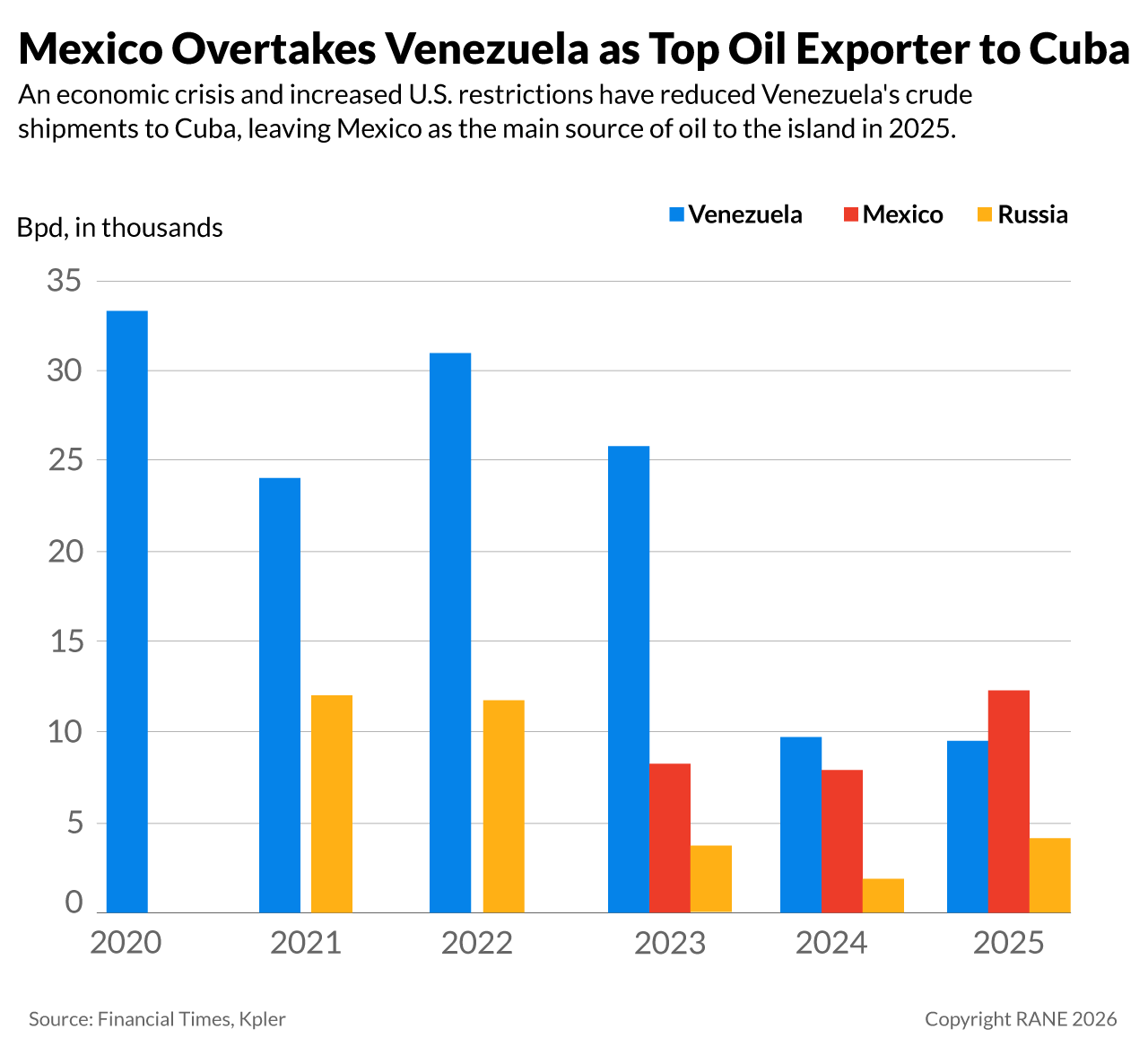
Despite having resisted an economic embargo for decades, severe economic and energy crises and increased U.S. pressure have further worsened socioeconomic conditions and undermined the Cuban government in recent months. The United States has stepped up pressure against Cuba following the Dec. 16 blockade on oil from Venezuela and the Jan. 3 capture of then-Venezuelan President Nicolas Maduro. Washington is seeking to prevent Cuba from receiving support from allies, which has been instrumental in allowing the socialist regime to survive 64 years under U.S. embargo. After the collapse of the Soviet Union, Venezuela became Havana's most strategic ally and main supplier of subsidized oil, which it used to generate power and to obtain hard currency. In return, Havana provided Caracas with doctors, counterintelligence expertise and security officers. However, Venezuela's decreasing oil production amid an economic crisis and the resumption of U.S. sanctions after U.S. President Donald Trump returned to office in 2025 led Mexico to become Cuba's main source of crude in 2025. The island has experienced widespread and long-lasting blackouts since 2024 as the country's economy and energy infrastructure have severely deteriorated. As a result, the government has weakened, as evidenced by its isolation from traditional allies, evident incapacity to fulfill basic state functions and small antigovernment protests, which had previously been repressed. The United States' recent efforts to curb oil shipments to Cuba have further deteriorated the already acute socioeconomic crisis, intensifying shortages of food, medicine and fuel and leading to the suspension of public transportation in Havana. Under Trump, the U.S. government has increased its focus on the Western Hemisphere, seeking to fight drug trafficking and illegal migration and curb the presence of China and other rivals. U.S. Secretary of State Marco Rubio's background as a Cuban-American and his anti-left ideology also mean undermining leftist autocracies in Latin America is at the core of U.S. strategy in the region.
- Mexican President Claudia Sheinbaum is seeking ways to maintain what she describes as humanitarian aid to Cuba. On Feb. 9, Mexico sent food and other basic supplies to the island.
- On Jan. 27, Trump said, "Cuba will be falling pretty soon." The following day, Rubio said that "we would love to see the regime [in Cuba] change, that doesn't mean we are going to make it change." Rubio has outlined demands for any potential deal with Cuba, including the release of political prisoners and the acceptance of regular deportation flights.
- In June 2025, the Trump administration imposed stricter policies on Cuba and reversed the easing measures imposed by former President Joe Biden.
- In June 2024, the Cuban government announced"wartime economy" measures to tackle rising inflation and a ballooning fiscal deficit. In July 2024, it imposed stricter controls on the still incipient private sector.
- In February 2024, Cuba for the first time formally requested assistance from the U.N. World Food Programme to secure milk for children due to shortages of subsidized food items.
While Cuba offers limited economic opportunities to the United States, a deal that paves the way for economic liberalization would represent a political and geopolitical win for the Trump administration. Compared to Venezuela, Cuba can provide very limited economic gains to the United States. Even though it has critical mineral deposits, the scale of business opportunities from increased bilateral trade or investments would be negligible compared to Venezuela's oil and gas potential. Foreign companies could benefit from cheap labor in agricultural activities or develop solar and wind power projects to reduce the island's reliance on imported fuel for its thermoelectric power plants, but these projects would take years or even decades to develop. The small territory, low-skilled labor force and generally limited economic potential suggest that the Trump administration's goal is more likely linked to U.S. domestic politics and geopolitical goals. Claiming to have put an end to the communist model in Cuba (even if some members of the regime remain in power, as was the case in Venezuela) would likely help Trump and Rubio garner support among U.S. voters, particularly in Florida. That would boost Trump's popularity and Rubio's potential political ambitions to run for Florida governor or U.S. president. More broadly, coercing Cuba to stick to Washington's demands out of fear of economic or military retaliation would undermine Russian and Chinese influence and reaffirm U.S. dominance in the Western Hemisphere, in line with the National Security Strategy released in December 2025.
- Cuba holds some of the world's largest reserves of critical minerals and is one of the top 10 producers of nickel, used to make stainless steel and rechargeable batteries.
- The island also has about 7% of the world's cobalt reserves, used in EV batteries.
Washington is unlikely to resort to a large military operation to destabilize the Cuban government but will likely threaten further economic restrictions to trigger gradual economic liberalization, though structural political changes are unlikely in the short term. The Trump administration is likely to step up surveillance operations, carry out military drills or even deploy warships near Cuba to pressure Havana. In an escalatory scenario, isolated U.S. air strikes could target government buildings. However, the United States' appetite for a full-scale ground invasion of Cuba is limited, given high domestic political and popular opposition. Washington will instead most likely seek to establish a remote regime management dynamic similar to the one it is currently pursuing in Venezuela. To do so, in addition to military force and the ongoing oil embargo, the Trump administration could also block remittances or suspend commercial flights to the island by changing regulations or closing the country's airspace. That would further strangle the economy, exacerbate shortages of food, basic goods and medicine and force the Cuban government into complying with some of Washington's demands. The White House would likely pressure the Cuban government for a gradual transition period rather than pushing for sudden political liberalization. The main goal would be to progressively end its centralized economic model. Free and fair elections and significant changes to Cuba's single-party communist political system are unlikely to be among Washington's top priorities this year.
The acute state of Cuba's economy and fear of U.S. military action will create incentives for the Cuban government to make concessions to Washington, including freeing political prisoners, cooperating on the fight against narcoterrorism, supporting private sector activity and creating special economic zones to attract U.S. capital. Imminent economic collapse, mounting U.S. economic pressure and the threat of a U.S. military operation similar to the one carried out in Venezuela will create incentives for Diaz-Canel to engage in negotiations with the Trump administration to remain in power and prevent an extraction or legal proceedings in the United States. Even though a comprehensive agreement is unlikely in the short term, Diaz-Canel will likely be willing to make ad hoc concessions to Washington. These would likely include freeing political prisoners, cooperating on the fight against drug trafficking and terrorism and modestly opening up the Cuban economy to U.S. firms without requiring significant changes to the country's political structure by the end of the year. A roadmap for regulatory changes could entail the elimination of the 2024 rules that restricted Cuban small and medium-sized private enterprises and the gradual elimination of price controls and import caps. Another potential measure would likely be the creation of special economic zones (SEZs) with tax incentives and reduced red tape for U.S. firms to operate in the country. The ports of Cienfuegos and Santiago de Cuba could be potential sites to replicate the Mariel Special Development Zone. While foreign investments would likely take a long time to materialize, Washington would gradually lift part of its sanctions to allow U.S. firms to explore opportunities in the reconstruction of the country's housing and infrastructure and establish stronger supply chains for consumer goods.
- The Mariel Special Development Zone was established in 2013. It aims to modernize the country's economy by bypassing the traditional bureaucracy of the Cuban state to attract foreign capital, technology and export-oriented industries. It features a deep-water container terminal and has 64 approved businesses from 21 countries, with committed capital exceeding $3.2 billion.
- In July 2025, the U.S. State Department designated Diaz-Canel under Section 7031(c) of the Foreign Operations and Related Programs Appropriations Act for corruption and human rights violations, suspending his visa. The Jan. 29 executive order declaring a national emergency regarding Cuba does not explicitly name Diaz-Canel for a criminal investigation, but does allow the U.S. Treasury and State departments to investigate his alleged ties to "malign actors."
- Cuba's constitution establishes that the country's socialist system and its political and social order are "irrevocable." While it provides room for reform, it technically blocks amendments that would openly dismantle the socialist character of the state or the "leading role" of the Communist Party of Cuba.
The slow pace and social costs of Cuba's economic opening would raise the risk of instability, making sustained subsidies and U.S. involvement critical to avoiding a broader humanitarian and migration crisis. Economic changes would almost certainly be gradual, meaning many measures could be announced over the coming months but not be fully implemented this year. Even if some are enacted, their impact on the Cuban economy would likely take time to materialize. As Cuba opens its economy, consumer-oriented businesses would continue to rely mostly on remittances, given Cuban salaries would remain very low and not keep up with the likely inflation such liberalization would entail. That would likely prevent most of the population from being able to afford basic goods, meaning some government subsidies would remain in place. Poverty would rise and Cuba would require sustained humanitarian aid to cushion the impacts of its economic transition. To that end, the U.S. government would have significant incentives to provide humanitarian and financial support or seek to enforce policies friendly to businesses to attract private capital to Cuba and generate better-paying jobs in order to prevent a humanitarian crisis and the potential collapse of the government. Cuba's geographic location — only 90 miles south of Florida — and the importance of Latino voters for state and national elections in the United States will likely be significant incentives for the Trump administration to seek to avoid a civil war or other failed-state scenario on the island, akin to Haiti's, to prevent a migration wave into the United States.
- Cuba receives between $2 billion and $4 billion in money transfers per year (via legal and unregulated channels), mostly from Cubans working in the United States. Remittances get to more than half of the country's homes, helping drive domestic consumption and providing hard currency for the government to import goods.
In the low-likelihood, high-impact scenario that the Cuban government refuses to engage with Washington or fails to reach a deal, the Trump administration would be more likely to resort to military force to weaken or oust the regime. In an unlikely scenario, escalating U.S. economic and military pressure and rising social discontent among Cubans are not enough to lead Havana to actively engage in negotiations with Washington or for it to make the concrete concessions the Trump administration demands. This would be more likely if the U.S. government requires immediate change in government leadership or a structural political reform of the country's single-party socialist rule. Amid an impasse in talks, the socioeconomic situation worsens and protests across the country become widespread and violent. As the government tries to repress dissent and retain power, Cubans attack or invade government buildings. In a matter of days, the situation escalates to an internal armed conflict. The Trump administration announces overt military operations, purportedly to defend the Cuban population and prevent state collapse and a migration wave that would threaten U.S. national security. The U.S. military carries out air strikes targeting the Cuban military and special forces operations to extract or eliminate Diaz-Canel or other government and high-ranking military officials. Given Cuba's small territory, the presence of a U.S. military base on the island and its geopolitical importance, Washington could deploy a small contingent of troops to prevent further destabilization, which would likely be required to remain in the country indefinitely, as the situation would take years to materially stabilize or improve. Given its military superiority and likely popular support for a change in government, such an occupation would be met with limited armed resistance by regime loyalists.
