
On the campaign trail, U.S. President Donald Trump and his allies consistently portrayed Mexican drug cartels as national security threats to the United States, advocating for direct U.S. kinetic operations against these groups. Trump echoed this sentiment during his first address to Congress of his second term in March, declaring that ''cartels [were] waging war in America'' and that it was ''time for America to wage war on the cartels.'' However, there are signs that he and members of his administration remain undecided on whether to conduct unilateral armed operations against cartels without Mexico's permission.
In February, The New York Times reported that White House officials were split on the issue, with one side allegedly urging caution due to fears of undermining cooperation with the Mexican government on illegal migration, and the other side advocating for a harder-line approach, including the use of force against cartel leaders. During an April 16 phone call with Mexican President Claudia Sheinbaum, Trump offered to have U.S. armed forces take a leading role in combating Mexican drug cartels, which Sheinbaum firmly refused. Trump later confirmed, ''If Mexico wanted help with the cartels, I would be honored to go in and do it.'' Then, on Aug. 8, The New York Times reported that Trump had secretly directed the Pentagon to "begin using military force against certain Latin American drug cartels that his administration has deemed terrorist organizations.''
Mexico's stance on the issue has been clearer. President Claudia Sheinbaum has consistently opposed potential U.S. military operations in Mexico, viewing them as a violation of sovereignty — a sentiment widely shared by the Mexican population. Under Sheinbaum, Mexico has also intensified its own counter-cartel operations.
Still, Trump's offer of military support, the designation of cartels as terrorist groups in February, and repeated comments regarding their control of Mexico and threat to the United States leave the door open to unilateral U.S. military and/or covert action to directly combat the cartels. It is thus worth exploring what such operations might entail and their objectives, as well as their potential implications for both the United States and Mexico.
Goals of U.S. Operations
Cartels are ubiquitous in Mexico, with a presence in every state and every business sector. The fight against them is a decades-old story, with previous Mexican and U.S. efforts to combat cartels successful in weakening or even fully dismantling individual groups but not eliminating the wider problem of cartel influence, which has only grown over time. For example, the years-long crackdown on cartels under former Mexican President Felipe Calderon (2006-2012) effectively defeated the Zetas — a group that was once one of Mexico's most powerful criminal organizations and one of the world's largest drug trafficking organizations. But the operations against the Zetas fractured the group into dozens of smaller groups. Within a decade, this fragmentation allowed the Sinaloa Cartel, the newly formed Jalisco New Generation Cartel and various other groups to seize control of the Zetas' former territories and illicit enterprises. As a result, many areas of Mexico previously dominated by the Zetas are now less safe than they were before the group was dismantled.
Based on rhetoric from the Trump administration, the primary focus of any direct U.S. counter-cartel operations would not be to reduce violence levels in Mexico, but to reduce impacts on the United States itself — namely, the illegal drugs and migrants flowing across its southern border. First, the Trump administration is focused on combating drug trafficking, particularly of fentanyl, into the United States. This was a significant focus of Trump's 2024 campaign and a long-standing point of Republican criticism of the former Biden administration. Though there are alternative sources of fentanyl, cocaine and other illegal drugs, Mexican drug cartels are the largest source for U.S. consumers, suggesting to members of the Trump administration that actions that substantially disrupt their operations could theoretically eliminate the most important source of drugs being trafficked into the country and potentially slash drug consumption. Second, the Trump administration is intent on reducing the level of immigration to the United States. Cartels and other Mexican organized crime groups have become highly engaged in the transport of migrants through Central America and Mexico and across the U.S. border, giving criminal organizations another source of revenue. Though illegal border crossings at the U.S.-Mexico border have dropped significantly since early 2024 amid expanded Mexican government efforts and increased U.S. immigration restrictions, Trump administration officials have cited the cartels as a major driver of migration.
Likelihood of U.S. Operations
It is unclear whether the Trump administration will conduct operations against cartels in Mexico without the Mexican government's permission. For one, this would risk damaging U.S.-Mexico relations and hindering cooperation on illegal immigration. Mexican government efforts have been crucial in significantly reducing migrant encounters at the U.S. southern border, which dropped by 43% between December 2023 and May 2024. A withdrawal of Mexican support on this issue would thus risk triggering a new surge in border crossing attempts. Furthermore, Trump has so far maintained a relatively friendly personal relationship with Sheinbaum (especially when compared to his relations with leaders of other U.S. allies), which may make Trump himself more hesitant to take any action that could jeopardize those cordial ties. The potential negative impact on U.S. businesses in Mexico may also be a deterrent, as unilateral U.S. operations against cartels could trigger boycotts against American products and create chaotic conditions that worsen logistical challenges.
There are also domestic political constraints to consider. A war against Mexican cartels would require substantial resources and expenditure. This directly contradicts Trump's campaign promise to reduce involvement in global conflicts and foreign aid, as well as his administration's efforts to curb overall government spending. In a calmer geopolitical environment, the White House would have more bandwidth to focus on security threats stemming from Mexican cartels. But against the backdrop of worsening U.S.-China relations and ongoing wars in the Middle East and Ukraine, such actions could be seen as starting more conflicts. This risk was exemplified by Trump's approval of U.S. strikes on Iran in June, which drew criticism from within his own support base.
But despite these constraints, comments by Trump and his allies on the threats that Mexico's cartels pose to the United States demonstrate that they continue to view combating such groups as a priority. The increased punishments for fentanyl trafficking that the White House passed on July 16 and Trump's comments that cartels have ''very strong controls over Mexico'' indicate that the Trump administration remains focused on curbing cartel activity. Though the Aug. 8 reporting on the directive to use military force against Latin American criminal groups did not specify that Trump intended the Pentagon to target Mexican groups, they would be natural targets given their extensive presence so close to the United States, and the fact that they comprise the majority of the groups that have received the terrorist designation. The security threat posed by Mexican cartels is also unlikely to ease in the coming years, evidenced by the rising number of fentanyl-related deaths in the United States and ongoing violence in Mexico, which could prompt the Trump administration to pursue direct operations in the future. Moreover, while the White House may currently believe that conducting counter-cartel operations would make it seem like Trump is not fulfilling his promise to decrease U.S. involvement abroad, the administration may increasingly see such operations as necessary to show Trump is taking a tough stance against groups that threaten U.S. national security.
Based on these dynamics, it is more likely than not that the Trump administration will launch some level of direct operations against Mexican cartels at some point in his remaining three and a half years in office. There are several scenarios that would make direct U.S. operations against cartels more likely. The first is another incident of cartel violence in Mexico that directly harms U.S. citizens, such as the March 2023 kidnapping of four Americans in the border city of Matamoros, which ultimately killed two of the victims. The second is a severe, high-profile incident of cartel violence within the U.S. homeland, particularly if it results in casualties among law enforcement or civilians. And the third is a significant deterioration in U.S.-Mexico relations, which would make Trump himself less personally inclined to maintain a strong relationship with Sheinbaum.
Potential Levels of U.S. Operations
Should the Trump administration decide to act against cartels in Mexico, it has a spectrum of options ranging in intensity. Any new initiatives would aim to supplement current U.S. operations in Mexico, which include intelligence, surveillance and reconnaissance flights; extensive signals and human intelligence collection; pressure on the Mexican government for extradition of cartel members and increased Mexican domestic counter-crime operations; and covert actions to bring cartel members and leaders into the United States. The White House's choice among the following options will hinge on the state of Mexico-U.S. relations and the perceived threat posed by cartels.
Scenario 1: Light and Sporadic Drone Strikes
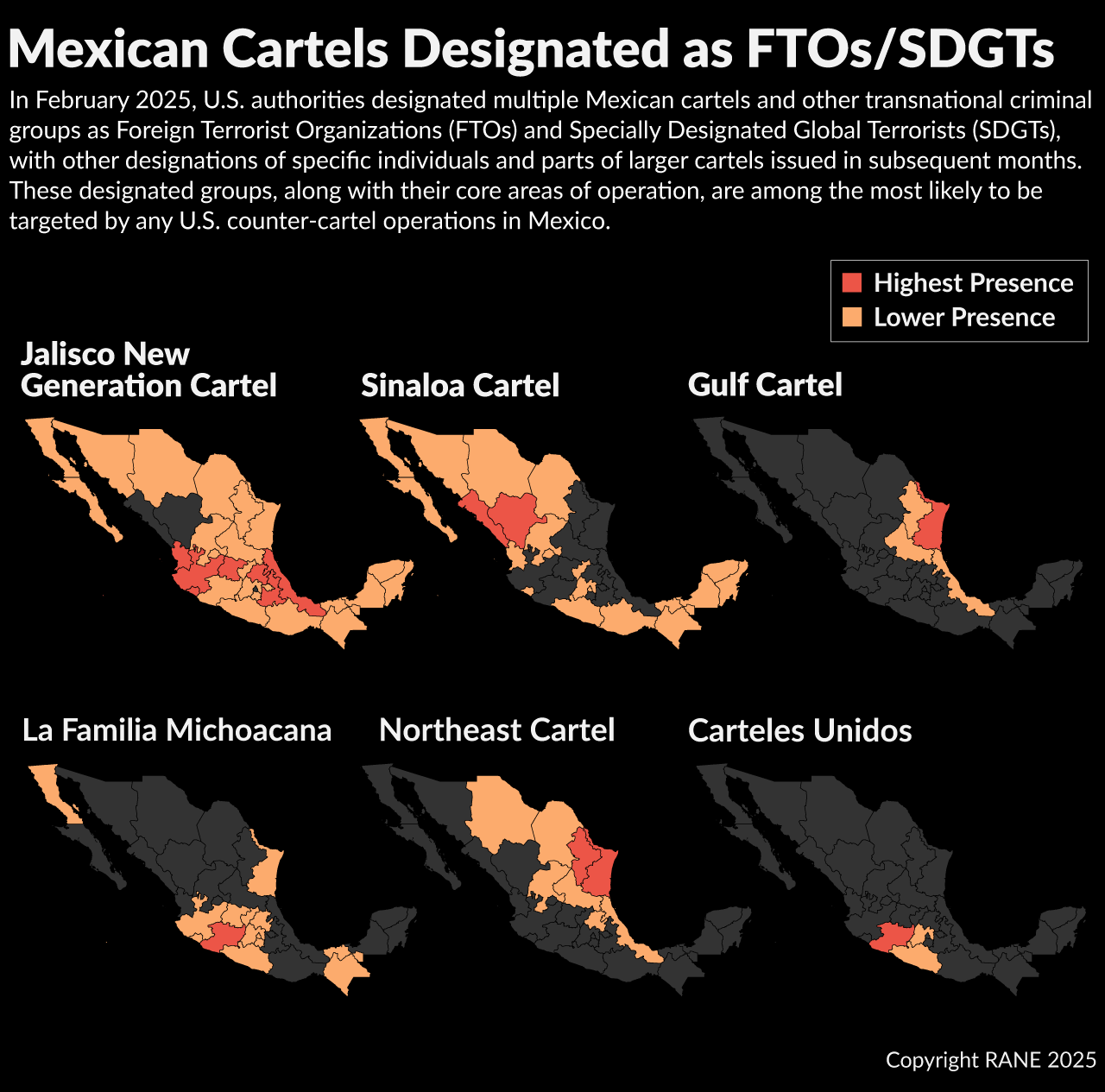
In this most likely scenario, the Trump administration orders a few drone strikes in the remote areas where major cartels (e.g., Sinaloa Cartel, Jalisco New Generation Cartel or Gulf Cartel) operate, with a focus on Mexican states along the U.S. border. The strikes target locations like fentanyl manufacturing labs, cartel-controlled storage facilities, or areas where high-ranking cartel leaders are active. This would come alongside an increase in current U.S. operations in Mexico, including surveillance operations and diplomatic and economic pressure on the Mexican government for expanded counter-cartel operations.
Any U.S. strike on Mexican territory would constitute a violation of sovereignty in the eyes of the Mexican government and many Mexican citizens, but the Sheinbaum government would likely seek to balance tempering domestic grievances with maintaining strong relations with the United States in order to minimize the economic fallout from Trump's tariffs, as the Mexican economy is highly reliant on exports to the United States. Compared with the other more escalatory scenarios, this scenario would give the Sheinbaum government the opportunity to more easily move past the strikes on Mexican territory, stating that while they are a troubling breach, her government will continue to cooperate with the Trump administration.
A small number of strikes would be highly unlikely to significantly weaken, let alone actually dismantle, even a single Mexican cartel. While it may temporarily reduce violent actions and trafficking by some groups who seek to avoid U.S. targeting, within a few weeks or months their operations will return to normal. However, even with only a small number of strikes, Mexico would see a surge in anti-U.S. sentiment, triggering protests outside the embassy and consulates, as well as minor boycotts of U.S. businesses.
Scenario 2: More Intense and Expansive Drone Strikes
In this scenario, the Trump administration launches more extensive drone strikes in border areas, as well as in areas deeper into Mexico where cartels have a heavier presence, including the states of Sinaloa, Jalisco and Guanajuato. The White House could also approve strikes in areas known to be central to drug production and trafficking, particularly Colima, Michoacan, Sonora and Baja California states. While the majority of such strikes would target remote areas, a small number may occur in more densely populated towns and cities central to cartels, including Culiacan, Sinaloa; Ciudad Juarez, Chihuahua; and Colima City, Colima. Such strikes significantly raise safety threats for bystanders. Total strikes would fall somewhere in the low dozens per year, at a similar scale to previous U.S. strikes in Pakistan, albeit over a much shorter time period, and would significantly raise safety threats for bystanders.
This scenario would raise the likelihood of a rupture in U.S.-Mexico ties that lasts for several months and potentially even years. Given the threats to civilians and the significant violations of Mexican sovereignty caused by the U.S. strikes, Sheinbaum would likely order the reduction of U.S. diplomatic personnel within Mexico and decrease or cease cooperation with the United States on efforts to counter migration and organized crime. The Mexican government may also announce it is considering retaliatory economic measures, such as trade restrictions or tariffs. However, given Mexico's high economic reliance on exports to the United States, any such actions would likely be limited and have low overall impact on the United States. This scenario would also trigger anti-U.S. sentiment and protests within Mexico at a larger and more sustained scale than in the previous scenario, particularly in the event of civilian casualties.
If U.S. operations target a single group with particular intensity, it could lead to the collapse of that cartel, as members defect and individual regional branches fracture away. Such a development would raise competition between rival criminal groups in areas of Mexico where the larger group operated; in the case of targeted U.S. strikes against a group like the Jalisco New Generation Cartel, which operates in almost every Mexican state, it would significantly raise nationwide safety threats. As dozens of trafficking organizations would continue operating, drug trafficking into the United States would continue, although the destruction of some labs would necessitate their sourcing from other parts of Mexico or the world, leading to a diversification in drug manufacturing that potentially raises security threats elsewhere as criminal presence grows.
Scenario 3: Extensive Strikes and Deployment of Special Operations Forces
In this least likely scenario, the Trump administration launches a larger scale of the drone strikes described in Scenario 2, rising to the high dozens within a year, and additionally orders targeted raids or other direct action by U.S. special operations forces within Mexico. Such ground operations would almost certainly remain limited to remote areas in regions near the U.S. border to minimize the likelihood of U.S. casualties and accidental clashes with Mexican security forces (a significant concern, given the longstanding challenge of Mexican police and military involvement in organized crime). These ground operations would be focused on extracting or eliminating specific cartel leaders and destroying facilities central to the targeted cartels. They would likely be tailored to fully dismantle multiple major cartels, and they would probably successfully do so for at least some of those targeted. However, the vacuum left behind would allow any of the dozens of smaller cartels and gangs to move in and attempt to seize the targeted groups' former territory and resources, leading to widespread cartel competition that resembles war-like conflict in much of the country. This would significantly worsen levels of violence across Mexico, raising safety threats and logistical challenges for businesses due to cartels' expanded use of blockades on major roads. In response to the existential threats posed by the U.S. strikes, some criminal groups would probably seek to retaliate against the United States. Cartels have previously used terrorism-like methods against civilians in response to Mexican government counter-crime efforts, indicating that they could also target U.S. citizens or government targets in Mexico and, to a lesser degree, in the United States itself. This scale of U.S. operations would reduce Mexican-origin fentanyl trafficking to the United States to a greater extent than Scenario 2. But the expansion of other criminal groups would ultimately see trafficking levels resurge within two years, and in the meantime, criminal groups from other countries would expand their own trafficking operations to the United States.
The presence of U.S. troops or paramilitary personnel conducting operations within Mexico would necessitate a harder-line response from the Sheinbaum government. This would likely involve suspending diplomatic ties and security cooperation with the United States, imposing tariffs on U.S. products (including potentially dairy and steel), and potentially suspending visa-free U.S. travel to Mexico. For the United States, launching such an extensive military campaign in Mexico would also lead to criticism and diplomatic tensions with other countries, particularly Canada and the European Union. Additionally, it would further strain the White House's relations with countries like Greenland and Panama by contributing to low but elevated concerns that the Trump administration could become willing to use force to claim territories elsewhere.
The Devil You Know
The three scenarios identified are unlikely to achieve the long-term goal of reducing illegal drug trafficking into the United States. This raises another question: Is there anything the United States can do to end national security threats from transnational organized crime groups?
Government security efforts elsewhere in Latin America appear to provide potential solutions, including within Mexico. When Sheinbaum served as governor of Mexico City, her government successfully reduced violence in the capital city, with homicides dropping by approximately 44% from 2019 to 2023. Meanwhile, in El Salvador, a counter-crime state of emergency launched in 2022 successfully decreased the country's homicide rate from 17.6 per 100,000 people in 2021 to 1.9 per 100,000 people in 2024, making it one of the safest countries in the Western Hemisphere. These examples, which involved extremely different tactics, show that security conditions can be improved using different methods. But the broader Latin American region tells a different story. While El Salvador was seeing record-low homicide levels in 2023, Ecuador faced record highs as criminal groups expanded trafficking operations in the country, after previously being one of the safest countries in South America. Other countries, such as Brazil and Colombia, have seen crime rates fluctuate, but criminal groups never fully leave these countries, which remain central nodes in the transnational drug market.
Indeed, the United States is perhaps the most important node in that market as the final destination for illegal drugs. While other attractive destinations certainly exist and are serviced by Latin American criminal groups (Canada and Europe, for example), the United States is attractive both in its proximity to criminal groups and due to its size of potential consumers with disposable income. The U.S. opioid crisis, fueled by overprescription of painkillers within the legitimate medical system since the 1990s, along with the large areas of the United States experiencing poverty following the 2008 recession and the COVID-19 pandemic, further contributes to the scale of Americans vulnerable to drug addiction.
Therefore, while both the Trump administration and future U.S. governments will undoubtedly attempt to stem the flow of illegal drugs into the United States via foreign policy and security operations, the reality is that the most significant driver of this challenge is domestic conditions within the United States. U.S. forces can defeat the Sinaloa Cartel. They can fracture the Gulf Cartel and the Jalisco New Generation Cartel into dozens of rival pieces. But within months or at most a few years, high U.S. demand means new sources of illegal drugs, human trafficking, extortion, kidnapping and other violence will enter the scene, and many may pose greater threats than those that came before – to the U.S. and Mexico both.
