
If the United States follows through on threats to designate transnational criminal organizations as terrorist groups, it would create significant compliance and operational challenges for businesses in Mexico, harm the Mexican economy and U.S.-Mexico relations, and open the door to unilateral U.S. military or covert action on Mexican soil. Shortly after taking office on Jan. 20, President Donald Trump signed an executive order creating a process for certain ''international cartels'' and other criminal organizations to be designated as Foreign Terrorist Organizations (FTOs) or Specially Designated Global Terrorists (SDGTs). The order states that cartels have engaged in a campaign of violence and terrorism and that they control ''nearly all illegal traffic across the southern border of the United States.'' The order requires that the secretary of state, in consultation with other departments, make a recommendation regarding the designation of transnational criminal groups as FTOs and/or SDGTs within 14 days of the order, Feb. 3, 2025. In addition, the order requires the attorney general and the secretary of homeland security to prepare to invoke the 1798 Alien Enemies Act and to prepare facilities necessary to expedite the removal from the United States of ''those who may be designated under this order.'' The order did not detail specific Mexican cartels that would be considered for the designations, but it did state that the review should consider the Venezuelan gang Tren de Aragua and the Salvadoran gang Mara Salvatrucha (MS-13).
- The executive order stated that ''international cartels constitute a national-security threat beyond that posed by traditional organized crime,'' explicitly referencing the links between such groups and already-designated terrorist groups and antagonistic foreign governments. The order also referenced cartels' engagement in insurgency and asymmetric warfare.
- Trump also signed a separate executive order clarifying the military's role in protecting the United States' territorial integrity. Under the order, the Secretary of Defense must deliver a plan to secure the nation's borders against mass migration, as well as narcotics trafficking, human smuggling and trafficking, and other criminal activities, seemingly stating that the military will be involved in efforts to combat criminal trafficking from Mexico to the United States. While signing the order, Trump responded to a question about whether he would order special forces into Mexico against the cartels by saying, ''Could happen.''
The executive order is Trump's first action to follow through on his campaign promises to combat transnational criminal groups, but designating cartels as terrorists is very controversial. During his presidential campaign, Trump repeatedly criticized then-President Joe Biden's handling of immigration, drug trafficking and violent crime emanating from Mexico and other parts of Latin America, and he and his allies repeatedly called on the Biden administration to designate Mexican cartels as terrorist organizations. The Biden administration refrained from doing so, as the use of such designations on cartels is controversial due to questions about whether or not the cartels fit the customarily understood definitions of terrorist organizations with extremist ideological motivations. Opponents of the terrorist designations targeting cartels also note that the designations would create significant compliance, security and logistical challenges for U.S. and Mexican businesses, as well as pull resources from counterterrorism efforts targeting groups like the Islamic State.
- Drug cartels have been active across Mexico for decades, but the scale of violence and their entanglement with licit economies in both Mexico and the United States have expanded significantly over the last 15 years. Despite a crackdown on cartels by former Mexican President Felipe Calderon between 2006 and 2012 that removed some top cartel leaders, this campaign backfired by triggering a period of cartel fragmentation that worsened violence, doubling the country's homicide rate over a decade, with some Mexican cities now the most violent in the world.
- Mexico's crime problem hurts the United States in myriad ways, including via the trafficking of drugs like cocaine, heroin and fentanyl, as well as migrant trafficking, which has increasingly become a key part of cartels' revenue streams. Drug cartels also engage in other crimes in the United States, such as burglary and robbery, though there are typically minimal homicides in the United States attributed to the groups as they seek to limit their violence to avoid a greater crackdown.
- Within Mexico, drug cartels typically avoid directly targeting U.S. citizens and other Westerners due to the significantly larger response from the Mexican government that such incidents draw, but groups in particularly violent areas of the country sometimes accidentally hurt or kill U.S. citizens. One particularly high-profile incident in recent years was the kidnapping of four American citizens in the border city of Matamoros in March 2023, which led to the deaths of two of the victims; the Gulf cartel later apologized for the incident, which was likely a case of mistaken identity.
- During his first presidential term, Trump vowed to designate certain Mexican cartels as terrorist organizations in 2019, but he refrained from doing so due to a request by then-Mexican President Andres Manuel Lopez Obrador, with whom Trump had a generally positive relationship.
The three mechanisms identified in the executive order would target designated groups and individuals differently, leading to distinct impacts. Though the Trump administration will likely debate which designation to use, the measures are administratively easy to implement, with the process fully controlled by the executive branch. This means the White House could implement the initial round of terrorist designations against cartels as soon as early February.
- Foreign Terrorist Organization: According to Section 219 of the Immigration and Nationality Act, the secretary of state has the authority to designate FTOs. The designation requires U.S. financial institutions to freeze the assets of targeted organizations and restricts noncitizen associates from entering the United States. Financial institutions, organizations, and individuals in the United States and abroad could be criminally prosecuted for knowingly providing ''material support or resources'' to the targeted groups.
- Specially Designated Global Terrorists: SDGT designations fall under the authority of the Department of the Treasury, lack the automatic restrictions on affiliated individuals entering the United States, require a greater standard of proof that a U.S. citizen ''willfully'' provided support to a terrorist organization, and carry lower prison times for violators. However, the designation includes isolating economic restrictions similar to those under FTOs and allows the Department of the Treasury to designate additional individuals or entities supporting designated entities. The SDGT designation also includes more severe penalties for financial institutions and businesses that provide services to SDGTs, allowing the U.S. government to freeze an entity's assets and impose secondary sanctions; comparatively, the FTO designation restrictions only apply within U.S. jurisdictions. Therefore, the SDGT designation would create operational and compliance challenges for businesses similar to those created under the FTO designation, and it would also make financial institutions more hesitant to operate in areas where SDGTs are present.
- Alien Enemies Act: The Alien Enemies Act of 1798 is not a terrorist designation but an authority that allows the executive branch to deport or detain citizens of an enemy nation. U.S. presidents have invoked the act during major conflicts, such as in World War II when the United States interned Americans of Japanese descent, but the act does not require Congress to declare war for the president to use it. In recent decades, discussion of its use for deportations of illegal immigrants has grown, and Trump's reference to it in his executive order regarding criminal groups indicates that his administration may invoke it. In comparison to the FTO and SDGT designations, this would create minimal compliance concerns, instead bolstering the Trump administration's authority to deport migrants and members of organized crime groups.
If imposed, FTO and SDGT designations would create significant operational challenges and compliance concerns for companies, financial institutions and nongovernmental organizations, and more broadly damage business in Mexico. It remains an open question whether and how aggressively the Trump administration will designate cartels and enforce penalties, as it remains possible that Trump will back down like he did in 2019. However, signs thus far indicate that his administration intends to move forward with this plan. As cartels are deeply intertwined with Mexico's legitimate economy — including the agriculture, manufacturing and energy sectors — FTO and/or SDGT designations would expose organizations operating in Mexico and elsewhere to compliance risks, including accusations of providing material support to a terrorist organization, including if they are believed to have made extortion payments. If found guilty, penalties could include years of imprisonment for employees, significant fines and property seizure. This risk would necessitate a significant increase in compliance resources for organizations to maintain financial documentation ensuring the organization's operations are not exposed to the groups, raising operating costs. However, in much of Mexico and Latin America (one of the most corrupt regions in the world), it is nearly impossible to eliminate exposure to organized crime groups fully, particularly in high-crime areas. This means the designations would risk triggering a withdrawal of business and financial services from particularly at-risk areas and potentially even larger parts of Mexico where cartels are particularly active; the likelihood of withdrawals would increase significantly if the U.S. government began actively prosecuting businesses over their alleged support of cartels, particularly via any SDGT designations on major criminal groups. These developments would hamper business operations in Mexico and, in a more extreme scenario, any sizable withdrawal of businesses from Mexico would damage Mexico's economy, decreasing the country's investment attractiveness and worsening poverty levels. In addition, reduced operations would decrease the availability of key business services like banking, insurance, telecommunications and logistics, increasing operational costs and delays and potentially making it impossible to access certain services in some areas. Even for companies that only source products from Mexico, local business partners could be designated as SDGTs, making it illegal for U.S. companies to buy from them and creating supply chain disruptions. Furthermore, the business services companies that remain in affected regions would need to increase scrutiny of their business partners, potentially delaying transactions as financial companies increase scrutiny of them.
- The American Chamber of Commerce in Mexico released a survey in 2024 in which 12% of surveyed companies reported that criminal groups had ''taken partial control of the sales, distribution and/or pricing of their goods.'' Additionally, 45% said they received extortion demands for protection payments — payments that would amount to terrorist financing if the group is designated as an FTO or SDGT.
- A January 2024 report by the Global Initiative Against Transnational Organized Crime found that organized crime groups are highly engaged in the avocado industry, extorting local producers and helping some producers expand their operations. The SDGT designation of a criminal group involved in the avocado sector could also make related agriculture companies SDGTs, preventing foreign food companies from purchasing products from the organizations.
- Cartels are also active in the United States, exposing businesses in border states in particular to similar scrutiny, though at a significantly lower level than within Mexico. This risk may be particularly pronounced for organizations linked to Mexico or Latin America, as they may be racially profiled as involved with drug cartels, potentially leading other U.S.-based companies to avoid doing business with them or leading to greater scrutiny that disrupts normal business operations. This concern would be more significant under the SDGT designation, as U.S. entities can be designated as SDGTs but not as FTOs. Still, due to the significantly lower scale of criminal overlap with the licit U.S. economy in comparison to Mexico, it would be easier for organizations to ramp up their internal audit processes to avoid exposure to cartels.
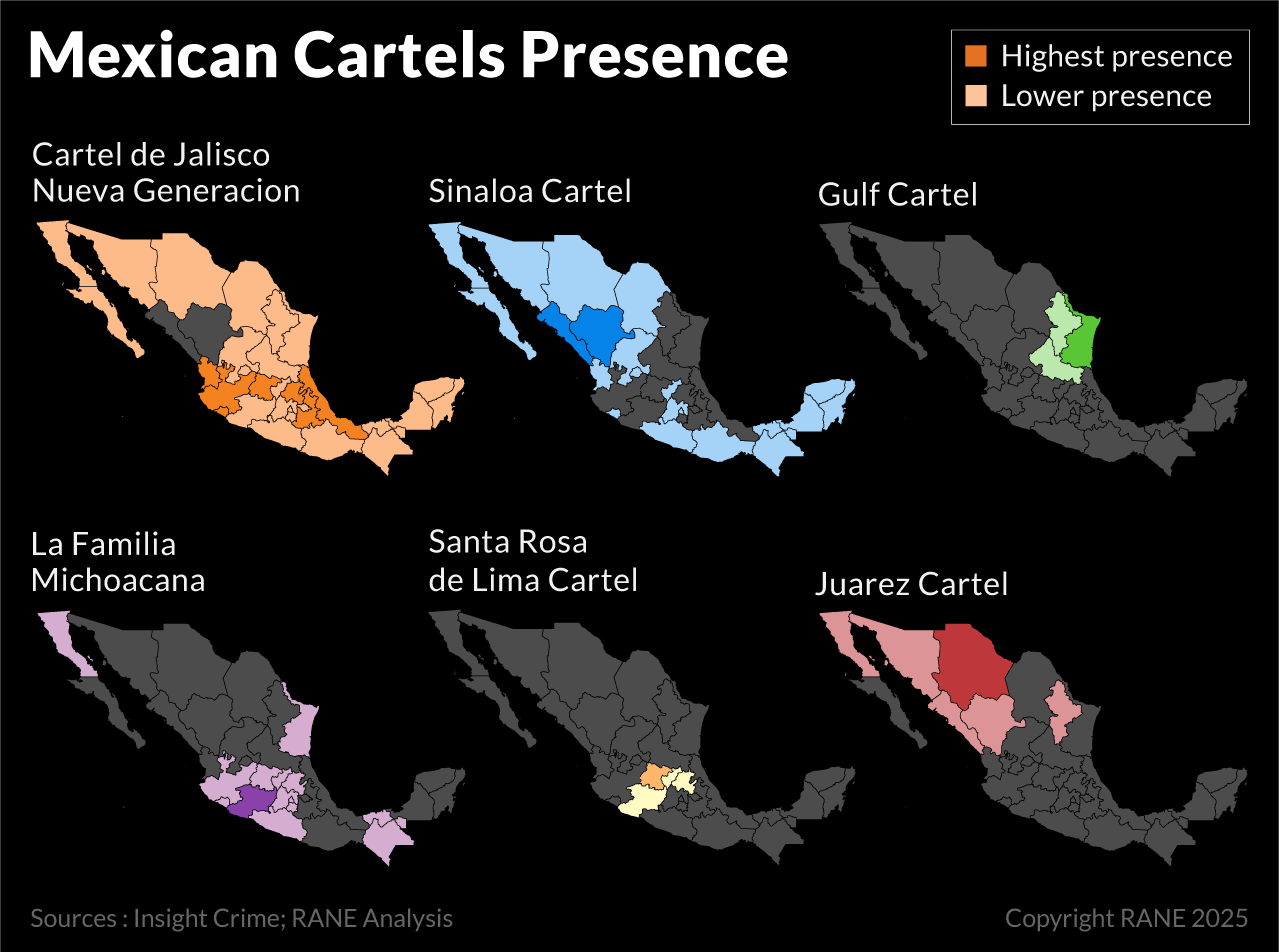
Terrorist designations would most likely target Mexico's most powerful cartels, groups active on the U.S. border, and major transnational groups from elsewhere in the region, meaning the most intense challenges for businesses would be in different geographic areas. While the executive order did not define which Mexican cartels would likely be designated, the following groups are the most likely to be targeted:
- Cartel de Jalisco Nueva Generacion (CJNG): CJNG is one of Mexico's two most powerful cartels and is present in almost every Mexican state and operates abroad, including in Ecuador and Guatemala. The group successfully expanded its operations partially as a result of the expansion of the fentanyl trade, making it likely to be targeted in any terrorist designation. The group is also known for its use of extreme violence and the militarization of its territories, often using terrorist-like tactics including bombings and explosives-laden drones to terrorize local communities. A terrorist designation for the group would have widespread economic impacts given the cartel's extensive geographic presence and engagement in industry, with the most significant impacts in Jalisco, followed by Colima, Nayarit, Guanajuato, Veracruz, Hidalgo and Puebla.
- Sinaloa cartel: The Sinaloa cartel is Mexico's other most powerful cartel and has an international presence, though within Mexico its presence is more geographically limited than CJNG's. Reports have indicated that the Trump administration is currently only considering designating the two. The group has been active for decades, is active in the fentanyl trade, and has deep economic and political ties in the states where it operates, meaning avoiding interacting with the group would be highly challenging for businesses. Designations targeting the group would most significantly impact operations in Sinaloa, Durango, Chihuahua, and Sonora.
- Gulf cartel: The Gulf cartel is significantly smaller than CJNG and the Sinaloa cartel but is highly active on the eastern parts of the U.S.-Mexico border, potentially making the group an attractive target for the Trump administration. The most affected states would be Tamaulipas and Nuevo Leon, therefore having a particularly significant impact on manufacturing in northern Mexico.
- Mara Salvatrucha (MS-13): MS-13 is a Salvadoran gang present in Honduras, Guatemala, Mexico and the United States. Many U.S. politicians who express concern with transnational criminal groups' operations in the United States focus on MS-13 given that the group is semi-regularly found to be linked to organized crime-related deaths in the country. The designation of MS-13 would create challenges for operations in El Salvador, Honduras and Guatemala, though likely to a lesser extent than cartel designations, as the group is comparatively less engaged in the licit economy.
- Tren de Aragua: Tren de Aragua is a Venezuelan gang that has grown significantly in the last five years amid a surge in emigration from Venezuela, as the group has engaged in human trafficking operations across the Western Hemisphere. The group has received significant media and political focus in the United States in the last year amid later disproven reports that the group was occupying communities in Colorado and Texas, though U.S. officials still express concern over the group's apparent expansion into the country. The group is known to extort smaller businesses and government officials in some areas of operation, with the most significant impact likely in Colombia, Peru and Chile.
The terrorist designations would also worsen U.S.-Mexico relations, especially if they lead to any unilateral U.S. military strikes against the cartels within Mexico. Mexican President Claudia Sheinbaum strongly opposes the United States designating the cartels as terrorist groups, indicating that if Trump does so, it would further damage already-strained relations between their two administrations. Sheinbaum is limited in the degree she can oppose the Trump administration given Mexico's deep economic reliance on the United States, and her government's need to minimize the scale and length of any tariffs the new White House places on Mexico. Still, a worsening in relations would likely see reduced bilateral cooperation on issues such as combating organized crime, addressing migration and improving business ties. It would also hamper negotiations on extending the United States-Mexico-Canada trade agreement that is up for review in 2026. Furthermore, on multiple occasions, Trump has called for direct military operations against cartels in the form of drone strikes and special forces incursions into Mexican territory without permission from the Mexican government, as well as covert activity. Such operations would further harm U.S.-Mexico relations and increase safety concerns near the U.S. border, which may deter the Trump administration from following through on them. Still, Trump's executive orders on the terrorist designations and the military deployment to the border together demonstrate the rising potential of the White House pursuing unilateral action in Mexico. While such unilateral operations may kill certain cartel leaders or briefly disrupt groups' operations, they would be unlikely to result in a sustained drop in violence and would instead be more likely to trigger cartel fracturing, increasing violence in the targeted cartel's areas of operation. Finally, direct U.S. targeting of cartels would risk decreasing cartels' typical reluctance to target U.S. citizens in violent crime, raising the risk that Americans and other Westerners in Mexico could be specifically targeted in retaliatory attacks or kidnappings. In a more extreme scenario in which the Sinaloa cartel or CJNG escalates retaliatory attacks, the groups could conduct attacks within the United States, posing more direct domestic security threats; as such attacks would certainly trigger more severe U.S. government backlash against the group responsible, this scenario would only occur if the cartels face severe existential threats that lead them to act as aggressively as possible.
- The United States has long engaged in activities aimed at undermining transnational crime in foreign countries. But in recent decades, Washington has refrained from direct military operations against such groups in Latin America. In 2024, the United States successfully arrested Sinaloa cartel founder and leader Ismael ''El Mayo'' Zambada Garcia by working with other cartel leaders to trick him into boarding a plane that then flew to El Paso, Texas. The arrest was the result of a months-long operation by the FBI and Homeland Security Investigations.
