
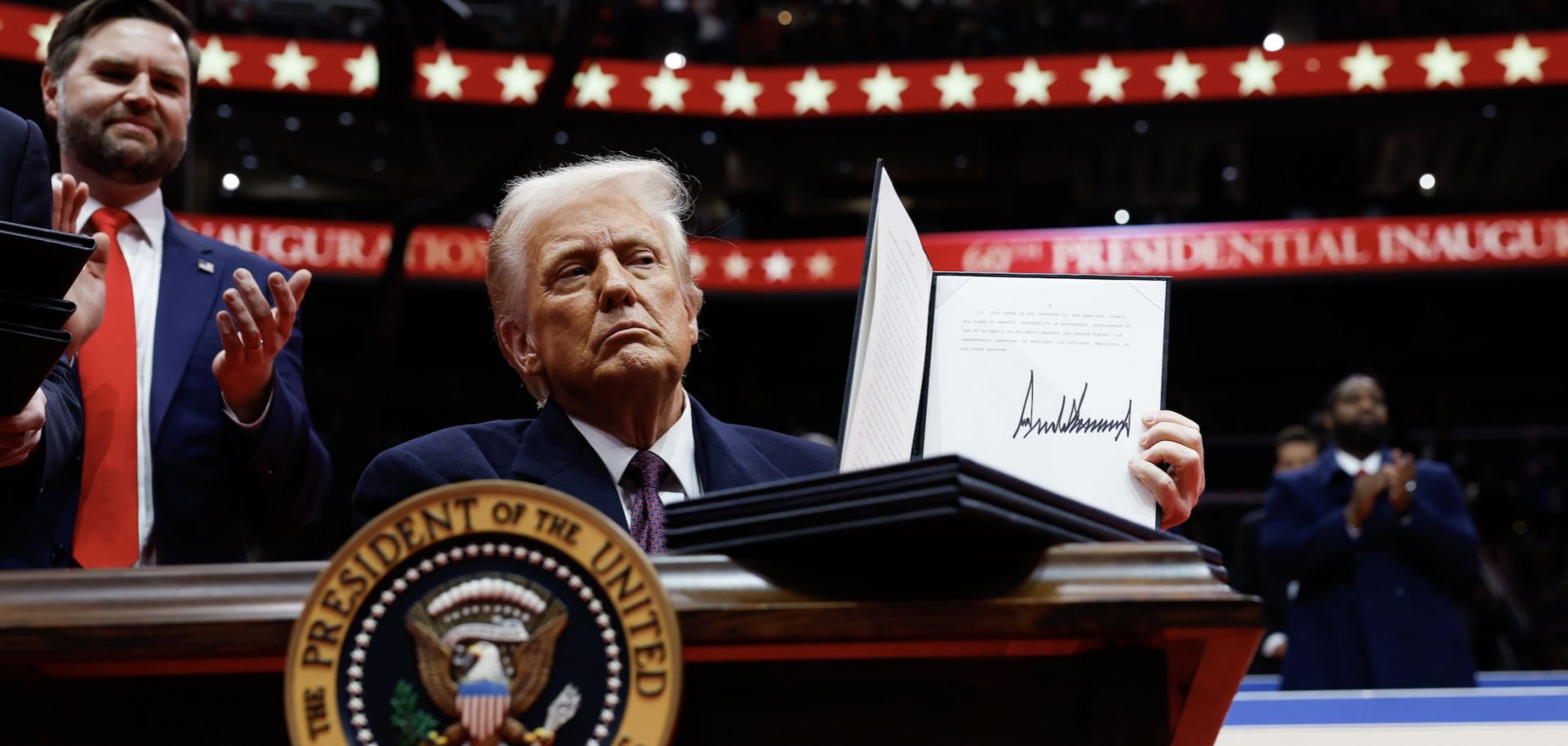
U.S. President Donald Trump's initial executive orders bolster border security, review tariffs, deregulate fossil fuels and withdraw the United States from the Paris Agreement in a push to reverse his predecessor's policies and advance hardline agendas on immigration, trade and energy. However, many of these initiatives will face legal challenges and/or logistical risks, or have a limited short-term impact. Shortly after his inauguration on Jan. 20, Trump signed a series of executive orders that underscore some of the main priorities of his next administration. The majority of the orders are memos mandating departments of the U.S. federal government to review various policies. But Trump's early decisions on tariffs, immigration and energy policies nonetheless provide insight into his priorities and how his second term may unfold in the coming months and years.
Trump's decision to increase security at the U.S.-Mexico border and end birthright citizenship will face legal challenges, but his other policies will likely be implemented, portending cross-border trade disruptions. Trump has already signed multiple executive orders focused on immigration, including one declaring a national emergency at the U.S.-Mexico border, which allows for the deployment of armed forces and the National Guard to the border. Another order directs the U.S. military to ''prioritize the protection of the sovereignty and territorial integrity of the United States along our national borders,'' specifically including illegal mass migration, trafficking activities and other criminal acts. Trump also signed an order that creates a process by which to designate international cartels as Foreign Terrorist Organizations or Specially Designated Global Terrorists, including drug cartels in Mexico, as well as criminal groups in other Latin American countries, like the Venezuelan gang Tren de Aragua and the Salvadoran gang Mara Salvatrucha. A separate order suspends the U.S. Refugee Admission program, which resettles refugees in the United States. Additionally, Trump signed an order ending birthright citizenship for those born in the United States to parents who are not legally in the country, or who are not citizens or permanent residents. However, civil rights activists immediately challenged this order, making its future uncertain, as it arguably violates the U.S. Constitution. Other orders call for finishing the U.S.-Mexico border wall that began being built during Trump's first term, and reimplementating the ''remain in Mexico'' policy that requires asylum seekers to wait in Mexico while their claims are being processed. Increased security at the border with Mexico (and potentially Canada) will risk creating logistical challenges for cross-border supply chains as soon as next week. The Trump administration's move to deactivate the CBP One app, which allowed migrants to apply to enter the United States legally as asylum seekers, will also risk causing additional supply chain challenges by potentially triggering protests among migrant communities near border crossings. Together, these orders set the stage for Trump's broader crackdown on immigration, including his key campaign pledge to deport the millions of people currently living in the United States illegally. However, it remains unclear how quickly such mass deportations could occur, particularly as several so-called sanctuary cities like Chicago have imposed restrictions on local officials' cooperation with certain federal immigration authorities.
While Trump's executive order on trade does not mandate any immediate tariffs, his reiterated threat to impose tariffs on Mexico and Canada suggests a growing likelihood of such taxes being levied against at least one of the two countries. While he was signing his raft of day-one executive orders, Trump remarked that his administration was ''thinking'' of placing 25% tariffs on Mexico and Canada, potentially as soon as Feb. 1. However, the executive order that Trump signed on trade does not mandate any immediate tariffs. Instead, it orders various government agencies to review unfair trade practices by other countries. This includes directing the Commerce and Homeland Security secretaries to assess migration and fentanyl flows from Canada, Mexico and China and recommend trade and national security measures to resolve the issue, which could trigger some tariffs in the future. The order also mandates the launch of a consultation process for the July 2026 review of the United States-Mexico-Canada Agreement, a review of Beijing's fulfillment of the United States and China's so-called ''Phase One'' trade deal, and a review of the U.S. government's export control system, among other similar reviews and investigations. The Trump administration is more likely to impose tariffs on Mexico than Canada, given Trump's aggressive action on the border with Mexico and concerns about cartel and drug trade activity along the United States' southern border, which is significantly higher than it is along its northern border. So far, markets have shrugged off the threat of tariffs on Mexico and Canada because they were excluded from his initial list of executive orders. Still, any lengthy implementation of U.S. tariffs on their goods would risk plunging Mexico and Canada into economic recessions by the end of 2026, and would also wreak particular havoc on the highly integrated North American automotive supply chain, along with seasonal flows of produce and agricultural goods. The lack of quick action on China also does not suggest that Trump's focus on the Asian superpower is waning, as Trump's order includes a significant review of all U.S. trade policies toward China that will likely lay the groundwork for new tariffs early in his new term.
- In response to the threat of tariffs, the Mexican government issued a decree on Jan. 21 that supports President Claudia Sheinbaum's ''Plan Mexico'' strategy to promote nearshoring despite the trade frictions with the United States. The decree includes fiscal incentives like tax deductions that would remain in place until the end of Sheinbaum's term in 2030.
Trump's threat to impose retaliatory measures against other countries' tax policies over concerns about unfair targeting of U.S. companies could open another major front in U.S. economic confrontation with Western (and other) countries that goes well beyond tariffs. Another executive order Trump signed on Jan. 20 mandates U.S. agencies to notify the Organization for Economic Cooperation and Development, or OECD, that the United States would not honor any commitments made by the Biden administration to the OECD regarding a global tax deal reached in 2021, absent an act by Congress adopting the deal's rules (which almost certainly will not happen with Republicans in control of both the Senate and the House of Representatives). The executive order also directs the treasury secretary and the U.S. trade representative to investigate any foreign countries not in compliance with a tax treaty with the United States or that have (or will likely soon have) any tax rules in place that are extraterritorial or disproportionately affect U.S. companies. Within 60 days of launching these investigations, the U.S. agencies must then propose measures to retaliate against such non-compliance or tax rules. The OECD pact aims to change the global balance of where taxation occurs, as well as establish a minimum 15% global corporate income tax for large companies (which many U.S. companies effectively fall under) on their corporate profits; if these companies' global profits are taxed below the 15% level, other countries can top up taxes on them. This thus creates a reasonably high chance that the United States will find that many OECD countries disproportionately target U.S. companies, mainly tech companies, particularly if more countries reintroduced digital services taxes that the OECD deal was designed to replace. The reviews of foreign countries' tax policies are thus a major shot across the bow to the OECD countries that signed the global tax deal and are planning to implement it, which include the United Kingdom, EU member states, Japan, Canada and South Korea. The investigation ordered by Trump also goes beyond just the OECD tax deal and could result in finding that many countries' tax structures unfairly target the United States, exposing other nations to potential retaliation measures including tariffs and additional U.S. taxes on foreign companies operating in the United States.
Trump's initial actions to support the fossil fuel industry will only have a modest impact on U.S. energy supplies, as U.S. production will be unaffected by many of the regulatory changes. On Jan. 20, Trump declared a ''National Energy Emergency'' as a part of several executive orders designed to support the U.S. oil and gas industry and reduce U.S. efforts to pursue renewable energy sources. The emergency order authorizes government agencies to expedite the use of the Defense Production Act and other powers to facilitate the production, transportation and refining of domestic energy resources. The order also empowers agencies to expedite environmental reviews of various energy products, and potentially impose a waiver allowing the year-round sale of E15 gasoline. Additionally, Trump signed executive orders to rescind Biden's pause on LNG export reviews and eliminate an ''electric vehicle mandate.'' Trump also ordered the review of all actions burdening the development of oil and gas resources, and the implementation of several measures to increase oil and gas drilling in Alaska and temporarily halt the issuance of new federal offshore wind leases. U.S. oil and gas production is not currently held back by the measures the executive orders target, like a lack of offshore permitting. This is because U.S. light tight oil growth is more dependent on commercial factors, like oil prices and the strength of the dollar, than federal regulations. The reversal on the pause of new LNG export applications will affect new LNG export capacity five to six years in the future as U.S. LNG export capacity growth will rise over the next few years regardless. Trump's attempt to roll back various energy regulations implemented during Biden's presidency — including tax credits for EVs, vehicle emissions standards, and power sector emissions requirements affecting coal and older natural gas power plants — will have a larger impact on keeping U.S. fossil fuel demand elevated for longer. Some of the reviews on various infrastructure projects could also expedite approvals for the construction of new electricity generation and transmission projects that are hindering the build-out of the U.S. grid to handle growing power demand from AI and data centers.
Finally, the United States' withdrawal from the Paris Agreement will weaken global momentum for pursuing more ambitious climate targets, and will also make mobilizing climate finance more difficult. As expected, Trump signed an executive order triggering the start of the United States re-withdrawing from the 2015 Paris Agreement and all commitments made under the U.N. Framework Convention on Climate Change. The executive order also revoked the U.S. International Climate Finance Plan. Other global leaders will cite the U.S. rollback in reducing their own climate ambitions. Indeed, Russian energy giants are already proposing to the Kremlin that Russia exit the Paris Agreement. If Russia follows the United States out, then two of the world's three largest oil producers will have left the pact, giving cover to countries like Saudi Arabia to also leave while further weakening global cooperation on climate change. Nevertheless, the executive order did not go as far as some U.S. conservatives wanted, as it did not include a U.S. withdrawal from the U.N. Framework Convention on Climate Change itself, which would have pulled the United States out of annual climate change conferences altogether.
