
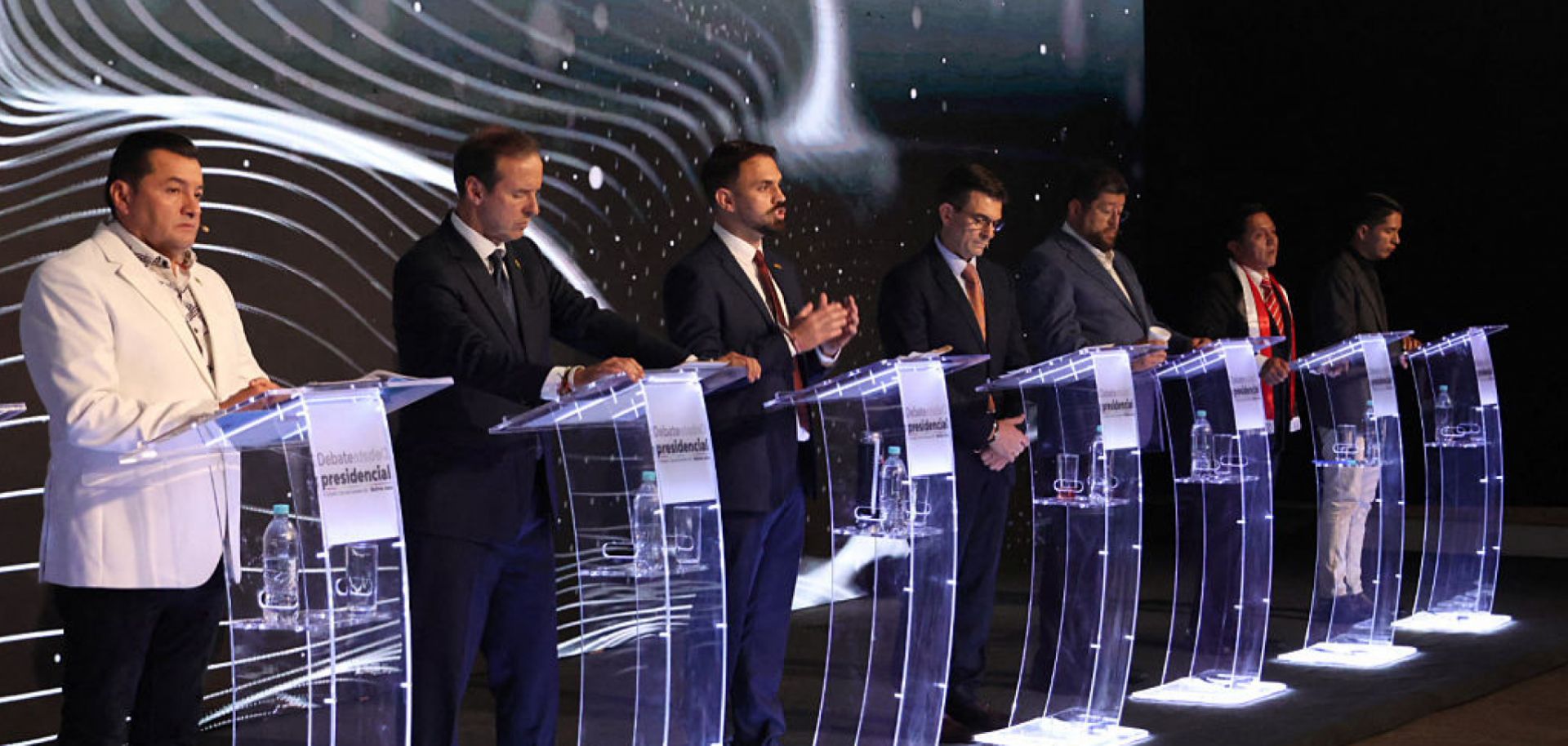
Bolivia's upcoming elections will likely end the left-wing ruling party's grip on power amid widespread frustration over economic turmoil and legislative paralysis. A right-wing win would shift the government's focus toward improving the business climate, but deep-rooted socioeconomic challenges are expected to persist in the long term. On Aug. 17, Bolivia will hold general elections, with voters choosing a new president, all 130 members of its Chamber of Deputies and all 36 members of its Chamber of Senators. In the likely event that no presidential candidate achieves more than 50% of the vote or a 10 percentage point advantage over the next closest candidate in the first round, there will be a runoff vote on Oct. 19. All electoral winners will take office on Nov. 8. Polling suggests low support for the ruling left-wing Movement Toward Socialism party (MAS), with polling firm SPIE reporting in mid-July that Samuel Doria Medina of the center-right Unity party is leading with 21.8% support, followed by former President Jorge Quiroga of the right-wing Libre alliance with 20.7% support. Senate President Andronico Rodriguez, an independent candidate who was previously a member of MAS, typically polls in third place with around 10% support. Meanwhile, MAS candidate Eduardo del Castillo has only 1.9% support according to SPIE. Current President Luis Arce of the MAS party announced in May that he would not seek re-election amid high disapproval for his government.
- Quiroga was elected Vice President in 1997 alongside President Hugo Banzer (Bolivia's dictator from 1971 to 1978). When Banzer resigned in August 2001 due to health problems, Quiroga became president for the final year of Banzer's mandate, leaving office in August 2002.
- Bolivia's October 2019 elections experienced significant claims of electoral irregularities, after former President Evo Morales (2006-19) won re-election with 47% of the vote, without the need for a second round. Mass protests over the irregularities forced Morales to resign along with the rest of the line of succession. This led the second vice president of the Senate, Jeanine Anez of the opposition, the far-right Social Democratic Movement, to assume the presidency until new elections could be held in October 2020, during which President Arce was elected. A few months later, in March 2021, Anez was arrested and ultimately convicted of crimes related to an alleged coup d'etat during the 2019 elections. She remains in prison as of 2025.
The elections come amid a political dispute that has upended the ruling MAS party, hindering governance and exacerbating the country's economic crisis, ultimately driving a significant drop in support for the party. Though President Arce initially was a close ally of former President Morales, in recent years, they have become increasingly at odds with one another as Morales attempted to seek re-election despite constitutional term limits barring him from doing so. As Morales and his supporters put pressure on Arce to take action to help Morales run for an additional term, the MAS party fractured over who should lead the party and who should represent the party in the 2025 elections. These tensions escalated in early 2024 to create policy gridlock as MAS members aligned with Morales refused to support Arce's policy initiatives, which ultimately prevented the government from effectively responding to a worsening foreign reserves shortage, resulting in fuel and goods shortages across the country. Amid political tensions, economic hardship and public frustration, a failed military coup unfolded in June 2024. However, significant uncertainty remains over whether it was a genuine attempt or, as opposition groups claim, a move orchestrated by President Arce to consolidate his political power. In the months since, economic conditions and political tensions have only worsened, with increased inflation and recurring coup accusations by both Arce and Morales, leading to regular mass demonstrations against the Arce government by both Morales' supporters and by right-wing political parties and activities frustrated with the economic crisis and shortages of fuel and basic necessities. Morales left the MAS party in February 2025 and attempted to run for president under the Front for Victory party, but his candidacy was rejected. Despite this, he has continued to insist on being included in the election, even in the final weeks before the vote. These compounding crises have resulted in a significant drop in support for MAS and the left-wing more broadly, with Arce's disapproval levels rising to over 70% in late 2024 and remaining high through mid-2025.
- In 2024, Bolivia's public debt reached 95% of GDP, up from 80.1% of GDP in 2022. In addition to high government spending on subsidies, a drop in natural gas exports (a major contributor to government funds) has further contributed to poor economic conditions. According to Bolivia's National Statistics Institute, exports in 2024 were $1.64 billion, down from a high of $6.11 billion in 2011.
- According to the World Bank, Bolivia's GDP growth fell from 6.1% in 2021 to 1.4% in 2024.
- Bolivia's National Statistics Institute reported on July 2 that consumer prices rose by 5.2% in June 2025 from May 2025 and by 24% from June 2024, the highest annual inflation rate in 34 years.
- Over the past two years, Morales' supporters have repeatedly staged protests that turned deadly. In weekslong protests in June 2025, clashes killed six people, including four police officers, one of whom died after having dynamite strapped to his body, then detonated. The protests also injured more than 300 people. Though support for MAS is low, Morales has retained a sizable base of supporters who are willing to engage in mass, violent protests.
Based on pre-election polling, it is likely that right and center-right parties will gain control of both the executive and legislative branches, leading to austerity measures and efforts to make Bolivia more attractive for investment. Election polling suggests MAS is on track to lose both its legislative majority and the presidency in the upcoming vote. Polling indicates that it is likely Quiroga and Medina will progress to the second round, and as left-wing voters will prefer the more centrist Medina over right-wing Quiroga (particularly given Quiroga's links to the former dictatorship), Medina will likely win the presidency in an October runoff vote. Meanwhile, in the legislative branch, center-right and right-wing parties will likely achieve enough seats to form a coalition, which will provide Quiroga or Medina the bandwidth to implement many of their policy goals. The return of the right-wing to power for the first time since 2006 (save Anez's one-year presidency) will see Bolivia's government implement pro-business policies intended to make the country more attractive to foreign investment, including by reducing taxes and regulations for businesses. Both Medina and Quiroga would likely seek to reach an agreement with the IMF for debt relief, and they would almost certainly implement austerity measures to achieve this. This would include reduced government spending on social programs and subsidies, including fuel, which will likely trigger violent protests among poorer Bolivians, as seen following previous efforts to reduce subsidies. If Quiroga defeats Medina, the chances of a government crackdown on the MAS party would increase, likely triggering corruption investigations and possibly the arrests of Morales, Arce, and others — actions that would almost certainly spark mass protests in major cities. Based on the candidates' rhetoric, Quiroga would also likely attempt to implement more extensive austerity measures than Medina, with Quiroga promising to "privatize everything," repeatedly stating that the Bolivian state's size must be substantially reduced, and stating that austerity measures are "a necessary change." If implemented effectively and maintained in the face of popular backlash, austerity measures could ultimately improve economic conditions and make Bolivia more attractive for foreign investment, particularly assisting in the exploitation of lithium reserves in the long term.
- Bolivia has the world's largest lithium reserves, accounting for roughly 20% of identified lithium. However, the country has struggled to develop the lithium industry due to pushback from local communities, while infrastructure shortcomings, heightened political instability, unrest risks and concerns over nationalization have made the country unattractive for investors in recent years.
In the low likelihood scenario that Bolivia's left-wing retains government control following the elections, more moderate cuts in government spending and legislative gridlock will mean Bolivia's crises continue. While unlikely, Castillo and/or Rodriguez could make it to the second round. Election polling in Bolivia is often unreliable due to difficulties in reaching poor, rural voters who tend to back left-wing candidates, raising the possibility that the polls underestimate support for Castillo and/or Rodriguez and that a late surge of support could still materialize. This remains possible given MAS and Morales have maintained a strong electoral base for the past two decades, and there is still a low but lingering chance the party could unify behind Rodriguez or Castillo — especially if Morales unexpectedly throws his support behind one of them to block a right-wing victory. However, Morales' current rhetoric makes such an endorsement unlikely. Rodriguez is more likely to win than Castillo, given Rodriguez's larger distance from the MAS party establishment and his likely greater support from Morales's supporters. In the unlikely event that this occurs, the upper and lower legislative houses of the Legislative Assembly will likely be more evenly divided between the left- and right-wing, potentially requiring the formation of a coalition from a broader range of political groups or the regular formation of short-term alliances to pass specific legislation. This would raise the likelihood of further gridlock in the legislature and make it significantly harder for Castillo or Rodriguez to pass legislation. Both candidates would attempt to reduce government spending and subsidies given the significant reserve crisis, but would do so less extensively than the right-wing candidates. Rodriguez has promised to seek loans from groups other than the IMF and said he would maintain government involvement in the mining sector. The mixture of persisting legislative gridlock and light-handed economic adjustments will mean the country's economic challenges persist and likely worsen further over at least the next five years in this scenario.
- In the months leading up to the 2020 elections, polls showed Luis Arce and center-right candidate Carlos Mesa in a tight race, suggesting a likely runoff between the two. However, in the actual election, Arce won 55% of the vote and was elected in the first round.
- In July, Morales criticized Rodriguez, formerly a protege and close ally, claiming that he is right-wing and accusing him of acting against the principles of the MAS movement.
The elections are highly likely to experience mass, violent unrest and potentially challenges to the election results, which will further damage the country's attractiveness in the long term. Elections in Bolivia are commonly contentious, as seen in 2019, and given high anti-government sentiment and regular mass, violent demonstrations by Morales' supporters over the last two years, it is almost certain that Bolivia will experience significant violence during the election cycle. At the low end of violence, the losing side will organize protests in the days after the vote on Aug. 17 and potentially Oct. 19, with the largest demonstrations expected in La Paz and Santa Cruz de la Sierra; some protesters may block highways — including near border areas — with relatively minor clashes or incidents of violence. In a more extreme scenario in which political parties allege electoral fraud, protests will likely see participation in the hundreds of thousands nationwide, sustained over the next year and potentially longer, given Morales' already-demonstrated ability to mobilize his supporters for extended, disruptive protests. While there is no indication that another coup attempt similar to that in June 2024 is likely, it is probable that a political figure will claim a rival is attempting a coup d'etat in the coming months. This will further contribute to unrest threats and raise political tensions, with the low potential for a repeat of the 2019 elections, in which Morales was forced to resign. Extensive coup allegations, political tensions and unrest will further hinder efforts to overcome economic challenges as well, as such incidents will further the perception among international businesses and investors that Bolivia is not an attractive location for investment due to significant operational challenges and political instability. Due to this, even if the right-wing wins the vote and embarks on efforts to improve the operating environment, companies will remain hesitant, as the continued popularity of Morales and other political figures that support extensive subsidies, social programs and government control of extractive industries will fuel concern that any new pro-business measures will be rolled back in the future. This will extend to organizations considering investing in Bolivian lithium, as any investments would be at risk of future nationalization. Amid these concerns, Bolivia will struggle to overcome its crises over the coming years, and it is unlikely that a significant improvement will occur before the next general elections in 2030, with the moderate likelihood that current challenges will persist over the next decade.
- Bolivia's net foreign direct investment inflow has been below 1% of GDP in recent years, at 0.2% in 2022 and 0.1% in 2023, significantly lower than regional neighbors such as Peru, which saw net inflows of 1.5% of GDP in 2023 despite the country's own internal political instability.
