
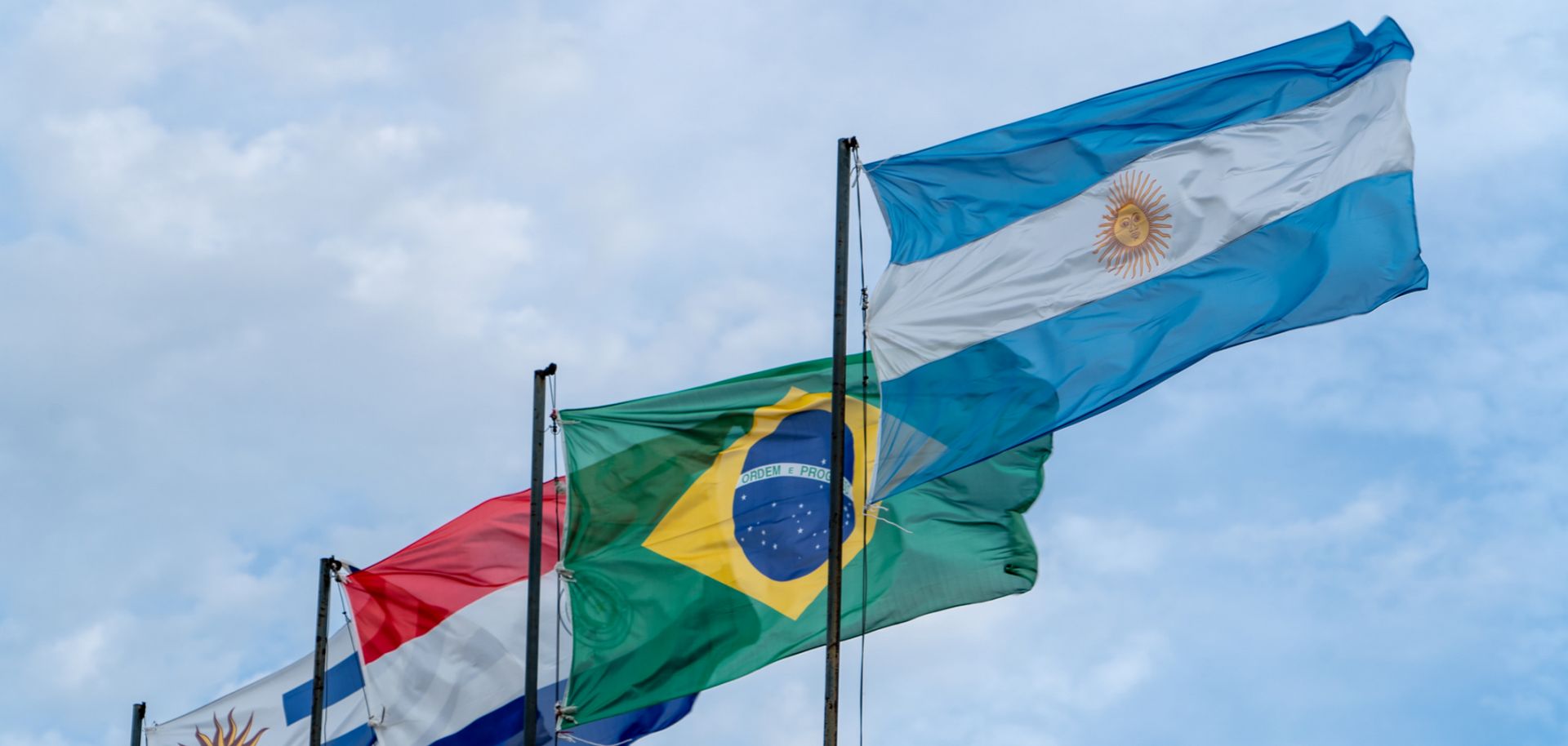
The upcoming Mercosur summit will likely advance two key initiatives: increasing member state autonomy on tariff decisions and progressing new free trade agreements amid the rise of U.S. protectionism. On July 2-3, Buenos Aires will host the 66th meeting of Mercosur's Common Market Council (CMC) and presidential summit. Discussions will focus on the April 11 agreement reached by Mercosur foreign ministers to temporarily expand the number of imported goods each member country is allowed to exempt from the bloc's Common External Tariff (CET). Until December 2028, the five members of the South American trade bloc (Argentina, Brazil, Paraguay, Uruguay and Bolivia) will be allowed to apply their own unilateral tariffs on 150 items, up from the previous 100 items. This will, in turn, give Mercosur nations more flexibility in managing their foreign trade policies, including by potentially negotiating narrow tariff-free deals with countries outside the bloc without violating Mercosur rules.
- In 1995, Mercosur implemented a Common External Tariff (CET), which imposes a tariff rate ranging from 0% to 35% on all products imported from outside the bloc. But individual member states are allowed to keep a list of goods that are exempt from the tariff, formally called the National List of Exceptions, to ease the impact on their economies (by, for example, exempting certain food items to mitigate inflation in case of crop failures). For the goods added to this list, member states can unilaterally set external tariffs that are lower than the CET that all Mercosur members must abide by.
- Until 2023, Mercosur members could change up to 20% of the items on their exemption lists every year, but in December 2023, the bloc approved a new rule allowing all items to be modified in 2024 and 2025.
The agreement to expand exemptions to Mercosur's common tariff comes amid recent efforts by individual members to negotiate bilateral trade deals with third countries, which had threatened to collapse the bloc. Mercosur has a common trade policy that prevents members from signing bilateral trade agreements with countries outside the bloc. But reaching bloc-wide trade deals has proven difficult, with Mercosur only signing four such agreements since its creation in 1991. In recent years, this has fueled internal calls for an easing of the bloc's rules barring countries from signing bilateral trade deals with external countries, with some members even threatening to exit Mercosur over the issue. Uruguay, under former right-wing President Luis Lacalle Pou (2020-2025), unsuccessfully pushed for a bilateral trade agreement with China. While Uruguay's new left-wing president Yamandu Orsi supports participation in Mercosur, Argentine President Javier Milei has also threatened to leave the bloc in order to free his administration to pursue a bilateral trade deal with the United States. But Brazil, Mercosur's main industrial producer, has been hesitant to increase the flexibility of the bloc's trade regulations for fear that letting other members import goods from competing nations at lower tariffs would undercut Brazil's manufacturing sector. These competing trade interests among its members have, in turn, raised concerns about Mercosur's potential collapse, driving foreign ministers to reach a compromise solution in April that relaxed the bloc's rules regarding its common tariff.
- Argentina, Brazil, Paraguay and Uruguay founded Mercosur in 1991 with the aim of promoting economic integration and political cooperation in South America through the establishment of a common market. Venezuela became a full member in 2012 but was suspended in 2016 amid failure to comply with democratic rules. In 2024, Bolivia became a member and has until 2028 to align its legislation with the bloc's guidelines.
- Intra-bloc trade grew in the 1990s, driven by a political environment that supported privatization and free market economies. By 1998, goods traded within the common market accounted for 23% of member countries' exports, But significant financial crises, particularly Argentina's in 2001, followed by political shifts and divergent national interests, led the bloc to gradually lose momentum. As a result, intra-bloc trade has not surpassed 15% of Mercosur members' exports since 2001.
- Argentina and Brazil together account for 94% of the Mercosur market's GDP and 92% of its population.
- Mercosur signed free trade agreements with Israel (2007), Egypt (2010), the Palestinian Authority (2011) and Singapore (2023). In 2024, the bloc reached a political agreement with the European Union on a draft trade deal after 25 years of negotiations, but the trade deal still needs to be ratified.
Greater flexibility on tariff decisions will enable Mercosur countries to unilaterally negotiate narrow deals with third countries. Mercosur's large consumer market also makes it attractive for countries seeking to mitigate the impacts of the United States' trade wars, which will propel negotiations on new bloc-wide free trade agreements. While Mercosur countries remain barred from reaching bilateral free trade agreements with third parties, they can still negotiate lower tariffs with individual trading partners for goods not subject to Mercosur's common tariff. The expansion of goods that Mercosur nations can exempt from the CET will thus offer them more flexibility in negotiating these narrow trade deals. For instance, in its ongoing bilateral negotiations with the United States, Argentina is seeking to leverage the new rule to offer Washington reduced tariffs on the now greater number of CET-exempt Argentine goods, hoping this will give Buenos Aires relief from some of new U.S. tariffs. Beyond tariff discussions, the upcoming summit will also focus on Mercosur's ongoing efforts to reach bloc-wide free trade agreements with the European Union, the European Free Trade Association (comprising Iceland, Liechtenstein, Norway, Switzerland) and the United Arab Emirates. Mercosur leaders will likely seek to secure political commitments to ratify the new trade deal with the European Union, taking advantage of Mercosur's simpler ratification process compared with the complex EU approval route. These bloc-wide trade negotiations will likely make quicker progress than past ones due to the added momentum provided by rising U.S. protectionism, with European countries and the United Arab Emirates seeking to diversify their trade ties away from the United States in response to new tariff threats. But while the relaxation of rules and other countries' growing interest in trading with the bloc will help ensure Mercosur's survival in the coming years, its members' calls for greater flexibility and pursuit of bilateral agreements with external partners still threaten to undermine the purpose of the customs union itself.
- The United States purchased 8.1% of Argentina's total exports in 2024, making it the second-largest destination of Argentine goods. Argentina, meanwhile, purchased 2.9% of U.S. total exports the same year, making it the 38th-largest destination for American exports.
- The Mercosur-EU trade deal has faced firm opposition in Europe, particularly from France, Poland and Austria, due to concerns that importing cheap South American agricultural goods will harm local farmers. This has cast doubt over whether the European Union will ratify the deal, which requires the approval of both the European Council and the European Parliament.
- In recent months, Mercosur and the European Free Trade Association have held several rounds of technical talks on a free trade deal. Foreign ministers from countries in both groups agreed in April to pursue completion of the agreement "in the coming months."
