
Stagnated trade deals and dwindling intra-bloc commerce have put Mercosur in a deadlock that is further compounded by structural discrepancies and growing political divergence, which will likely result in just minor rule changes to prevent the dissolution of South America's largest trade bloc. Paraguayan President Santiago Pena hosted Mercosur's presidential summit on July 8, which marked the end of his country's six-month rotating presidency. The meeting's main topic was the accession of Bolivia as a permanent member of the bloc, which comprises Argentina, Brazil, Paraguay and Uruguay. However, Argentine President Javier Milei's absence was the most notable political development of the event, not only for being the first time a president had skipped such a meeting in 23 years, but also because Milei has heavily criticized Mercosur and has hinted at withdrawing Argentina from the bloc. The summit's joint statement was also delayed due to Argentina's opposition to language related to gender equality and environmental protection, as well as broader narrative disputes over last month's coup attempt in Bolivia.
- Member countries' presidents openly criticized Milei's absence and emphasized their commitment to Mercosur as an important instrument for regional integration, despite acknowledging the bloc's shortcomings and challenges.
- Argentina was represented by Chancellor Diana Mondino, who stated the bloc needs an adrenaline shock to realize its untapped potential and called for making Mercosur's rules on trade negotiations more flexible.
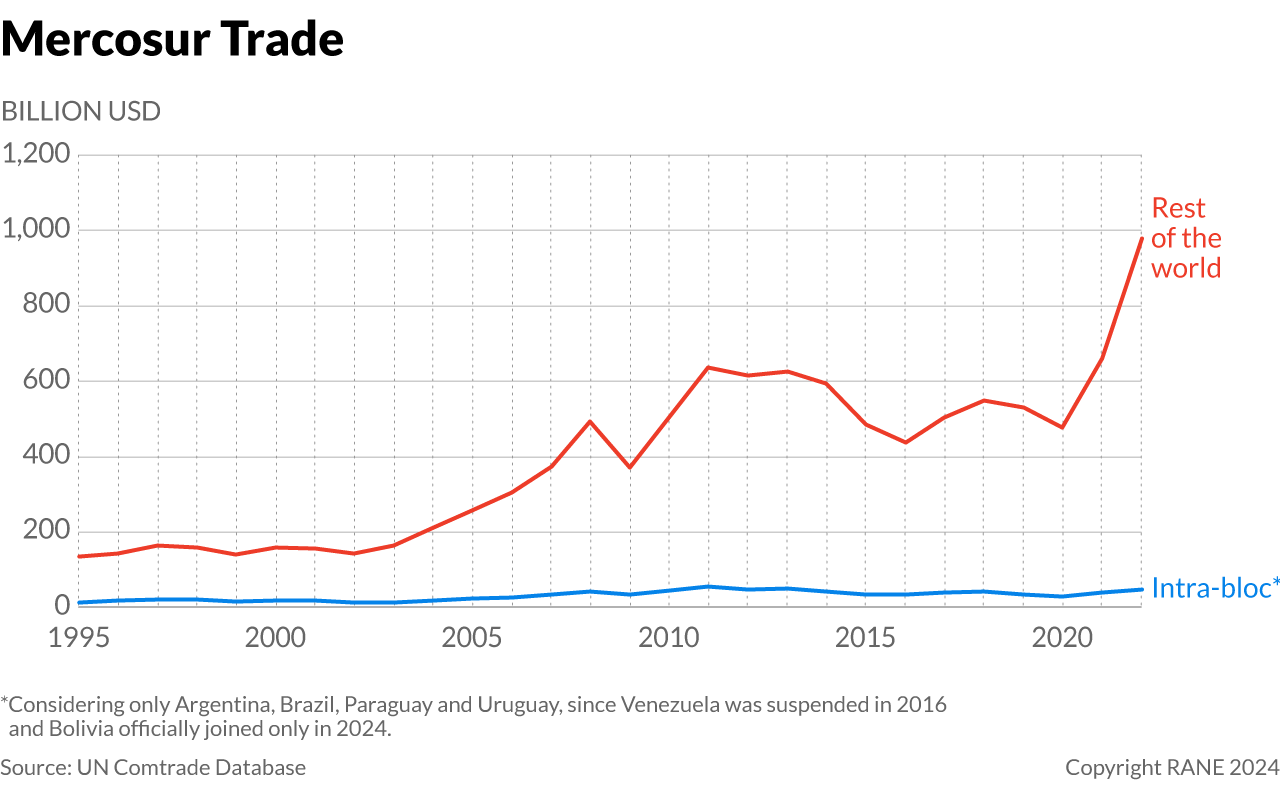
For decades, Mercosur members' drastically different economic and population sizes have undermined the bloc's commercial integration and negotiation capacity, while internal political disagreements have fueled pressure to relax its rules. With a nominal GDP of $ 5.7 trillion, Mercosur was the 5th largest economy globally in 2023, but the scale of its members is strikingly different, with Argentina and Brazil combined accounting for 92% of the bloc's population and 94% of its GDP. As a result, both Argentina and Brazil have much more influence than Paraguay and Uruguay, and the former protectionist industrial sectors' lobbies have contributed to Mercosur's often protectionist approach to foreign trade. For instance, it had a 35% import tariff for goods from outside the bloc between 1995 and 2022, when it was reduced to 25% for most imports. Additionally, intra-bloc trade has remained stagnant over the past decade and the fact that Mercosur economies produce similar goods, especially agricultural commodities, prevents complementary commerce. Internal political differences and the need for consensual decisions have also undermined negotiations for free trade agreements (FTAs). Against this backdrop, Argentine President Milei is not the only one calling for reform. In 2021, Uruguayan President Luis Lacalle Pou said Mercosur held his country ''hostage'' and has since sought to ink a bilateral deal with China. This, however, goes against Mercosur's rules. As a customs union, there is free trade within the bloc, but there is also a common trade policy that prevents members from signing bilateral trade agreements with countries outside the bloc. Despite reinforcing his calls for relaxing these rules on trade deals with external countries during the July 8 summit, the Uruguayan leader publicly committed to the bloc's unity, indicating he would not seek to dissolve Mercosur while holding the rotating presidency until January 2025.
- Trade between Mercosur members grew significantly during the union's first few years, reaching 25.1% in 1998, but a severe crisis in Argentina pushed this figure down to 12.8% by 2002. Intra-bloc trade stood at only 10.3% in 2022, significantly below similar groups. Intra-zone commerce within the Association of Southeast Asian Nations (which comprises ten countries), for example, stands at around 24%.
- Mercosur has signed only four FTAs: with Israel (2007), Egypt (2010), the Palestine Authority (2011, but only put into effect by Brazil in July 2024), and Singapore (2023). In 2019, Mercosur and the European Union agreed on a draft deal for an FTA, but the agreement has not been ratified amid renewed environmental and protectionist concerns from both sides.
Political tensions between Brazil and Argentina mean that Mercosur is unlikely to implement significant reforms in the short-to-medium term, but minor changes, such as tariff exceptions for specific goods or countries, are possible. Uruguay will continue to push for trade talks with China, while Paraguay will likely seek new trade partners (as it did by leading initial talks on a Mercosur-United Arab Emirates trade deal in 2024). But Argentina and Brazil will remain the bloc's main actors given their economic and political heft. Since Argentina's libertarian president Milei and Brazil's leftist president Luiz Inacio Lula da Silva are unlikely to develop a pragmatic relationship due to their ideological differences, regional cooperation will be curtailed at least until Lula finishes his term in December 2026. Against this backdrop, Mercosur's trade deal with the European Union will almost certainly not be ratified amid opposition from European farmers and South America's industrial sector. The bloc's talks with China are also unlikely to prosper due to Paraguay's unwillingness to cut diplomatic ties with Taiwan. Negotiations with other potential partners will face various obstacles as well, especially amid frequent concerns over how a flood of agricultural exports from Mercosur countries would impact those potential partners' economies. Therefore, Mercosur is likely to neither leave its dormant state nor significantly benefit from the global realignment of supply chains being fueled by rising geopolitical tensions between Western and Eastern powers (commonly referred to as near- or friend-shoring). But despite the South American trade bloc's poor outlook, its dissolution remains unlikely. Mercosur is still an important tool for Brazil to project regional influence by ensuring its neighbors' trade policies are aligned with its own interests while securing markets for its manufactured goods as well. The bloc also remains an important economic platform for the smaller economies in the group — namely, Paraguay and Uruguay — by giving them preferential access to large consumer markets and, in theory, providing them with better terms in international deals as part of a bloc than they would otherwise have individually. Most likely, Mercosur will ink a handful of FTAs with small economies and make ad hoc changes to its regulations (such as exceptions to its external common tariff to accommodate specific categories of goods or products from a given country. These efforts will help partially appease internal demands without compromising the structural nature of the customs union, translating to a broad continuation of Mercosur's current stagnated status with isolated improvements.
- Mercosur has held trade talks with Lebanon, the European Free Trade Association (Iceland, Liechtenstein, Norway and Switzerland), Indonesia, Vietnam, South Korea, Canada, Japan and the United Arab Emirates; discussions with the former three have entered a more advanced stage.
- When Mercosur implemented a Common External Tariff (CET) in 1995, it let each member maintain a separate exceptions list to allow for the gradual adjustment of their economies. This mechanism has remained in place, permitting each country to decide, based on internal factors, which products can have an import tax different from that defined in the CET. Until 2023, Mercosur members could change up to 20% of the items of their own lists every year, but in December 2023, the bloc approved a new rule allowing all items to be modified in 2024 and 2025, indicating an openness to flexibility and suggesting similar minor modifications are possible in the coming years.
