
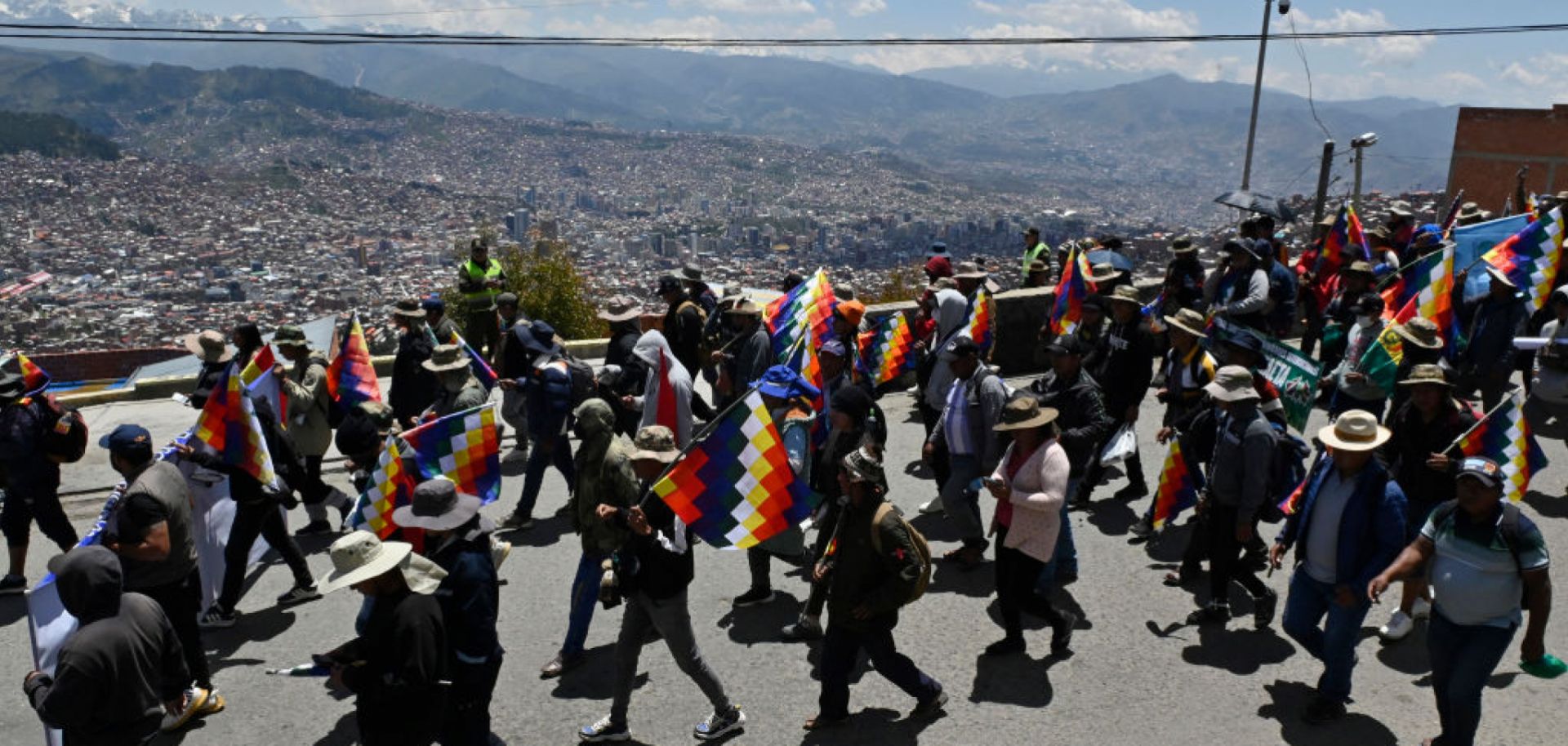
Bolivia's socioeconomic crisis will worsen in the coming months, fueling political instability ahead of the country's August presidential election amid shortages of dollars and fuel. In recent months, Bolivia has seen an increase in social turbulence as an ongoing economic crisis has resulted in widespread shortages of dollars and imported goods, which has prompted the government to resort to controversial means of addressing disruptions to the supply of goods, angering many in the private sector. On March 25, Bolivia's constitutional court suspended a measure in the country's 2025 budget that businesses claimed allowed authorities to seize goods private companies store. The government said the measure would prevent price speculation and shortages of food, medicine and fuel, a recurring issue over the past two years. In an attempt to address fuel scarcity, the Bolivian government on March 24 exempted diesel and gas imports from the value-added tax and customs duties, and pledged to reduce administrative procedures to expedite imports. The court ruling and government announcement came a week after business associations representing farmers, transporters and retailers held a march from Patacamaya to La Paz, both in the western department of La Paz. They demanded the revocation of the budget provision that allowed goods seizures and pressured the government to address a long-lasting economic crisis that has resulted in the scarcity of hard currency and imported items.
- For several months now, Bolivians have faced hourslong lines for fuel and scarcities of other basics including flour, sugar and medicine are scarce and often rationed at subsidized retailers the government runs amid a severe lack of dollars has impaired the country's ability to import goods over the past two years.
- The crisis moved the government on March 24 to allow remote work for public servants and virtual classes for students in an attempt to reduce fuel consumption.
- As supplies of essentials fail to meet demand and the boliviano currency weakens in the unofficial market, Bolivian annual inflation reached 13.2% in February 2025, its highest since 2008, up from 2.52% in the same month of 2024.
- Bolivia will hold general elections Aug. 17, and a runoff if necessary Oct. 19.
A decade of economic decline on the back of dwindling gas exports and shrinking dollar reserves combined with frequent political crises have resulted in widespread shortages. Former President Evo Morales relied on booming gas exports and high commodity prices to implement large fuel price subsidies and other social benefits for most of his first two terms in office, from 2006-14. Corruption and political appointments over the past two decades have led state-run oil and gas company YPFB to reduce investment in exploration and discoveries to replace depleting wells, leaving declining revenues from diminished gas exports and lower international prices. Against that backdrop, Bolivia has had large fiscal deficits for 11 consecutive years and current account deficits in nine of the years since 2014. Foreign exchange reserves to maintain fixed fuel costs and a stable exchange rate meanwhile fell 87%. The economic malaise was compounded by political instability that started with widespread demonstrations following the 2019 presidential election, in which Morales was elected to a fourth term despite a three-term limit set by the Bolivian Constitution. Amid transparency controversies and legitimacy challenges, Morales resigned and fled the country. His former finance minister, Luis Arce, won the rerun vote in 2020. Despite both belonging to Morales's Movement Towards Socialism Party, the politicians clashed over who would lead the party and run for president in 2025. That rift fractured Arce's legislative base, resulting in policy paralysis and preventing the government from approving requests to access foreign funds or other measures that could help curb the deepening socioeconomic crisis. Amid the political stalemate and growing popular dissatisfaction with the government, Bolivia saw a failed coup attempt in June 2024 and has faced recurring marches and protests over the past two years. In February 2025, Morales left MAS after 27 years and announced a run for president by the left-wing group Front for Victory, in defiance of the constitution.
- As a result, the country's economy has significantly slowed in recent years, with average gross domestic product growth falling from 4.6% from 2010 to 2019 to 2.7% from 2021 to 2024, a figure that ignores the impacts of the pandemic in 2020 and 2021.
- Gas production in Bolivia peaked at 765,874 TJ in 2014 but dropped by one-third to 512,347 in 2022, according to the most recent International Energy Agency data; the share of total gas production exported meanwhile dropped from 81% to 71% over the same period.
- Bolivia's fiscal deficit averaged 7.4% of GDP between 2014 and 2024 while its current account deficit averaged 2.7% of GDP over the same period, according to the Inter-American Development Bank.
- Bolivia had $15 billion in foreign exchange reserves in 2014, which dropped to $1.9 billion in December 2024; roughly $200 million of this are in cash, which has not sufficed to cover the country's average import needs of nearly $1 billion per month.
The government will not solve the economic crisis, as its opponents will not cooperate with the administration before the elections. This means fuel and dollar shortages and protests will likely pose growing operational and safety risks, while deteriorating socioeconomic conditions will intensify migration abroad. As Arce seeks reelection, he is unlikely to abide by private sector calls to liberalize fuel imports fully. The sale of diesel at international prices versus at the subsidized rate would likely result in an inflation shock that would further undermine the president's popularity and electoral prospects, meaning that agriculture, mining and construction activities will continue to face operational challenges on the back of limited diesel supply over the coming months. Minor changes to import regulations will not suffice to address shortages, as the main constraint is the government's limited dollar reserves, a problem likely to persist in the medium term. A divided legislature and politicians jockeying for the upcoming election means gridlock will persist, preventing the Arce administration from obtaining international funds and restoring its import capacity. The president may respond by pursuing populist measures seeking to alleviate the impacts of shortages and inflation in the short term, such as introducing stricter export and capital controls, additional tax exemptions for consumers, or additional duties on companies, especially in the mining sector. This would further complicate Bolivia's public finances. As the economic crisis deepens and fuel, food and medicine scarcity increasingly impact businesses and the broader population, members of private sector associations, unions and civil society are likely to demonstrate more frequently. This popular dissatisfaction and political polarization will pose growing risks of violence, vandalism and clashes with police forces as the election approaches. The turbulent electoral period and deteriorating socioeconomic conditions will likely result in an increasing exodus to neighboring countries, especially Peru and Chile. The high economic, political and unrest risks will also likely prevent or at least delay the development of lithium projects in the medium term, blocking another potential alternative for the ongoing crisis.
- On March 12, Bolivia's state energy firm YPFB announced it will use cryptocurrency to pay for energy imports. While this could offer some relief from basic goods shortages, it will not solve the problem.
- Over the past month, the government suggested that YPFB work as an intermediary for fuel imports for companies, but private sector representatives rejected the proposal, calling for a liberalization of rules so they could independently purchase fuel from abroad.
- Arce will likely seek further support from non-Western countries, such as China, Cuba and Russia. Help from these nations is likely to help only marginally, especially since existing partnerships have not prevented the deterioration of Bolivia's socioeconomic conditions in recent years.
- Four right-wing opposition groups seek to unify around a single candidate, but will likely struggle to coalesce behind one candidate to challenge the left-wing candidates Arce and Morales.
