
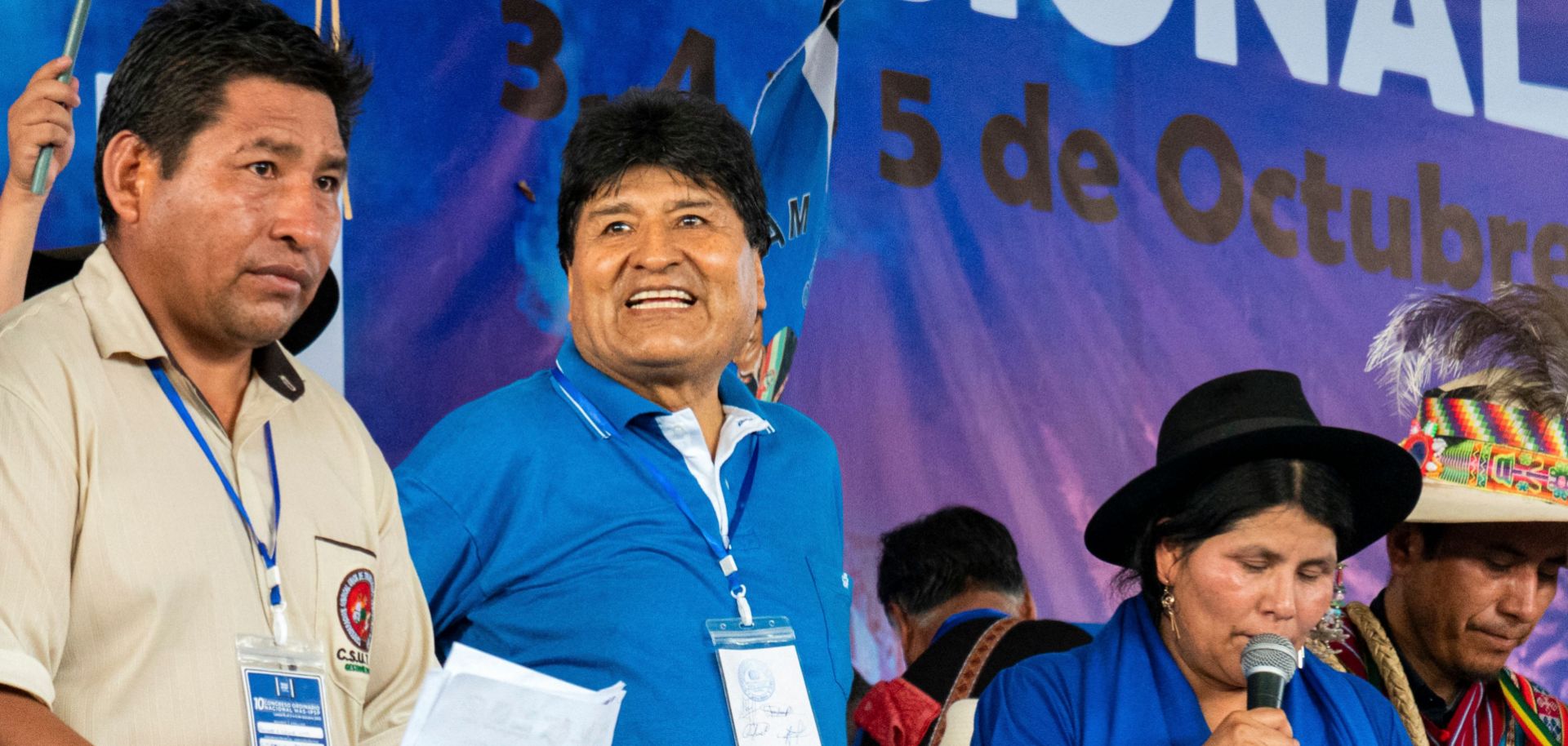
In Bolivia, the reversal of the ruling party's selection of a new leader will prolong a political dispute that creates economic instability, fuel shortages, violent unrest, logistical disruptions and policy uncertainty for businesses over the next two years. On May 23, Bolivia's Supreme Electoral Tribunal (TSE) rejected the registration of union leader Grover Garcia as the ruling left-wing (Movement Towards Socialism) MAS party's new leader over procedural inconsistencies in the party's voting process, including the failure to allow all registered delegates to participate in the vote. The ruling undoes the results of the May 3-5 internal MAS party congress, during which President Luis Arce and his allies pushed former President Evo Morales (2006-2019) out of power in the party. The TSE ruling means that MAS reverts to the leadership elected in 2017, with Morales remaining the party's leader. The decision comes amid infighting within the MAS party as Morales and Arce compete over who will be the party's candidate during the October 2025 presidential and legislative elections.
- Morales is Bolivia's longest-serving president, but resigned during the country's political crisis over alleged fraud during the 2019 presidential election, which led to weeks of protests. Subsequently, Morales received political asylum in Mexico. Congress later annulled the 2019 elections, calling new elections in 2020, during which Arce won the presidency. Morales returned to Bolivia in 2020 and has remained a dominant figure in Bolivian politics.
- Morales and Arce were previously allies, with Arce serving as Morales' Minister of Economy and Public Finance, and with Morales supporting Arce's 2020 presidential bid. However, since 2020, the two have fallen out amid Arce's efforts to distance himself from Morales and establish himself as the MAS party's dominant political figure.
The dispute over the MAS party leadership and who will be the party's 2025 presidential candidate highlights broader political instability brought on by tensions between Morales and Arce. Bolivia has long experienced political instability due to disputes between the MAS party and opposition right-wing parties. However, the current bout of political tumult is the result of infighting within MAS over whether Arce or Morales should be the party's presidential candidate in 2025, which has fractured President Arce's support in both chambers of Bolivia's legislature. Morales is currently barred from running in the 2025 ballot due to term limits, though this restriction could be overturned by a future Constitutional Court ruling. To secure such a ruling, Morales' supporters want Arce to trigger judicial elections in the hopes of stacking the Constitutional Court with individuals who would let Morales run, but Arce — who himself plans to run for reelection in 2025 — has refused to do so. In early 2024, this dispute led Morales to label Arce a ''traitor'' of the MAS party and call on his supporters to launch mass protests throughout the country, which blocked roads for weeks in January and February and included violent clashes with security forces that left three people dead and dozens injured. In addition, Morales' supporters in the legislature have defected, undermining Arce's ability to pass legislation. In recent months, this internal fracturing has impeded the government's ability to respond to Bolivia's foreign reserves crisis, which has been building since before the COVID-19 pandemic but has escalated in the last year amid decreased exports and increased government spending on expensive consumer subsidies. Recently, Arce put forward a package of foreign loans intended to combat the crisis. But despite his MAS party having a majority in both the lower and upper houses, Arce has been unable to secure legislative approval due to opposition from pro-Morales MAS lawmakers, who have made their support for the loans contingent on Arce agreeing to back Morales' 2025 presidential bid. The ongoing gridlock over the loan package has, in turn, seen Bolivia's foreign reserves continue to dwindle. The crisis has also led to decreased consumer spending, price increases for some foreign goods as importers struggle to acquire foreign currency, and shortages of some products, including fuel.
- In December 2023, the Constitutional Court disqualified Morales from running for re-election in 2025 over a limit on presidents serving more than two terms. Morales' supporters want Arce to trigger judicial elections so the judges (whose mandates legally ended on Dec. 31) can be replaced with individuals who will reverse the ruling and allow Morales to run. Judicial elections are still being organized, with no indication of when they will occur.
- Bolivia's foreign reserves peaked at $13.59 billion in 2014, and dropped below $1 billion in mid-2022. As of December 2023, reserves had fallen to just $166 million. The reserves shortage is the result of expensive government subsidies on fuel and food and decreased exports, including of natural gas, which previously bolstered Bolivia's foreign reserves, amid dwindling production as supplies are depleted.
- Bolivia's economic growth has also slowed in recent years amid a drop in public and private investment. According to the World Bank, the country's real GDP is projected to grow by 1.6% in 2024, down from approximately 2.1% in 2023 and 3.6% in 2022.
- In February 2024, Fitch Ratings downgraded Bolivia's Long-Term Foreign Currency Issuer Default Rating from B- to CCC, placing it further into ''junk'' territory, indicating high risk of a debt default. The Bolivian government has reduced the release of data on the country's foreign reserves, which Fitch Ratings assesses creates further economic uncertainty and indicates that conditions have worsened since the last data release.
The persistence of Arce-Morales political tensions will hinder the government's ability to respond to economic challenges, harming the business environment and triggering anti-government unrest that will pose logistical challenges to businesses, while opening the door to long-term political uncertainty. As the Arce-Morales rift is centered on the October 2025 elections, it is highly unlikely to alleviate in the near term, especially as efforts are ongoing to organize judicial elections that could ultimately make Morales eligible to run. The rift will hinder the passage of legislation, preventing the government from addressing the foreign reserve crisis and leading to further shortages of fuel and other imported supplies, including manufactured goods and food. If the reserve crisis worsens, it will steadily increase the risk of Bolivia defaulting on its debt in the coming years, threatening the country's long-term economic stability. In the near term, this would exacerbate shortages of imported goods like fuel, and though prices for certain essentials may not rise due to government subsidies, available funds for those subsidies are already becoming strained. Such developments would negatively impact Morales or Arce's supporters and thus could lead the political figures to compromise, but there is so far no sign this development is forthcoming. As economic challenges persist, additional protests are certain over the next year and a half in the lead-up to the October 2025 elections. Protests in Bolivia in recent years have repeatedly demonstrated activists' willingness to cause widespread, extended disruptions to daily life and the economy, with some unrest continuing for a month or longer. Additional demonstrations ahead of the 2024 ballot will thus likely create significant logistical challenges for supply chain shipments, disrupting agricultural and mining sector exports in particular. Such disruptions will further hurt Bolivia's investment attractiveness, though this is unlikely to notably affect investments in developing the country's lithium extraction infrastructure due to the importance of Bolivia's lithium reserves to the global technology and clean energy sectors. Furthermore, if the two leaders' rift worsens, Morales or Arce could form a separate party, which would weaken MAS' electoral chances ahead of the 2025 general elections by splitting up the party. The next election does not currently appear likely to yield a significant political shift, as left-wing parties like MAS have long retained a majority of popular support in Bolivia. But this support could deteriorate amid political instability and worsening economic conditions, potentially raising the likelihood that the government changes hands in 2025. In such a scenario, left-wing parties would likely retain legislative control, potentially forming a coalition with the centrist Civic Community party, but a right-wing party could win control of the presidency, creating further legislative gridlock and long-term policy uncertainty.
- Bolivia is part of the ''Lithium Triangle'' alongside neighboring Chile and Argentina, together accounting for 60% of global lithium reserves. The Bolivian government estimates the country has 21 million tons of lithium, the largest in the world. Bolivia has lagged behind other lithium reserve countries in production, with facilities operating below capacity amid electricity and water shortages.
- Protests in support of Morales and in opposition to economic challenges in the first months of 2024 have regularly included roadblocks, with protesters blocking major highways from Santa Cruz, the country's largest city and commercial capital, to other parts of Bolivia and border-crossings with Peru and Chile. The blockages delayed shipments of soy products and other foods, as well as shipments of precious metals like gold and zinc to ports in Chile and Peru for export internationally. The weeks of protests in January and February 2024 cost Bolivia's economy at least $600 million.
