
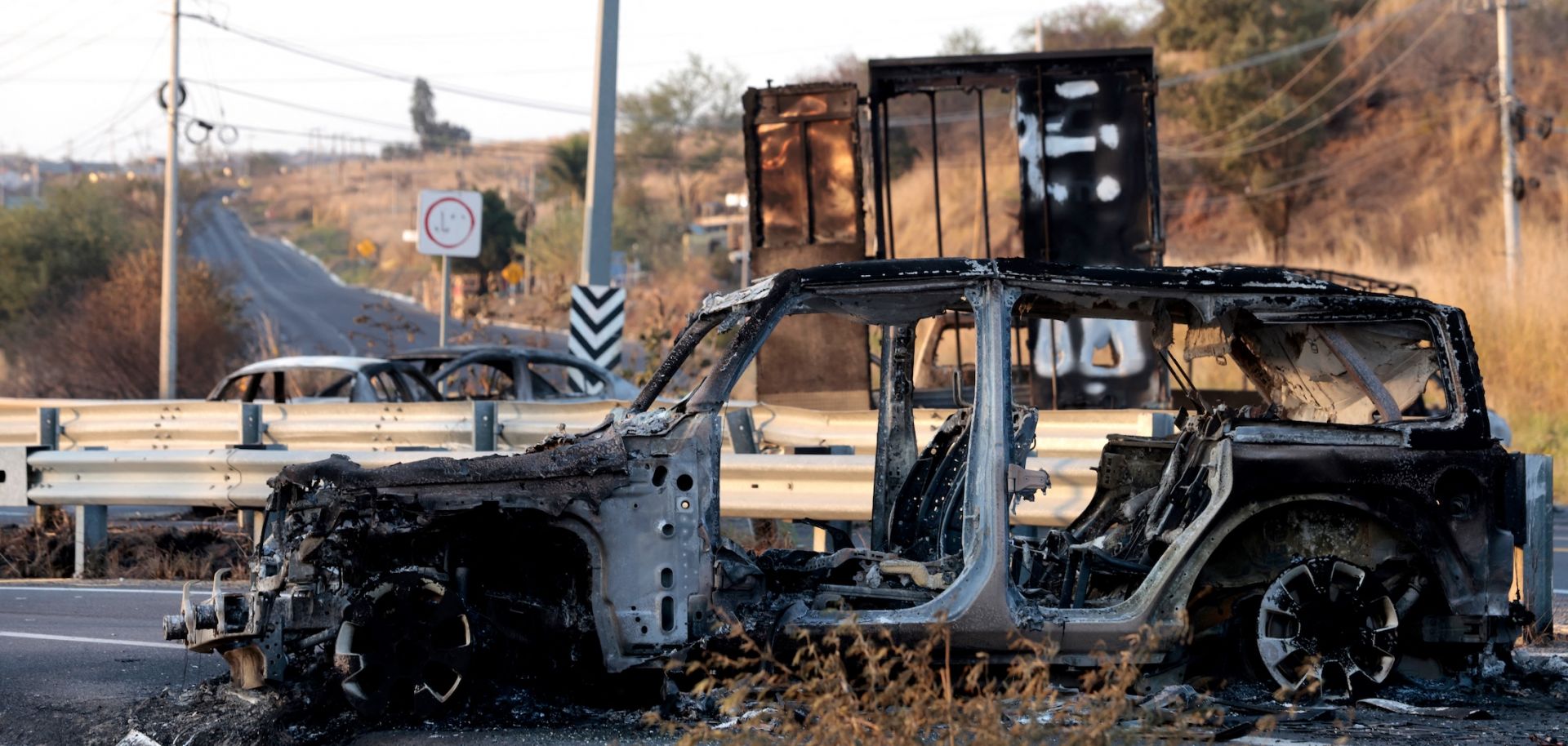
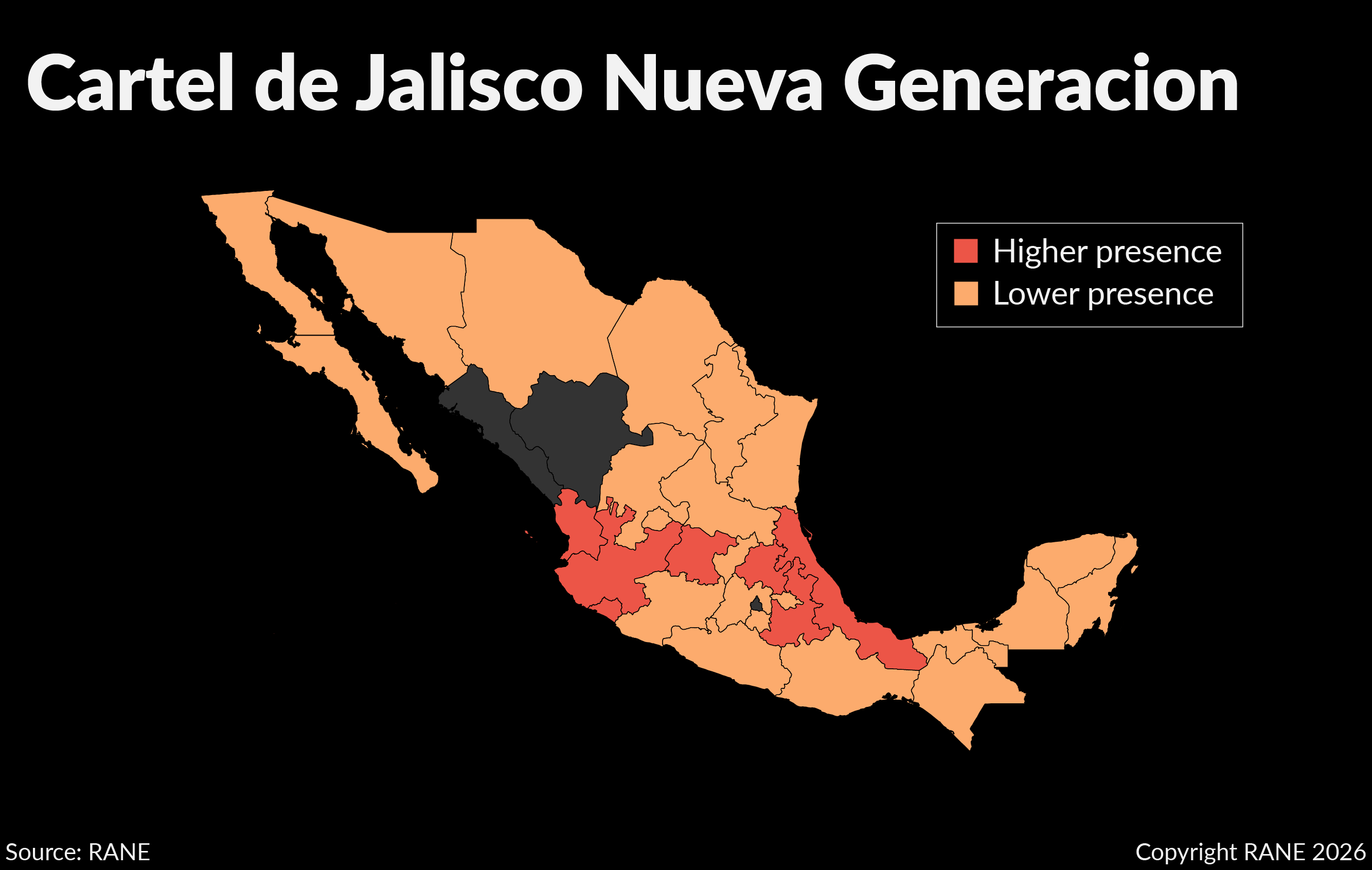
The Mexican operation that killed a major cartel leader will improve U.S.-Mexico relations in the short to medium term, but the likely surge in cartel violence will increase pressure for U.S. military action in Mexico, while obstacles for businesses will likely hurt the Mexican economy. On Feb. 22, a Mexican military operation, backed by U.S. intelligence, killed Nemesio Oseguera "El Mencho," the top leader of the Jalisco New Generation Cartel (CJNG). He was critically injured during a shootout with security forces and died in authorities' custody. Mexican special forces conducted the operation in the Jalisco town of Tapalpa, approximately 75 miles south of the state capital Guadalajara. Following the operation, CJNG members carried out a widespread wave of retaliatory attacks throughout Jalisco and the neighboring states of Colima, Guanajuato, Michoacan, Nayarit and Zacatecas, as well as other parts of the country with a strong CJNG presence, including the states of Baja California, Queretaro, Nuevo Leon and Tamaulipas. Attacks, which killed at least 25 National Guard troops, included arson against vehicles and businesses, shootings, clashes with security forces and the imposition of over 250 narcoblockades, in which cartel members set up barriers to disrupt traffic on major roads and highways.
- The military operation killed four other members of CJNG during the raid, and another two died while being transferred to Mexico City; authorities arrested two additional members and seized armored vehicles, rocket launchers and other weapons. Retaliatory violence is common in Mexico following military operations against cartels and particularly operations that apprehend or kill criminal groups' leaders.
- The U.S. State Department warned U.S. citizens in Jalisco, Tamaulipas, Michoacan, Guerrero and Nuevo Leon to shelter in place amid security operations; the attacks included severe violence in Puerto Vallarta, a port city and tourist destination in Jalisco, where flights were canceled.
- Following the operation, U.S. Ambassador to Mexico Ronald Johnson noted that bilateral security cooperation has reached unprecedented levels. According to media reports, the operation against "El Mencho" used intelligence provided by a newly created U.S. military task force focusing on drug cartels.
- Oseguera was one of the founders of CJNG in 2009 and one of Mexico's most wanted criminal leaders. Under Oseguera's leadership, CJNG became the country's most violent and geographically expansive cartel, with a presence in almost every Mexican state. In February 2025, the administration of U.S. President Donald Trump designated CJNG a Foreign Terrorist Organization (FTO).
The military operation occurred amid a broader realignment of Mexico's security strategy under President Claudia Sheinbaum, who has adopted a more confrontational, intelligence-led approach to fighting cartels amid increased U.S. pressure. Since taking office in October 2024, Sheinbaum has shifted away from her predecessor Andres Manuel Lopez Obrador's "hugs, not bullets" approach, which largely avoided proactive operations to directly confront cartels. Her administration has instead prioritized an intelligence-focused approach to carrying out operations targeting cartels' main leaders and operators, strengthening national security forces and increasing collaboration with the United States. This shift has come as the White House has put significant pressure on Mexico to tackle cartels, given their role in drug trafficking and illegal migration to the United States. Trump has threatened to conduct U.S. military action on Mexican territory, which Sheinbaum has repeatedly pushed back against. Instead, her government has increased operations targeting drug labs and extradited dozens of cartel members to the United States.
- Mexican Secretary of Security Omar Harfuch has created a subsecretary of intelligence and investigation within the security minister, launched a hub to share security intelligence between the Army, the Navy and civilian police, and carried out direct interventions in state police forces, especially in areas with intense cartel presence, such as Guanajuato, Guerrero and Sinaloa states. The operation against CJNG will further strengthen Harfuch's position, enabling him to further consolidate power and become a major player in Mexican politics over the coming years.
The killing of "El Mencho" will likely boost Sheinbaum's domestic political standing and improve her government's relations with the United States, but over time, the likely surge in cartel violence will pose significant operational and security risks for companies, risking some level of harm to the Mexican economy, while also leading the White House to resume pressure for U.S. military action in Mexico later this year. Despite the retaliatory violence, the success in killing one of the top cartel leaders in the country will likely help Sheinbaum sustain high approval ratings in the near term, given that the operation illustrates her government's efforts to fight cartels, one of Mexicans' main concerns. The operation will also improve U.S.-Mexico relations, not only because it shows Mexico's concrete efforts to fight cartels, in line with the Trump administration's priorities, but also because it showcases room for bilateral cooperation without requiring the presence of U.S. troops in Mexican territory, a development the Sheinbaum administration has sought to avoid. In the coming weeks and months, that will likely help Mexican authorities currently engaged in trade discussions with the U.S. government, including around tariffs and the review of the U.S.-Mexico-Canada Agreement (USMCA). But as the year continues, a likely escalation of violence and destabilization of Mexico's security environment — especially if there is a fracture within CJNG — will increase the potential for incidents involving U.S. citizens or companies in Mexico. Heightened insecurity and recurring retaliatory attacks are also likely to disrupt logistics and expose firms to increased cargo theft and security risks, reducing industrial and commercial activity and denting the Mexican economy. Such developments would likely lead the Trump administration to step up pressure and eventually secure concessions from the Mexican government to conduct targeted aerial strikes or special forces operations in Mexico to assist Mexican security-led operations and broader efforts against cartels by year-end.
- A February poll showed that 77% of Mexicans approved of the Sheinbaum administration.
- The United States is conducting bilateral talks with Mexico and Canada on the USMCA, whose review must be completed by July 1. Even if the White House decides to withdraw from the trade pact and seal deals with Mexico and Canada separately, the strong momentum in U.S.-Mexico ties (especially compared with sour U.S.-Canada relations) will likely see Mexico retain preferential access to the U.S. market.
- In 2025, the Mexican economy grew 0.6% compared to 2024, marking the fourth consecutive annual slowdown, which is the longest since at least the 1980s. Despite retaining privileged access to the U.S. market due to USMCA, Mexico has struggled to attract investment amid a large budget deficit, trade uncertainty due to U.S. protectionism and a constitutional overhaul that curbs rule of law.
