
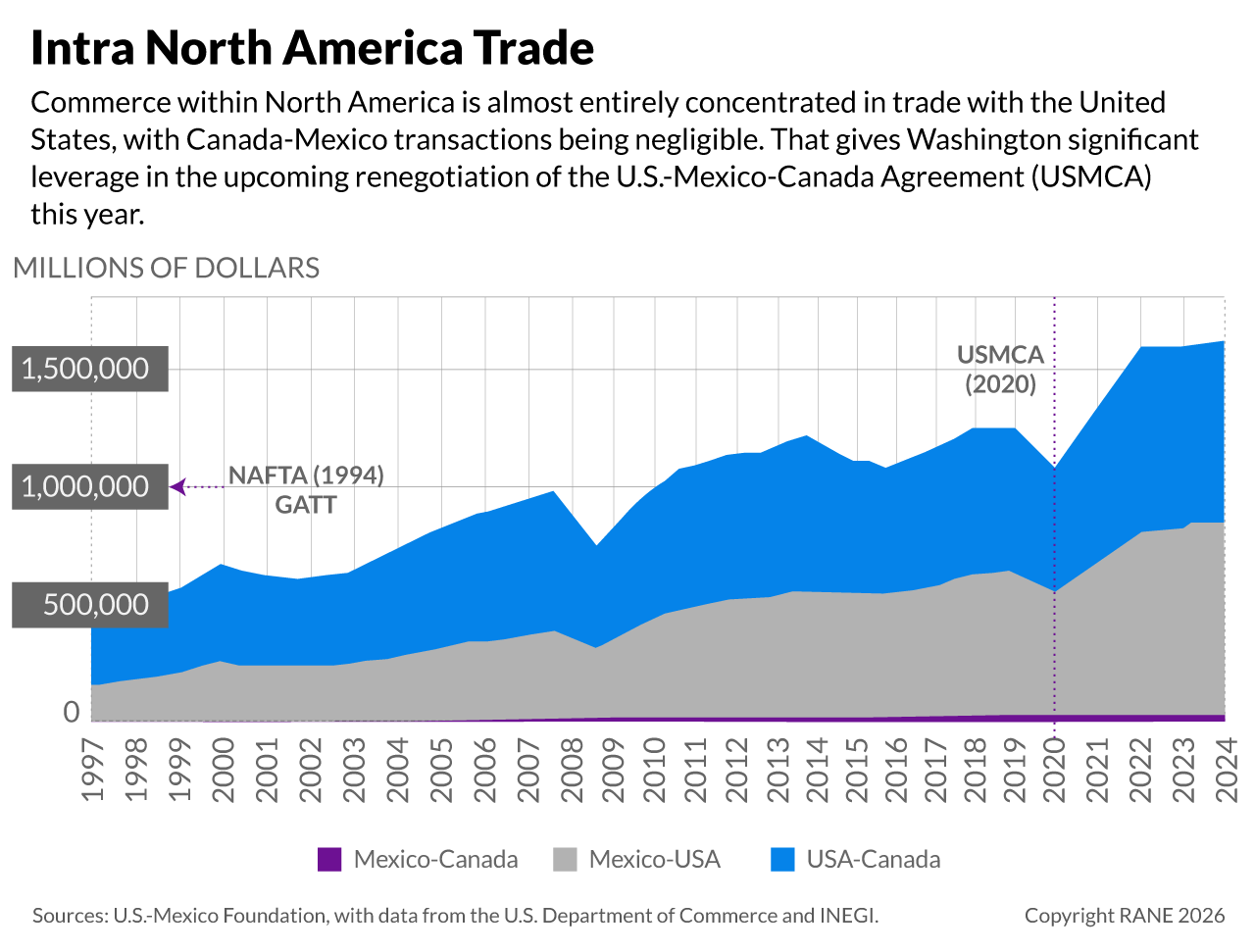
After complex negotiations, the U.S.-Mexico-Canada Agreement (USMCA) is likely to be extended with stricter rules of origin and higher labor requirements that will make North American supply chains less competitive, but Canada and Mexico will maintain a competitive edge that will help drive investments in the long term, should they retain preferential access to the U.S. market. Washington, Mexico City and Ottawa must decide by July 1, 2026, whether to extend the USMCA for a 16-year term or enter into yearly reviews over the next 10 years (the so-called sunset mechanism). The USMCA was signed on Nov. 30, 2018, after more than a year of negotiations during U.S. President Donald Trump's first term. It entered into force on July 1, 2020. The agreement's primary goal was to modernize trade rules and address long-standing grievances, especially around labor rules, digital trade and intellectual property. It replaced the 1994 North American Free Trade Agreement, which pioneered a trilaterally integrated market but eventually faced criticism for failing to account for digital advancements and U.S. manufacturing job losses. Over the past 30 years, supply chains have become increasingly integrated across the region, especially those in the automotive, aerospace and electronics manufacturing sectors, with intra-regional trade reaching $1.6 trillion in 2024.
- Commerce with Canada and Mexico accounted for one-third of all U.S. goods traded in 2024, while the U.S. market accounted for 76% of all Canadian exports and 81% of Mexican goods sold to other countries in 2024.
- The agreement governs a market of over 500 million people, representing roughly 30% of global GDP.
The United States will likely threaten to scrap the USMCA or replace it with bilateral deals as a negotiating tactic, stoking business uncertainty and market volatility. The long-term economic, social and political implications of the renegotiation outcome will add complexity to discussions, as the three governments will likely struggle to appease the interests of the private sector and civil society. Disagreements could trigger occasional demonstrations, especially in Canada and Mexico, whose economies are highly exposed to trade with the United States. Against that backdrop, the White House will likely threaten to abandon the treaty or replace it with bilateral agreements. Such negotiation tactics to obtain concessions from Canada and Mexico will fuel market volatility and business uncertainty, which could postpone investment decisions until the second half of the year. Should Washington actually trigger the process to leave the pact, business uncertainty would increase and last longer, further postponing investments. The contentious nature of negotiations will likely delay an agreement until the deadline nears, if negotiators are able to reach a settlement at all. In the event that renewal talks fail and the USMCA instead enters into yearly reviews, market sentiment would significantly sour, leading to stronger stock price declines, downward economic projection revisions for the coming years and eventually negative outlooks for sovereign ratings in all three countries, as the prospects of less integrated supply chains would reduce potential growth, particularly in Mexico and Canada and, to a much lesser extent, the United States. However, the annual reviews mean the three countries would likely reach an agreement that guarantees the survival of the USMCA at some point over the coming decade, even if this does not happen by the end of Trump's term in 2029.
Canada and Mexico will most likely make concessions to the United States to secure USMCA renewal, but stricter rules are likely to make North American supply chains less efficient, while pending controversial issues will likely trigger panel disputes. Highly integrated supply chains, economic interdependence and private sector pressure will likely lead the Trump administration to favor USMCA extension. Still, the United States will use its significant economic leverage over Canada and Mexico to extract concessions during negotiations. Ottawa and Mexico City are likely to push back against provisions overly favorable to the United States, but are likely to agree to Washington's broader demands and diluted versions of key provisions. The renegotiation will almost certainly result in the implementation of stricter provisions regarding core-parts lists, labor-value content, higher working standards and more stringent rules of origin, especially impacting the auto, steel, aluminum and electronics sectors. Furthermore, Washington is likely to impose tariffs on certain imports exceeding quota levels. These changes will reduce the competitiveness of North American supply chains compared with current conditions and contribute to higher inflation in the United States. Moreover, even if the USMCA renewal addresses major issues, unresolved U.S. concerns are likely to persist, meaning Washington will almost certainly formally invoke a Chapter 31 dispute panel. Such a development would be particularly likely regarding an ongoing trade dispute over Mexico's energy policy.
- A 2022 USMCA dispute process over Mexico's 2021 Electric Power Industry Law, which favored state-owned utility company CFE, was largely halted when the Mexican Supreme Court ruled in January 2024 that parts of the bill were unconstitutional.
- Mexico's 2024 constitutional reforms, effectively giving CFE grid dispatch precedence, occurred too late for the Biden administration to trigger a new consultation. So far, the Trump administration has prioritized tariffs over USMCA enforcement on this issue.
- Bipartisan congressional pressure around the issue is rising. The November 2024 Mexican Energy Trade Enforcement Act aims to force the Trump administration to request a dispute panel over CFE and state-owned oil company Pemex favoritism during the USMCA joint review. While passage is unlikely without White House support, the bill comes as the U.S. trade representative prepares to submit negotiating priorities by early January 2026.
The main changes to the agreement will be concentrated on the auto sector, likely including stricter rules of origin, the reversal of the "roll-up" mechanism and new criteria for electric vehicles. The revamped USMCA will result in significant regulatory changes to the auto sector, given its economic importance to the U.S. economy and, most importantly, its political importance to the Trump administration. The United States will push for stricter enforcement and a textual amendment to overturn a 2025 dispute panel ruling in order to explicitly restrict the roll-up mechanism to core parts. This move aims to limit the amount of foreign content within North America's free trade zone, which will likely make it harder for manufacturers, particularly in the auto sector, to meet regional content thresholds for duty-free or lower tariff access to the U.S. market. This outcome aligns with the Trump administration's goal of incentivizing the reshoring of high-value component manufacturing within the country. Furthermore, the USMCA renegotiation will likely reach consensus on new rules for EVs, reflecting the rapid shift toward electrification since the deal's 2020 implementation. These new EV-focused rules of origin provisions are also likely to mandate higher North American content for critical components such as batteries and magnets.
- A 2025 panel ruling determined that an auto part that already meets the regional value content rules should be treated as 100% North American content when used in making a final product, such as a finished vehicle, even if it contains non-originating materials. This methodology simplifies calculations by "rolling up" the qualified parts' value, preventing the need to track all non-originating components.
Mexico's protectionist policies and the Trump administration's calls for increased energy exports will make the energy sector a priority of USMCA renegotiations. If the renegotiation remains trilateral and does not fragment into bilateral talks, the United States and Canada will likely present a unified approach vis-a-vis Mexico's energy policies and challenge the interventionist changes introduced by Mexico's 2024 energy reform. Mexico's pursuit of energy sovereignty will continue to collide with Washington's and Ottawa's demands for fair market access for foreign companies. The main points of contention are likely to include Mexico's classification of its state-owned enterprises as "public enterprises," which gave Pemex and CFE social responsibilities that could conflict with the USMCA Chapter 22's requirement that these companies operate on "commercial considerations." Furthermore, a broader pattern of constitutional changes implemented by President Claudia Sheinbaum's administration has weakened oversight bodies, including in the energy sector. This erosion of impartiality raises concerns about potential conflicts of interest, as a government body, rather than an independent regulator, would ultimately rule on disputes between private sector entities and state-owned enterprises or even the government itself, potentially violating the USMCA's Chapter 28 on good regulatory practices. Additionally, the 2024 reform itself may be a violation of the USMCA's Chapter 14 on investments, particularly the "ratchet clause," which prohibits a country from closing sectors to private participation after previously opening them to foreign investment and trade. While the Mexican government will not reverse its constitutional reforms, it is likely to agree to some regulatory amendments or to pay compensation to foreign companies in the energy sector in order to keep its energy sovereignty approach to policymaking. Moreover, amid these growing disagreements in the energy sector, the United States and Canada have initiated dispute consultations against Mexico, but they claim the Mexican government has delayed these proceedings, hindering dispute resolution. In response, Washington and Ottawa could push to reform the dispute settlement process, potentially by introducing a "snap-back" or other enforcement mechanism that would allow complaining countries to impose tariffs or other retaliatory measures if a dispute is unduly postponed. Mexican regulatory shifts have also created obstacles to cross-border power flows. Consequently, the United States will press Mexico City for greater clarity and nondiscriminatory treatment regarding power flows and grid connections.
- Mexico's 2024 energy reform reversed the 2013 pro-market reform and increased the Mexican government's influence over the sector, further allowing it to manage and regulate electricity production, transmission and commercialization, while giving state-owned enterprises, such as Pemex and CFE, priority over private players.
- The reform also resulted in Mexico's energy ministry absorbing independent regulators like the Energy Regulatory Commission and National Hydrocarbons Commission.
- Mexico's regulatory barriers to power flows with the United States include ambiguous or discretionary grid access rules that impede private generators from securing interconnection rights needed to sell electricity across the border, as well as lengthy permitting delays or outright denials for private generation projects, especially those connected to export-oriented industrial hubs.
- Electricity trade between the United States and Mexico is small but has grown since 2013, with Mexico exporting more to the United States.
Washington will also seek to outline clear rules and implement mechanisms to prevent the circumvention and transshipment of Chinese goods to North America. As the United States grows increasingly concerned about Chinese companies using Mexico to bypass tariffs and access the U.S. market, Washington will push Canada and Mexico to also implement rules to curb commerce with China and limit Chinese goods and inputs in North America. Mexico has anticipated such pressure and already imposed a series of tariffs on Chinese goods over the past year. More initiatives could come into force in close coordination with the Trump administration, most likely targeting Chinese electric vehicles, steel and manufacturing inputs. However, Mexico City's and Ottawa's tariffs on Chinese goods and export controls to China are unlikely to be as strict as those Washington has implemented (and may yet implement) in an attempt to avoid a harsh reaction from Beijing, which would include trade investigations, export controls or retaliatory tariffs. There will likely be restrictions on investments from state-owned enterprises from countries officially designated as “non-market economies,” which would aim to target entities from China. Such a provision would curb Chinese state-owned companies' ability to enjoy USMCA trade preferences or invest in critical infrastructure, technology assets or companies in the region. Such restrictions will also likely cover strategic sectors, such as autos, metals and electronics. In that regard, the White House will aim for rules aligned with existing U.S. policies, especially the Inflation Reduction Act, which excludes critical minerals and battery components sourced from non-market economies, aiming to shield North America from Chinese components. Bureaucratic changes that are likely to be implemented across Canada, Mexico and the United States include reporting requirements and customs enforcement, increased data sharing and joint inspection protocols. Even though North American countries may also increase scrutiny of Chinese investments in strategic sectors, Chinese companies will likely legally pursue greenfield projects to embed themselves in North America, a strategy the USMCA would struggle to block without raising questions about violations of international law.
- In September 2024, the Sheinbaum administration proposed imposing tariffs of up to 50% on more than 1,400 items from countries with which Mexico does not have a trade agreement, targeting especially China, though Mexico's Congress negotiated a dilution of some provisions. The average final tariffs on the list ranged between 30% and 35%, depending on the sector, and came into effect on Jan. 1, 2026.
- In December 2024, the Mexican government announced a temporary tariff increase from 25% to 35% on 138 textile intermediate goods to prevent importers from unduly benefiting from tariff reductions for input imports and ultimately selling finalized goods at a lower price than those manufactured in Mexico.
- These measures followed a broader Mexican government crackdown on the commercialization of Chinese-manufactured goods that have illegally entered the country, including the seizure of 90,000 items from large distribution centers of goods produced in China.
A revamped pact is also likely to see the expansion of the Rapid Response Labor Mechanism beyond manufacturing and higher working condition requirements, likely increasing labor costs and reducing Mexico's competitiveness. The Rapid Response Labor Mechanism is a labor dispute-settling tool that currently focuses on the manufacturing sector, and USMCA negotiations will likely include language expanding the mechanism to cover issues involving the agricultural and services sectors. The ultimate goal will be to enforce better working conditions so operations in Mexico are more aligned with those in the rest of North America and so existing labor practices do not translate into an undue advantage for companies. Washington and Ottawa, pressured by local unions, will push Mexico City to improve workers' rights, increase pay and ensure the minimum wage keeps up with inflation. Such discussions are likely to be successful because Sheinbaum's government favors pro-worker laws. However, these regulatory changes will make labor more expensive and undermine Mexico's strategic advantages vis-a-vis the United States and Canada, reducing its competitiveness within North American supply chains compared with current conditions. Even then, labor costs in Mexico would remain cheaper than in the rest of North America.
- While the Rapid Response Labor Mechanism covers some service and agricultural activities, it is focused on addressing disputes in "priority sectors" that either trade across borders or compete in the domestic market, such as manufacturing, automotive and aerospace parts, electronics and electrical equipment, steel, aluminum and mining.
- With nearly 40 cases initiated and at least 21 solved since 2021, the Rapid Response Labor Mechanism has been the most active enforcement tool of the USMCA.
- The Rapid Response Labor Mechanism is an enforcement tool designed to protect workers' rights to freedom of association and collective bargaining. It typically reaches a resolution within months rather than the years traditional trade dispute settlements can take.
The renegotiation will also update rules around rapidly evolving technologies that have grown obsolete in recent years, especially cybersecurity. The United States, Canada and Mexico are highly likely to quickly reach consensus on less contentious changes to the agreement, especially regarding rules around digital trade, which have grown outdated amid the rapid evolution of artificial intelligence and cybersecurity threats. While changes to rules on AI governance, responsible development and data use will be unlikely given the Trump administration's deregulatory approach to technology matters, the three countries are likely to coordinate on cybersecurity requirements. Moreover, Washington will likely leverage these discussions to seek a permanent repeal of unilateral digital services taxes, which the Trump administration says are highly detrimental to U.S. Big Tech companies. While the Canadian and Mexican governments are likely to avoid pursuing digital services taxes, subnational leaders — particularly in Quebec — could approve legislation that creates friction and undermines USMCA talks.
- In June 2025, Canada rescinded its digital services tax proposal that would have imposed a 3% tax on Big Tech companies after the Trump administration threatened to suspend all bilateral trade talks. On July 10, the Trump administration announced that tariffs on goods from Canada that did not comply with the USMCA would increase from 25% to 35% effective Aug. 1.
Although a revamped USMCA will make North American supply chains less competitive, Canada and Mexico will retain preferential access to the U.S. market, giving them a strategic advantage over other countries, likely mitigating uncertainty and boosting investment and economic activity in the region. The likely extension of the trade pact would avoid triggering the "sunset mechanism," reducing the imminent uncertainty that prevailed among businesses and investors in 2025. That is likely to boost business sentiment and allow investors to carry out long-term investment plans in a more predictable environment, resulting in increased domestic and foreign direct investment in the region and avoiding negative revisions of economic indicators, such as GDP growth and job generation, that the lack of an agreement would entail. Against the backdrop of the Trump administration's protectionist trade policies, the USMCA's renewal would allow Mexico and Canada to retain preferential access to the U.S. market, even if low tariffs are imposed, enabling them to maintain an important competitive advantage vis-a-vis other countries that have been used as manufacturing hubs over the past decades, such as Indonesia, Malaysia, the Philippines, Thailand and Vietnam. Such a strategic edge would likely offset the inefficiencies a revamped USMCA would bring compared with existing conditions (because of stricter rules of origin and higher labor requirements), mitigate business concerns with the Mexican government's interventionist policies (from the energy reform to the "Plan Mexico" industrial policy) and a deteriorated rule of law (particularly because of Mexico's broader constitutional reforms and the judicial elections). Therefore, the USMCA's extension would increase nearshoring opportunities amid the maintenance of integrated supply chains across North America's various economic sectors, even with new restrictive rules in place. Lastly, a successful renegotiation of the USMCA would likely help progress talks around pending trade issues between Washington and Ottawa and, especially, Mexico City, given the relationship between the Trump and Sheinbaum administrations has been smoother and more pragmatic. A potential trade deal in which Mexico retains lower non-USMCA tariffs than the ones other countries face, or that reduces existing duties on steel, aluminum, vehicles, auto parts and other goods would also help it maintain its attractiveness as a manufacturing hub in North America since despite increased labor costs and obstacles to supply chains, its workforce would still be cheaper than that from the United States and Canada and preferential access to the U.S. market would give it an edge compared with emerging country competitors. Reduced uncertainty would further drive long-term investment and economic growth. Nevertheless, given the Trump administration's erratic policymaking style, Canada and Mexico will seek to reduce their reliance on the United States by diversifying trade with other countries, which is likely to only marginally limit their dependence on the U.S. market in the medium term, given the high share of their exports that currently go to the United States.
- In January 2025, the Mexican government announced the six-year "Plan Mexico," aimed at boosting output, investment and the labor market on the back of public and private investments in order to mitigate uncertainty caused by Trump's erratic and protectionist trade policies. The initiative combines reducing red tape, improving energy and transport infrastructure, and using public procurement to boost demand for domestic goods while increasing available income to expand the domestic market.
- Mexico's industrial policy prioritizes the automotive, pharmaceutical, textile, oil and gas, and aluminum and steel sectors.
