
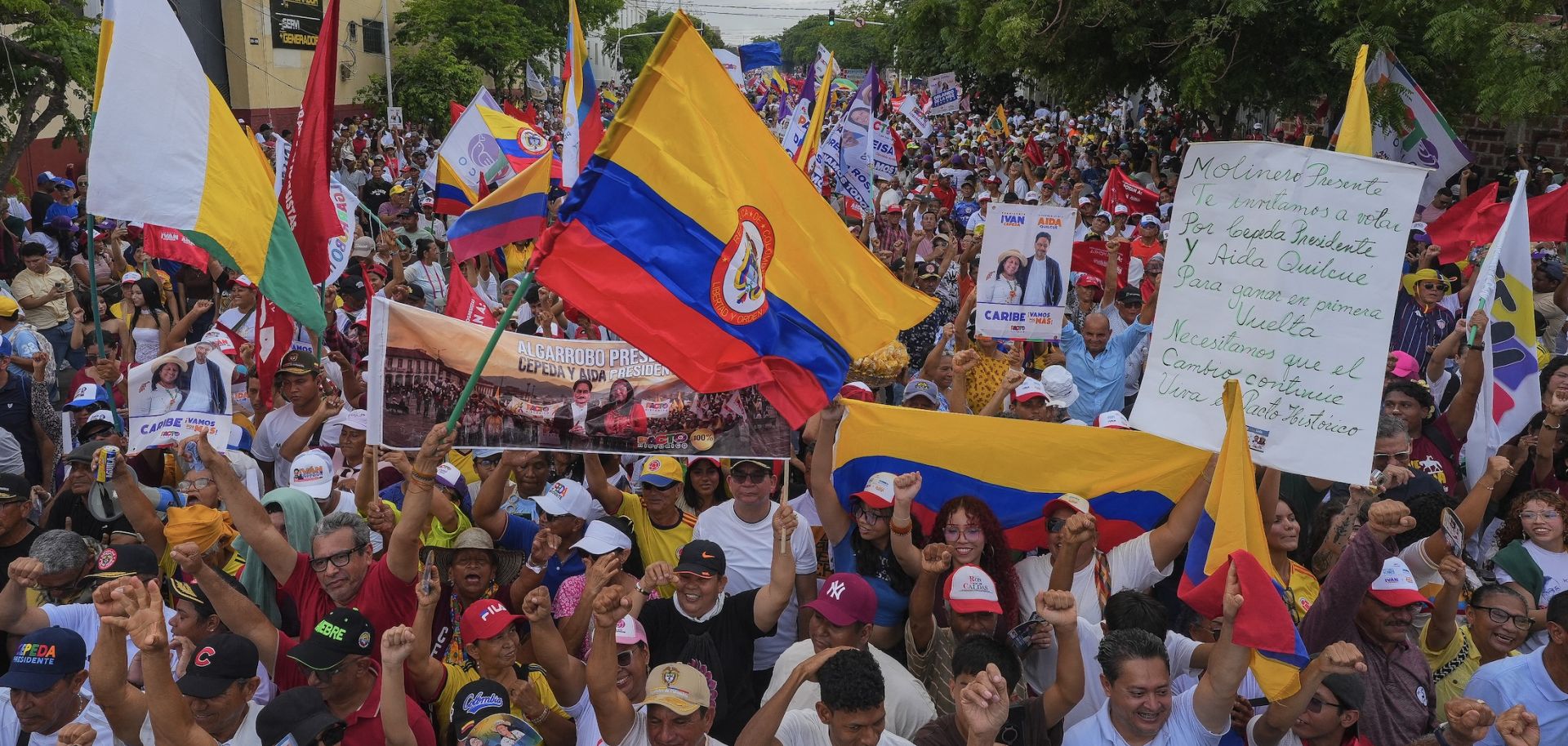
Editor's Note: For geopolitically significant elections, RANE publishes detailed scenario analyses that outline potential outcomes of the vote and their various domestic and international implications. Our previous scenario analyses have covered elections in Germany, Canada, Australia, Poland, South Korea, Japan (twice), Guyana, Norway, Moldova, the Netherlands, Chile, Bangladesh, Denmark and Peru.
Colombia will hold the first round of its presidential election on May 31, with a runoff on June 21 if no candidate receives more than 50% of the vote. The winner takes office on Aug. 7. On March 8, voters elected a new bicameral Congress, which resulted in a fragmented legislature in which the leftist Historic Pact won the most seats in both chambers (25 of 103 seats in the Senate and 42 of the 183 seats in the House of Representatives), while the center-right Democratic Centre came in second. President Gustavo Petro is constitutionally barred from re-election. The next president will inherit a polarized society, a declining fiscal position, a deteriorating security environment and growing coca cultivation and cocaine production. From an international perspective, Colombia-U.S. relations have been fraught, while Bogota signed a Belt and Road Initiative cooperation agreement with China in 2025.

If left-wing Senator Ivan Cepeda (of the Pacto Historico party) wins, he will expand Petro's agenda with higher social spending, talks with armed groups, land redistribution and higher taxes, though limited congressional support will moderate his plans. If right-wing businessman Abelardo de la Espriella (of the Defenders of the Homeland movement) is elected, he will pursue fiscal austerity, deregulation and a militarized security strategy aligned with the United States, likely governing by decree amid institutional conflict and instability. If moderate Senator Paloma Valencia (of the Democratic Centre party) becomes president, she will likely build a centrist coalition to cut corporate taxes, limit social spending and strengthen market-friendly and U.S.-backed security policies.

Scenario #1: Left-Wing Candidate Ivan Cepeda Wins the Presidency
A Cepeda administration would deepen much of Petro's agenda, adopting an interventionist approach to macroeconomic policy while operating mostly within institutional boundaries rather than clashing with oversight bodies and the judiciary, limiting institutional friction and political instability. His administration would focus on implementing the 2016 peace agreement with armed groups, expanding social programs under a lax fiscal policy and seeking to influence central bank decisions without formally breaching its independence. Cepeda would maintain restrictions on new oil exploration and tighten environmental and community requirements on extractives. A mostly center and right-wing Congress would act as an effective check on the administration, diluting or blocking measures openly opposed to business interests and allowing only parts of Cepeda's agenda to advance through tough negotiations. This dynamic would periodically lead to legislative gridlock, reliance on decrees, regulatory uncertainty and subdued business sentiment. Cepeda's proposed reform to further reduce the tax burden on the poor would stall in Congress while social spending rises, meaning fiscal deficits would persist, sovereign ratings would face further downgrades, financing costs would stay elevated and the currency would remain under pressure. Businesses would face elevated tax and compliance costs, energy-transition headwinds, persistent insecurity and a deteriorating fiscal backdrop, but not a rupture with Colombia's institutional or market framework. On security, Cepeda's approach would prioritize prevention and negotiations, sustaining high crime rates and friction with Washington, keeping Colombia outside the U.S. list of certified anti-drug partners and exposing trade-oriented firms to tariff threats.
Implications
- Cepeda governs without a legislative majority, forcing him to make concessions to secure support, which leads to occasional policy paralysis, institutional friction, recurring use of decrees and legal uncertainty throughout his term.
- Cepeda often criticizes the central bank and high interest rates, but does not formally interfere with the institution's independence. His macroeconomic agenda prioritizes increasing taxes on corporations and the wealthy and a prominent state role in the economy, meaning state-owned companies, such as Ecopetrol, are used as policymaking tools. As a result, business sentiment remains subdued and foreign direct investment dwindles.
- Cepeda seeks a reform to increase the tax burden on the wealthy and the private sector, reduce duties on the low-income population and fund social spending. But legislative opposition to measures perceived as detrimental to business interests delays a fiscal reform or enables just minor changes, which significantly limit revenue gains. Fiscal rule constraints and technocratic pushback partially offset policy volatility, but sovereign risk premiums are elevated, financing costs are high and the currency is under pressure, with credit-rating outlooks remaining negative.
- Cepeda maintains restrictions on new exploratory contracts and prioritizes energy transition initiatives, deepening concerns around Colombia's declining reserves and its structural gas supply capacity. This sustains long-term fiscal and external-account risks, given the country's historical reliance on oil and gas for government revenue and exports. But it also creates opportunities in the renewables space, albeit with challenges around permitting and financing.
- Cepeda increases environmental and community requirements, strengthens prior-consultation processes and signals skepticism toward large-scale extraction, particularly of coal, open-pit projects or those in environmentally sensitive areas. This raises compliance costs, prolongs permitting processes and delays greenfield project timelines. Congressional resistance, fiscal dependence on extractive revenues and the mining sector's political influence limit the scope for aggressive resource nationalism. This means that companies encounter increased hurdles, but they do not face insurmountable challenges.
- Cepeda's prevention-oriented, socioeconomic approach avoids militarized crackdowns, which limits short-term gains against extortion, homicide and gang penetration in legal parts of the economy, such as commerce and transport. As a result, businesses — especially those in retail, logistics and urban services — remain exposed to high crime rates, such as extortion and property crime.
- Cepeda revives Petro's failed Total Peace negotiations under stricter conditions, but continues to prioritize deals with armed groups over military confrontation. Isolated ceasefires or partial dismantling of guerrillas temporarily reduce violence levels in some areas while armed groups exploit talks to consolidate elsewhere or take territory from disarmed groups. As a result, firms in the energy, mining and infrastructure sectors or those with operations in rural parts of the country remain exposed to extortion, isolated attacks on assets and indirect safety risks to assets and personnel.
- Existing policies that enabled growing coca production remain in place, as Cepeda focuses on the demand side of drug trafficking, crop-substitution initiatives and resists forced eradication and aerial fumigation. This sustains friction with the United States, leaving export-oriented companies exposed to trafficking-related violence, supply chain infiltration, and reputational and regulatory risks stemming from likely U.S. pushback.
- Reliance on political bargains to secure support in Congress, including for political appointments and the allocation of public funds, strengthens a patronage system prone to corruption. Although oversight institutions remain broadly functional, anti-corruption investigations involving government members are slow, and companies continue to face bribery requests and influence peddling risks when engaging with federal, state and local governments for public contracting or licensing.
- Right-wing opposition and business sectors occasionally mobilize to oppose tax and regulatory measures, leading to localized strikes and demonstrations that periodically disrupt operations in Bogota and other major cities. Cepeda's ties to social movements and unions initially lower the risk of large anti-government protests, but this may change over time if he fails to achieve economic and social reform goals.
- Cepeda's pursuit of an autonomous foreign policy clashes with the United States' effort to exert increased influence in the Western Hemisphere, straining U.S.-Colombia relations, especially around Venezuela and security cooperation to fight drugs. As a result, Colombia likely remains excluded from Washington's list of certified anti-drug partners, which limits funds and bilateral cooperation. The United States also continues to threaten to impose tariffs or launch unilateral anti-drug operations in remote areas of the country, exposing trade-oriented companies to uncertainty and occasional obstacles to selling to the U.S. market.
- Cepeda deepens engagement with China, building on Colombia's accession to Beijing's Belt and Road Initiative by expanding Chinese participation in infrastructure, energy and mobility projects. This expands opportunities for Chinese firms and fuels competition for Western companies in the country, while drawing U.S. pressure that translates into occasional project-level scrutiny, tariff threats and investigations into government policies or officials, fueling uncertainty and undermining trade.
- Cepeda prioritizes alignment with leftist leaders across Latin America, especially those in Mexico, Uruguay and Brazil, while sustaining occasional friction with Ecuador. When engaging with most of the region's right-wing governments, Cepeda maintains a pragmatic approach rather than an overly ideological stance to avoid isolation, thereby limiting direct business disruption. His administration also gradually strengthens relations with Venezuela, aiming to benefit from the country's oil and gas revamping while prioritizing environmental diplomacy on the global stage.
Scenario #2: Far-Right Candidate Abelardo de la Espriella Wins the Presidency
An Espriella government would represent a sharp shift in governing style and security policy relative to recent administrations, though it would largely operate within existing elite structures. Espriella would pursue heavy-handed efforts against guerrilla and criminal groups, harsh austerity and deregulatory measures, and strong alignment with U.S. interests. Very limited support in Congress, with only one deputy and four senators from his Defenders of the Homeland movement, would compel Espriella to largely govern by decree, resulting in frequent clashes with legislators and the judiciary while fueling legal and regulatory uncertainty. He would be able to push his security agenda the fastest because it relies on executive authority. However, advancing his pro-business economic platform — which focuses on deregulation, tax cuts and spending reductions — would prove more difficult. Additionally, court rulings and congressional resistance would constrain the most aggressive components of his pro-business economic platform (including deregulatory measures, tax cuts and spending reductions), leaving the deficit, debt and rating trajectory largely unresolved and souring business sentiment. Espriella would quickly reverse Petro's ban on new extractive contracts, improving the medium-term outlook for mining and the oil and gas sectors, streamlining permitting at the cost of litigation and resistance from local communities and environmentalists. Militarized security and resumed coca crop eradication measures would produce short-term gains alongside human rights concerns and retaliatory violence, but would secure U.S. counternarcotics certification. Alignment with Washington would also deepen while relations with China and Venezuela deteriorate.
Implications
- Due to very limited legislative support, the Espriella administration frequently relies on decrees, which — combined with the often disruptive nature of its security, economic and social policies — leads to court challenges and heightens institutional friction, political instability and regulatory uncertainty. The judiciary and Congress act as active checks, likely diluting some of Espriella's security policies, approving only part of his economic agenda, and blocking broader reforms to the country's institutional framework. Despite firebrand and disruptive rhetoric, Espriella also adheres to existing patronage systems and elite frameworks to secure political support.
- Espriella relies on the credibility of his vice president, former Finance Minister Jose Manuel Restrepo, to advance economic measures that strongly favor business interests via harsh austerity, deregulation and tax cuts. But the lack of legislative support means that many initiatives stall or are briefly reversed, fueling regulatory uncertainty, souring business sentiment and deterring investments.
- Although businesses welcome Espriella's pledges to cut spending and reduce the size of the state, court rulings and legislative pushback limit results, frustrating private sector expectations. Amid the lack of long-term fiscal consolidation, Colombia's fiscal deficit, debt and rating trajectory remain largely unresolved, undermining the business environment.
- Espriella moves to quickly reverse Petro's moratorium on new oil and gas exploration and restarts private upstream investment — something that advances through executive branch decisions and is unlikely to face pushback from Congress, which is dominated by centrist and right-wing lawmakers who favor business interests. This improves the medium-term outlook for the oil and gas sector and attracts moderate investor interest. However, legal uncertainty around decree-based changes, which can be reversed by future governments, partially dampens investors' appetite for large and long-cycle project commitments.
- Espriella also streamlines permitting and limits community- and environmental-related consultations to accelerate extractive projects. These changes similarly draw investor interest but also spark litigation, and occasional community resistance and protests, thereby sustaining legal uncertainty, operational disruption and reputational risks, which leaves businesses cautious.
- Espriella pursues a militarized, mass-incarceration model to fight crime, often resorting to states of exception and a growing use of the military. This approach likely reduces urban crime in certain areas in the short term, improving popular perceptions about safety and business operating conditions. However, human rights concerns also increase, while retaliatory violence from criminal groups poses indirect safety risks to businesses.
- Espriella ends negotiations with militant and criminal groups and launches a harsh military offensive against guerrillas, dissidents and cartels, framing them as terrorists. High-profile operations disrupt groups temporarily but lead to frequent clashes, retaliation against infrastructure and security forces, and occasional incidents targeting civilians or private sector assets, undermining support for Espriella's initiatives in the long term. Firms with extractive operations or a footprint in rural Colombia also face a volatile security environment.
- To reduce coca cultivation areas and cocaine production, Espriella resumes forced eradication and aerial fumigation. He also conducts military strikes on drug trafficking targets, aligning with U.S. priorities. This eases U.S. pressure and allows Colombia to regain its certification as a U.S. ally in counternarcotics efforts. But drug trafficking groups adapt to new regions, likely leading to the forced displacement of civilians and retaliatory violence. As a result, businesses in these areas face operational disruption and indirect safety risks, especially those in the agro-industrial and logistics sectors.
- Despite a strong anti-corruption rhetoric, Espriella appoints loyalists to key positions, eroding oversight efforts and raising compliance risks. The weakening of anti-corruption mechanisms likely results in recurring bribery requests for companies when engaging with the public sector. Reduced institutional checks also make public-sector dealings less transparent, increasing exposure for companies that engage in government contracts, with the Espriella administration often favoring businesses politically or economically connected to the president.
- Espriella's confrontational style, culture war rhetoric and harsh austerity platform fuel recurring protests from unions, students, leftists and rural communities within the first few months of his taking office. The administration likely responds with a heavy-handed security crackdown, raising the risk of clashes with police forces and escalation to violence. Companies near protest hotspots, in turn, face persistent risks of vandalism, operational disruption and higher insurance costs.
- Espriella strongly aligns with U.S. President Donald Trump on security, counternarcotics and ideology. This results in expanded intelligence-sharing, training and operational coordination with the United States, as well as occasional joint military operations to fight guerrillas, drug traffickers and coca plantations. It also enables Colombia to regain full certification as a U.S. counternarcotics ally, securing additional funds and resources for security policies. Strong ties with the Trump administration curb threats of additional tariffs, retaliatory trade investigations or unilateral U.S. military action in Colombia, benefiting export-oriented sectors, such as energy, coffee and gold, while limiting bilateral diplomatic and defense tensions.
- Espriella adopts hostile rhetoric toward China, scrutinizes or blocks Chinese investment in strategic sectors, and signals distance from the Belt and Road framework, likely deprioritizing implementation or withdrawing from the initiative in an escalatory scenario. This raises legal and regulatory risk for Chinese-linked projects and creates openings for U.S., European and other investors, while risking Chinese trade retaliation given China's weight as a Colombian export market, impacting mostly commodity exporters.
- Espriella establishes closer ties with the right-wing governments in El Salvador, Argentina and Chile. He also adopts a confrontational posture toward the left-wing governments in Venezuela and Cuba, echoing U.S. positions. But while this occasionally leads to public spats (particularly with Caracas), Espriella's firebrand rhetoric has limited direct impact on trade and logistics with these countries, posing contained risks for businesses.
Scenario #3: Center-Right Candidate Paloma Valencia Wins the Presidency
A Valencia administration would pursue a market-friendly agenda that combines fiscal consolidation, tax reduction, a smaller state and the resumption of extractive activities with a security strategy reliant on U.S. support to fight guerrillas. She would leverage her established party and alliances with centrist legislators to assemble a center-right bloc that advances significant portions of her agenda while diluting or delaying only the more controversial reforms, reducing overall legal uncertainty and policy-paralysis risks. Valencia would prioritize deregulation, lower corporate taxes and expanded access to credit, while targeting gradual fiscal consolidation through selective spending restraint rather than severe austerity. Such measures would support a gradual recovery in private investment, though tax cuts would limit near-term deficit reduction, a key concern for investors. Still, the prospect of legislative approval would help stabilize credit-rating outlooks and lower financing costs over time. Valencia would reverse Petro's ban on new mining and oil and gas projects with legislative backing that gives the policy more durability than a decree, though the expansion of extractive activities would also fuel occasional environmental and Indigenous mobilization. Valencia's security policies would prioritize recovering territory from guerrilla groups and fostering a U.S.-backed counternarcotics alliance that restores Colombia's certified ally status. However, localized gains against armed groups and organized crime would be incremental, given resource constraints.
Implications
- Valencia builds a coalition in Congress with the center-right and traditional parties, enabling her to secure majorities even amid pushback on specific debates, as leftist lawmakers constantly seek ways to slow or block her agenda. That said, her institutional approach supports a broadly stable environment, which reduces regulatory and political instability risks, and helps improve business sentiment.
- Valencia prioritizes macroeconomic orthodoxy, reduces state intervention, lowers corporate taxes and increases access to credit. This — combined with a stable political environment, regulatory predictability and an independent central bank — improves business sentiment and supports a gradual recovery in private investment.
- The Valencia administration targets gradual fiscal consolidation through selective spending restraint and a smaller state, rather than severe austerity, but corporate tax cuts limit short-term deficit reduction. Still, a sustainable long-term agenda and the prospect of legislative approval help stabilize the country's credit rating outlook, thereby reducing financing costs and supporting broader improvements to the business environment in the long term.
- Valencia reverses Petro's moratorium on oil and gas projects and creates conditions for new exploration activities to begin over time, while also backing green energy alternatives. Legislative support also makes her energy policies more durable than decree-based efforts, easing legal uncertainty and strengthening investor interest.
- In the mining sector, Valencia streamlines permitting, provides fiscal incentives and prioritizes the industry as a driver for economic growth and revenue generation. She favors project timelines over environmental, social and governance (ESG) concerns, which improves Colombia's competitiveness and attracts private sector interest. However, protests from local communities and environmentalists occasionally disrupt operations and cause reputational damage for mining companies.
- Valencia strengthens police, intelligence and specialized anti-crime units and resorts to the armed forces and national police to launch offensives against gangs and extortion rings in Colombia's largest cities. This contributes to localized, gradual reductions in urban crime and marginally improves business operating conditions, but organized criminal organizations' resiliency and pervasive presence in the country limit significant long-term improvements.
- Valencia moves away from open-ended negotiations with criminal and militant groups and deploys public security forces to regain territorial control in some parts of the country, leading to clashes and retaliatory attacks. However, gains are incremental due to the government's limited resources and armed groups' entrenchment and expertise in Colombia's mountainous topography. Business operations in rural areas thus remain exposed to extortion, indirect safety risk and retaliatory violence.
- Valencia heavily relies on U.S. support to jointly expand crop eradication efforts and a militarized confrontation against drug traffickers. While the efforts improve bilateral relations and Colombia regains its certified status of a U.S. ally in the fight against drugs, operations are circumspect in some parts of the country, meaning groups are able to relocate and resist the strategy, continuing to pose risks to companies and civilians' safety and occasionally disrupting agricultural or transport activities in remote parts of the country.
- Patronage mechanisms and pork-barrelling continue to fuel corruption risks, given Valencia's reliance on coalition-building among traditional parties. While oversight bodies remain mostly independent, helping uncover corruption scandals, companies still encounter bribery requests in public contracting and permitting.
- Public spending cuts and stricter security occasionally trigger protests from unions, students and the left, but the Valencia administration does not resort to violent repression, limiting risks of escalation to widespread unrest. The increase in extractive activities triggers periodic protests by environmentalists and/or Indigenous communities, creating some localized disruptions and indirect safety risks for businesses near protest hotspots or around project sites in environmentally or socially sensitive areas.
- Valencia seeks a pragmatic realignment with the United States on security, counternarcotics and trade, including the accession to the Shield of the Americas. This stabilizes the bilateral relationship, increases security cooperation by securing Colombia's certification as a U.S. ally in counternarcotics efforts, and helps preserve stable access to the U.S. market for Colombian exporters.
- Valencia adopts a pragmatic posture toward China, welcoming Chinese investments while prioritizing relations with the United States. Her administration occasionally scrutinizes certain Chinese projects in strategic sectors, but does not impose systematic restrictions on Chinese trade and investment, limiting the risk of major retaliation from Beijing.
- The Valencia administration aligns with center-right and right-wing governments in the region and adopts a firmer stance on Venezuela without seeking confrontation. But it maintains pragmatic trade and security cooperation with governments across the political spectrum, potentially de-escalating tensions with Ecuador. This approach helps preserve regional trade and logistics stability, as ideological friction is unlikely to cause business-disrupting crises.