

Argentina's Oct. 26 midterms will determine whether the government can advance its pro-market reforms or face a sharp decline in governability and investor confidence. A weak result for the government is likely to trigger a significant devaluation of the peso, renewed capital controls and heightened political instability. Argentina will hold legislative elections on Oct. 26 to pick 127 out of the 257 seats in the Chamber of Deputies and 24 of the 72 seats in the Senate. The vote comes two years after libertarian President Javier Milei was elected and at a time when his administration faces significant challenges to pass legislation because of its minority position in the Argentine Congress. The government and its allies in Congress have also struggled to prevent the opposition from passing legislation and overturning a series of presidential vetoes in recent months that restricted funds for provinces, education, healthcare and disaster relief. The pushback comes after Milei significantly reduced public spending during his first two years in office, laying off public servants, cutting subsidies and limiting pension increases. An electoral defeat in the Buenos Aires province in September fueled concerns, especially among investors, that Milei's allies may underperform in the national vote, concerns exacerbated by the government facing corruption scandals and a weakening economy. Market jitters have led to a depreciation of the peso and forced the central bank to sell more than $1 billion from its depleted reserves since Sept. 17 despite an International Monetary Fund (IMF) program and financial support from the United States.
Milei's Liberty Advances (LLA) party has only 38 deputies and six senators, which means it cannot pass legislation on its own or stop opposition moves to block presidential decrees. While some lawmakers from centrist parties helped LLA early in Milei's government, in recent months the government has struggled to find external support in either chamber of Congress.
- In 2024, the Milei administration delivered Argentina's first annual fiscal surplus in 14 years and reduced annual inflation from 211% in December 2023 to 31.8% in September 2025.
- On Sept. 7, the main opposition force, the left-wing Homeland Force (FP), defeated LLA in the legislative elections in the Buenos Aires province, in which 40% of the country's voters live. This led to market volatility, as most opinion polls predicted a much closer result and a better LLA performance.
- On Oct. 20, the United States confirmed a $20 billion currency swap line to support the allied Argentine government. Washington has said it is working with private banks to provide another $20 billion loan, in addition to the $20 billion facility the International Monetary Fund approved in April.
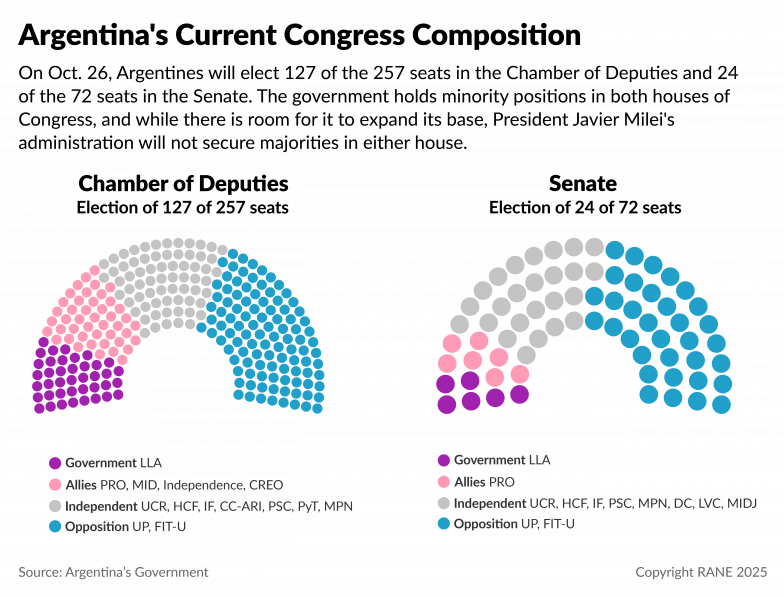
The outcome of the legislative election will determine whether Milei can advance his pro-business reforms or whether he will instead face a sharp decline in market confidence and governability. LLA and its centrist allies have two goals for the legislative election: obtain more votes than FP (which would suggest that Milei has a good chance of re-election in the 2027 presidential election) and control at least one-third of the seats in either chamber of Congress (which would allow the government to prevent the opposition from blocking presidential decrees). Any result short of that level would be perceived as a significant defeat for the government and would drastically reduce its capacity to pass pro-business legislation. In such a scenario, market confidence in the government would fall, curbing foreign investments, economic growth and the government's ability to meet the IMF's reserve accumulation targets. On the contrary, in a scenario in which Milei has a more comfortable margin to secure the support from independent legislators, the government would be able to pass pro-business legislation and limited reforms.
- The government and its allies need at least 86 seats to block opposition efforts to overturn presidential vetoes or progress with impeachment proceedings.
- In contrast, while the government and its allies will not be able to secure a simple majority of 129 seats as only 127 are up for election, a result between 100 and 105 seats would put it in a better position to negotiate legislative proposals, leading to positive market signals.
Argentina will likely undergo a currency devaluation regardless of the outcome of the election, but a government defeat would mean a significant weakening of the peso while a victory would enable a more gradual transition. The peso is at center stage of this election for various reasons. For years, Argentine governments have maintained strict capital controls that aimed to limit dollar outflows and artificially stabilize the exchange rate. Part of Milei's economic platform consists of gradually eliminating capital controls to avoid a sharp currency devaluation that would fuel inflation. The IMF has pressured the government to let the peso float freely, but political concerns around impact on consumer prices and the popular backlash that measure would entail led the government to implement a currency band (a range of upper and lower acceptable exchange rates for the peso to fluctuate between). However, depleted foreign currency reserves mean the Milei administration will not be able to continue interfering in the currency market for long, ensuring that another sharp currency depreciation is highly likely after the election. While the magnitude is uncertain, a weaker peso would make Argentine exports more competitive but would fuel import costs and increase prices domestically. The weaker LLA's performance in the midterm elections, the sharper the peso depreciation will likely be, as indications of a weaker government will lead investors to sell off Argentine assets, accelerating capital outflows while increased demand for dollars will further weaken the peso. The government would likely resort to capital controls, increasing obstacles for companies to repatriate profits, while increasing deposit requirements for banks in an attempt to reduce the amount of pesos circulating in the economy, further increasing borrowing costs. Even if the LLA party performs well in the midterms, the Milei administration still has the incentives to devalue the peso after the election. While a strong electoral performance would help the government retain investor confidence and attract investment and dollars, the peso would still be overvalued, meaning a devaluation would likely still occur, although less severe than in a scenario of electoral defeat.
A better result for LLA in Congress would open the door to additional pro-business reforms but an electoral defeat would virtually kill Milei's libertarian agenda. The government's main priorities in the remainder of Milei's term include additional albeit less severe spending cuts, the privatization of some state-owned companies in the transport, oil and gas and energy sectors and changes to the country's labor and fiscal frameworks to make them more business-friendly. Policy priorities are likely to include further reductions of bureaucracy, capital controls and export taxes as well as measures aimed at boosting agrifood and extractive exports, reducing taxes and simplifying labor relations. A more comfortable presence in Congress would allow the Milei administration to simplify the country's tax system, eliminate some fiscal incentives and reduce taxes on companies and individuals, improving the Argentine business environment. As the government would retain investor confidence, Argentina would attract more significant investments, increasing dollar inflows and reducing the risks of default in the long term. Moreover, changes to labor laws would aim to reduce litigation and dismissal costs, adapt the legal framework to the gig economy and promote formal jobs while deregulating relations between employers and workers. Argentine unions, which have strong mobilization capacity, are likely to resort to occasional demonstrations to force negotiations with the government, likely leading to partial dilutions or even the removal of the most controversial labor proposals. That means that even in a scenario of electoral victory, only some watered-down laws would likely be approved over the next two years instead of comprehensive reforms. If the government and its allies do not perform strongly, the Milei administration would increasingly resort to decrees to govern, but Congress's ability to block them will pose growing obstacles for the administration.
