
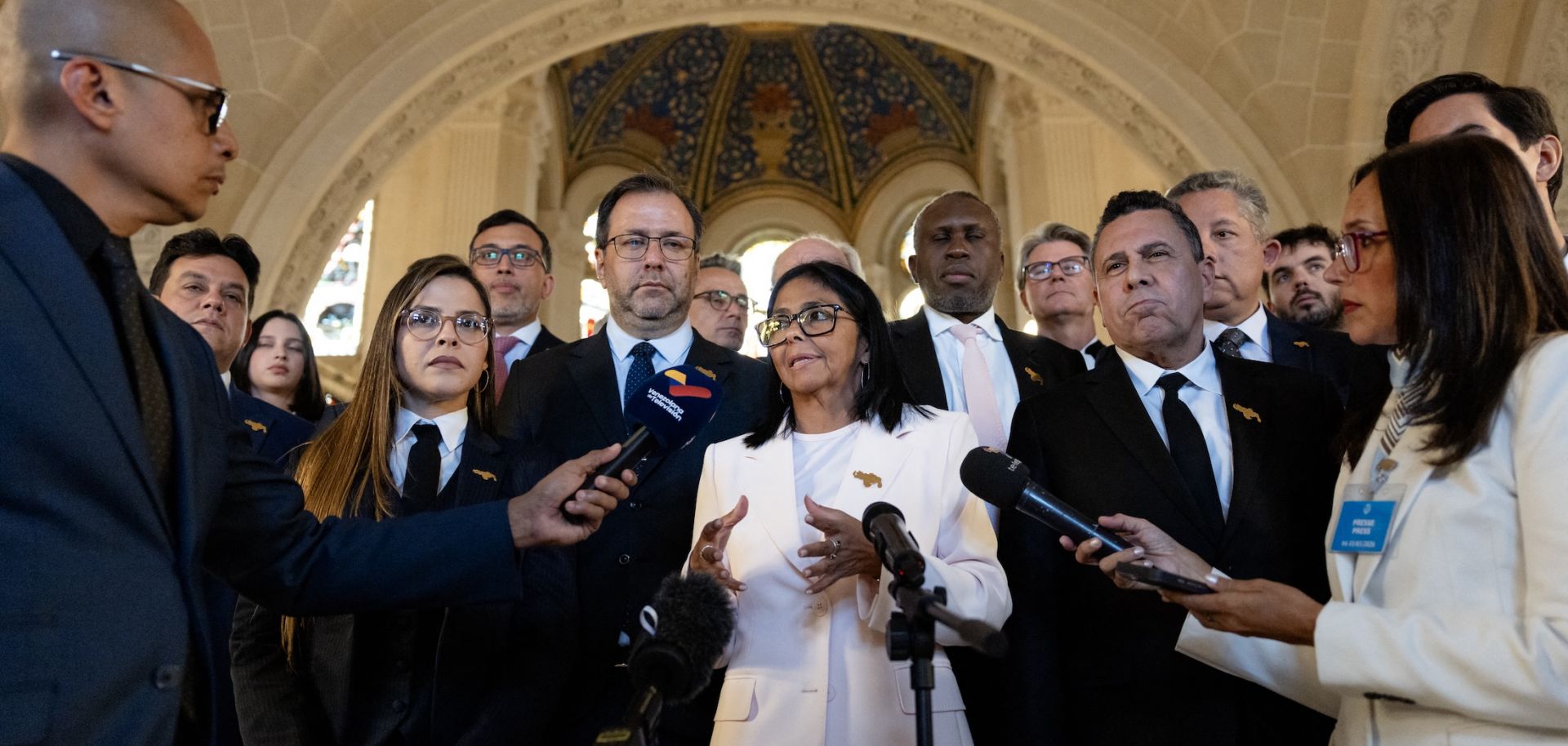
Acting President of Venezuela Delcy Rodriguez has consolidated power and initiated an economic opening after the United States' Jan. 3 intervention, which will pave the way for major economic reforms and create opportunities in key economic sectors, though structural bottlenecks and long-term political instability risks will persist. July 3 marks six months since the U.S. military operation that extracted then-President Nicolas Maduro from Caracas and triggered the country's most significant political realignment in decades. Since assuming power, then-Vice President and Oil Minister Rodriguez has replaced several allies of Maduro with loyalists, consolidating power. She has also pursued a pragmatic relationship with Washington and appeased U.S. demands to open the Venezuelan economy by advancing structural reforms designed to attract foreign capital to strategic sectors. In return, the U.S. government issued licenses and partially relaxed sanctions. Lastly, Venezuela has also allowed U.S. military activity in its territory.

- Rodriguez has sidelined dozens of high-ranking Maduro-era government and military officials, including former Minister of Industry Alex Saab (who was deported to the United States in May) and former Defense Minister Vladimir Padrino Lopez (who now serves as Agriculture minister). The main exception is Interior Minister Diosdado Cabello, who still controls the regime's paramilitary apparatus and looms as a potential threat to Rodriguez's leadership.
- Venezuela enacted a hydrocarbons reform on Jan. 29 and a mining reform on April 16, opening both sectors to private investment; on June 2, the National Assembly gave initial approval to also allow private capital in the electricity sector.
- Several Western companies, especially from the United States, have announced investments and agreements in Venezuela, mostly in the oil and gas sector, over the past six months.
- A U.S. strike on June 12 killed Tren de Aragua founder Hector Guerrero Flores, known as Nino Guerrero, in an operation the interim government said it had invited.
- Venezuela is the clearest example of the Trump administration's approach to the Western Hemisphere under the so-called Donroe Doctrine. The strategy seeks to reassert U.S. influence through stronger security cooperation, a militarized campaign against drug trafficking, support for friendly governments, efforts to counter the regional influence of China, Russia and Iran, and securing strategic resources.
The Venezuelan regime will prioritize survival, leading to a cooperative relationship with the United States and resulting in limited instability for business over the coming year, but companies will continue to face political, regulatory and unrest risks in the long term. Rodriguez and other regime leaders will almost certainly avoid a confrontational approach toward Washington over the next 12 months to reduce the likelihood of renewed military pressure, harsher sanctions and personal legal risks, including from the U.S. judiciary. As a result, Caracas will likely continue to make political and economic concessions to the United States. This will likely create a period of relative stability compared with the uncertainty that followed Maduro's capture, which, combined with pro-business regulation to open the country's economy, will result in increased foreign investments and a gradual recovery of the country's economy over the coming years. However, businesses will remain exposed to risks of political instability, regulatory volatility and protest activity in the long term, stemming mostly from potential political splits caused by ideological differences within the regime and, most importantly, financial motivations. In addition, should living standards fail to improve, popular discontent could trigger unrest and destabilize the government. That said, barring a scenario of widespread violence or a coup that brings to power a leader adversarial to U.S. interests, Washington is unlikely to push for a democratic transition over the coming year. Such pressure is likely to increase toward the end of the Trump administration, as critics of leftist autocracies in the region will likely push for free and fair elections while Trump remains in office. This will likely create friction between the Trump and Rodriguez governments. The new landscape brought about by the U.S. tutelage of Venezuela will create opportunities. Companies with elevated risk tolerance levels, which are likely to benefit from entering the country in the early stages of economic opening, will be especially likely to benefit, though the process will be a lengthy and uneven transition rather than a rapid normalization of the country's business environment.
- Regime splits could emerge over Rodriguez's acquiescence toward Washington as well as financial reasons. Many government and high-ranking military officials profited from connections to illegal and corrupt activities and will likely lose access to these revenue streams as the Rodriguez government makes regulatory changes that appease the United States.
- For ideological reasons, key members of the Trump administration, especially U.S. Secretary of State and National Security Adviser Marco Rubio, will likely seek to leverage their influence not just to weaken leftist autocracies in Latin America but to concretely put an end to these regimes. They are likely to push for established time frames for an election or concessions from Caracas that would prevent the regime from remaining in power were U.S. pressure to ease after Trump leaves office.
Regulatory reforms and improved relations with Washington will create conditions for a gradual expansion of Venezuela's oil and gas industry, though structural constraints will prevent production from rapidly recovering. Venezuela has approved reforms designed to attract foreign investment and is negotiating new contract structures between state-owned company PDVSA and international firms. These measures will likely continue to increase investor interest in upstream opportunities and result in a growing participation of the private sector in Venezuela's crude production over the coming years. Such dynamics will help the country revamp its oil and gas production in the long term, but companies will face severely degraded production infrastructure, including export terminals, pipelines and refineries, following years of underinvestment. Other structural bottlenecks that will slow down the recovery process include a lack of adequate equipment and labor, insufficient power supply, significant bureaucracy and widespread corruption. Lastly, even though the U.S. Department of the Treasury has issued several licenses and partially relaxed its sanctions for businesses to do business in Venezuela, companies will likely adopt a cautious approach to limit compliance risks. Businesses are likely to wait for additional licenses or specific authorizations that cover all the steps in a project's life (from financing to production) before committing to long-term operations. While crude production is likely to marginally increase over the coming months, it will likely take more than a decade and over $100 billion in investments for output to triple and return to early-2000s levels. Given the technical challenges of extracting Venezuelan extra-heavy crude, including the potential for diluent shortages, exploring offshore gas reserves may prove technically more accessible than reviving upgraders in the Orinoco Belt.
- The reform of Venezuela's Organic Hydrocarbons Law aims to revitalize the collapsed industry by allowing private and foreign companies to independently produce and export oil. It formalizes productive participation contracts that bypass the rigid joint-venture constraints established in 2006. Private operators can now directly participate in the exploration, extraction and export of crude while benefiting from reduced taxes and royalties and a framework that allows for international arbitration.
- Despite the reform, PDVSA and its subsidiaries will maintain an important presence in key assets. Given the politicization of appointments to key positions in the sector over the past 20 years, corruption and project inefficiencies will remain part of the Venezuelan business environment.
- The Trump administration will likely prioritize U.S. business interests, meaning U.S. companies will likely be among the first to receive authorizations or have preferential treatment when negotiating with the Venezuelan government. That said, Washington is unlikely to undermine efforts from other foreign companies to help revamp Venezuela's oil and gas industry, given the vast sums such an endeavor would require.
- Critics in Venezuela consider the oil and gas reform unconstitutional, which raises concerns that a future government (either resulting from a coup or a democratic election) could challenge existing contracts.
Recent reforms will likely attract mining investment given Venezuela's vast reserves, but security conditions will be the main obstacle to large-scale investment. Venezuela enacted the Organic Mining Law reform on April 16, opening gold and strategic minerals to national and foreign investors (as long as they are not from China, Russia, Cuba, Iran and North Korea). The pro-business legislation reduces taxes for mining companies and aims to provide longer-term regulatory predictability by allowing for longer contracts, although the state will retain control over project authorizations. These changes will likely attract private capital to the country's vast mineral reserves, though companies will face operational and security challenges. Most deposits are located in areas controlled by armed groups, including Colombian guerrillas, local gangs and transnational groups that operate in tacit partnership with members of the Venezuelan military. Because the Venezuelan regime relies on profits from illegal mining (among other illicit activities) to maintain the loyalty of the armed forces, fully eradicating these criminal enterprises from mining areas will be politically difficult for the government. Such efforts are likely to be partial and selective, likely creating conditions for companies to operate in some specific regions, though heavily armed threat actors will continue to pose persistent security risks and operational risks. Criminal organizations may also seek to extort money from multinationals and charge protection fees, posing compliance risks, especially given the U.S. designation of multiple Latin American cartels as Foreign Terrorist Organizations (FTOs) and Specially Designated Global Terrorists (SDGTs).
- The Mining Law reform cuts royalties from 30% to 13% and establishes a mining tax of up to 6% of gross revenue with exemptions from several existing levies. It also extends concessions to up to 30 years, extendable for two additional 10-year periods.
- While the reform repeals forced state ownership and grants access to international arbitration, it leaves the Venezuelan government with the power to approve projects and declare minerals strategic. It also gives the central bank first claim on all gold produced.
- Similar to the framework that gives the United States control over oil revenues, Washington will also channel mining revenue into U.S. Department of the Treasury escrow accounts.
- Venezuela holds unmined geological gold reserves of up to 2,343 metric tons (about 74.98 million ounces).
- At least 86% of Venezuela's gold is produced illegally. Roughly 70% is smuggled and laundered abroad.
- The country also has large reserves of diamonds, iron ore and bauxite. It also contains deposits of minerals critical to the energy transition, such as nickel, coltan, copper and rare earths.
The planned opening of the electricity sector will become a critical pillar of Venezuela's broader economic recovery strategy, creating opportunities throughout the electricity value chain. Venezuela currently faces a power supply deficit, meaning that several parts of the country, including Caracas, undergo recurring blackouts. In June, the National Assembly preliminarily approved an electricity reform and the government announced two deals to increase generation capacity. These developments reflect the fact that power generation capacity will need to expand to keep up with growing demand from oil and gas activities and broader economic recovery. The reform — which legislators will almost certainly approve over the coming weeks — aims to end 15 years of state monopoly and allow concessions of up to 25 years in generation, transmission and distribution, with a possible 15-year extension. These changes give investors the time frame needed to amortize the large upfront investments required to rebuild the power grid. The changes will create opportunities for generation companies and firms involved in transmission, distribution, grid modernization and industrial self-generation projects. Dealmaking will accelerate over the coming year. Initial agreements are likely to be concentrated on the rehabilitation of existing infrastructure rather than the construction of new plants, which is a faster and cheaper means of increasing capacity. Generation is likely to gradually expand rather than surge, meaning blackouts may become less frequent or last for less time but not disappear entirely. However, should there not be enough appetite to increase generation and transmission capacity, the unreliability of the power grid will become a major constraint for the country's economic recovery and the expansion of extractive sectors.
- Currently, only 40% of Venezuela's 30 GW of installed capacity is operational, meaning production revolves around 12 GW while average demand is about 14 GW.
- Media reports indicate that Venezuela's hydroelectric production has declined nearly 40% since 2020, while thermal plants run at about 15% of capacity because of insufficient fuel.
- The electricity reform allows private companies, joint ventures and minority-state firms to operate across the full chain of generation, transmission, distribution and commercialization and creates a formal framework for renewable energy. However, it concentrates approval power in the presidency, fueling political risks in the long term, and defers the politically sensitive ending of subsidies to a later stage.
- On June 13, Venezuelan authorities announced a deal with Argentina-based Industrias Metalurgicas Pescarmona to rehabilitate two hydroelectric dams in Bolivar state. The company was privatized in 2025 and is run by a U.S.-based fund.
- On June 15, Rodriguez announced a memorandum of understanding with GE Vernova to increase power generation capacity by 1 GW within two years, with a goal of exceeding 5 GW after four years.