
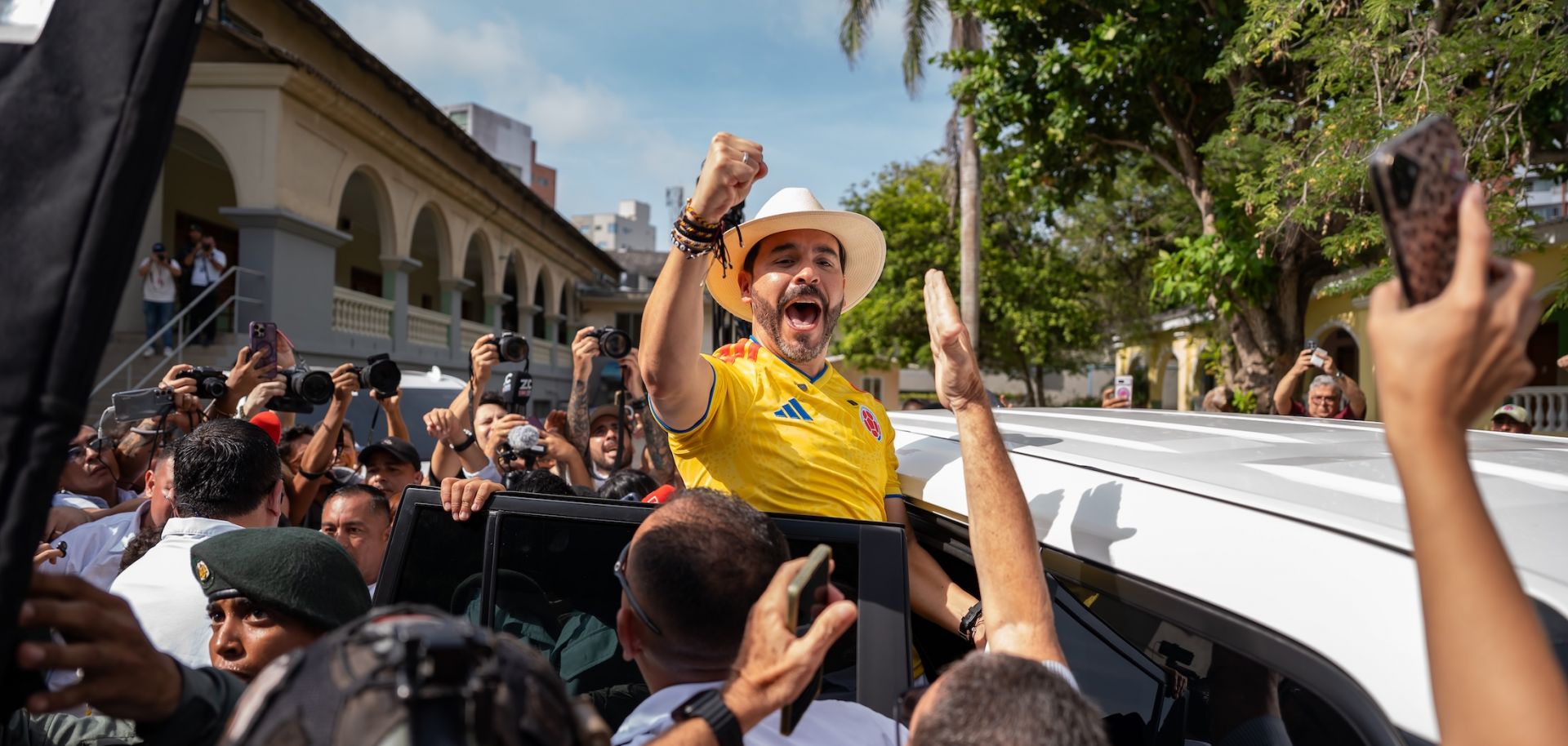
Colombia's far-right president-elect will pursue a pro-business agenda and adopt strict security policies in coordination with the United States, but a lack of congressional support will hinder implementation, and retaliatory violence will heighten security risks, especially in rural areas. Colombian far-right outsider Abelardo de la Espriella won the June 21 presidential runoff election with 49.66% of the vote, compared with 48.70% for leftist Sen. Ivan Cepeda, the country's national registrar confirmed on June 23. This presidential election was the country's closest in three decades and had one of the highest voter turnouts ever recorded, at 63.6%, underscoring heightened polarization. De la Espriella's narrow margin of victory will likely fuel political disputes during the transition period and legitimacy challenges throughout his term, but the new government will take office on Aug. 7, as scheduled. De la Espriella outperformed most polls in both rounds, campaigning on the reversal of outgoing President Gustavo Petro's security, economic and social policies, restoring a hard-line anti-crime approach and deepening ties with the United States. His platform resonated with voters frustrated with rising crime, weak economic growth and the failure of Petro's flagship "Total Peace" strategy, which consisted of negotiations with the country's armed groups.

- After initially announcing he would challenge the results from roughly 33,000 polling stations and wait for the official scrutiny process before formally conceding, Cepeda accepted his defeat on June 24. Petro also called for verification of the results, which will likely be confirmed over the coming days. On June 23, the national registrar said the preliminary and final vote counts differed by just 0.003% of the ballots.
Limited congressional support will force de la Espriella to govern through executive action, increasing institutional friction, policy volatility and regulatory uncertainty for businesses. De la Espriella will take office with very limited legislative support since the party that backs his movement secured only a few seats in Congress. That fact, coupled with the legislature's high fragmentation, means he will likely need to moderate his anti-establishment rhetoric and resort to traditional patronage systems to form coalitions with established parties on specific issues. In this way, de la Espriella will likely secure approval for diluted parts of his agenda, but controversial issues will remain a challenge. De la Espriella will respond by introducing some changes via decree, including ending Petro's Total Peace strategy, adopting forced coca eradication methods, redesigning Colombia's military and foreign affairs strategy, reversing restrictions on oil and gas contracts, appointing new leaders of the country's state-owned companies like Ecopetrol, and downsizing the state, such as by reducing discretionary spending, merging agencies or freezing hires. However, this use of unilateral executive action will likely spark recurring clashes with Congress and the judiciary, especially combined with the president's belligerent rhetoric and disregard for the political establishment and oversight bodies. To this end, Congress will likely dilute de la Espriella's reforms to Colombia's tax, labor, healthcare and prison systems and block efforts to weaken oversight bodies, withdraw Colombia from multilateral bodies or broadly relax gun controls. This legislative resistance will prevent a sharp democratic erosion, but it will also likely slow policymaking and create legal and regulatory uncertainty around government decisions.
- The far-right National Salvation Movement party that backs de la Espriella's Defenders of the Homeland movement controls only four out of 102 Senate seats, while Cepeda's and Petro's left-wing Historic Pact is the largest single force in the Senate, with 25 seats. The traditional right-wing opposition party, Democratic Center, elected 17 senators, while centrist and center-right parties have nearly 50 legislators.
- In the House of Representatives, no party controls more than a quarter of the 181 seats. The Historic Pact holds 39 seats, while the Democratic Center and the Liberal Party control 30 and 29, respectively, underscoring Colombia's highly fragmented and coalition-dependent political system.
- De la Espriella has promised to sign 90 decrees in the first days after taking office, focusing primarily on security, healthcare, education and the economy, with broader goals to fight corruption and reduce the size of the state.
- The judiciary is the main check on presidential power, as two high courts (the Council of State and the Constitutional Court) can suspend or annul executive branch decrees; moreover, Congress can act to pass legislation overriding the president's agenda, refuse to convert temporary emergency measures into permanent law or simply refuse funding to the president's agenda, creating a de facto obstacle to its implementation.
The administration's pro-business agenda will initially improve investor sentiment, but implementation challenges, structural fiscal vulnerabilities and governance concerns will likely constrain improvements to the business environment in the long term, while corruption will continue to fuel compliance risks. De la Espriella's administration will rely on the credibility of Vice President-elect and former Finance Minister Jose Manuel Restrepo to reassure domestic and international markets about its commitment to an economic platform centered around fiscal austerity, deregulation and lower corporate taxes. The government will also seek to shift economic growth drivers from public investment and household consumption to private sector activity, including exports. The pro-business transition away from Petro's interventionist and lax fiscal approaches will improve investor sentiment in the first months of de la Espriella's government, drawing international interest, strengthening the peso and allowing for some debt rollover transactions at more favorable rates. However, many of de la Espriella's proposals to cut public spending and improve state efficiency to strengthen Colombia's fiscal position will require congressional approval, which will hinder implementation and limit structural improvements, thereby weakening investor optimism and even souring markets' mood in the long term. Moreover, companies will remain exposed to broader constraints that will continue to undermine the business environment. For instance, de la Espriella will likely maintain an aggressive anti-corruption rhetoric, but his reliance on patronage networks to secure establishment support will likely favor business groups with political connections to the government. This system will pose compliance risks for companies engaged in public contracts and impair competitive processes among private sector players.
- Colombia's fiscal deficit reached 6.2% of GDP in 2025, while the general government's gross debt stood at 60.9% of GDP as of April 2026, according to the International Monetary Fund.
- De la Espriella pledged to reach a primary fiscal surplus, which would entail an initial spending cut of 70 trillion pesos ($20.3 billion) but generate annual structural savings of 3.1% of GDP from public payroll cuts, reallocation of subsidies and the sale of unproductive assets.
- Credit rating agencies removed Colombia's investment-grade status in 2021 and have repeatedly cited fiscal pressures and political uncertainty as key concerns.
- Colombia ranked 99th out of 182 countries in Transparency International's 2025 Corruption Perceptions Index.
The extractive sector will benefit the most from de la Espriella's unraveling of Petro's interventions, though legal disputes and social opposition will remain risks for investors. Unlike fiscal and tax reforms, many energy and mining policies can be altered through executive decisions, allowing the new administration to quickly reverse Petro's restrictions on new hydrocarbon exploration and adopt a more favorable stance toward private investment. This shift will improve medium-term production prospects and attract renewed interest from international investors seeking greater policy stability and a friendlier political environment. De la Espriella will likely prioritize streamlined permitting procedures, reduced environmental and community consultation requirements and the launch of new bidding rounds, especially for oil and gas and mining. However, many of these changes will be implemented through decrees rather than legislation, which will fuel long-term policy uncertainty, as future administrations could easily reverse them without congressional approval. Moreover, de la Espriella's approach to local communities and environmental protection will almost certainly trigger litigation and social resistance, particularly in regions with strong environmental activism or Indigenous presence, meaning companies would likely face reputational risks and operational disruption from occasional protests.
- Colombia holds proven oil reserves of nearly 2 billion barrels and natural gas reserves exceeding 2 trillion cubic feet. Oil and mining account for nearly half of the country's exports and are critical sources of fiscal revenue and foreign exchange.
- Petro suspended the signing of new oil and gas exploration contracts after taking office in 2022, though existing projects remained operational.
- The mining sector has faced recurring disruptions from community consultations, environmental lawsuits and road blockades in departments such as La Guajira and Cesar.
Heavy-handed security policies will likely improve safety in major cities, though a return to militarized fighting against armed groups will fuel retaliatory violence, increasing security and operational risks in some rural areas. In Colombia, security policy largely falls under executive authority, and stricter anti-crime measures were among de la Espriella's main campaign promises, so security regulatory changes will likely be among the first to be implemented. Expanded police funding, equipment and patrolling will likely reduce crime indicators in large urban areas over the coming months, while higher incarceration rates and persistent belligerent rhetoric against criminals could help sustain a decline in crime rates in the long term. De la Espriella will also abandon Petro's Total Peace strategy in favor of military operations against guerrilla organizations, dissident factions and drug trafficking groups. Additionally, his administration will resume forced coca eradication, including with aerial fumigation programs. To pursue both objectives, he will rely on cooperation with the United States, especially since these goals overlap with the U.S. Trump administration's strategy for the region. That said, military operations against guerrilla groups will likely drive retaliatory attacks in small towns or rural parts of the country, targeting mostly security forces, government buildings or authorities. Meanwhile, attacks against civilian targets, private sector assets or critical infrastructure (especially in the oil and gas sector) could also occur and would pose security and operational risks to companies, especially those in remote regions where state presence remains limited.
- Coca plantation, cocaine production and armed groups' control of territory have expanded in Colombia since Petro took office in 2022, as criminal organizations used the truce negotiations with the government to reorganize and expand their illicit activities.
- Historically, armed groups and criminal organizations have targeted oil pipelines, electricity infrastructure and mining operations.
- De la Espriella has promised to build 10 mega-prisons in areas far from major cities.
De la Espriella will pursue a sharp geopolitical realignment toward Washington while adopting a more confrontational approach toward China and leftist governments in the region, though the economic impact of his belligerent rhetoric will likely be limited. The new administration's ideological affinity with the Trump administration and shared priorities on security and counternarcotics will likely result in deeper intelligence sharing, military cooperation and diplomatic coordination with the United States. Closer ties will also lead Washington to recertify Colombia as an ally in the fight against drug trafficking, further facilitating joint efforts and reducing the risk of bilateral disputes that could lead to tariff threats or other restrictions that could disrupt trade or investment. De la Espriella is also likely to occasionally criticize China and increase scrutiny of Chinese investments in strategic sectors, particularly infrastructure, telecommunications and energy, and even threaten to or actually withdraw from the Belt and Road Initiative. While this could create opportunities for U.S. and European companies, it would also fuel legal and regulatory uncertainty for projects involving Chinese capital. That said, a significant deterioration or a rupture of bilateral relations that leads to a sharp reduction or suspension of Chinese investments in Colombia is unlikely to occur because of structural constraints, such as the fact that many large projects are already under development and canceling or seeking to change existing contracts would create major legal or financial liabilities. Additionally, Congress does not share de la Espriella's animosity toward China, and pressure from Colombian businesses will also dissuade the new government from significantly reducing Chinese capital inflows. More broadly, even though de la Espriella is likely to occasionally criticize Venezuela's leftist government, Bogota and Caracas will likely work together under U.S. coordination, resulting in partnerships in the energy sector and in the fight against transnational crime.
- The United States remains Colombia's largest export destination, receiving approximately one-third of Colombian exports. China became Colombia's second-largest trading partner during the past decade and has expanded investments in infrastructure, energy and transport projects, such as Bogota's first underground metro, currently under construction.
- Since 2000, Colombia has received more than $14 billion in U.S. assistance through security cooperation frameworks, including or derived from Plan Colombia, a U.S. foreign aid and military initiative launched in 2000 to combat drug cartels, eradicate coca crops and weaken left-wing guerrilla groups in the country.
- On Oct. 24, 2025, the U.S. government decertified Colombia as an ally on counternarcotic efforts "[d]ue to President Gustavo Petro's disastrous and ineffective counternarcotics policies," even though a waiver maintained financial support and cooperation on anti-drug trafficking efforts.