
Editor's Note: With many significant elections occurring in 2024, RANE is publishing a series of scenario analyses focused on different outcomes of major elections occurring this year, describing how an election outcome might unfold with implications for each potential outcome. The first installment covered India's general election, the second covered European parliamentary elections, the third covered South Africa's general election, the fourth covered Mexico's presidential election, the fifth covered Iran's presidential election, the sixth covered the United Kingdom's general election, the seventh covered Sri Lanka's presidential election, the eighth covered the U.S. presidential and congressional elections and the ninth covered Ghana's general election. The following is a scenario analysis for Romania's parliamentary elections.
Opinion polls ahead of Romania's parliamentary elections scheduled for Dec. 1 indicate four main possible coalition government scenarios, each with distinct implications for the country's domestic and foreign policies, stability, and overall strategic direction.
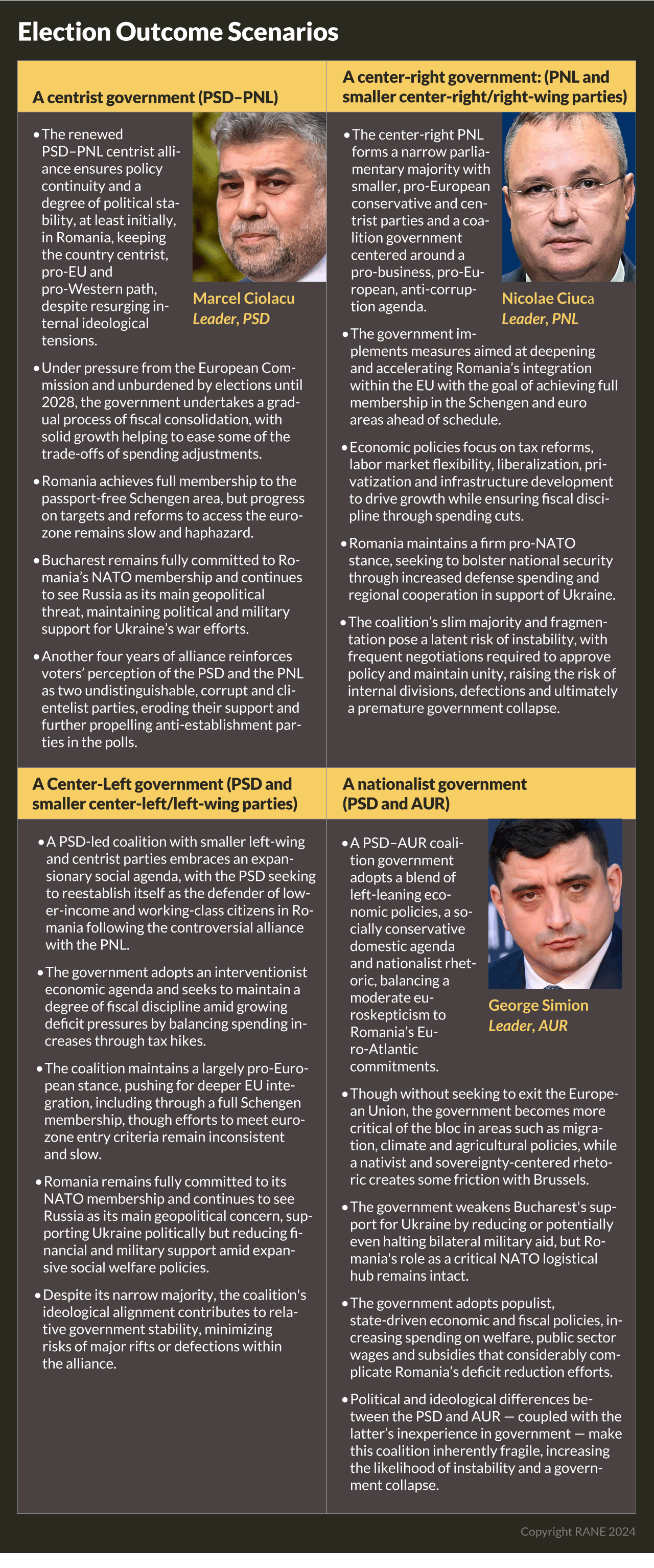
In the most likely scenario, the now ruling centrist coalition led by the economically left-wing, socially conservative Social Democratic Party, or PSD, and the liberal, center-right National Liberal Party, or PNL, gains enough seats to repeat its alliance in parliament. A second PSD-PNL government would lead to policy continuity in Romania, keeping Romania on a centrist, pro-EU and pro-Western path. The government would pursue policies aimed at deepening the country's EU integration, including efforts to join both the Schengen area and eventually the eurozone by the decade's end, and, with no elections scheduled for four years, would have the political stability to undertake a gradual fiscal consolidation process amid mounting pressure from the European Commission to reduce its fiscal deficit. Ideological differences on issues like judicial reforms, spending priorities and anti-corruption measures may test the coalition's cohesion, however, especially should economic or political pressures arise.
Two alternative, equally unlikely scenarios would see either a center-right government led by the PNL with support from smaller conservative and centrist parties, or a center-left government led by the PSD alongside left-leaning allies. In the first scenario, a PNL-led coalition would focus on a strongly pro-business, pro-Europe and anti-corruption agenda, prioritizing tax reforms, labor market flexibility, privatization and an accelerated eurozone accession for Romania while maintaining fiscal discipline. With a slim majority and reliance on a constellation of smaller parties in parliament, however, the center-right government would face challenges in policy cohesion and political stability, while the PSD opposition would likely rally powerful protests and strike movements against it. Meanwhile, a PSD-led center-left government would adopt a more interventionist economic approach, focusing on social spending, raising the minimum wage, increasing pensions and capping energy prices, seeking to appeal to lower-income and working-class voters. Such a government would pursue progressive tax reforms and maintain a socially conservative stance domestically, while generally aligning with EU integration and NATO. Although more stable due to ideological alignment, a center-left government could face economic constraints and limited pressure from international markets over fiscal discipline.
Finally, though significantly less likely than a PSD-PNL coalition, a fourth scenario would see the PSD forge an alliance with the nationalist Alliance for the Union of Romanians, aka the AUR. This government would blend a socially conservative agenda with left-leaning economic policies, emphasizing state intervention and increased welfare spending, all the while embracing a nationalist rhetoric that could strain relations with ethnic minorities and Brussels. Although the Alliance for the Union of Romanians lacks sufficient influence to jeopardize Romania's EU or NATO membership, the party would advocate for more sovereignty-centered, nativist policies that could create friction with the European Union on issues like migration, climate and agricultural policies. Meanwhile, while reducing bilateral military support to Ukraine, Romania's role as a critical NATO logistical hub would likely remain intact under this government. Ideological differences and the Alliance for the Union of Romanians' inexperience in governance, however, would make this coalition unstable, with a high risk of collapse due to internal disputes and policy conflicts.
A Centrist PSD-PNL Government
The center-left PSD and the center-right PNL repeat their alliance in parliament to form a coalition government that maintains a high degree of policy continuity in Romania, keeping the country on a centrist, pro-EU and pro-Western path, despite internal ideological tensions. A parliamentary majority for the two parties, possibly with the addition of a smaller party like the ethnic Hungarian UDMR, allows the coalition to pursue its agenda without significant resistance from the opposition. The government pursues close economic integration within the EU, implementing the reforms needed to gain full membership of the visa-free Schengen area and join the eurozone by the end of the decade. With no elections for four years, the government has the political leeway to undertake a gradual process of fiscal consolidation amid growing pressure from the European Commission to reduce the public deficit (which is projected to reach between 7% and 8% of GDP in 2024). Robust economic growth supports these efforts, reducing the size of the necessary fiscal adjustments. Ideological differences between the two parties on issues like the economy, judicial reforms and anti-corruption measures may, however, pose challenges to the government's stability, especially as stabilizing factors that have kept the alliance together amid the post-pandemic recovery and the war in Ukraine gradually wane over the course of the parliamentary term. Against this backdrop, factors like an economic or financial crisis, social unrest or plummeting approval ratings could raise the risk of a government collapse and early elections.
Implications
- The renewed PSD-PNL alliance ensures policy continuity and a degree of political stability (at least initially) in Romania, somewhat reassuring both domestic and foreign investors and positively impacting investments in sectors reliant on regulatory certainty like energy, infrastructure and finance.
- The election has little to no impact on bond yields and government borrowing costs.
- The country continues to experience comparatively strong levels of economic growth as it gradually converges with wealthier EU member states and continues to qualify for much-needed EU funds.
- Under pressure from the European Commission and thanks to a majority in Parliament and the absence of elections until 2028, the government undertakes gradual fiscal consolidation to reduce the public deficit through modest spending cuts and revenue-boosting measures, supported by robust economic growth that helps ease the financial strain of these adjustments. Progress is slow amid disagreements between the two co-ruling parties over the necessary fiscal adjustments, however, with the deficit still above the 3% of GDP threshold by the end of the parliamentary term.
- International credit rating agencies maintain Romania's rating largely stable, with small improvements and a positive outlook thanks to the government's fiscal consolidation efforts, though its rating is still the lowest in the European Union.
- Progress on targets and reforms to access the eurozone remains slow and haphazard, with inflation consistently well above eurozone averages and very little progress on improving institutional quality in the country or tackling corruption and money laundering.
- Romania achieves full membership in the passport-free Schengen area (including for land travel). The removal of border checks facilitates the free flow of goods and people with other European countries, reducing transit times and transportation costs for companies moving goods across Romania's borders, thus encouraging cross-border economic activities and positively contributing to growth.
- The development of the Neptune Deep natural gas project in the Black Sea proceeds according to schedule, with production starting by 2027, making Romania one of the largest natural gas producers in the European Union and strengthening the country's and bloc's energy security.
- Increased natural gas production and investment boosts GDP growth in the country through job creation and associated industries like infrastructure, logistics and local services, and improves fiscal stability thanks to the additional revenue for the Romanian government.
- Romania remains fully committed to its NATO membership and continues to see Russia as its main geopolitical threat. The government continues to support Ukraine's war efforts politically and militarily.
- The government gradually increases defense spending, prioritizing investments in modernization across all military branches and infrastructure to reinforce Romania's strategic role in Eastern Europe and the Black Sea region, offering opportunities for companies in the defense, aerospace, security, infrastructure development and logistics sectors.
- Another four years of alliance reinforces voters' perception of the PSD and the PNL as two undistinguishable, corrupt and clientelist parties, and popular support for both parties decreases over time. Meanwhile, support for the nationalistic and anti-establishment Alliance for the Union of Romanians (which remains the main opposition force) continues to grow.
- Should the two parties adopt particularly unpopular measures to accelerate fiscal consolidation without fear of immediate electoral repercussions, such as cuts to health care, pensions or education, the risk for anti-government demonstrations would increase.
- Despite the government's stability in Parliament, ideological tensions between the two coalition partners may lead to friction on issues like labor reform, social policies and anti-corruption measures — especially in case of an economic downturn and/or persistent social unrest — raising the risk of political instability, a government collapse and early elections.
A PNL Plus Smaller Right/Center-Right Party Government
The center-right PNL party cobbles together a narrow parliamentary majority with smaller, pro-European conservative and centrist parties alongside a few independents and defectors from other factions. Centered around a pro-business, pro-European agenda, the coalition implements measures aimed at deepening and accelerating Romania's integration within the European Union with the goal of achieving full membership in the Schengen and euro areas. Economically, the government focuses on tax reforms, labor market flexibility, economic liberalization, privatization and infrastructure investments to drive growth while ensuring fiscal discipline through spending cuts. The government also maintains a firm pro-NATO stance, seeking to bolster national security through increased defense spending and regional cooperation in support of Ukraine. Meanwhile, PNL's junior partners like the pro-business Save Romanian Union, the conservative People's Movement Party and the conservative Forta Dreptei push for an anti-corruption agenda, emphasizing transparency, judicial reforms and high-level investigations to fight corruption. The coalition's slim majority and fragmentation pose a latent risk of instability, however, requiring delicate negotiation and compromise to maintain unity, secure consistent legislative support and prevent internal divisions. This means the PNL-led alliance is characterized by a slow and sometimes unpredictable decision-making process, which makes the government unstable and constantly at risk of premature collapse. Moreover, the PSD mobilizes its base, which includes unions and public sector workers, to protest welfare spending cuts, labor reforms and anti-corruption investigations it calls political prosecution against party members and allies, rallying large anti-government demonstrations and strikes.
Implications
- Pro-business policies, including tax reforms favoring businesses and middle-income earners and labor market flexibility, positively contribute to growth and boost Romania's competitiveness and attractiveness as a business and investment destination in the European Union.
- The government sets an earlier target to join the eurozone (for instance, by the end of the parliamentary term in 2028) and implements policies and reforms necessary to keep inflation low and meet accession criteria, including pegging the national currency to the euro, allowing greater scrutiny of its banking sector by the European Central Bank, implementing measures to tackle corruption and money laundering, and accelerating deficit reduction efforts.
- The anticipated eurozone membership and the measures implemented to align with this goal also contribute to reducing inflation and currency risk, positively contributing to private consumption and benefiting companies in import-export sectors.
- The government accelerates fiscal consolidation efforts, implementing measures such as income tax reforms to eliminate existing loopholes and exemptions, a value-added tax reform to levy more items at the standard rate, and a reassessment of the country's pension reform to stretch out the fiscal burden resulting from it.
- Markets reward the greater emphasis on fiscal discipline, and Romania's credit rating improves, resulting in lower borrowing costs, which also helps improve Romania's business environment and overall attractiveness.
- The government's strong pro-EU stance reassures European partners, signaling Romania's commitment to EU integration and further contributing to smooth the path toward Schengen and eurozone membership. Full membership in Schengen eases cross-border movement, coupled with prospects for a quicker eurozone accession, this makes Romania a more attractive base for companies' seeking to establish regional operations in the European Union.
- Labor unions, political activists and other groups push back against government cuts to social spending, slower public sector wage adjustments compared to the previous governments and labor reforms, staging industrial action and widespread protests coordinated by opposition parties like the PSD and causing frequent operational and business disruptions.
- While the European Union and the business community welcome enhanced anti-corruption efforts and judicial reforms from the new government, high-profile investigations face opposition and claims of political bias, particularly from the PSD, increasing the likelihood of anti-government demonstrations.
- Growing external pressures from the opposition and labor unions, coupled with internal divisions within the coalition government, slow efforts on institutional quality improvements and ultimately water down reforms aimed at enhancing the rule of law and judiciary independence in the country.
- The coalition's narrow majority and ideological differences create a fragile foundation for the government, with frequent negotiations required to maintain unity, raising the risk of internal divisions, defections and ultimately a premature government collapse.
- If the installment of a centrist, pro-business coalition government initially boosts investor confidence, the political instability and policy uncertainty resulting from the coalition's internal weaknesses creates frustrations for businesses relying on regulatory stability and timely reforms for long-term investments.
- Romania remains fully committed to NATO membership, increases defense spending and takes measures to better integrate its military with those of its alliance partners. Romania continues to see Russia as its main geopolitical threat and to support Ukraine's war efforts. Romania increases its political and financial support for Moldova and lobbies the European Union to accelerate the country's entry into the bloc.
A PSD Plus Smaller Left, Center-Left Party Government
A decisive election victory grants the PSD enough seats in Parliament to form a majority in parliament alongside smaller left-wing and centrist parties and with the help of a few independents. The coalition government embraces a social agenda aimed at expanding public spending on health care, education and social security, with the PSD seeking to reestablish itself as the defender of lower income and working-class citizens in Romania following the controversial alliance with the PNL in the previous government. On the economy, the interventionist government prioritizes raising the minimum wage, increasing pensions and capping energy prices, appealing to its older and low-income voter base. Seeking to maintain a degree of fiscal discipline amid growing deficit pressures, the coalition somewhat balances spending increases with higher corporate and income taxes for high earners. While economically left wing, the PSD maintains socially conservative stances, championing traditional values in Romania. On foreign policy, the coalition maintains a largely pro-European stance without drastic shifts from previous administrations. It pushes for deeper EU integration, including full Schengen membership, and maintains a firm commitment to an important and growing role for Romania within NATO, supporting Ukraine and gradually increasing defense spending. Despite its narrow majority, the coalition remains relatively stable due to its ideological homogeneity and thanks to the PSD's strong election mandate and firm control over the alliance.
Implications
- The government raises the minimum wage, increases pensions, maintains caps to energy prices, helps with housing affordability and increases subsidies for essential goods, which improves the financial stability of low-income households in Romania and strengthens the PSD's base among these groups.
- The government also favors interventionism and economic statism, expanding public ownership in key sectors such as energy, transport and infrastructure, regulating prices for essential goods and services, and seeking to stimulate private consumption by increasing public sector wages.
- Incremental wage increases and rising social spending help increase the purchasing power of lower income consumers in Romania, benefiting sectors like retail, consumer goods and real estate. Companies in labor-intensive industries face gradual labor cost increases, however, translating into lower margins, deterring private sector investment and slowing private sector wage growth.
- The government increases public spending on health care, education and social security, potentially improving public services but also adding pressure on the government's fiscal balance.
- To balance increased social spending, the government reforms the tax system by introducing progressive taxation and raising taxes on corporations and high-income individuals.
- The departure from the competitive flat-tax regime, coupled with higher corporate and income taxes, negatively impacts business sentiment and investment in Romania.
- Despite efforts to somewhat balance rising spending with revenue increases through tax hikes, deficit reduction efforts continue at a slower pace than originally projected by the previous government, leading to a slight deterioration in Romania's credit score and gradually raising borrowing costs.
- The PSD-led government deprioritizes judicial reforms and anti-corruption efforts, which draws criticism from EU institutions and civil society groups, but not to an extent that would cause significant concerns regarding rule of law violations in Brussels.
- Efforts to meet eurozone entry criteria remain inconsistent and slow, with the government's social welfare expansion contributing to inflation (which remains persistently above the eurozone average) and with the PSD's aversion to judicial and anti-corruption reforms limiting progress in enhancing institutional quality, combating corruption and preventing money laundering.
- Romania secures full membership in the Schengen area, allowing for land travel without border checks. This removal of barriers streamlines the movement of goods and people with other EU countries, cutting down transit times and transportation costs, which in turn boosts cross-border trade and contributes to economic growth.
- The coalition's ideological alignment contributes to relative government stability, minimizing risks of major rifts or defections within the alliance despite the slim parliamentary majority.
- Romania remains fully committed to its NATO membership and continues to see Russia as its main geopolitical concern. While Romania continues to support Ukraine politically and within the European Union and NATO, Bucharest's expansive social welfare policies mean that defense spending is not a priority for the government, which leads to growing friction with the United States.
A PSD + Alliance for the Union of Romanians Nationalist Government
The PSD and the nationalist Alliance for the Union of Romanians form a coalition government adopting a blend of left-leaning economic policies, a socially conservative domestic agenda and nationalist rhetoric. The Alliance for the Union of Romanians is critical of both the European Union and, to some extent, NATO. But as junior partner in a PSD-led coalition, it lacks the leverage to seriously threaten Romania's membership in either organization, which would also require presidential support. The party is still able to weaken Bucharest's support for Ukraine by reducing or potentially even halting military aid. Still, Romania's role as a critical NATO logistical hub remains intact. While the Romanian government does not seek to exit the European Union, it becomes more critical of Brussels in areas such as migration, climate and agricultural policies. On the other hand, the alliance embraces a nativist and sovereignty-centered rhetoric, fueling tensions with ethnic minorities in Romania and drawing criticism from Brussels, though not to the point that would justify legal action or economic sanctions against Bucharest. The government adopts populist, state-driven economic and fiscal policies, increasing spending on welfare, public sector wages and subsidies that considerably complicate Romania's deficit reduction efforts. Though slowly, Romania's budget deficit continues to expand, increasing borrowing costs and ultimately limiting the government's ability to respond to eventual future economic downturns. Political and ideological differences between the PSD and the Alliance for the Union of Romanians — coupled with the latter's inexperience in government — make this coalition inherently fragile, increasing the likelihood of instability and a government collapse.
Implications
- Though the Alliance for the Union of Romanians has sought to present a more moderate image in recent months, the alliance would somewhat isolate the PSD politically in Europe, with the party likely to be pushed out of the Socialists and Democrats group in the European Parliament yet unwilling to join euroskeptic groups.
- The government is more willing to challenge the European Union in areas such as migration, climate, energy and agricultural policies, pushing back against initiatives such as the Fit for 55 and Repower Europe packages, the new Pact on Migration and Asylum or any attempt to reform the Common Agricultural Policy (especially reducing subsidies or attaching environmental conditions).
- Tensions between Brussels and Bucharest may increase with the Alliance for the Union of Romanians in the coalition government over rule of law violations and democratic backsliding concerns, though not to the point of triggering legal actions or financial penalties against Romania, as the government would likely seek to avoid overt conflicts with the European Commission.
- The government is critical of further large EU financial and military packages in support of Ukraine, joining the likes of Slovakia and Hungary in criticizing such measures and calling for a peace agreement, yet falling short of vetoing sanctions against Russia or measures in support of Ukraine.
- The government halts further bilateral military aid shipments to Ukraine, possibly by blocking the proposed transfer of a Patriot missile defense system, but the impact is very limited given the few stocks in Romania still available for transfer to Kyiv.
- While interrupting the already limited bilateral aid, Romania continues to serve as a key logistical hub for military aid to Ukraine from other NATO allies, including by providing training for Ukrainian F-16 pilots and expanding infrastructure to handle Ukrainian cargo, all elements of much greater strategic value than any aid shipment Romania has sent or could still provide to Ukraine.
- The government increases social spending on welfare programs, including subsidies for essential goods, direct cash transfers to low income households to address cost-of-living concerns and rent control or other house affordability measures.
- The government champions traditional values and family support programs, seeking to address Romania's demographic challenges while appealing to both the Alliance for the Union of Romanians' traditionalist and the PSD's working-class bases, for instance by expanding child benefits, tax breaks for families and housing incentives for young couples, though these measures largely fail to meaningfully impact birth rates or emigration levels.
- The government implements policies designed to attract Romanians living abroad to return through tax breaks and other incentives, all the while tightening immigration rules for non-EU citizens into the country.
- Appealing to the Alliance for the Union of Romanians' nationalist base and PSD's rural supporters, the government considerably increases agricultural subsidies for small- and medium-sized Romanian farmers, while also increasing support for other traditional strategic and traditional industries like automotive, energy and infrastructure through subsidies and tax breaks.
- The coalition's expansive social welfare and spending programs strain the government's budget, keeping the deficit high despite mounting EU pressure to consolidate public finances. The seven-yearlong medium-term fiscal adjustment plan spares Romania from EU sanctions under the excessive deficit procedure during the government's term, but it leads to a further deterioration in the country's credit score and growing borrowing costs.
- Despite persistently high deficit levels, a solid economic growth and still relatively low debt-to-GDP levels keep the likelihood of a financial crisis in Romania low, though eventual exogenous shocks like an economic downturn or a new inflation crisis could increase the risk.
- The Romanian government promotes conservative views on issues such as LGTBQ+ rights and abortion and increasingly aligns its views with those of the Romanian Orthodox Church. This results in protests by sexual and other minorities in Romania and to criticism from foreign nongovernmental and organizations promoting these group's rights.
- Though unlikely, should the government clash with Brussels over minority rights (for instance if takes discriminatory measures against the country's Hungarian and Roma minorities), rule of law violations or democratic backsliding, this could affect the flow of EU funds, negatively impact growth and exacerbate Romania's financial risks, increasing the risk of a financial crisis.
- Romania will seek deeper economic integration with Moldova and will promote Chisinau's entry into the European Union. Relations between Romania and Hungary are likely to deteriorate, as Budapest accuses Bucharest of undermining the rights and culture of ethnic Hungarians in Romania and Bucharest accuses Budapest of backing secessionist forces in Transylvania.
