
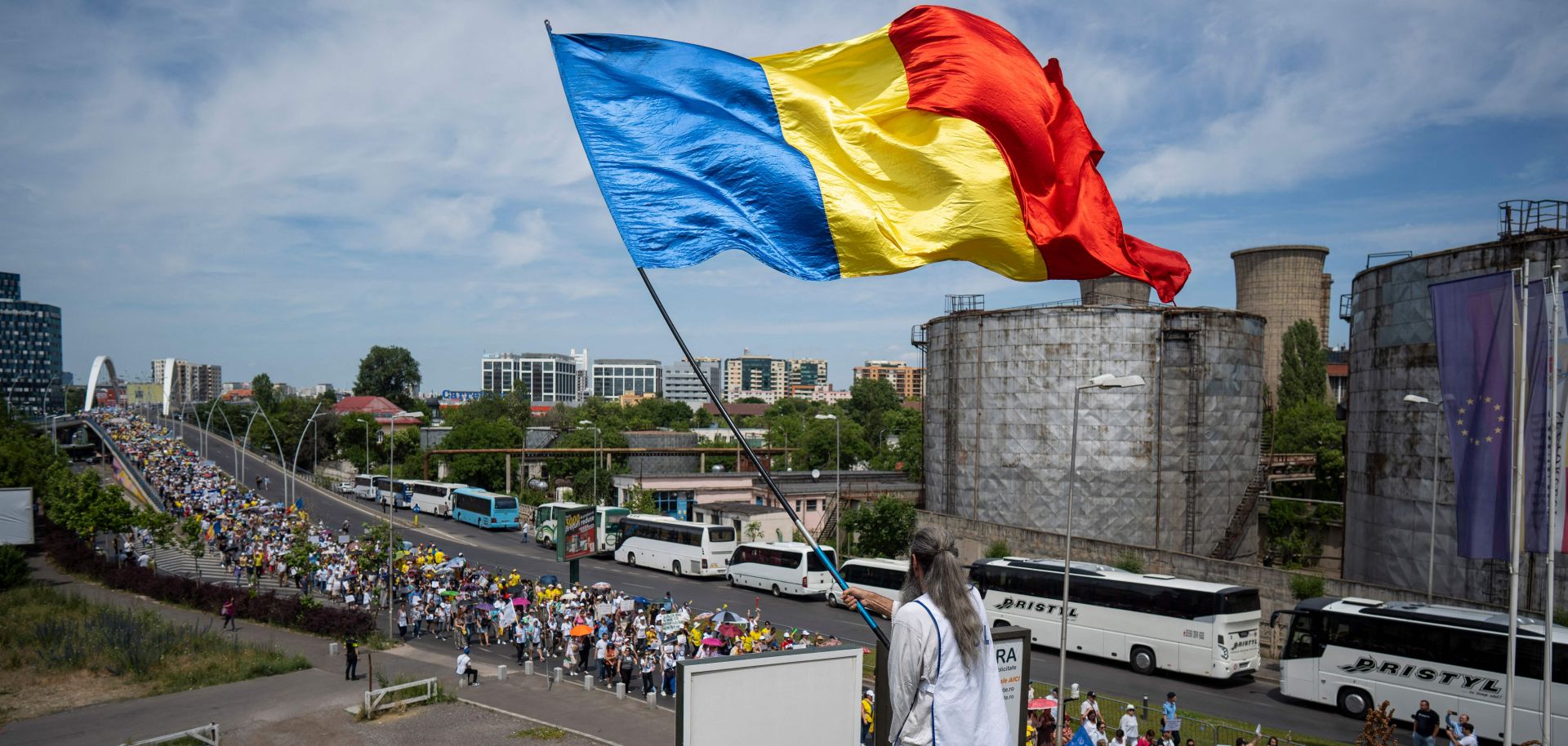
An ideologically divided Romanian coalition government is struggling to come up with measures to reduce the country's fiscal deficit, which will open the door to additional social unrest and potential economic risks. On July 11, representatives from the European Commission arrived in Romania to discuss measures to reduce the country's fiscal deficit. The visit came only days after Romanian newspapers reported on June 30 that the European Commission had sent a letter to the Romanian government asking the country to reduce its fiscal deficit, which reached 2.32% of GDP between January and May 2023, compared with 1.48% during the same period of 2022. This EU pressure on the Romanian government is happening less than a month after the Romanian Parliament appointed center-left Social Democratic Party (PSD) leader Marcel Ciolacu as the country's new prime minister on June 15. Ciolacu succeeded Nicolae Ciuca, from the center-right National Liberal Party (PNL), who resigned on June 12. While the transition was a part of the coalition pact between the PSD and the PNL (which in December 2020 agreed that they would each appoint a prime minister for a period of two-and-a-half years), the rotation was not without controversy, as the PSD and the PNL engaged in intense negotiations over the future of policy in the days prior to Ciuca's resignation.
- Romania has been under the European Union's Excessive Deficit Procedure, which requires the country to reduce its fiscal deficit, since 2019. Bucharest has agreed with Brussels to take its fiscal deficit below 3% of GDP by the end of 2024 at the latest, or else it would face economic sanctions from the commission, which could include the suspension of EU structural funds.
- The European Union has allocated roughly 45 billion euros in cohesion funds for Romania for the 2021-2027 budgetary period, plus roughly 29 billion euros in funds from the National Recovery and Resilience Plan. These are significant amounts for a 240 euro billion economy like Romania's.
The European Union's pressure on Romania comes as the country faces increased social unrest due to the ongoing cost-of-living crisis. In recent months, several sectors of Romanian society have taken to the streets to express their discontent with social and economic conditions in the country. Europe's energy crisis and consequent cost-of-living crisis have significantly impacted Romania, where inflation peaked at 16.7% in November (one of the highest inflation rates in the European Union). While the European Commission expects Romania's inflation to fall below 10% by the end of 2023, it will remain high by EU standards and will disproportionately impact workers in low-paid jobs. This will come on top of the country's structural issues, which include below-EU-average spending on healthcare and education — meaning that underpaid workers in these and other sectors will likely continue to express their grievances through strikes and demonstrations during the rest of the year and beyond.
- Between May 22 and June 12, Romanian teachers and auxiliary staff held multiple strikes and large demonstrations across the country to demand higher wages. The protests only ended after the government granted a 25% pay increase for teaching staff. The reaction to the teachers' strikes was one of the main reasons that Ciolacu's appointment as prime minister was delayed, as the issue of pay raises was controversial between PSD and PNL.
- In late May, railway workers threatened to hold strikes during the summer unless they received higher wages and the state improved safety conditions in the sector. Some also held small protests in front of Romania's transport ministry.
- On June 8 and July 13, thousands of healthcare workers then protested in Bucharest demanding higher wages, additional staff and better working conditions. According to the protesters, a ''decline in real wages driven by inflation'' was leading to a ''decrease in the quality of healthcare'' in Romania.
The combination of intra-coalition ideological discrepancies and heightened social unrest will make it hard for the Romanian government to implement structural reforms, which could result in higher economic risks. Bucharest has promised Brussels to reduce its fiscal deficit to 4.4% of GDP in 2023, down from 6.2% of GDP in 2022. But ideological differences between the coalition government's two partners over how to reduce the deficit will make it difficult for Romania to enact the corrective measures needed to honor this promise, as the PSD tends to support tax hikes (especially for large companies and high-income individuals) while the PNL tends to support tax cuts, along with spending cuts and deregulation, to boost business activity. The PSD-PNL coalition is unlikely to collapse in the short-to-medium term because Bucharest is interested in continuing to receive EU funds. The threat of Russian aggression or severe social and political instability in neighboring Moldova amid the war in Ukraine are also strong incentives to keep the government together. Still, the ongoing protests by public workers in healthcare, education and other sectors will continue to fuel policy disputes between the PNL (which has previously suggested that Bucharest should cut public spending to reduce the fiscal deficit) and the PSD (which will resist any measures that would negatively impact its voters in the public sector). If the government agrees to raise wages as a result of protests, it could contribute to inflation. For now, Romania is unlikely to face EU sanctions, as Brussels has a long history of granting extensions to countries that fail to reduce their fiscal deficits and is currently working on enacting softer rules for countries with high deficits. However, if implemented, such sanctions would have a substantial impact on the Romanian economy, as Bucharest is a net receiver of EU funds. Even if Romania's failure to honor its promises to the European Union does not result in sanctions, having a persistently high fiscal deficit creates other potential risks for the Romanian economy, including higher levels of borrowing to keep up with public spending (which could eventually result in a debt crisis), greater difficulties in reducing inflation (which was 10.6% in May, one of the highest in the European Union), and potential credit rating downgrades from the world's largest credit rating agencies (which would result in higher borrowing costs for Bucharest).
- According to Romanian media, the government is currently discussing economic measures to reduce its fiscal deficit, including higher taxes on properties, an increase in the dividends tax rate, the elimination of preferential VAT rates and even a hike in the general VAT rate, along with a one-off tax for companies whose turnover exceeds 100 million euros. The government is also reportedly considering raising Romania's minimum wage to keep up with rising living costs. These measures would reportedly enter into force at either the beginning of August or September, but Romanian news outlets have said that nothing is concrete at this point due to ideological disputes between PSD and PNL, which want to protect their own voters.
- On July 13, Romania's minister of labor and social protection, Marius Budai, resigned following revelations of inhumane conditions and criminal activities in three care centers near Bucharest. The country's family minister, Gabriela Firea, resigned on July 14. While these resignations are not connected to Romania's fiscal woes, they will contribute to turbulence within the Romanian cabinet that could further complicate negotiations on economic measures.
