
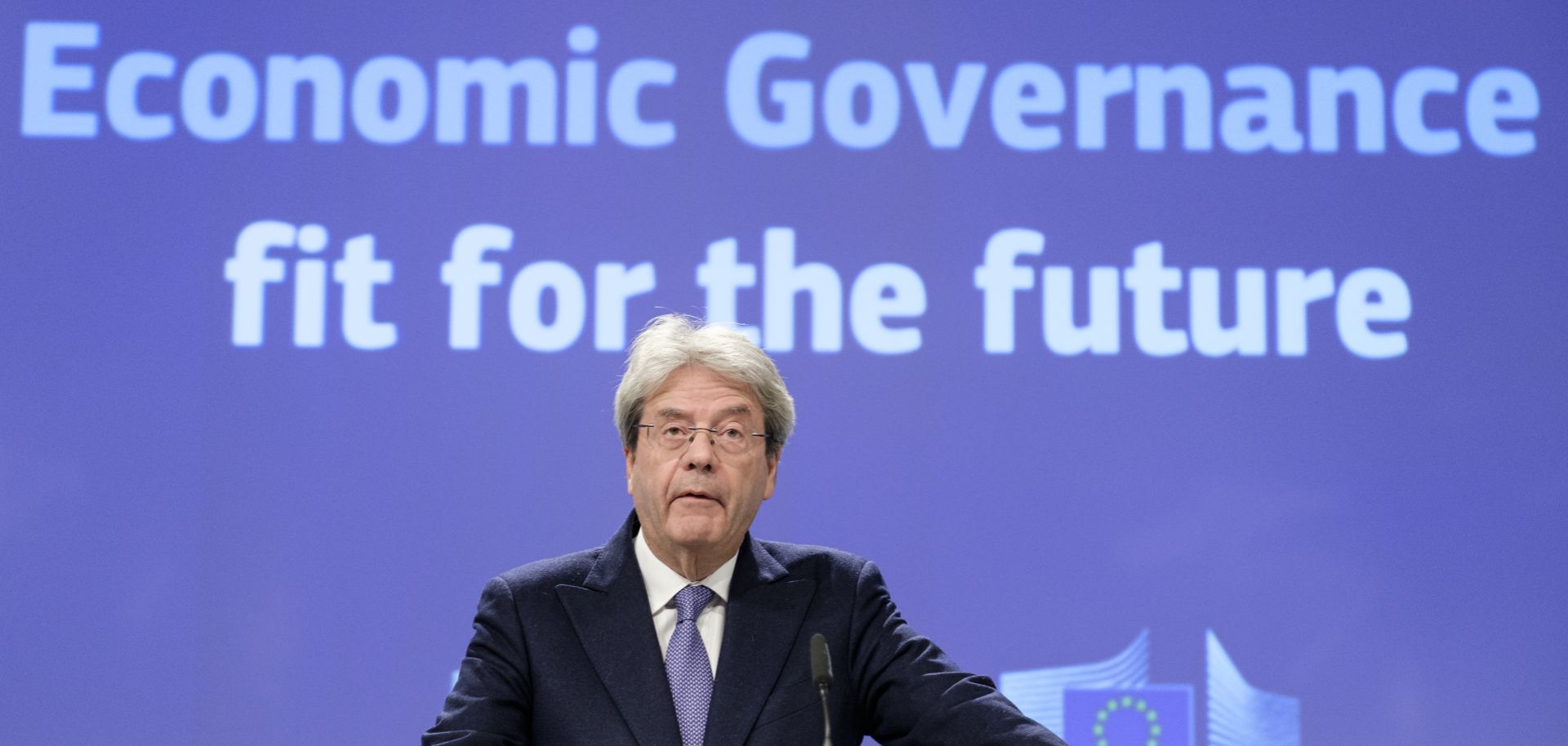
EU Economy Commissioner Paolo Gentiloni holds a press conference in Brussels on April 26, 2023, after the European Commission presented a proposed overhaul of the bloc's economic governance rules.
The latest proposed reform to the European Union's debt and deficit rules would help avoid the problematic austerity measures of the past decade as the bloc tries to gradually bring down record-high debt levels. But persistent disputes between northern and southern member states may delay its implementation, while insufficient fiscal space for public investment in key policy areas would still increase calls for greater fiscal integration over time. On April 26, the European Commission unveiled its proposal to reform the European Union's Stability and Growth Pact (SGP), which establishes sovereign debt and fiscal deficit limits for member states. The proposal would see member states create and present plans laying out their fiscal targets and measures to address macroeconomic imbalances, along with priority reforms and investments over a four-year period. The new rules would allow EU countries to set their own fiscal adjustment paths as long as they ensure their public debt falls over four years and stays on a downward path for the following decade. Key targets of the existing rules (government deficit below 3% of GDP and public debt below 60% of GDP) would remain in place, but governments would have more time and flexibility to achieve them. The proposal also introduces a more stringent enforcement regime for member states that do stray from the agreed fiscal adjustment paths, which would lead to the opening of an excessive deficit procedure and, eventually, financial sanctions. EU governments and the European Parliament will discuss the new rules in the coming weeks and months, with the aim of striking a final agreement by the end of 2023.
- The European Commission initially suspended the SGP in early 2020 to allow member states to increase public spending to cope with the COVID-19 pandemic. The rules have since remained suspended, with governments now grappling with the economic fallout from the war in Ukraine. Brussels has promised to introduce an updated SGP in 2024
- Under the updated SGP, if a government's deficit exceeds 3% of GDP, it will have to cut its deficit by 0.5% of GDP every year until it is below the limit. However, member states could get up to seven years to reduce their debt and deficit levels if they implement reforms that increase fiscal sustainability and encourage growth, or invest in areas like the green and digital transition or security and defense.
- According to 2022 government finance statistics from Eurostat, EU member states including France, Italy, Spain and Belgium will likely fall under the new corrective mechanism.
- The proposal strengthens the European Commission's enforcement regime by making fines smaller but more likely under an excessive deficit procedure. It also retains the possibility for escape clauses that would suspend the application of the SGP in case of extraordinary circumstances (like the new outbreak of a pandemic or a war in Europe).
The reform proposal aims to gradually bring down debt levels across the European Union amid higher debt levels inherited from COVID-19 and the energy crisis, while allowing for more fiscal space for public investment in key policy areas and avoiding painful austerity measures. The commission's proposal aims to revise the European Union's current fiscal rules (whose enforcement has traditionally been problematic) to better reflect member states' current economic realities following the COVID-19 pandemic and amid the ongoing war in Ukraine, which have massively increased public debt levels across the bloc by forcing governments to enact expensive emergency measures. The proposal also aims to adjust the SGP in light of emerging challenges related to the green and digital transition that will require increased public spending over the coming years. The reform is meant to facilitate a reduction in public debt ratios across the European Union in a ''realistic, gradual and sustained manner,'' as promised by European Commission President Ursula von der Leyen in her 2022 State of the Union address in September.
- In November, the commission circulated an initial draft for overhauling the SGP that excluded any uniform debt reduction benchmark, which triggered pushback from Germany and other fiscally conservative member states. In an attempt to address those concerns, the commission's new draft proposal unveiled on April 26 introduces a minimum annual deficit reduction target of 0.5% of GDP for countries with deficits above 3%. While this does not go as far as what Germany had demanded (a 1% rate for highly indebted states), it is still a significantly stricter rule than the original version.
- The four-year debt reduction goal would replace the existing rule under which governments must cut debt by 1/20th of the excess above 60% of GDP every year. Debt-laden countries like Italy, Spain, Greece and Portugal have long viewed this requirement as far too demanding.
Brussels' proposal will face resistance from northern member states, and particularly Germany, which could delay the implementation of the new SGP until after 2023. The initial reactions to Brussels' latest proposal show that member states remain divided on key details of the SGP reform. Fiscally conservative countries such as Germany and the Netherlands have expressed skepticism over the commission's attempt to shift from universal rules to bespoke debt-reduction paths under national plans, fearing highly indebted countries would enjoy too much discretion in how to consolidate their public finances. Despite Brussels incorporating extra safeguards and a stricter enforcement regime in a bid to address some of these concerns, Berlin is still calling for stricter debt-reduction targets. Germany, in particular, is also concerned about a potential politicization of fiscal rules in the bloc, whereby too much power is given to the commission to weigh member states' fiscal policies. By contrast, France and Italy see the proposals as a step forward in moving away from the bloc's current one-size-fits-all approach to debt and deficit rules, which they see as problematic. The two countries also see the additional safeguards demanded by Germany as defying the very purpose of creating a more flexible system based on member states' own debt reduction trajectories. Regardless, the European Union will still eventually adopt the proposed SPG reform (even if with some adjustments) because most EU members agree that the old rules are no longer fit for purpose. However, Brussels may struggle to broker a final deal on a revised framework by the end of 2023. This scenario would also raise the possibility of the SPG's reinstallment being further delayed. It could also see a return to the bloc's old debt and deficit rules in 2024, which would further reduce some governments' capacity to provide fiscal stimulus to their economies amid slowing growth and tightening financial conditions.
- On April 28, Germany's finance minister Christian Lindner argued the commission's proposal did ''not yet meet'' Berlin's requirements and that ''significant modifications'' were needed, including ''numeric benchmarks.''
- The Netherlands did not echo Germany's request for fixed minimum debt-reduction targets, with a spokesperson for the Dutch government issuing a more moderate reaction. But in response to the proposal, Amsterdam did demand more ''ambitious debt reduction'' and ''better compliance and enforcement.''
- Italy's finance minister Giancarlo Giorgetti reiterated Rome's call for investment expenses linked to the COVID-19 recovery plan and the green transition to be excluded from the calculation of deficit targets, which was not met in Brussels' proposal.
- France's finance minister Bruno Le Maire said Paris was ''opposed to uniform automatic deficit and debt reduction rules,'' arguing that some parts of the proposal will need to be reworked.
While the commission's reform proposal would grant member states more fiscal space for public investment, most countries will still need more room to increase spending in order to pursue key EU policy priorities for the rest of the decade, thus increasing pressure for deeper fiscal EU integration. Although more flexible and spread across longer time frames, the fiscal adjustment that countries would need to undertake to put their debt on a steadily declining path over the rest of the decade under the new SGP would still come at a time of higher debt levels and higher interest rates (and therefore higher borrowing costs for governments) since SGP rules were suspended in 2020. In this environment, public investment in areas such as energy security, decarbonization, green industrial production, and defense will be harder to pursue. Defense (which is entirely dependent on public investments) and the energy transition (which relies heavily on the public sector to unlock private financing) will require particularly high levels of government spending, which current EU funds (such as the NextGenerationEU post-pandemic recovery fund) can only partially cover. Against this backdrop, some southern and eastern EU member states may have to choose between meeting key policy priorities or breaking fiscal rules systematically for the rest of the decade — either of which would likely renew north-south divides within the bloc. For this reason, the European Union and its more fiscally sound member states in the north will face growing pressure from countries like Italy, Spain, and France to either move toward a deeper EU fiscal integration or, at the very least, increase common financing tools to fund key projects of common interest, such as energy interconnections, industrial subsidies and joint defense procurements.
- In the short term, the reinstatement of SGP rules in 2024, even in their reformed version, will force governments to at least partially consolidate their national budgets for next year. The resulting less expansionary fiscal policies, coupled with the European Union's continued tight monetary policy, will most likely dampen the bloc's economic growth in 2024.
- The new SGP's implementation will not yield the kind of austerity measures that stagnated Europe's economic growth in the 2010s following the global financial crisis, thanks to the absence of strict budget cuts requirements and an overall significantly higher degree of flexibility on fiscal adjustment paths. However, less fiscal space for most member states across the European Union will still reduce governments' ability to meet demands for public sector wage increases or provide cost-of-living support. EU countries are thus likely to continue facing labor shortages and social unrest through the end of 2024, as stubborn inflation continues to keep living costs high across the bloc.
- NextGenerationEU funds will expire in 2026, meaning southern and eastern EU member states that are currently receiving large amounts of the funds will have even fewer resources available for the second half of the decade to maintain public investment in areas like the green and digital transition.
- A study published by the New Economics Foundation on April 28 showed that the proposed SGP overhaul would leave a majority of EU member states without sufficient fiscal space to meet green spending needs in areas such as industrial policies, public infrastructure, and scale up the rollout of renewables. According to the report, only Sweden, Ireland, Denmark and Latvia would be able to meet their climate targets under the commission's proposal. Other member states, including Germany, would be able to meet less ambitious climate goals, but most countries — including France, Italy, Spain, Poland and the Netherlands — would not be able to invest enough to achieve the European Union's own climate goals.
