
Editor's Note: With many significant elections occurring in 2024, RANE is publishing a series of scenario analyses focused on different outcomes of major elections occurring this year, describing how an election outcome might unfold with implications for each potential outcome. The first installment covered India's general election, the second covered European parliamentary elections, the third covered South Africa's general election, the fourth covered Mexico's presidential election, the fifth covered Iran's presidential election, the sixth covered the United Kingdom's general election, the seventh covered Sri Lanka's presidential election, and the eighth covered the U.S. presidential and congressional elections. The following is a scenario analysis for Ghana's Dec. 7 general election.
Ghana will hold general elections Dec. 7 to elect a new president as well as 276 members of the country's Parliament. Lawmakers will be elected using a first-past-the-post voting system, but the presidential election will go to a runoff Dec. 28 if no candidate secures more than 50% of votes in the first round. In recent decades, Ghana's political life has been structured around the competition between the center-left National Democratic Congress, or NDC, and the center-right New Patriotic Party, or NPP, with former President John Mahama running for the NDC and Vice President Mahamudu Bawumia running on the NPP's presidential ticket. In addition, two candidates from smaller political parties — Alan John Kyerematen and Nana Kwame Bediako — will also compete for the presidency, raising the odds of a runoff compared to past elections. Despite the emergence of stronger third party candidates than in previous election cycles, the NPP and NDC have dominated the electoral campaign. Both main political parties have deployed inflammatory rhetoric that has heightened political polarization, especially the NDC, which has cast doubt on the integrity of the Electoral Commission. This has raised the risk of political violence ahead of, and especially on and after, election day, as vigilante groups linked to Ghana's two main parties could engage in intimidation at polling stations and launch retaliatory attacks against each other.
If Mahama wins the presidency, he will likely do so with the NDC securing a comfortable parliamentary majority. In this election outcome, the transfer of power will be mostly seamless at the institutional level, though NPP supporters would likely organize demonstrations to denounce Mahama's return to the presidency, causing political tensions to remain high for several weeks after the election as sporadic scuffles between NPP and NDC youth groups break out. Once in government, the NDC would increase government intervention in the economy to bolster the manufacturing sector and infrastructure development. Mahama will likely maintain broad compliance with Ghana's current International Monetary Fund program despite pledges to renegotiate it, but his government will ease the pace of fiscal consolidation as it removes some of the unpopular taxes passed by President Nana Akufo-Addo.
If Bawumia wins the presidency, he most likely would do so in a runoff and with the NPP failing to secure a strong majority in Parliament due to the parliamentary election's first-past-the-post voting system and divisions within the party. The NDC is unlikely to recognize Bawumia's victory, instead claiming that the Electoral Commission tilted the election to his advantage, especially in the event of tight election results. The NDC likely organizes demonstrations to contest the outcome of the vote, triggering counterprotests by Bawumia's supporters, intensifying polarization and potentially resulting in months-long political instability. The Supreme Court ultimately dismisses the NDC's legal challenges and confirms Bawumia as Ghana's president. Bawumia's government maintains continuity with regard to Akufo-Addo's economic policy, including compliance with Ghana's IMF program. If Ghana's Supreme Court finds the country's anti-LGBTQ+ bill lawful, Bawumia will sign it into law, which could see the World Bank pausing financial support for Ghana amid pressure from LGBTQ+ groups.
John Mahama Elected President
John Mahama is elected president by a significant margin, and the NDC secures an outright majority in parliament. The NPP does not contest the outcome of the vote due to Mahama's comfortable victory and smoothly transfers power at an institutional level. Certain NPP supporters hold localized demonstrations to express their discontent with Mahama's return to power, and vigilante groups linked to the NPP and NDC clash sporadically after election day. This causes political tensions to persist for several weeks after the election, especially in the NPP's stronghold of the Ashanti region in central Ghana. Once in office, Mahama's government intervenes in the economy through greater public investment in transport and energy infrastructure to support the development of light industry. The government also makes Ghana's labor laws more flexible by facilitating businesses' ability to employ staff on rotational shifts throughout the day. In parallel, the government attempts to renegotiate Ghana's support program with the IMF and scraps certain unpopular taxes introduced during the Akufo-Addo administration, threatening to cause delays to fresh financial disbursements from the fund. While this temporarily heightens market uncertainty in Ghana, Mahama ultimately remains broadly compliant with the IMF support program and likely advances revenue-raising measures on large companies operating in extractive industries to make up funding lost from the scrapping of unpopular tax cuts. This deters certain foreign investors from pressing ahead with new investments in the country's hydrocarbon and mining sectors, but Ghana is still likely to enjoy a gradual economic recovery in the first years of Mahama's term owing to fiscal adjustment completed during Akufo-Addo's term. Mahama attempts to reset relations with neighboring Francophone countries and engages in regional counterterrorism efforts to prevent the expansion of jihadist activity from the Sahel into coastal West Africa.
Implications
- The NDC secures a strong majority in Parliament, ensuring the smooth passage of key legislation such as the budget. This averts a rise in political uncertainty and mitigates downward pressure on the Ghanaian cedi.
- NPP supporters hold demonstrations to protest Mahama's return to power, while NPP- and NDC-linked vigilante groups clash sporadically. This results in heightened physical security risks persisting for several weeks after the election, while demonstrations result in time-limited disruptions to supply chains and transportation services. Demonstrations are most likely in the central Ashanti region, where the NPP enjoys strong support, although some demonstrations are also likely in Accra.
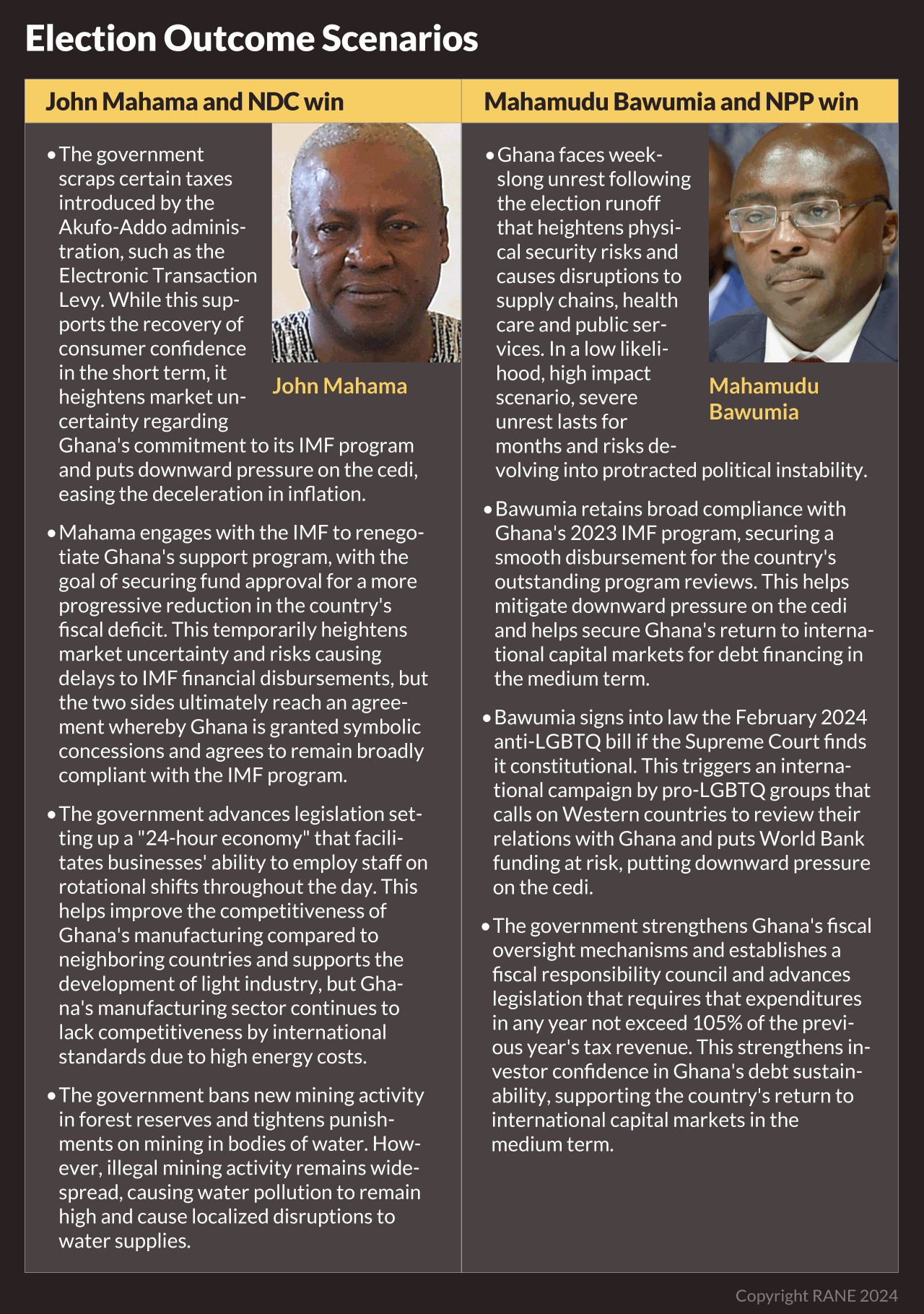
- The government scraps certain taxes introduced by the Akufo-Addo administration, such as the Electronic Transaction Levy. While this supports the recovery of consumer confidence in the short term, it heightens market uncertainty regarding Ghana's commitment to its IMF program and puts downward pressure on the cedi, easing the deceleration in inflation.
- Mahama engages with the IMF to renegotiate Ghana's support program to secure fund approval for a more progressive reduction in the country's fiscal deficit. This temporarily heightens market uncertainty and risks causing delays to IMF financial disbursements, but the two sides ultimately reach an agreement whereby Ghana is granted symbolic concessions but agrees to remain broadly compliant with the IMF program.
- The government grants banking licenses to certain financial institutions that had their banking license removed during Akufo-Addo's first term in office. This boosts households' and small businesses' access to credit, but creates medium- and long-term risks for Ghana's financial services sector, as banks having their banking license reinstated may be insufficiently capitalized and lack best practice due diligence procedures.
- The government launches new agricultural initiatives to support farmers in expanding agricultural output, including through the creation of new farm banks to improve access to credit and supporting the adoption of modern farming equipment and techniques. This helps agricultural production continue to increase gradually despite more frequent extreme weather events, benefiting the country's balance of payment by lowering the need to import basic foodstuffs and increasing revenue generated by cash crops.
- The government sets up agrifood zones that provide businesses easier access to processing resources and enable them to lower logistics costs. This supports the strengthening of local agribusiness clusters, but the initiative's success remains hampered by expansion and unreliable energy supplies, resulting in only limited job creation in rural areas.
- The government launches a $10 billion, five-year development that aims to expand and upgrade the country's transport and energy infrastructure using a public-private partnership format. While the advancement of infrastructure projects takes years to complete, this helps incrementally lower transport costs and add more power generation capacity to the country's electricity grid in the long term, making Ghana a more appealing investment destination for manufacturers.
- Mahama reaches out to neighboring Francophone countries to reset relations following allegations that Ghanaian security services signed a nonaggression pact with jihadist groups in northern Ghana during the Akufo-Addo administration, which helps maintain momentum in strengthening regional counterterrorism efforts. The coordination of Ghanaian security forces with that of neighboring countries gradually improves, but northern Ghana remains exposed to jihadist activity due to the continued deterioration of Burkina Faso's security environment and a persistent lack of funding for regional counterterrorism initiatives.
- The government advances legislation setting up a "24-hour economy" that facilitates businesses' ability to employ staff on rotational shifts throughout the day. This helps improve the competitiveness of Ghana's manufacturing compared to neighboring countries and support the development of light industry, but Ghana's manufacturing sector continues to lack competitiveness by international standards due to high energy costs.
- The government increases taxation on large companies operating extractive industries and increases the government's stake in new mining projects. This deters foreign investors from proceeding with new investments in the mining and hydrocarbon sectors, curbing government revenue.
- The government bans new mining activity in forest reserves and tightens punishments on mining in water bodies. Illegal mining activity remains widespread, however, causing water pollution to remain high and localized disruptions to water supplies.
The NPP Retains the Presidency, but Lacks a Strong Parliamentary Majority
A Bawumia victory is most likely to coincide with the NPP failing to secure a strong parliamentary majority due to divisions within the party and the first-past-the-post voting system used for the parliamentary election. If a runoff occurs, it will prompt the NPP and NDC to escalate their use of inflammatory rhetoric to mobilize voters, heightening political polarization in the country during the three-weeks between the first round and the runoff. If the results are close, the NDC is unlikely to recognize Bawumia's victory, and instead claims that the Electoral Commission tilted in favor of the NPP through improper management of voter rolls. The opposition party thereafter files a petition to the Supreme Court to challenge the results and launch large-scale demonstrations to denounce alleged vote rigging. The Supreme Court ultimately rules in favor of Bawumia, however, and tensions gradually deescalate over the course of 2025. As political tensions ease, the government initiates tax reforms, including the transition to a flat tax regime along with policies aimed at increasing the digitization of Ghana's economy. The passage of legislation is slowed by the NPP's lack of a strong parliamentary majority. In parallel, Bawumia reinforces Ghana's fiscal oversight mechanisms and remains compliant with the IMF support program, successfully completing the program's review. Despite this, Ghana's financial support from the World Bank remains at risk, as Bawumia reiterates his intent to signal the country's anti-LGBTQ+ bill into law if the Supreme Court approves the measure, causing short-term market uncertainty that puts downward pressure on the cedi.
Implications
- Ghana faces weekslong unrest following the election runoff that heightens physical security risks and disrupts supply chains, health care and public services. In a low likelihood, high impact scenario, severe unrest lasts for months and risks devolving into protracted political instability.
- In the unlikely event that Bawumia and the NPP win the election decisively, the risk of protracted violence will decrease, as many NDC supporters are likely to be demobilized. Protests are still likely, however, including in Volta and Oti regions, where the NDC enjoys strong support.
- The government strengthens Ghana's fiscal oversight mechanisms, establishes a fiscal responsibility council and advances legislation that requires that expenditures in any year do not exceed 105% of the previous year's tax revenue. This strengthens investor confidence into Ghana's debt sustainability, supporting the country's return to international capital markets in the medium term.
- Bawumia's lack of a strong parliamentary majority repeatedly delays the passage of structural reforms and sporadic upsurges in political volatility. This adds downward pressure on the cedi, thereby adding upward pressure on inflation.
- If the NPP secures a strong parliamentary majority, the government faces reduced challenges in passing legislation, including potential new fiscal consolidation measures, in turn easing downward pressure on the cedi.
- Bawumia retains broad compliance with Ghana's 2023 IMF program, securing a smooth disbursement for the country's outstanding program reviews. This helps mitigate downward pressure on the cedi and helps secure Ghana's return to international capital markets for debt financing in the medium term.
- The government introduces a one-time tax amnesty for households and businesses from the payment of taxes from previous years and waives penalties for failures to file taxes in previous years. This helps marginally increase the tax base, but tax avoidance remains widespread due to the large size of Ghana's informal sector, causing long-term vulnerabilities to Ghana's fiscal balance to continue.
- The government establishes a $100 million Fintech Fund tasked with delivering seed capital to Ghana's tech startups. While this supports the growth of new tech startups by easing access to credit, Ghana's tech companies face hurdles in growing, leaving Ghana's tech sector broadly uncompetitive compared to international competitors.
- The government implements a five-year digital nomad visa and work permit. While this does not improve Ghana's appeal to workers from other Economic Community of West African States countries due to freedom of movement provisions within the bloc, it helps Ghana attract qualified workers from other African countries, supporting marginal improvements in productivity in Ghana's high-end sectors, such as tech and finance.
- The Bawumia government introduces an e-cedi, Ghana's central bank digital currency. This supports the growth of Ghana's digital payment ecosystem, reducing transaction costs for businesses, but the initiative only finds limited success in tackling corruption, tax avoidance and money laundering, as individuals retain access to cash options.
- Bawumia signs the February 2024 anti-LGBTQ bill if the Supreme Court finds it constitutional. This triggers an international campaign by pro-LGBTQ groups that calls on Western countries to review their relations with Ghana and puts World Bank funding at risk, putting downward pressure on the cedi.
- Bawumia supports regional counterterrorism structures, but faces mistrust with Burkina Faso and Togo over allegations that Ghanaian security services are involved with jihadist groups in northern Ghana. This results in only marginal improvements to joint counterterrorism with both countries, increasing northern Ghana's vulnerability to jihadist attacks in the medium term.
- The government increases its reliance on public-private partnerships to expand and maintain public infrastructure. This reduces public expenditure that helps finance the government's transition to a flat-tax regime.
- If the NPP secures a strong parliamentary majority, the government is likely to shift Ghana's income tax system to a flat-tax regime. This would cause a shortfall in government revenue as higher-income earners and large companies pay less taxes, but encourages private sector investments in the Ghanaian economy, supporting the country's economic recovery and job creation.
