
Ghana will likely enjoy rebounding economic growth in 2025 thanks to its adherence to its International Monetary Fund (IMF) program, even if political risks from upcoming elections pose short-term threats and the country's lack of economic diversification potentially hinders growth in the medium to long term. On Sept. 5, Ghana's government invited its Eurobond investors to exchange their bonds for newly issued ones, a pivotal step in the country's debt restructuring process. This marks the latest milestone in Ghana's debt overhaul — a key component of its May 2023 $3 billion support package with the IMF. It also comes after the country finalized a debt restructuring deal with official creditors and reached an agreement in principle with Eurobond investors to overhaul $13 billion of dollar-denominated bonds in June. Moreover, the Ghanaian government has pressed ahead with a range of structural economic reforms since December 2022 as part of its Post-COVID-19 Program for Economic Growth (PC-PEG), including fiscal consolidation measures, reforms to state-owned enterprises, and the recapitalization of state-owned banks. Together with the country's progress in restructuring its debt, the PC-PEG has enabled Ghana to maintain strong compliance with its IMF program, helping it secure a $360 million disbursement in late June after the fund completed the second review of Ghana's support package. This has helped stabilize Ghana's national currency, the cedi, which has broadly plateaued in recent months after slumping by over 20% between January and June.
- Ghana secured a support package from the IMF in May 2023 after the country defaulted on around $30 billion of its external debt in December 2022. As of September 2024, the IMF has disbursed around $1.56 billion in financial support to Ghana since the start of the program, with a further $1.4 billion due to be delivered in tranches of around $350 million every six months. The IMF is slated to complete its third review of Ghana's program in December.
- Ghana's fiscal deficit stood at 11.7% in 2022, but this narrowed to 4.5% of GDP in 2023 on the back of fiscal consolidation measures and improved revenue performance. Ghana's mid-year fiscal policy review foresees a fiscal deficit of 4.2% in 2024.
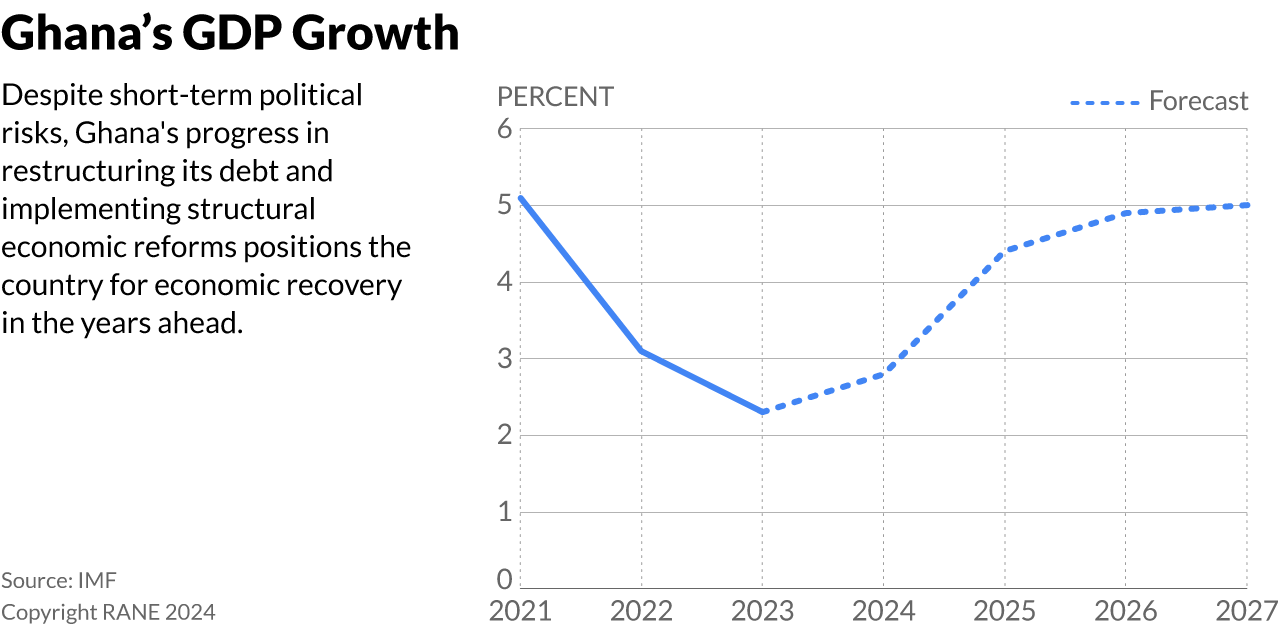
Despite Ghana's adherence to its IMF program, the economy faces short-term risks due to the potential for violence related to the country's upcoming general election, and because the two leading presidential candidates support measures that may jeopardize financial support from multilateral lenders. The Ghanaian government's structural economic reforms are expected to boost the country's GDP growth, which the IMF foresees rising from 2.8% in 2024 to 4.4% in 2025. However, Ghana's Dec. 7 general election could undermine the country's economic recovery given the elevated risk of post-election political instability. The two main contenders in the presidential race are Vice President Mahamudu Bawumia, who hails from outgoing President Nana Akufo-Addo's New Patriotic Party (NPP), and John Mahama of the opposition National Democratic Congress (NDC). Mahama, who previously served as Ghana's president from 2012-2017, has accused the Electoral Commission of colluding with the ruling NPP, which has increased political polarization in the country. Given that the NDC already contested the outcome of Ghana's 2020 general election, there is an elevated likelihood of Mahama contesting the official results of the 2024 election if NPP candidate Mahamudu Bawumia is declared the winner. This would portend potentially large-scale post-election violence, which could in a low-likelihood, high-impact scenario devolve into protracted political instability that prevents a return of foreign investments into the country. Even if the election process is not marred by large-scale violence, both the NDC and NPP have forwarded proposals that threaten external support from multilateral lenders. Bawumia has vowed to sign Ghana's anti-LGBTQ bill into law, which risks prompting the World Bank to suspend further disbursements to the country. Mahama, meanwhile, has vowed to renegotiate the country's IMF deal, which could also result in delays in the disbursement of new IMF tranches. Either of these cases would thus risk reducing the availability of hard currency in the country and increase downward pressure on the Ghanaian cedi.
- Ghana's parliament passed the Human Sexual Rights and Family Values Bill, commonly known as the anti-LGBTQ bill, with bipartisan backing on Feb. 28. The bill introduces three-year prison terms for individuals identifying as LGBTQ and five-year sentences for individuals sponsoring LGBTQ activities. However, President Akufo-Addo has said that he would only sign the bill into law if it was deemed constitutional by Ghana's Supreme Court, which has yet to rule on the matter.
- Polling from Global InfoAnalytics published on Sept. 10 showed that Mamaha would receive 53% of the vote in the Dec. 7 ballot, against 31.6% for Bawumia, with no other candidate exceeding the 3% mark. The poll showed that 11.2% of voters were still undecided.
- In August 2023, the World Bank halted financial support to Uganda after the country passed an anti-LGBTQ bill.
The limited risk of protracted political instability means that Ghana will likely experience an economic recovery in 2025 and beyond, even if the economy's lack of diversification will leave Ghana vulnerable to future commodity shocks. Despite an elevated risk of the general election's outcome being contested, Ghana's relatively stronger institutions compared with most other African countries reduce the likelihood of the ballot resulting in protracted political instability. Moreover, both Bawumia and Mahama's controversial campaign proposals may not be implemented. Bawumia, like President Akufo-Addo, has hinted that signing the anti-LGBTQ bill into law would be contingent on Ghana's Supreme Court ruling that the bill was constitutional, while Mahama would likely face strong pressure to comply with Ghana's IMF program as a failure to do so would risk triggering a further depreciation of the cedi. In addition, while Bawumia signing the anti-LGBTQ bill into law would have a high risk of prompting the World Bank into freezing support to Ghana, it would be less likely to derail the country's IMF program. This means that despite election-related risks, Ghana's economic rebound remains likely to materialize, which — together with the country's progress in its debt restructuring — could enable Ghana to regain access to international capital markets in the medium term. Rebounding economic growth will also help progressively alleviate socioeconomic grievances, even though these will likely persist over the coming year amid ongoing, albeit declining, inflation. Nonetheless, the Ghanaian economy remains heavily exposed to potential commodity shocks over the coming years as over 80% of the country's export revenue depends on gold, oil and cocoa. While both Bawumia and Mahama have pledged to accelerate efforts to diversify the economy, these initiatives will likely face significant challenges given Ghana's power shortages, as a reliable source of electricity is a key component for growth in the manufacturing and services sectors. With Ghana likely to remain heavily reliant on commodity exports in the year ahead, the country will remain exposed to potential drops in gold, cocoa and oil prices, which would expand the country's trade deficit and risk reducing government revenue due to declining royalties.
