
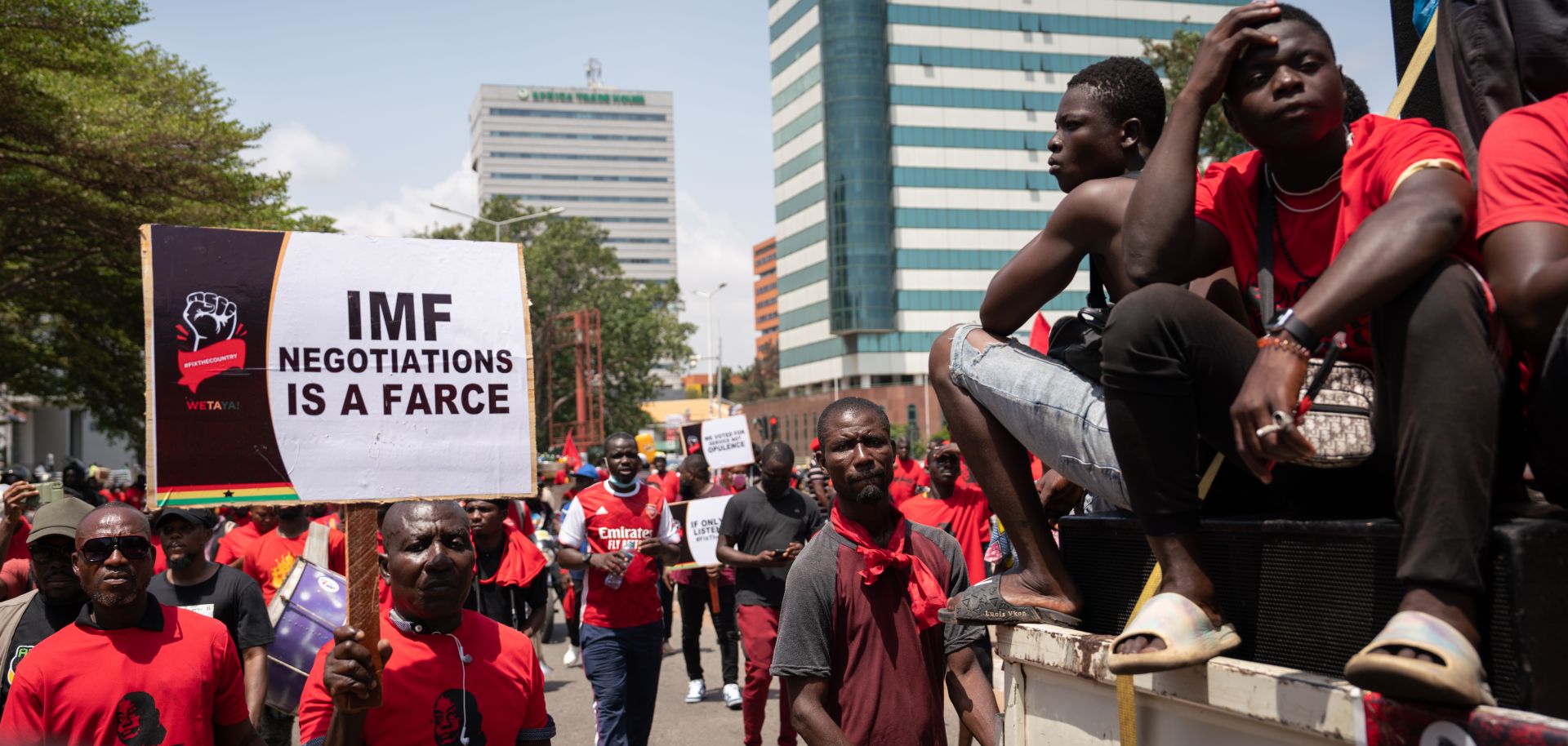
Ghanaians march in Accra on Nov. 5, 2022, to protest against the government’s handling of the country’s dire economic crisis.
The International Monetary Fund (IMF)'s approval of a $3 billion bailout will enable Ghana to begin recovering from its worst economic crisis in a generation, but the required unpopular fiscal consolidation measures may increase political volatility ahead of the 2024 general election. On May 17, the IMF Executive Board approved a relief package with an immediate disbursement of $600 million to support Ghana's economic recovery. The program is based on the Ghanaian government's Post-COVID-19 Program for Economic Growth (PC-PEG), which seeks to implement wide-ranging reforms to build macroeconomic and debt sustainability. Ghana is also in the process of restructuring its external debt under the Group of 20 (G-20) Common Framework, which the IMF had set as a prerequisite for the disbursement of funds. IMF Managing Director Kristalina Georgieva said that bilateral creditors have agreed to make Ghana's debt sustainable, but details on debt negotiations have not yet been made public.
- In the days preceding the IMF's announcement, Minister of State for Finance Mohammed Amin Adam said the Ghanaian government expects another $600 million disbursement in November 2023 and for the remainder of the loan to be granted in equal portions of $350 million every six months.
- The G-20 Common Framework was launched in 2020 during the COVID-19 pandemic as a mechanism to coordinate debt relief between the Paris Club of sovereign creditors and other lenders like China and private creditors.
The IMF deal comes after Ghanaian President Nana Akufo-Addo reversed his previous policy not to seek economic aid. In 2017, Akufo-Addo unveiled his ambitious ''beyond aid'' initiative, which sought to reduce Ghana's dependence on foreign aid. But in July 2022, the president reversed that policy when he requested a $1.5 billion aid package from the IMF (which then turned into the current $3 billion package) in the face of increasingly unserviceable debt costs, a currency crisis and revenue deficiencies. Over the course of 2022, these challenges led to Ghana losing access to international markets and precipitated the country's default in December 2022, when the finance ministry suspended debt payments on eurobonds, commercial term loans and most bilateral loans. The Ghanaian cedi's value against the U.S. dollar declined nearly 60% from 2021 to 2022, and the country's foreign exchange reserves dropped almost 50% from August 2021 to May 2023. Ghana's sharp economic decline and the decision to seek aid from the IMF prompted social unrest amid concerns that the bailout would entail more painful economic reforms (like tax hikes) and anger that the Akufo-Addo administration played into what some Ghanaians see as imperialist-era lending structures.
- Ghana has sought relief from the IMF 17 times since 1966, and the public is generally resistant to the consolidation measures that tend to accompany the loans.
- On Nov. 5, more than 1,000 Ghanaians took to the streets in the capital Accra to protest their president's handling of the country's economic crisis, chanting ''Akufo-Addo must go'' and ''IMF no.'' In June, police clashed with hundreds of demonstrators in Accra who were protesting against high fuel prices and tax hikes, resulting in 12 casualties.
The disbursement of the IMF relief package will enable the government to begin recovering from its economic crisis, although the required reforms are likely to be unpopular and politically costly. The loan will boost Ghana's foreign reserves and set up more sustainable macroeconomic policies, improving creditors' prospects of repayment. Ghana owes about $13 billion of debt owed to private creditors, although it's still not clear what the terms of debt restructuring will be under the G-20 Common Framework. The program will also require Ghana to carry out fiscal consolidation measures, some of which the government has already begun to implement (including revenue-raising tax increases and cocoa sector reforms). Lawmakers from the country's two dominant political parties — the ruling New Patriotic Party (NPP) and the opposition National Democratic Congress (NDC) — both appear to recognize the need to efficiently implement the IMF's required measures in order to unlock the funds that will kickstart Ghana's economic recovery. The Akufo-Addo administration will thus likely have enough votes in parliament to push through some of the required reforms. But the opposition will likely try to leverage public anger over certain consolidation measures (like tax increases) to garner support ahead of the December 2024 election, which could incentivize NDC lawmakers up for reelection to reject more unpopular measures and potentially incite violent demonstrations in the lead-up to the ballot. As Ghana's 275-seat unicameral parliament is split (with the NPP currently holding 138 seats, the NDC holding 137 and one independent lawmaker occupying the last seat), such political jockeying could prevent some of the IMF's required reforms from being carried out, although the organization may be more flexible on the timeline of implementation given the political context.
