
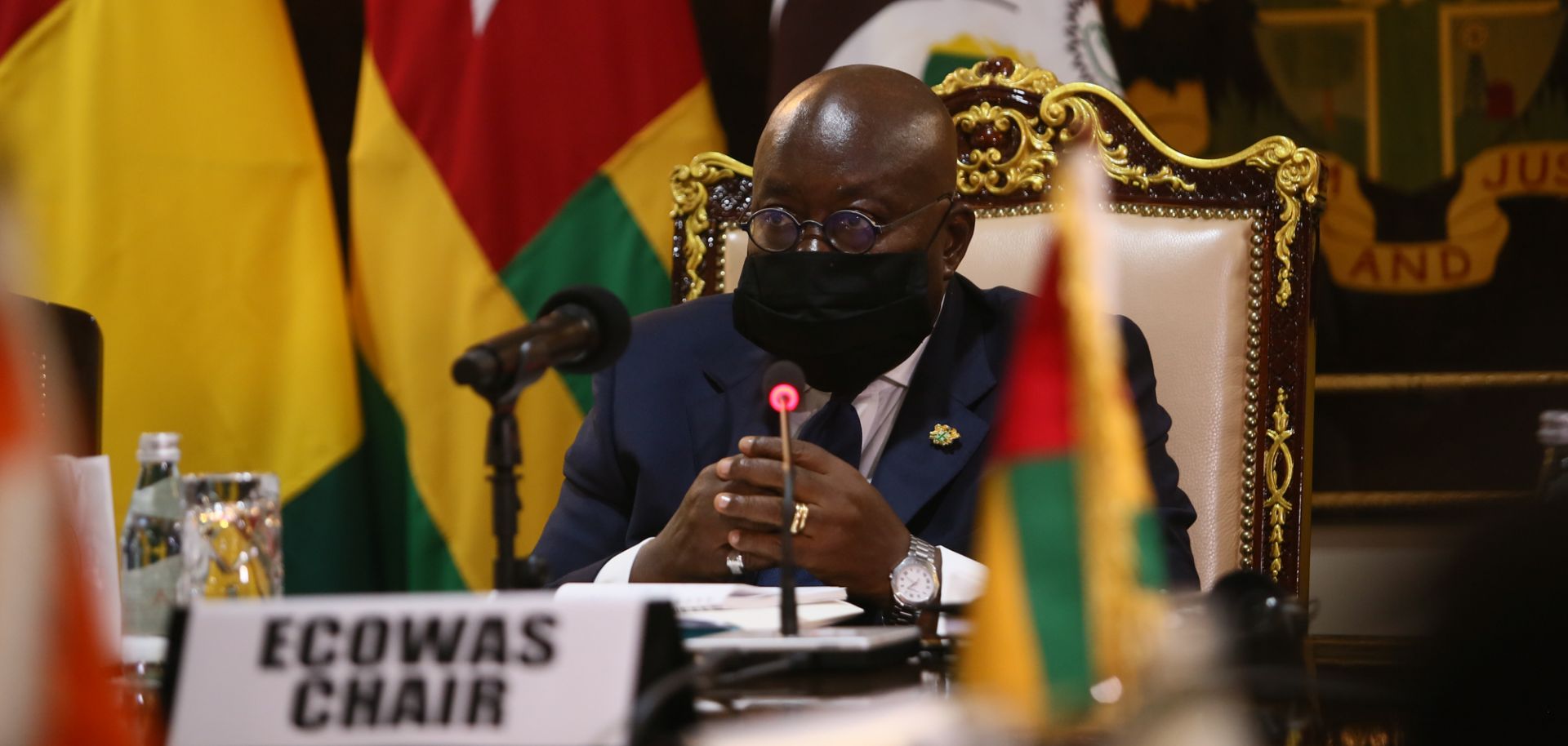
Ghanian President Nana Akufo-Addo is seen at an Economic Community of West African States (ECOWAS) meeting in Accra, Ghana, on Sept. 15, 2020.
Ghana’s increasing debt vulnerability risks limiting its own ability to obtain much-needed loans, as well as that of its neighbors by casting doubt on the entire creditworthiness of sub-Saharan Africa. In October, the risk premium on Ghana’s eurobonds increased by nearly 150 basis points (bps) to a yield of more than 900 bps (9%) over comparable U.S. Treasury benchmark securities. This sharp increase underlines the country’s growing indebtedness and reliance on external financing as global credit conditions tighten and interest rate hikes take hold. But given that Ghana is one of the largest eurobond issuers in sub-Saharan Africa, it also indicates global investors’ increasing risk aversion, which will affect funding costs for 19 other countries in the region with outstanding eurobond debt.
- The spread on Ghana’s credit default swaps (CDS), a form of insurance against non-payment, more than doubled over its average for the past year to 1,033 bps over U.S. Treasury CDS yields. Among 64 countries with outstanding CDS, only those for Argentina, El Salvador and Sri Lanka cost more.
- Ghana was planning to issue an additional $2 billion worth of new eurobonds in November, though the sale has since been postponed according to Bloomberg. With the high interest rates required, the projected total interest costs for Ghana’s debt would have been more than 9% of GDP and one-third of budgeted expenditures for 2022.
Ghana has strong economic growth potential, yet creditors are increasingly concerned with the country’s weak public finances. Ghana benefited from low global interest rates over the past 10 years and a high risk appetite among investors who, until recently, deprioritized debt sustainability concerns in allocating funds as they searched for high yields. It was the first country in the region to return to international capital markets with $3 billion in new eurobonds in March 2021 after capital flight from emerging markets and developing countries abated during the first year of the COVID-19 pandemic. Yet, the borrowing was at higher interest rates, ranging from 7.75-9.25% depending on the term, and shorter maturities than pre-pandemic levels with credit conditions tightening.
- Ghana was able to maintain slightly positive real GDP growth of 0.4% in 2020 through a combination of high fiscal spending that increased the country’s overall budget deficit to 15.2% of GDP. Central bank lending to the government also increased by 4.4%.
- Ghana’s 2021 budget aims to reduce the fiscal deficit to 10.5% of GDP, with plans to bring that level down to 8.1% by 2025. But these deficit levels are still extraordinarily high compared with Ghana’s 2010-2019 average of just over 6% of GDP.
- In mid-October, Ghana reported that government revenue fell short of target by 12% in the first seven months of 2021 and may continue at that rate for the rest of the year. At 14.9%, the Ghanian government’s revenue-to-GDP ratio is below the 15% minimum the World Bank considers necessary to provide essential government services.
- The lack of revenue will further slow an already nearly stagnant pace of fiscal consolidation and leave Ghana’s economy heavily exposed to risks of further fiscal slippage. As a result, Ghana’s public debt trajectory risks increasing well beyond the already projected increase to 83.5% of GDP this year and to 87% in 2025.
Further increases in public debt may not be sustainable, especially given Ghana’s large external financing needs. Financial markets have recently begun sending this message by repricing the country’s credit risk. The International Monetary Fund (IMF) and World Bank classify Ghana as at high risk of debt distress, although a July analysis said the country’s current debt could feasibly be paid if appropriate reforms were taken. Ghana’s recovery, however, depends critically on continued access to international capital markets and a resumption of foreign direct investment — neither of which is guaranteed if global financial conditions tighten or there is a loss of investor confidence. A failure to reduce the public debt with a credible fiscal consolidation or emergence of liquidity problems for a lengthy period, as well as sustained exchange rate depreciation, could all accelerate an economic decline. Ghana also lacks an identified revenue source for repayment, with its eurobond borrowing having so far been used mainly for budget support instead of financing development.
- Ghana’s gross external financing requirements are projected to reach more than $7.1 billion in 2021 — mainly to refinance existing debt, with the financing of the country’s current account deficit accounting for less than a quarter ($1.7 billion) of those needs.
- Without additional external financing, Ghana’s net international reserves of $5.2 billion can only cover a little over two months of imports.
- The IMF forecasts the Ghanian government’s overall balance of payments to deteriorate further over the next five years, due mainly to increasing interest costs. There is also an unknown stock of contingent government liabilities — especially in Ghana’s energy sector, where estimated arrears are currently at $3-4 billion and growing, according to Fitch Ratings.
- Meanwhile, Ghana’s capital and financial accounts of the balance of payments fell from a surplus of 4.6% of GDP in 2019 to only 0.9% in 2020 due to a fall in foreign direct investment and portfolio flows.
Ghana’s increasingly risky position also threatens sub-Saharan Africa’s general creditworthiness since Ghana is the most active issuer of eurobonds, with $11 billion of issuance just from 2018-2021. 20 sub-Saharan African countries had outstanding, tradeable eurobonds worth $136 billion outstanding as of end-June 2021. Of those, 17 are classified by the IMF and World Bank as being near or in debt distress, and only Botswana has an investment-grade rating. The largest outstanding debt stocks are owed by South Africa, Ghana, Zambia, Senegal, Gabon, and Ivory Coast. The possibility of disrupted finances leaves the sub -Saharan African region vulnerable to shocks, including higher international interest rates and tighter financial conditions, as well as commodity price shifts and export shortfalls. Even if this doesn’t lead to a generalized Africa debt crisis, individual country factors are becoming more prominent and lenders and investors will pay more attention to idiosyncratic risks, which could make it much more difficult for some countries to find foreign funds to grow and develop.
