
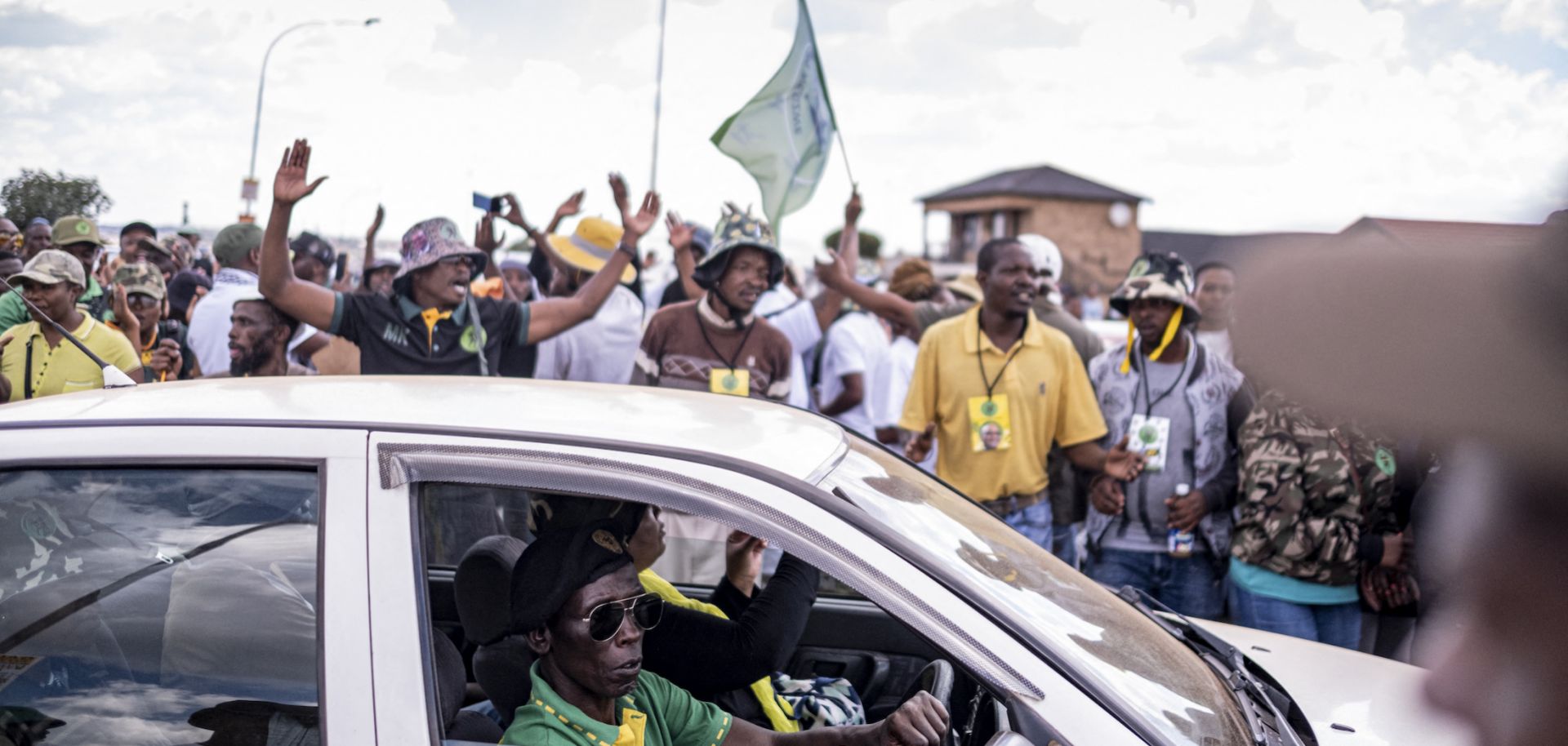
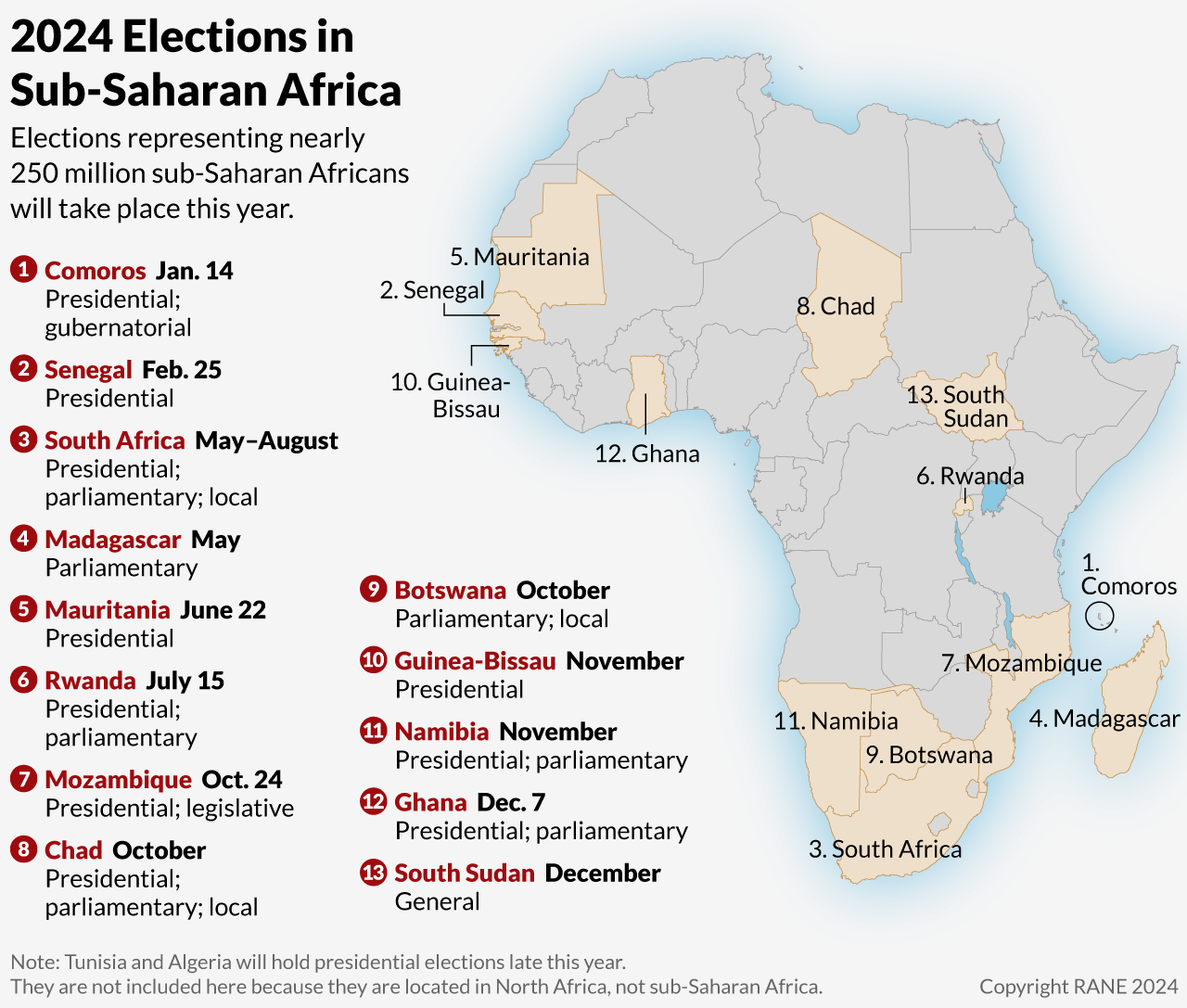
In sub-Saharan Africa, 13 countries will hold elections in 2024, but the polls in Senegal, South Africa, Chad, Ghana and South Sudan will likely be the most impactful, with potential implications ranging from economic fallout to political crises and democratic backsliding. Nearly 250 million sub-Saharan African citizens will head to the polls in what will perhaps be the biggest electoral year for the sub-continent in decades. The most significant of these elections will be held in Senegal, South Africa, Chad, Ghana and South Sudan; below we take a closer look at each of these ballots in the order in which they will occur.
Senegal
Senegal will hold a presidential election on Feb. 25, during which ruling party candidate Amadou Ba will run against a disunited opposition. President Macky Sall of the Alliance for the Republic currently governs Senegal, and put to rest widespread fears that the country's democracy would collapse when he announced in mid-2023 that he would not seek an unconstitutional third term, after which he announced his support for Ba., On Jan. 22, the Constitutional Council published the list of candidates who will be allowed to participate in the Feb. 25 presidential election, but opposition candidates Ousmane Sonko and Karim Wade were not on the list. The council ruled that Sonko was not eligible because he faces a six-month suspended prison sentence related to his conviction for defamation, and also deemed Wade ineligible because he had dual citizenship at the time he formally declared his presidential candidacy (Wade renounced his French citizenship the week of Jan. 15). The announcement sparked widespread condemnation, but it appears unlikely that the opposition candidates allowed to run will unite ahead of the election, increasing the likelihood that Ba will win.
The elections will likely be competitive and trigger bouts of unrest, although the real test will be the extent to which the government tries to interfere in the vote. Unrest related to perceptions of government abuses (including interference in the judiciary, manipulation of the electoral commission and utilization of state security forces for officials' personal gain) will likely occur in Dakar, Thies, Ziguanchor and other cities. While demonstrations have been relatively limited in recent months, specific events like police violence or allegations of fraud have the potential to trigger an escalation similar to the unrest seen during Senegal's July 2021 legislative elections. Violence and looting will all but certainly cause transportation, business and governance disruptions, but such disruptions would likely only last for a week or two at most given security forces' tendency to crack down on demonstrations (barring a very unlikely devolution of security). Although Ba has the upper hand, the election will still likely be close in contested areas of the country, and there will be locations that overwhelmingly vote in favor of the opposition. This means that if Ba wins and sticks to current President Macky Sall's economic development plan and fiscal consolidation measures as he has promised to do, he will likely face strong resistance, though likely not enough to prevent him from passing legislation. Despite this policy continuity, allegations of fraud and other irregularities during the electoral process may have a long-term impact on the country. Senegal is often heralded as a stable democracy in an extremely fragile region, and the erosion of its institutions raises risks of political instability, poor governance, business discontinuity and investor hesitancy. While this election alone will not determine the viability of Senegal's future democracy, state interference would further undermine public trust in the government and deepen the precedent for electoral fraud, contributing to long-term trends of democratic slippage.
South Africa
South Africa's election in mid-2024 will be the country's most competitive in 30 years, testing the political dominance of the ruling African National Congress (ANC) party. The ANC, which has ruled South Africa since the end of apartheid in 1994, faces its lowest-ever levels of popular support. While President Cyril Ramaphosa has said that he expects to win re-election comfortably, record-setting electricity blackouts, corruption scandals, insufficient health and education services, wage disputes, rampant poverty and high unemployment have led most pre-election surveys to predict that the ANC will win between 45 and 51% of votes, down from 57.5% in the previous election. This suggests high uncertainty over whether the ruling party will win the majority of parliamentary seats (and therefore easily clinch the presidency).
South Africa's election will increase political uncertainty amid a potential first-ever minority or coalition government and risk a broader political crisis. Home to sub-Saharan Africa's second-largest economy, the country is an export hub for southern Africa and plays an outsized diplomatic role. This means the highly uncertain and potentially unprecedented outcome of the upcoming election will impact not only South Africa, but the numerous Global South countries that look to South Africa for leadership. In the least disruptive scenario, the ANC would win over 50% of votes, maintain its parliamentary majority and re-elect Ramaphosa for a second presidential term. Still, the party would very likely continue to lose support over the long term, given factionalization and corruption within the party that prevent the government from addressing unemployment, poverty, inequality and the electricity crisis. In other, more disruptive scenarios, the ANC could be forced into a coalition from varying positions of weakness, depending on the margin of electoral defeat. If the ANC wins a large plurality of votes (meaning just under 50% and significantly more than the next closest party), it could still re-elect Ramaphosa by forming a coalition (although not necessarily a stable one) with a minority party, which may force the ANC to make some policy concessions, potentially ranging from more aggressive land reform to reducing social services. However, given that no opposition party presents as an obvious choice for alignment with the ANC, South Africa could also face a broader political crisis if no deal is struck. This scenario becomes more likely with fewer votes for the ANC; opposition parties could attempt to extract concessions for every vote of support in the National Assembly, potentially leading to parliamentary gridlock on crucial issues like electricity reform. Finally, the next-most popular political party, the Democratic Alliance (a pro-businesses opposition party popular in Cape Town with majority white supporters), could form a minority government, which would very likely precipitate a national reckoning and a sudden shift in power, race and political dynamics. The likelihood of this scenario, however, remains remote given the Democratic Alliance's limited national popularity.
Chad
Chad is scheduled to hold presidential and parliamentary elections in October, when Interim President Mahamat Idris Deby is expected to run to attempt to secure a five-year term. Deby assumed leadership in Chad in April 2021 after the passing of his father, Idriss Deby Itno, who died on the front line during a conflict with rebels after a 30-year reign. Following Deby Itno's death, the army established a transitional military council comprising 15 generals, with Deby junior at its helm. Deby later implemented a transition plan, which included a constitutional referendum passed in November 2023 that cleared the path for elections in October 2024. In January, Chad's ruling Patriotic Salvation Movement party designated Deby as its presidential candidate, confirming speculation that Deby would use some aspects of the new constitution to make his reelection more probable (like the requirement that candidates are born citizens of Chad to Chadian parents, disqualifying some potential opposition candidates who have Sudanese parents). Deby also appointed ex-prominent opposition leader Succes Masra as prime minister in January, removing his would-be primary challenger.
Deby's expected attempt to maintain power at the expense of electoral integrity risks triggering a military overthrow in Chad, the only remaining Sahelian country that has not experienced a coup in recent years. All three of Chad's Sahelian neighbors to the west have experienced one or multiple coups in the last three years, which has created a broader political environment of impunity. While there have not been any recent rumors of coup plots in Chad, the country is embroiled in several conflicts, has an active opposition movement that is critical of the Deby government, and is highly dependent on the cohesion of its military. Chad is experiencing rebel activity in the north, Islamist violence in the Lake Chad region, and is at risk of violent spillover from Darfur in Sudan. While Chad's military is among the most competent in the region, this worsening violence has previously triggered doubts about Deby's leadership. Chadian opposition parties and civil society members have also openly criticized Deby's alleged fraud in the constitutional referendum process and postponement of elections; in October 2022, security forces opened fire on people taking part in nationwide demonstrations to demand a transition to civilian rule, killing at least 50 people. Deby will continue to rely heavily on the military for legitimacy and support, making him especially vulnerable to opportunistic military leaders who may seek to exploit discontent in order to seize power. The election is a flashpoint that could provide such an opportunity, especially if electoral fraud is blatant, demonstrations are widespread and security forces use disproportionate force. As France's last remaining Sahelian partner, a coup in Chad would threaten a larger political crisis as it would risk a breakdown in the country's historically close partnership with Paris and create new opportunities for armed groups, potentially enabling cross-border collaboration in new territories across the Sahel.
Ghana
Ghana will hold presidential and national assembly elections on Dec. 7 as it emerges from its worst economic crisis in a generation. Ghana will hold general elections in December, when Vice President Mahamudu Bawumia will run under the New Patriotic Party (NPP) against opposition candidate and former president John Mahama under the National Democratic Congress. (NDC). Economic grievances will drive this election, meaning protests against austerity measures and high costs of living driven by high food and fuel prices will likely persist and may escalate into more violent demonstrations as the election nears. The National Assembly elections will likely be highly competitive, as Ghana's parliament is currently split between the NPP and NDC with one swing vote, the outcome of the National Assembly elections will also be highly impactful for the next president's ability to pass legislation.
Uncertainty over whether Ghana's next president will continue fiscal consolidation measures will likely compound investor hesitancy, delaying Ghana's full economic recovery through 2024. Backlash against the current administration's decision to seek relief from the International Monetary Fund (IMF) is highly likely to show up in polling, although this does not necessarily guarantee the opposition will win. Bawumia has vowed to continue the policies of President Nana Akufo-Addo, namely by adhering to the IMF program and continuing to invest in the country's national development strategy. Mahama has criticized Akufo-Addo's ''economic mismanagement,'' and has also pledged to prioritize Ghanaians' economic wellbeing (though it's currently unclear whether that means that he would abandon consolidation measures). Given how unpopular the IMF program and its associated austerity measures are with the Ghanaian public, it is possible that either candidate (although especially Mahama) could stop implementing the measures required by the IMF upon taking office. The January external debt restructuring package makes this less likely, given that the country is finally seeing progress coming out of its debt crisis. But nonetheless, even perceptions of uncertainty regarding adherence to the program will likely compound investor hesitancy and prolong Ghana's economic recovery.
South Sudan
In December, South Sudan will hold its first-ever national election since independence in 2011, where incumbent leader Salva Kiir is slated to run for another term. Kiir has led South Sudan since the war that led to the country's independence in 2011. In July, the ruling Sudan People's Liberation Movement party endorsed Kiir to run for the presidency in 2024. In 2022, Kiir postponed general elections originally scheduled for February 2023 to December 2024 and claimed that the country was not in place to support elections. In response to the ballot delay, the rival faction led by Vice President Riek Machar accused Kiir of trying to circumvent the country's power-sharing agreement. Machar, who has not yet announced his candidacy, is widely presumed to be Kiir's primary challenger in the presidential race. In December 2023, the United Nations warned that South Sudan would not be fit to hold elections given the lack of political infrastructure, the country's extreme poverty, the risk of fraud, and the country's poorly trained and ill-equipped security forces. Given these constraints, Kiir may cancel the vote if security becomes too difficult to maintain.
The election will very likely bring longstanding drivers of conflict to the fore, at the risk of triggering an extra-legal power grab and/or a resurgence of fighting. While South Sudan has experienced a fragile peace since fighting between Kiir and Machar's factions came to a close with a 2018 power-sharing deal, most of the underlying grievances that triggered the conflict remain unresolved. Additionally, potential violent spillover from Sudan that begins as local disputes among small militarized factions in South Sudan's northern states (perhaps triggered by the encroachment of armed groups from Sudan and/or refugee flows) risk spreading to the rest of the country if they draw on historical grievances, like ethnic tensions, division of resources and/or federal political representation. Against this backdrop, the election will raise political tensions and risks triggering a resurgence in violence and/or political instability. In the run-up to elections, the risk of an attempted military coup will increase, especially if rival factions perceive Kiir to be circumventing the power-sharing process and/or preparing to commit electoral fraud. Additionally, cancellation or postponement of the election would raise the risk of a coup, given that Kiir's opponents already perceive him to be manipulating legal frameworks for his own political advantage. Political instability and a resurgence of conflict would be mutually reinforcing and clashes would very likely disrupt oil wells, pipeline infrastructure and pumping stations, which would cause revenue losses for oil companies with operations in South Sudan. Furthermore, a resurgence of conflict would compound the already dire humanitarian crisis in the area, likely adding to Sudanese refugee flows to neighboring Chad and Central African Republic, as well as east and central Africa.
