
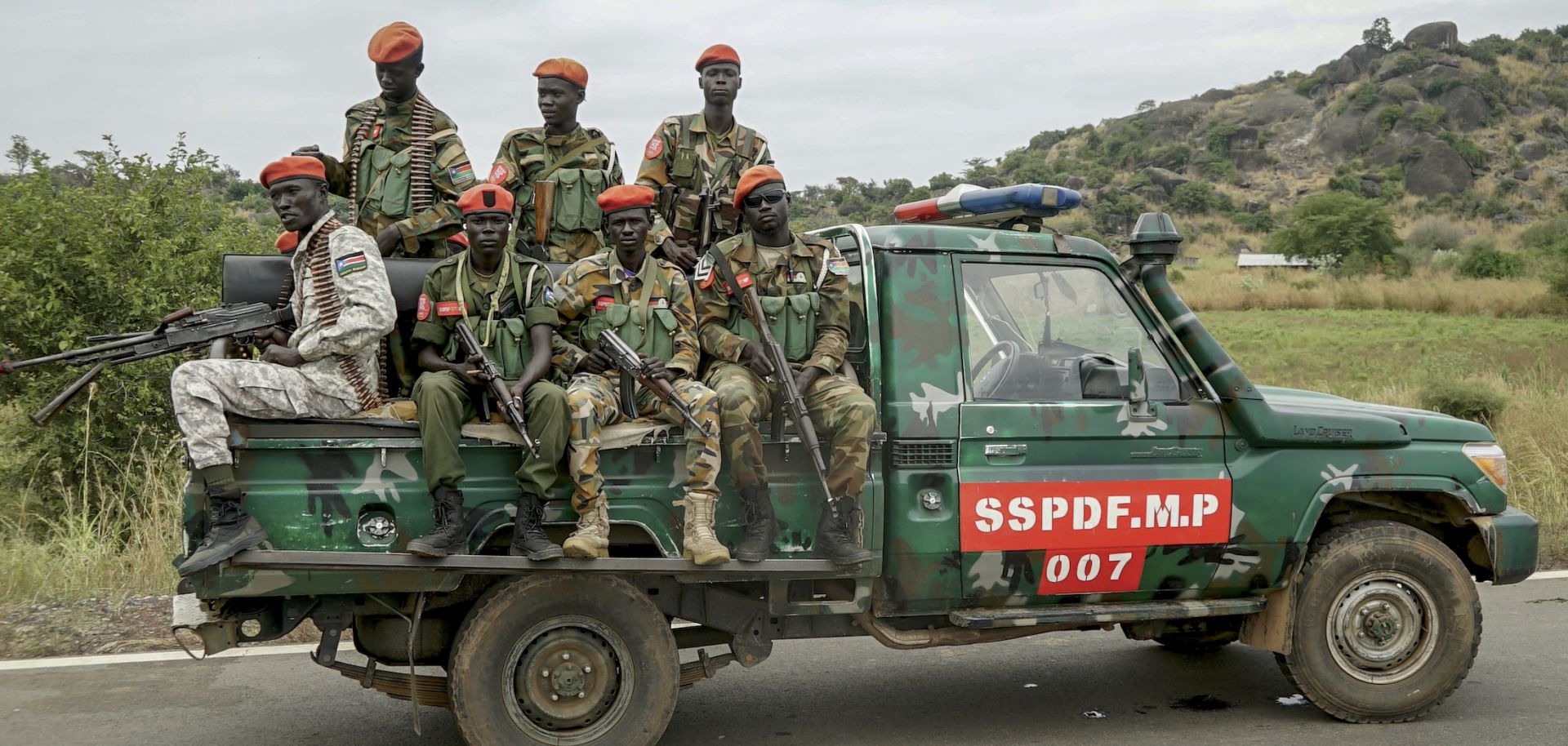
Recent coup allegations in South Sudan underscore threats to political stability, risking a resurgence of civil war that disrupts oil flows and inflames an existing regional humanitarian crisis. On Nov. 15, South Sudan's President Salva Kiir Mayardit dismissed the country's police chief following rumors of a coup plot on social media. The plot allegedly involved officers from the National Security Service and the South Sudan People's Defense Forces, and 27 individuals linked to the alleged plot have been apprehended. South Sudan has struggled with political instability since gaining independence from Sudan in 2011, as two major political factions and various splinter groups continue to vie for political dominance and access to state resources. Kiir postponed general elections originally scheduled for February 2023 to December 2024, which has triggered accusations by the rival faction led by Vice President Riek Machar that Kiir is attempting to circumvent power-sharing processes. While the coup allegations cannot be independently confirmed, the ongoing rivalry between Kiir and Machar and factionalism within the military suggest that such a plot is plausible.
- In December 2013, an alleged attempted coup following a dispute in the presidential guard barracks between Kiir and Machar loyalists precipitated the outbreak of civil war between the Dinka and Nuer ethnic groups, who support Kiir and Machar, respectively.
South Sudan's history of conflict, fragile peace agreement and embedded patronage networks sets the stage for a potential resurgence in fighting. Even though South Sudan's civil war officially ended in 2018, more than one-third of the South Sudanese population remains forcibly displaced — 2.2 million as internally displaced people and 2.3 million as refugees. Of the 8 million South Sudanese still in the country, 7.8 million face acute food insecurity and 43,000 face famine, illustrating the country's continued vulnerability to renewed fighting. The country's legacy of conflict, fragile peace agreement and patronage-based governance system largely drive these vulnerabilities. During South Sudan's first civil war that began in December 2013, the two sides largely fell along ethnic lines, with ethnic Dinka backing Kiir and ethnic Nuer fighting for Machar. The war killed 400,000 people and displaced more than 4 million others, eventually ending in 2018 with a power-sharing agreement that brought the two leaders together to form a government of national unity. However, a series of decisions by Kiir — including postponing elections until December 2024, delaying security force integration and aligning with some of Machar's rivals — has weakened the 2018 peace agreement and driven mistrust between the rivals, as many power-sharing mechanisms have not been implemented. Finally, the country's patronage-based governance style has created a "winner take all" system; Kiir uses oil export revenues to pay off political allies and would-be rivals and for his own self-enrichment, benefits that would be lost to him and his supporters should Machar or another rival take power.
Ahead of the 2024 scheduled elections, heightened political tensions and potential violent spillover from Sudan will raise the risk of civil war, which would undermine oil exports and likely trigger another regional humanitarian disaster. Next year's scheduled elections add to already high tensions among South Sudan's political factions, which raises the risk that military or political leaders in South Sudan will seek to overthrow the government. A coup would significantly raise the likelihood of a resumption of South Sudan's civil war, although heightened political tensions and spillover violence from Sudan could trigger a resurgence of widespread fighting in South Sudan even if Kiir remains in power. For instance, clashes that begin as local disputes among small militarized factions in South Sudan's northern states (perhaps triggered by the encroachment of armed groups from Sudan and/or refugee flows) could quickly spread to the rest of the country if they draw on historical grievances, such as ethnic tensions, division of resources and/or federal political representation. While fighting could break out along several fault lines, another iteration of conflict would most likely follow the same divisions as the 2013 war, during which ethnic Dinka backing Kiir fought ethnic Nuer supporting Machar. Concurrently, another delay to elections now scheduled for December 2024 — even without a flare-up in border conflicts — also risks triggering a resumption of fighting, perhaps spurred by Machar loyalists. If South Sudan becomes engulfed in full-scale fighting again, clashes would very likely disrupt oil wells, pipeline infrastructure and pumping stations, which would cause revenue losses for oil companies with operations in South Sudan. These disruptions could also undermine existing political structures given the government's reliance on patronage, as the risks of widespread conflict and political instability are mutually reinforcing. Large-scale clashes would also likely prompt an additional regional humanitarian crisis, meaning potentially hundreds of thousands of South Sudanese would join displaced Ethiopians, Somalis and Sudanese in regional refugee camps that are already strapped for resources.
- Since war broke out in Sudan's capital Khartoum in April, fighting between the Sudanese army and the rival paramilitary Rapid Support Forces has spread to the country's central, western and southern states. Along the border with South Sudan, intermittent clashes persist in the contested Abyei region among rival militant groups (some of which are alleged to be aligned with the Sudanese army), resulting in the deaths of 32 women and children on Nov. 17. Abyei has been the subject of a territorial dispute between the Ngok Dinka and Misseriya Arab nomads for years, and continued clashes risk erupting into a larger conflict that draws in armed groups that operate on both sides of the border.
- Refugees fleeing to South Sudan's northern states (especially Upper Nile) who now number in the low hundreds of thousands will likely exacerbate existing shortages of food, water, medical supplies and sanitation services. Resource scarcity could inflame long-standing ethnic tensions that harken back to the 2013 civil war (and previous wars, too), laying the groundwork for a resurgence of conflict in South Sudan's northern states bordering Sudan.
- South Sudan produces about 170,000 barrels of oil per day, much of which it exports through Sudanese pipelines to reach Port Sudan, but it only earns income from an estimated 45,000 barrels per day after shares owed to international oil and gas companies and fees paid to Sudan.
