
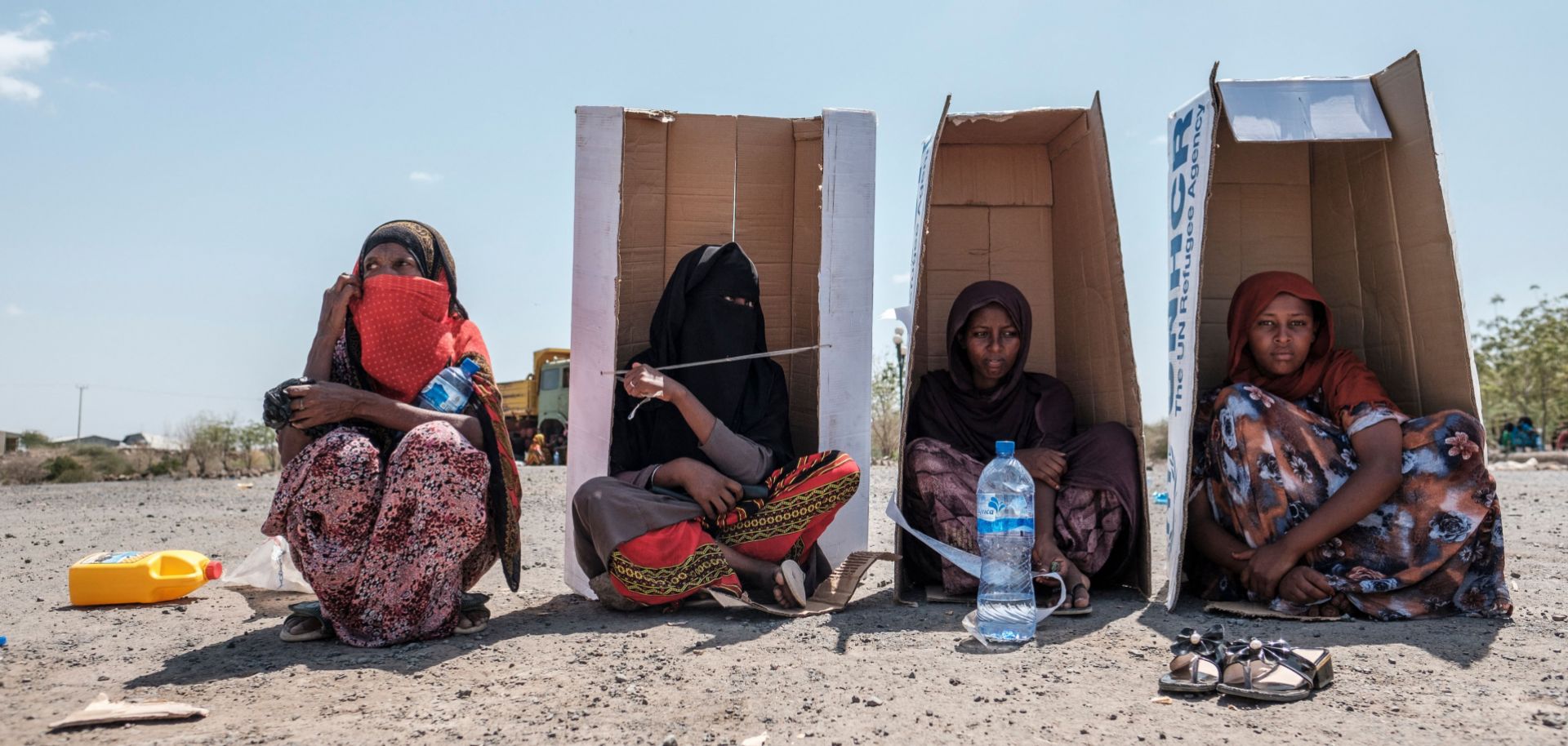
Women sit under U.N.-branded cardboard boxes in Semera, Ethiopia, on Feb. 14, 2022, as they wait to be registered at a hotel compound hosting civilians fleeing violence.
While a centuries-old phenomenon, gender-based violence (GBV) has become more widely discussed in recent years amid its rising global prevalence, with international organizations like the United Nations deeming it a ''shadow pandemic'' during the COVID-19 crisis in April 2020. On the geopolitical stage, however, GBV is still often viewed as exclusively a women's issue at worst – and a human rights issue at best.
GBV is both women's and human rights issue, but such a narrow framing of GBV fails to give adequate attention and weight to its impact on a country's political stability, economic growth and overall peace and security. This is especially true in sub-Saharan Africa, where rising GBV inhibits cross-sector development, normalizes the abuse of women during times of war, and risks hampering countries' democratic consolidation.
Gender-Based Violence as a Political Issue
While endemic across the world, gender-based violence has become particularly virulent in sub-Saharan Africa, as evidenced by recent events. In South Africa, the gang rape of eight women on the outskirts of Johannesburg in July prompted a public outcry against the rising number of sexual offenses in the country, which has increased by 13% since 2022 according to the South African Police Service. In Kenya, armed men physically assaulted dozens of women candidates in the run-up to the country's general election in August, but police made few arrests. In Zimbabwe, a female lawmaker and two female activists provided evidence that police had abducted, sexually abused and tortured them in May 2020 for criticizing the government's management of the COVID-19 pandemic, which the Zimbabwean government then responded to by accusing the women of lying and taking them to court.
This increase in gender-based violence (particularly against women politicians) in sub-Saharan Africa comes amid recent gains in women's representation in several governments. An unprecedented number of African women currently hold elective office as a result of electoral gender quotas and other efforts to increase women's political participation over the past ten years. But this progress has been met with intense backlash and, in many countries, has opened a new avenue for GBV. Indeed, political, religious, societal and social norms that preference male politicians and view women representatives as a threat to the status quo remain prevalent in African countries. This has, in turn, resulted in an uptick in politically-motivated GBV in response to the greater number of women pursuing public office — a trend that, if continued, will threaten these improvements to gender parity in African politics.
Further, physical, psychological and reputational violence raises doubts about the stability of African governments and the robustness of democratic practices. Threats against women participating in political processes, such as supporting or voting for certain candidates, leading human rights campaigns or participating in civil society initiatives compound these dynamics. In a variety of contexts, political actors, communal militias, gangs and/or individuals frequently use intimidation tactics to prevent or reduce women's ability to independently exercise electoral choice. In countries like Burundi, Nigeria, South Sudan, Zimbabwe and others, women are often attacked for showing up at polling stations or supporting an opposing candidate.
GBV that inhibits women's representation and participation in political life is directly related to governance outcomes. The exclusion of women from political life is an indicator of (and contributing factor to) weak democratic norms, as it is also correlated with lower levels of judicial oversight, transparency and freedom of press — all of which threaten the institutional strength and longevity of democratic or partially democratic African governments. In countries with partially democratic governments (like Mozambique, Tanzania and Ivory Coast), low female political participation and representation rates raise the risk of political instability by delaying and disrupting the transition toward more democratic governance. And in countries with governments that are already internationally recognized as democratic (like Nigeria, Kenya and South Africa), GBV fuels political volatility and ineffective governance by weakening democratic institutions. This, in combination with other factors contributing to democratic backsliding, will likely constrain the longevity and stability of democratic and partially democratic governments across the continent.
In non-democratic societies, GBV can also be used as a tool to further suppress dissent and consolidate political control, thereby securing regime continuity (often at the cost of hollowed institutions and diminished rule of law), as evidenced in the Central African Republic, Democratic Republic of Congo, Mali, Sudan and South Sudan, among other countries.
Gender-Based Violence as an Economic Issue
In addition to contributing to democratic backsliding in African countries, GBV also contributes to low female employment rates, high birth rates, investor hesitancy and uneven development, which bear economic costs that constrain growth. Girls' education rates tend to be lower in countries with higher rates of gender-based violence, which then directly impacts women's employment levels and job opportunities. However, targeted violence can prevent or deter women with secondary- and tertiary-level education from gaining employment in other countries as well.
A 2021 study by the International Monetary Fund that examined 18 sub-Saharan countries across all income groups found that a 1% increase in GBV can reduce economic activities by up to 8% in a given country. The relationship between GBV and economic activity is particularly observable in northern Nigeria, where active Islamist insurgencies and communal militias regularly target women and girls who leave their homes to attend school or work. While myriad factors constrain economic activity in northern Nigeria (including jihadist and militia activity, drought and poor infrastructure), women's absence from local economies due to fear of violence perpetuates the region's under-development.
Additionally, high rates of GBV are correlated with increased birth rates and lower participation in the labor force. At the family unit level, the correlation between female unemployment and high birth rates creates a heavier economic burden by leaving households with fewer income sources and greater financial needs. At the national level, the resulting population growth and depressed economic activity also risk undermining economic development, with the populations of more than half of the African continent's 54 countries expected to double by 2050. Indeed, many African countries lack the institutional, infrastructural, political, educational and health structures needed to support their current populations — let alone a massive influx of young people over the next 30 years. These structural deficiencies will be exacerbated in instances of low investor interest and/or confidence, which will likely increase long-term economic vulnerabilities to booming population growth.
GBV also poses security, reputational and operational risks to investors and companies in the region, further constraining economic growth. Countries with high levels of GBV pose safety and operational risks to foreign business travelers and employees, as they may be subjected to normalized forms of threats and physical assault either inside or outside the workplace. In addition to the immediate and personal trauma that survivors experience, violence will likely lead to lower productivity, worker retention and product quality, especially in industries that employ a high proportion of women. GBV prevalence also creates reputational risks for investors and companies, not just in obvious cases in which GBV is carried out within the company, but also if it is prevalent or commonly associated with specific industries and supply chains in the country or region, like agriculture and textiles.
Gender-Based Violence as a Security Issue
Finally, GBV serves as a tactical and strategic tool in armed conflict that normalizes societal violence against women and complicates reconciliation and reconstruction efforts. Gender-based violence has played a role in armed conflicts throughout history and across the world; GBV's prevalence during times of war thus is not a uniquely African issue. But many of the African countries in which GBV is most prevalent are embroiled in some form of armed conflict, as evidenced by Ethiopia's war in Tigray, the decades-long armed conflict in the eastern Democratic Republic of Congo, and the jihadist insurgencies in the Sahel.
Within such conflicts, sexual violence is typically opportunistic or strategic in nature, both of which drive its prevalence. In its opportunistic form, combatants exploit the breakdown of social and political order to carry out sexual violence against women and girls — and occasionally men and boys — as a form of plunder, payment or some other ''spoil of war.'' However, sexual violence is also used as a strategic weapon against warring sides (and uninvolved civilian populations) to humiliate, destroy, or subdue the enemy or those perceived as supporting the enemy.
GBV obviously has severe consequences for survivors regarding their health and psychological well-being, while longer-term societal and economic impacts mean that survivors are often subjected to social isolation and stigmatization, thereby creating barriers to their reintegration into society and the greater economy once the conflict ends. Many victims also do not report their abuses for fear of reprisal, which therein results in increased impunity for the perpetrators, especially if the perpetrators are in the military or police. Studies from the International Institute for Democracy and Electoral Assistance show that post-conflict reconstruction processes that do not incorporate justice mechanisms to address war crimes committed on all sides are more likely to experience a return to violence. Thus, GBV in armed conflicts often normalizes its prevalence in post-conflict societies, thereby perpetuating its practice and prolonging its negative impacts on the personal safety of the population, societal stigmatization and costs to the local and wider economy.
Gender-Based Violence as a Geopolitical Issue
Overall, rising rates of GBV will continue to threaten African governance, economic development and security in the coming decades. At the international level, human rights groups and multilateral institutions have failed to compel governments worldwide to comply with international norms, as organizations like the United Nations remain unable to enforce their own resolutions. And, while some leaders of wealthy nations may rhetorically condemn African governments for their complicity in the rising rates of violence against women, they are unlikely to use strategic tools like military assistance, trade relations and/or foreign investment to compel government action.
In sub-Saharan Africa, parliamentary gender quotas may result in the election of more female lawmakers, but the continued high rates of GBV will likely constrain the expected liberalizing effects of having more women in positions of power. Gender disparities in schooling and employment, meanwhile, will likely continue to exacerbate the negative aspects of population growth, as well as pose risks to potential business interests and investors. In conflict environments, GBV will persist and perpetuate psychological consequences and community-wide divides for generations to come, and failure to include gendered crimes in peace processes will likely precipitate resumptions of violence.
GBV certainly is not the only constraining factor to peace, stable governance and economic growth in sub-Saharan Africa. But continuing to overlook it as a geopolitical force will limit African governments' ability to actualize their geopolitical aspirations on the world stage.
