
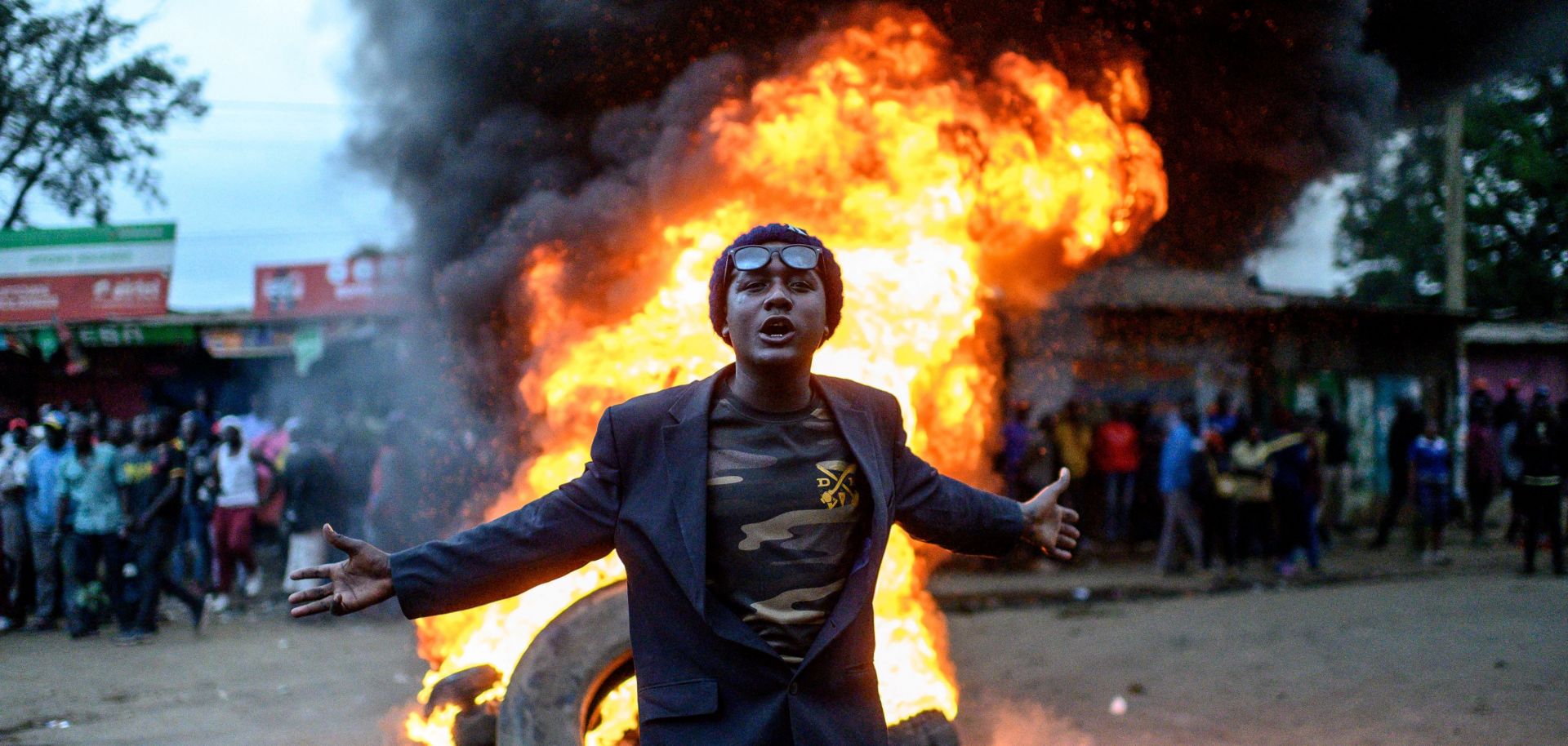
A supporter of Kenyan presidential candidate Raila Odinga gestures past a fire during a protest in Nairobi on Aug. 15, 2022, after William Ruto was declared the winner of Kenya's presidential race.
In Kenya, the losing presidential candidate's decision to challenge the results of the Aug. 9 election will prolong the country's political uncertainty, fuel concerns over unrest and potentially undermine the next president's policy priorities. On Aug. 15, the chairman of Kenya's Independent Electoral and Boundaries Commission (IEBC), Wafula Chebukati, declared William Ruto the winner of the 2022 presidential election, beating out five-time presidential aspirant and former Prime Minister Raila Odinga for the nation's top post. But Odinga and a group of IEBC commissioners have since rejected the result — fueling fears that what had been one of Kenya's most peaceful ballots could again devolve into mass violence and unrest. During an Aug. 16 press conference, seven IEBC commissioners said they dissented from Chebukati's announcement, claiming the chairman's tallies were ''a mathematical absurdity.'' Shortly thereafter, Odinga also called the election results ''null and void'' and said the alleged irregularities cited by the dissenting commissioners necessitated a recount. Odinga announced he would contest the electoral outcome at the Supreme Court as well, which could overturn the results of the Aug. 9 polls and institute a re-vote.
- The final tally announced by the IEBC chairman has Ruto winning 7,176,141 votes (50.49%), with Odinga securing 6,942,930 votes (48.85%). The dissenting IEBC commissioners said that the summation of percentages of votes awarded to each of the four candidates exceeded 100%, tallying 100.01% total. They claimed the extra 0.01% translates to approximately 142,000 votes, which is incorrect as such a percentage would actually constitute about 1,420 votes. But even if 142,000 supposedly excess votes were removed from Ruto's tally, he would still have secured more votes than Odinga.
- Since the Aug. 16 press conference, several Kenyan election watchdogs have rejected the dissenting commissioners' allegations of electoral fraud. Other observers have noted that current Kenyan President Uhuru Kenyatta — Odinga's political ally — appointed the four dissenting commissioners in 2021, while Kenyatta appointed the three approving commissioners in 2017 (their tenures will expire in 2023), perhaps reflecting some political factionalism within the commission.
- The 2022 election was lauded as one of the most peaceful and well-organized ballots in Kenya's history. The country's three prior presidential elections all yielded disputed victories that triggered varying degrees of unrest, looting, property destruction and business disruptions.
Within a month, Kenya's Supreme Court will rule in one of three ways, potentially determining that the alleged electoral irregularities necessitate a re-vote. Following the August 2017 general election in which Odinga ran against current President Kenyatta, Odinga contested the results and sent the case to the Supreme Court, which ordered a re-vote, before boycotting it and thus losing the presidency. This time around, Odinga will have to follow the same set of procedures as laid out in Kenya's 2010 constitution, beginning with submitting a petition to the nation's top court within 14 days of the election. The Supreme Court will then conduct a conference with all relevant parties to set the hearing schedule before it issues a decision within 14 days of the lawsuit filing date. As in 2017, the court could rule in one of three ways: it could invalidate the results of the election and order a new election within 60 days; it can find electoral irregularities but conclude that they are insufficient to overturn the results; or it can uphold the election. Before making any determination, the court could also require a recount.
- When Kenya's Supreme Court overruled the outcome of the 2017 election, it found irregularities in the transmission of results from polling stations and disparities in the number of votes cast. Three of the justices who overturned the election and one who dissented are still on the Supreme Court, which has seven members total.
If the Supreme Court upholds the results of the election, there are likely to be violent flare-ups in Odinga strongholds, though so far demonstrations are largely non-violent and isolated. As of Aug. 16, international electoral observers do not appear to support Odinga and the IEBC commissioners' allegations of irregularities, which preliminarily suggests that the polls were largely free and fair. If the Supreme Court rules to uphold Ruto's win, Odinga supporters in areas like Kisumu (Odinga's hometown), Nairobi (particularly Kibera, where people have already taken to the street in recent days) and Mombasa are likely to protest the outcome. These could be similar to the protests that occurred on Aug. 15 after the IEBC announced the results of the vote and involve erecting roadblocks, burning tires, looting businesses and clashing with riot police. The length and scale of any violence will depend heavily on remarks by Odinga, Kenyatta and other leaders in the coming weeks, as in past years, politicians' calls to reject electoral outcomes incited widespread violence. However, Odinga has so far called on supporters to let the court system handle the so-called ''dictatorial actions'' of IBEC chairman Chebukati and appealed for calm. While this should mitigate the risk of larger and potentially more violent demonstrations in the days ahead, any pro-Odinga unrest that is more violent and longer-lasting would offer an immediate challenge to Ruto's new administration, which is scheduled to take office in November.
- The independent and widely respected Election Observation group — made up of civic and faith-based groups — did its own electoral analysis and concluded that the results were accurate.
- After the contested election in 2007, both Ruto and Odinga incited ethnic violence that led to the killing of more than 1,000 people. But in the current election cycle, neither candidate has so far fanned ethnic flames in a similar way.
- Should the Supreme Court overturn the results and call for a re-vote, there will be an increased risk of violence, with potential clashes breaking out between Odinga supporters and aggrieved Ruto supporters who believe their electoral victory was ''stolen'' from them.
If Kenya's electoral results hold, Ruto's incoming administration will also confront a narrow parliamentary minority that could constrain its policy-making agenda. The degree to which Ruto is constrained will depend on the ability of Odinga's Azimio coalition to keep its narrow Senate majority and wider National Assembly majority; if it is able to do so, Ruto will likely face parliamentary deadlock that will curtail his ability to pass economic reforms promised on the campaign trail. However, it is also likely that some Azimio parliamentarians will defect to Ruto's Kenya Kwanza coalition if it becomes clear that Ruto will be Kenya's next president, which could enable Ruto to pass reforms if he is able to attract more than one senator and 12 National Assembly members.
- Odinga's Azimio coalition holds 19 Senate seats to Ruto's Kenya Kwanza Alliance's 18 seats, with the National Reconstruction Alliance (NRA, allied with Azimio) holding 1 seat. The Azimio coalition won 85 of 165 total seats to Kenya Kwanza's 71 seats and several smaller parties' 10 seats.
- While campaigning, Ruto promised to digitize tax mobilization, invest in employment and develop the agriculture sector to increase food production.
