
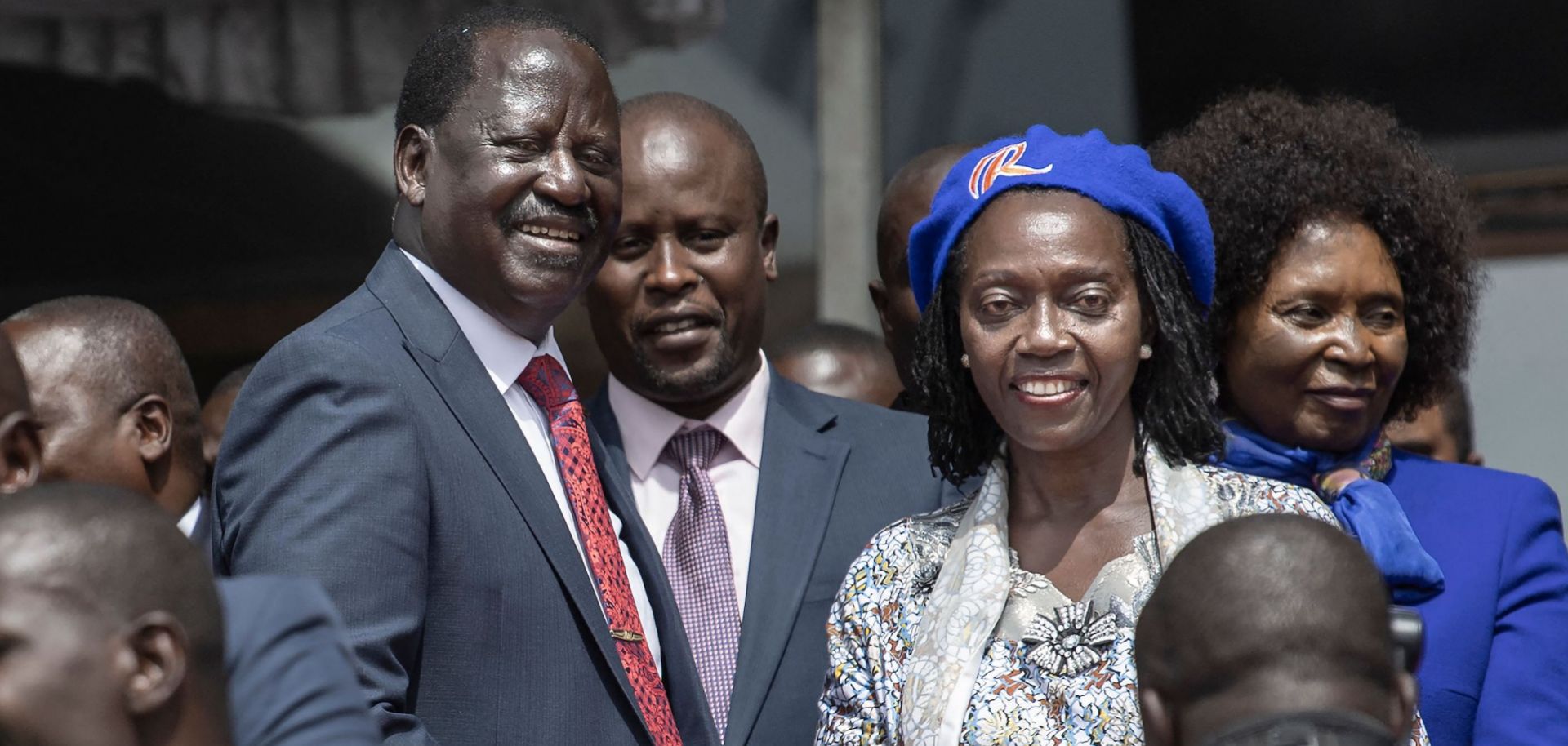
Raila Odinga (center left) shakes the hand of his newly announced running mate, Martha Karua, (center right), on May 16, 2022, in the Kenyan capital of Nairobi.
While the running mates selected by Kenya's presidential front-runners underscore the importance of the Kikuyu, youth and female vote in the East African country's August general election, they do not reduce the potential for social unrest in the event of a close or contested race. On May 16, Kenyan presidential front runners William Ruto of the Kenya Kwanza Alliance and Raila Odinga of the Azimio la Umoja coalition announced their running mates for the August general election. Ruto, Kenya's present deputy president, chose Rigathi Gachagua, a parliamentarian and businessman from the central Kenyan town of Mathira. While Gachagua lacks a nationwide political constituency, he does have deep pockets and a longstanding friendship with Ruto. Odinga, a former prime minister and a four-time presidential aspirant, meanwhile chose Martha Karua, a former justice minister from the Mount Kenya region well known throughout Kenya. Karua is the first woman to run on a major party's presidential ticket.
- While a record 46 candidates have entered the presidential race, Odinga and Ruto have emerged as front-runners. In a Nairobi-based Tifa Research April poll, 39% of people surveyed supported Ruto compared to 32% for Odinga.
- To win the presidency, a candidate must win more than half the national vote and at least a quarter of the ballots cast in half of Kenya's 47 counties.
The choice of Ruto's and Odinga's running mates is geared toward appealing to key ethnic, age and gender constituencies. Historically, the Kikuyu ethnic group, primarily located in the Mount Kenya region of the country's Central province, has been determinative in election outcomes; this is the first presidential race in which a Kikuyu is not seeking the presidency. The significance of the Kikuyu vote is underlined by the fact that both Ruto and Odinga selected Kikuyu running mates. While the Kikuyu ethnic group likely remains the most crucial voting bloc in Kenya, youth and women voters are also emerging as important constituencies. Kenya's burgeoning population means that the youth vote could determine the election's outcome. Gachagua and Karua each have championed policies advocating youth employment and political enfranchisement. By appointing Karua as his running mate, Odinga hopes to tap into Kenyan women voters. While they do not vote as a single bloc, a Tifa Research survey found that Kenyan women vote in higher proportions than men. By contrast, the Kikuyu ethnic group, to which current President Uhuru Kenyatta belongs and which comprises 22% of the population, could well vote as a bloc in favor of Odinga; otherwise, it might split between Odinga and Ruto.
- In selecting Gachagua as his deputy, Ruto appears to be prioritizing personal relationships and painting himself as a political outsider. In addition to potential Kikuyu votes, Gachagua brings millions in campaign funds from a number of business dealings, including ventures in medical supplies and venture capital. He bolsters Ruto's message to youth voters that by supporting the United Democratic Alliance, they are voting for more investment in small and medium businesses, job training opportunities, and jobs themselves — an appealing message to youth voters, who struggle with unemployment on a large scale. On the downside, the Kenyan Asset and Recovery Agency has accused Gachagua of corruption, which could cause voters fed up with government mismanagement to back Ruto instead.
- Odinga likely selected Karua as his deputy due to her long career in public service, absence of corruption charges (something fairly unusual for Kenyan politics), Kikuyu heritage and name recognition among Kenyan voters, and because she stands to make history as the first woman deputy president. But selecting Karua caused Odinga problems with his former political ally Kalonzo Musyoka. Musyoka had expected Odinga to select him deputy; he has now launched his own presidential bid, potentially drawing votes from Odinga's Azimio coalition.
A contentious election could result in violent unrest, particularly if the results stir up historical ethnic grievances. The most likely trigger for violence would be a Ruto loss. The Kikuyu have held the Kenyan presidency a disproportionate number of times, creating resentment among the Kalenjin ethnic group (approximately 11% of the population). Most Kalenjins live in the Rift Valley, and many believe the Kikuyu have enjoyed unfair access to state services, financing and business benefits. The 2012 election and subsequent 2017 reelection of Uhuru Kenyatta, an ethnic Kikuyu, and his deputy, Ruto, an ethnic Kalenjin, was pitched to the Kalenjin as an opportunity for Ruto to bolster his political experience in preparation for the 2022 presidency. A Ruto loss in 2022 would anger the Kalenjin, who might decide the election was stolen, triggering violent unrest. A contested or even close election would increase the likelihood of this scenario.
