
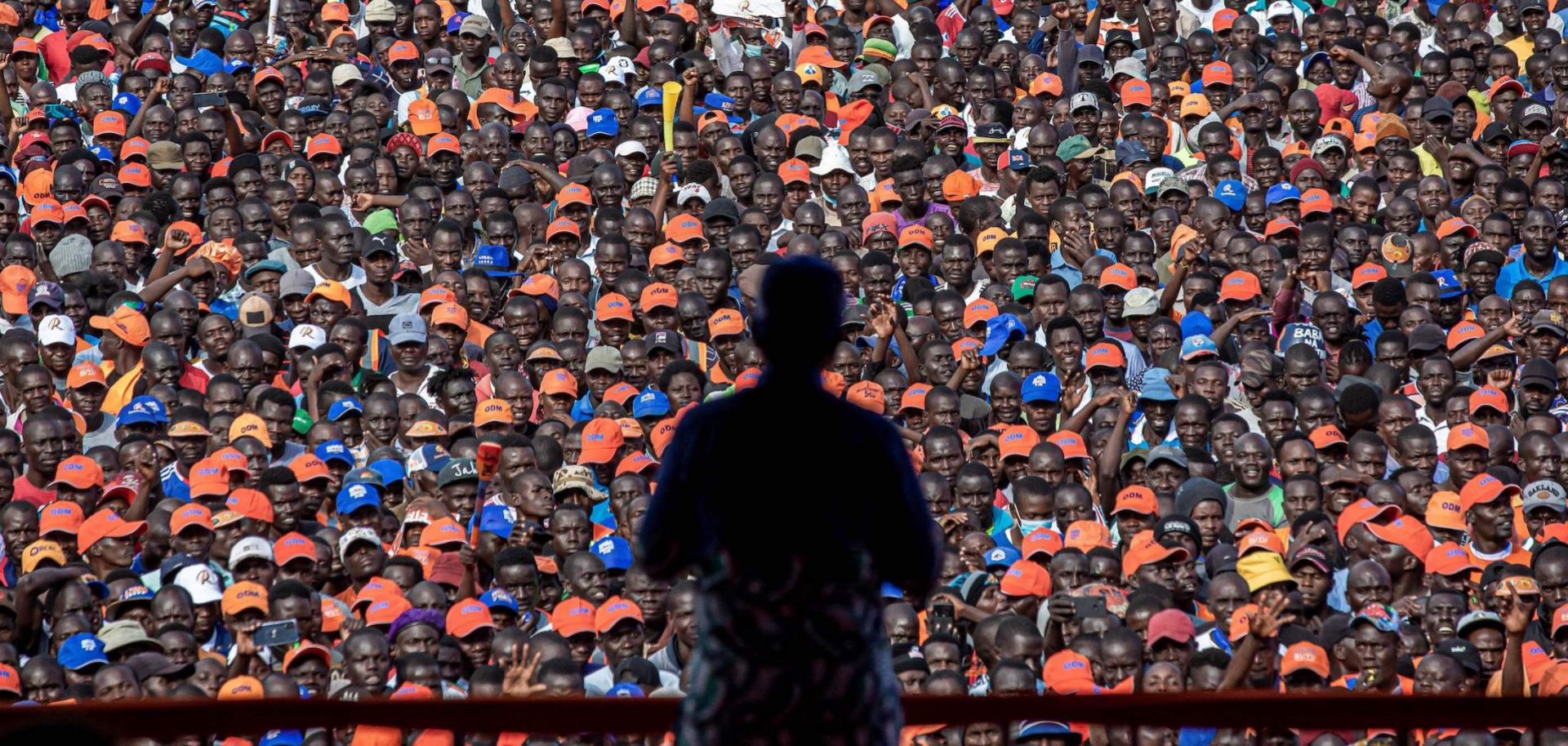
Kenya's former Vice President Kalonzo Musyoka delivers a speech during an Azimio La Umoja party (One Kenya Coalition Party) campaign rally in Jomo Kenyatta International Stadium in Kisumu on Aug. 4 ahead of the country's general election.
Neither of Kenya's presidential candidates has proposed a feasible plan to tackle the country's mounting debt burden, increasing the probability that the country's next president will be forced to abandon social spending commitments and pursue fiscal consolidation and/or debt restructuring, or else face an economic crisis. In the lead-up to Kenya's Aug. 9 general elections, the two leading candidates, Raila Odinga and William Ruto, have proposed opposing measures to address Kenya's mounting debt burden. Odinga, a political ally of current President Uhuru Kenyatta and a former prime minister, favors debt restructuring with the International Monetary Fund (IMF) while simultaneously increasing spending. Meanwhile, current Deputy President Ruto says Kenya can pay its debts without external support, advocating for reduced borrowing and increased tax revenue to meet rising debt servicing costs while also increasing social spending. Neither Ruto nor Odinga's economic commitments are feasible in their entirety, but Kenya's imminent serving costs increase the probability that the next president will renege on spending promises and pursue restructuring, regardless of campaign commitments.
- Polling from the TIFA research institute on Aug. 2 puts support for Odinga at 49% and for Ruto at 41%. According to the same poll, approximately 8% of registered voters are undecided.
- In early June, Odinga pledged to prioritize public-private partnership models in funding projects, setting up a cash transfer program so that poor households receive roughly $50 each month and establishing universal free healthcare and free education from early childhood to tertiary level. He's also promised a slew of tax breaks (including a seven-year holiday for start-ups and a three-year break for small- and medium-sized enterprises), as well as to review taxes on petroleum products to make gasoline more affordable.
- On July 20, Ruto said he would not restructure Kenya's debt if he wins the election because Kenya has the capacity to pay its debt. He also said that he would 'put the brakes on borrowing,' and that loans will be limited to priority areas that provide returns on investment and create jobs, like agriculture. Ruto plans to digitize tax mobilization as well, and said that resources will be increased by raising tax collection to 8% of GDP from its current 3.6% of GDP. Other elements of Ruto's plan include scaling up exports to improve Kenya's foreign currency earnings and investing in agriculture to increase food production. Ruto has also said that he will publicize Chinese loan contracts that have previously been kept private. But Kenyan contracts with Chinese lenders likely have privacy clauses, which would legally prohibit Ruto from making loan terms public.
A slew of borrowing for massive infrastructure projects under current President Uhuru Kenyatta has caused worsening debt distress and long-term sustainability problems. Since Kenyatta took office in 2013, the government has borrowed an estimated $48.8 billion to finance his 'legacy projects,' including the Standard Gauge Railway, the Lamu Port and the Nairobi Expressway. Kenyatta's borrowing spree has caused an increasingly unsustainable debt burden, with costs to service the country's $71 billion in total debt (70.2% of GDP, up from 39.7% in 2013) overtaking public spending for the first time in July. In June, Kenya's parliament approved a treasury proposal to raise the debt ceiling from $75.5 billion to $83.9 billion in order to fund its $7.2 billion budget deficit for its 2022-23 fiscal year. Kenya's treasury expects the government's interest payments as a percentage of total revenue to hit 28% by the end of the 2023 fiscal year, up from 12% in 2013-14. Upcoming debt maturities make the situation urgent: Kenya owes $2 billion in eurobond maturities coming due in 2024. Given the lack of feasible proposals to raise billions in revenue (tax mobilization plans, proposals to increase exports and efforts to increase manufacturing capabilities have failed to raise sufficient revenue to cover debt servicing costs in the last five years), it's unclear how the Kenyan government will pay the maturity without taking out new loans.
- Kenya planned to issue a $1 billion eurobond earlier this year to fill its budget deficit, but postponed the sale due to high borrowing costs.
- Bloomberg ranked Kenya sixth most vulnerable to a debt crisis in its 2022 assessment on 50 developing economies earlier this year.
Odinga's proposal of IMF debt restructuring and increased social spending are incompatible, which means if he is elected, either IMF negotiations will fail or the new government won't follow through on some social protection measures. The IMF typically asks governments to implement spending cuts as a part of debt restructuring deals. Odinga's proposals include billions of dollars of increases in social protection measures, which would require greater borrowing to finance. While Odinga's rationale for proposing such relief measures is rooted in widespread public discontent with rising prices for everyday goods and food and fuel shortages, it is very unlikely that an Odinga administration would find the funds to finance this spending and secure a debt restructuring plan. This means that either Odinga will have to take out new loans to finance these programs — a policy that is likely to be discouraged by the IMF — or be forced to abandon measures like universal free healthcare and education, tax breaks and cash transfer programs, which would likely result in deepening inequality and anti-government sentiment.
- Debt restructuring with the IMF is unlikely to be a straightforward process. Multilateral institutions like the IMF own approximately 33% of Kenyan debt, leaving 27% owned by public and private Chinese institutions, 29% by non-Chinese private financial institutions and 11% by other governments. Even if the Kenyan government reaches a deal with the IMF, large portions of its debt with other partners and the associated servicing costs will remain in play unless Kenya pursues debt restructuring under a framework, like the Group of 20 (G-20) debt restructuring initiative, which would require the coordination of Kenya's disparate creditors.
Kenya is unlikely to be able to service its debt in the next five to ten years without some kind of restructuring. If Ruto wins, he will thus either be forced into debt negotiations or risk default and economic crisis. Even if a future Ruto administration significantly reduces borrowing as compared to the current Kenyatta administration, the government will not be able to finance Kenya's $2 billion in eurobond maturities due in 2024 with domestic resources and/or foreign exchange reserves, as evidenced by insufficient resources to cover its 2022-23 budget. Rising yields will compound the problem, as the yield on the 10-year bond due in 2024 rose to 10.9% in June from 7.18% in April. Ruto's claim that Kenya will close the gap between revenue and spending by increasing tax revenue is doubtful, as Ruto's governance record does not indicate that he will be able to address long-standing problems within the revenue service like corruption, mismanagement and insufficient personnel. As such, the government will also be unable to finance Ruto's bottom-up investment model, which would create a $1.8 billion fund for small businesses to expand production in housing, food processing and manufacturing. Ruto said in March that he would finance this investment by diverting resources from major infrastructure projects. But even if the government is willing to abandon infrastructure projects, the Ruto administration would almost certainly still face a budget deficit in the 2023-24 fiscal year.
Debt restructuring, which is more likely under Odinga but could also happen under Ruto, would boost investor confidence and debt sustainability. But it would also produce a social backlash against the associated consolidation measures. The African Development Bank has suggested that Kenya's economic outlook will improve after the election regardless of who wins, in part because uncertainty over unrest will have dissipated and the era of Kenyatta's rampant borrowing will have passed. While that may be true for the short term, Kenya's long-term economic outlook is dependent on whether or not the country can service its debts and assure foreign investors of acceptable risk levels, which will require reduced spending and eventual debt negotiations. If Kenya secures a deal, measures could range from debt cancellation to extended repayment horizons and reduced interest rates. Such a relief package would boost investor confidence and likely attract renewed capital inflows into Kenya's energy, manufacturing and transport sectors, among others. But debt restructuring would also likely result in political backlash, as opposition figures and activists would probably politicize the deal in order to blame inequality and poverty on required spending reductions. The government's implementation of fiscal consolidation measures — like slashing fuel subsidies and food vouchers, and refusing to raise public sector wages — would likely drive social unrest. But while frequent demonstrations against such spending cuts may spook more risk-averse investors, the overall gains to investor confidence through renegotiated loan terms would likely outweigh any losses.
If, on the contrary, the next government fails to secure debt relief measures, a financial crisis will follow, leaving Kenya in a much weaker negotiating position when debt talks finally take place. A Kenyan default would cause the country's remaining investors to flee to safer markets, increasing the risk of a contagion effect in East Africa if international investors turn to places like the United States or Japan to avoid emerging market risks. Additionally, Kenya would struggle to secure future loans with favorable terms, potentially leading to an even longer-term debt sustainability problem as the country attempts to service high-interest rate loans 15 to 20 years from now. A default would also place Kenya's status as an African technological innovation hub in jeopardy, potentially deterring private sector funding for Kenyan agri-tech, education and healthcare solutions. Higher borrowing costs for personal financing and home loans would likely stunt the growth of Kenya's middle class and worsen the impacts of income inequality as well. The humanitarian toll of a greater economic crisis could lead to widespread hunger, poverty and unemployment in Kenya, which would likely create societal ripple effects that harm long-term development and growth. A default would also significantly reduce the Kenyan government's negotiating power in future debt restructuring talks with multilateral institutions like the IMF. Compared with a pre-default arrangement, any bailout program secured in the wake of a default would thus likely require Nairobi to impose much broader and deeper fiscal consolidation measures — portending drastic cuts to public sector wages, social protection measures and investments in public infrastructure. Additionally, a default would reduce Kenya's regional political influence, likely inviting a more economically stable neighbor to assume Kenya's role as a conflict mediator.
