
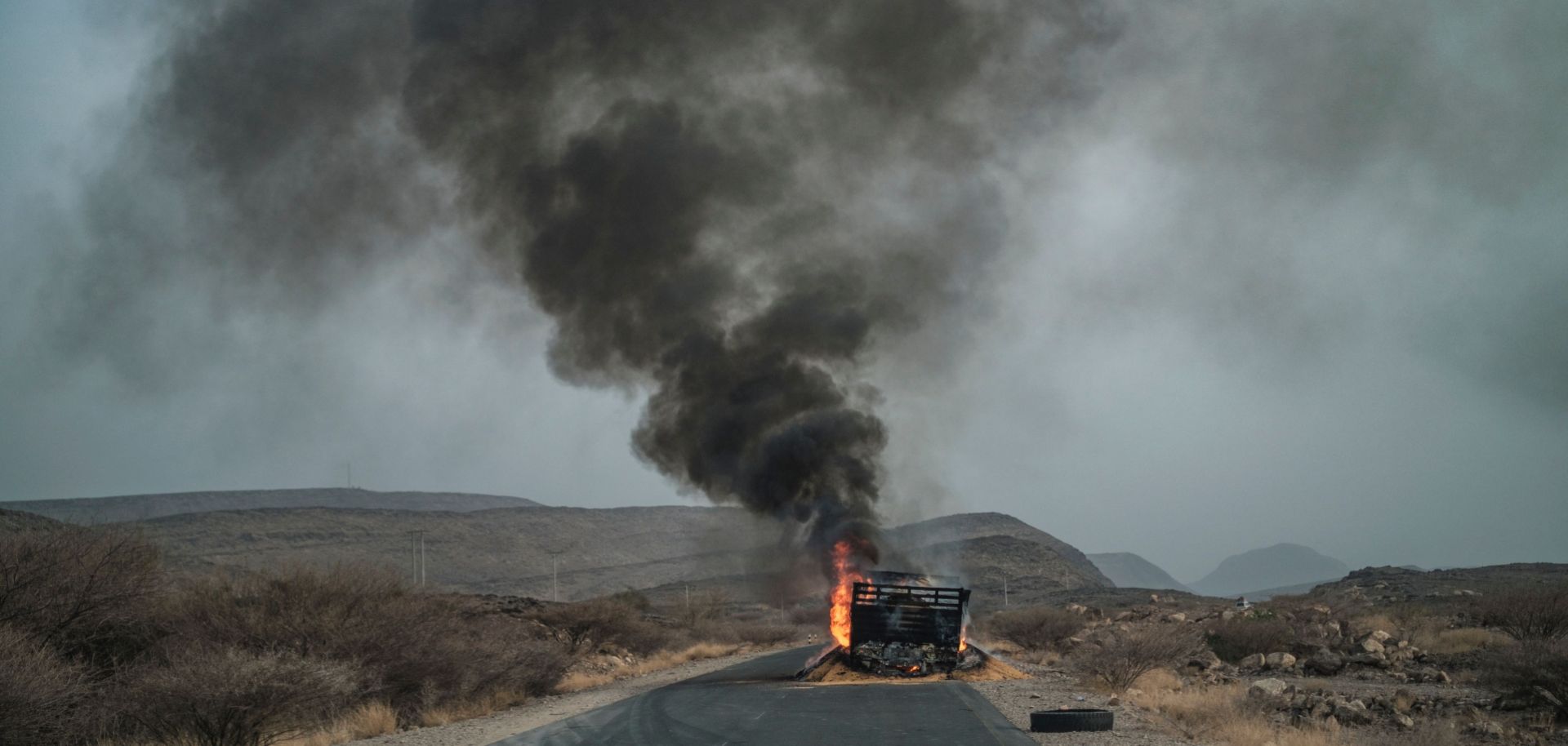
A truck carrying humanitarian aid to Ethiopia's war-torn Tigray region burns out on a road 80 kilometers from the northeastern city of Semera on June 10, 2022.
In Ethiopia, renewed fighting between the government and rebels in the Tigray region will likely persist through at least the end of the year, which will complicate the renewal of a cease-fire and deepen the humanitarian crisis in the war-torn country. Clashes in northern Ethiopia between the government's Ethiopian National Defense Forces (ENDF) and the rebel Tigray People's Liberation Front (TPLF) have erupted in recent weeks and show no signs of slowing, collapsing the humanitarian truce that the warring sides agreed to five months ago. After battling each other for nearly two years, both the ENDF and TPLF are grappling with growing personnel, equipment, intelligence and resource constraints. Neither, however, appears poised to stand down on their war aims, which haven't changed since the conflict began in November 2020 — with the Ethiopian government seeking to exercise state control over Tigray and the TPLF demanding an autonomous region and government.
- The latest round of fighting between the ENDF and TPLF broke out on Aug. 24 and ended a cease-fire initially signed in March. In the following days, the ENDF allegedly carried out several airstrikes on Tigray's regional capital, Mekelle,
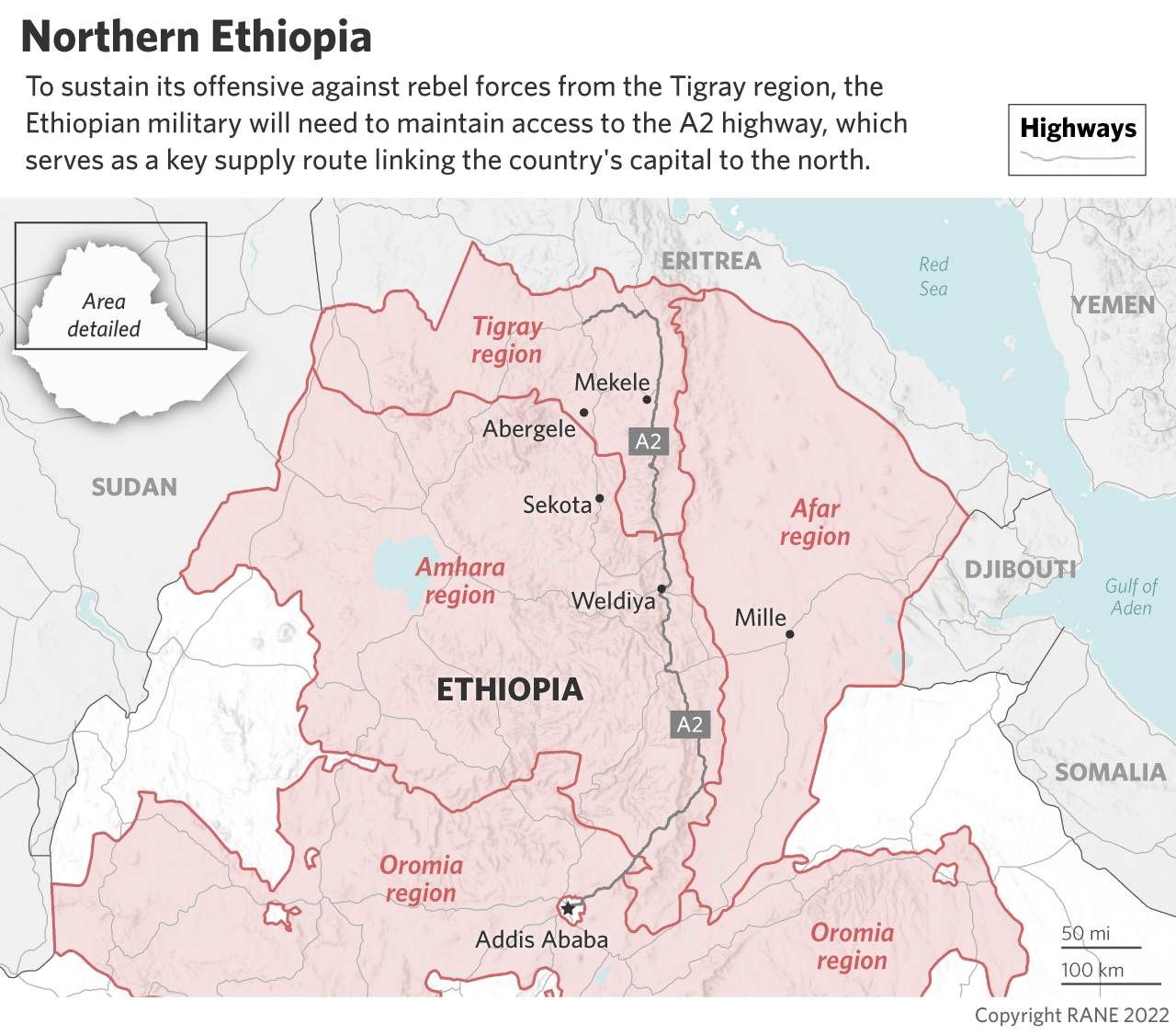
- The renewed clashes have so far been concentrated in the southeastern border region of Tigray, with the TPLF advancing into the neighboring Amhara and Afar regions. The TPLF also claimed Ethiopian forces are continuing to advance from Sekota toward Abergele near the Tigrayan border.
- In addition to fighting in the Tigray-Amhara border region, the Ethiopian government carried out two air raids on Mekelle since Aug. 26 that have allegedly targeted civilian areas and a hospital, though the Ethiopian government insists it is only targeting military facilities and outposts.
- Eritrean forces have joined the renewed clashes in Ethiopia's northern Tigray region and are reportedly carrying out a joint offensive with Ethiopian government forces in northwestern Tigray, according to a TPLF statement published Sept. 1. The Tigrayan military reported that the offensive is directed toward the northern town of Adyabo. Neither the Ethiopian government nor the Eritrean government has so far officially confirmed the offensive, although international media is widely reporting that the two countries' militaries are working in coordination.
- A record drought in the region has exacerbated the humanitarian fallout from Ethiopia's ongoing civil war by devastating crops and depleting the country's already limited water supply. According to the Council on Foreign Relations, Ethiopia is now home to the world's most severe starvation crisis, with 900,000 people in the country already facing famine and 1.8 million more at risk of going hungry. Additionally, over 61,000 Ethiopians have fled to Sudan since the war began in October 2020, and more than one million people have been internally displaced.
What to Watch For as Fighting Resumes
Amid the renewed clashes, there are four main ways that the conflict between Ethiopia's government and the TPLF could evolve in the coming months:
Scenario #1) Fighting continues in Tigray and border areas
The most likely scenario is a continuation of the current status quo in which fighting is sustained but remains confined to Tigray and its border regions. The TPLF has stated that its primary goal is to defend Tigray and media reports have claimed that it does not intend to advance forces further south than Kobo. If the rebels were to renege on these statements, the TPLF may attempt to take Woldia, a strategic town located approximately 65 kilometers (40 miles) south of Tigray and along the critical A2 highway, which connects Ethiopia's capital of Addis Ababa to Tigray's regional capital of Mekelle. This would require the TPLF to advance further south from Kobo but would offer them control of the intersection between the north-south A2 highway and east-west B22 highways in Amhara, which would bolster their leverage in negotiating a cease-fire given that these roads constitute important supply lines. Ethiopia has amassed a large force alongside Eritrean troops and Amhara militias to wage offensives and counter-offensives in Tigray's southern, northern and western regions. This plurality of war fronts, in conjunction with Ethiopian air raids on Mekelle, will likely contain clashes to Tigray and regions bordering Tigray. Furthermore, Eritrea's overt involvement in the renewed clashes will help the ENDF sustain offensives in northern and western Tigray, thereby potentially prolonging the fighting and reducing the likelihood of a cease-fire in the next quarter.
- This scenario includes sustained clashes, though they may vary in scale and frequency. Currently, the renewed fighting has escalated to large-scale offensives and air strikes, but has yet to yield sizable territorial gains for either the TPLF or the ENDF. Over a period of months, however, the clashes could become more scattered depending on both political will and tactics. For example, Ethiopia could stage a counteroffensive in the northern Amhara region, retake Kobo and establish a buffer zone from which neither side attempts to take territory across the border — thereby making flare-ups of fighting more sporadic and susceptible to escalation.
- In addition to reducing the likelihood of a cease-fire, sustained fighting will also worsen the dire humanitarian crisis in Tigray. In large part due to military blockades, the region has been without public services for over a year and nearly 90% of the civilian population is in need of humanitarian aid, according to U.N. estimates. By restricting aid delivery and distribution via further blockades and resource theft, sustained clashes will exacerbate Ethiopia's humanitarian crisis at a time when the region is also facing its worst drought in 40 years.
- The continuation of fighting will complicate the Ethiopian government's debt restructuring talks under the G-20 Common Framework as well. The negotiations began in 2020, but are currently stalled due to the ongoing war. The longer negotiations remain paused, the more at risk Ethiopia is of defaulting on its external debt.
Scenario #2) Fighting escalates beyond Tigray and reaches into Amhara
In a slightly less likely scenario, fighting continues over the next quarter with the TPLF pushing deeper into Amhara. Beyond Woldiya, the TPLF could seek to take strategic towns further south along the A2 highway, like Dessie and Kombolcha (which happened in the fall of 2021). In addition to applying greater pressure on the Ethiopian government by taking major cities in Amhara, such an advance would also allow the rebels to cut off one of the major supply lines from Djibouti, thereby imposing greater economic consequences on Addis Ababa. This would, in turn, strengthen the TPLF's leverage in potential negotiations with the government. While seizing Dessie and Kombolcha would provide the TPLF with a strategic victory, it would likely be met with stiff resistance from local Amhara militias and residents, as well as an ENDF counteroffensive. Moreover, any further advancement by the TPLF toward the capital of Addis Ababa would risk overextending the rebel group's A2 supply line from Mekelle — making it more vulnerable to attacks by Ethiopian, Amhara and Eritrean forces, which would likely force a TPLF withdrawal back to Kobo or Tigray.
The expansion of fighting further south in this scenario would have similar humanitarian implications as continued clashes in Tigray. But, the expanded conflict theater could also provide the Oromo Liberation Army (OLA) — a rebel group active in the Oromia region located south of Amhara and Afar — the opportunity to capitalize on collaboration with the TPLF, thereby potentially sustaining the fighting in Amhara. And this could, in turn, reduce the likelihood of an immediate return to a cease-fire, as Ethiopian President Abiy Ahmed would likely face increased political pressure from Amhara officials to force the TPLF to surrender rather than agree to end hostilities and enter into negotiations.
Scenario #3) The government and the TPLF renew their cease-fire
In this somewhat unlikely scenario in the fourth quarter, the TPLF and the government would agree to another formal cessation of hostilities. This scenario is unlikely in the coming months because of the deep mistrust between the TPLF and ENDF. Each side currently views the other as likely to use peace talks as an obfuscation of their true desire to inflict as much harm as possible on the other. Additionally, the TPLF and ENDF's strategic aims remain unchanged and mutually exclusive, meaning the likelihood of compromise — which would require at least one side to dilute those aims — is low.
However, the extreme humanitarian cost of the war (which so far has killed as many as 500,000 people via direct conflict) or the war's knock-on effects (like food insecurity and displacement) will continue to increase domestic and international pressure on both the Ethiopian government and TPLF leaders to stop fighting. This pressure will likely be compounded by the economic cost of the war, which has exacerbated currency devaluation, inflation and credit downgrades, and has also left Ethiopia on the brink of a debt crisis.
But perhaps the strongest driver toward a cease-fire for both sides is the challenge of maintaining supply lines and sustaining troops should fighting intensify. The ENDF and TPLF will find it increasingly difficult to continue to supply their troops with food, medical supplies, personnel and equipment the longer that the war persists. Taken together, these constraints and drivers mean that the Ethiopian war will most likely end in some kind of negotiated settlement, although likely not in the next two to three months.
- A new cease-fire would enable the delivery of humanitarian aid to millions of Ethiopians in need, as the war has intermittently disrupted aid convoys since November 2020.
- In the medium-to-long term, the cessation of hostilities would give a much-needed boost to Ethiopia's economy, improving its outlook and accelerating debt negotiations.
- A cease-fire, however, does not imply a peace deal, which would likely require concessions from multiple actors and take far longer to reach. Such a cease-fire may not hold, with fighting between the TPLF and ENDF resuming shortly after the two sides agree to halt hostilities.
Scenario #4) The TPLF poses a legitimate threat to Addis Ababa
In this unlikely scenario, Ethiopia returns to a similar state as in November 2021, when the TPLF marched south through Amhara along the A2 highway past Shewa Robit, threatening to invade the capital. But, the TPLF appears unlikely to threaten Addis Ababa again in the next quarter for numerous reasons, including:
- Eritrea's official entrance into the war means that the TPLF is drawn out on multiple fronts: against the ENDF and Amhara militias on its southern border and against Eritrea on its northern side. While the TPLF retains significant military capabilities, personnel and equipment, it is probably not enough to simultaneously take on both the Ethiopian and Eritrean militaries, protect the Tigray region, and continuously attack and hold territory en route to Addis Ababa for a sustained period of time.
- As in previous scenarios, the further south the TPLF marches, the more vulnerable its supply lines become.
- Ethiopians outside of Tigray are generally hostile to the TPLF's cause, complicating any efforts by the TPLF to hold territory in any other region of the county.
- TPLF aggression is incompatible with the narrative that the rebel group's leadership has attempted to craft over the last two years, which is one of attempted Tigrayan extermination by the ENDF.
- The TPLF's 2021 incursion on Addis Ababa garnered international condemnation that ultimately weakened support for the group among international organizations, on which the TPLF depends to exert pressure on the Abiy government.
- The humanitarian disaster in Tigray has left the TPLF in a weakened position of power by leaving it without enough resources to feed its population or soldiers (although this could be marginally mitigated by slightly increased food supplies at the end of the harvest season in September).
In the off-chance that the TPLF marches far enough south to pose a legitimate risk to Addis Ababa, aid blockades would likely persist along with Ethiopia's economic crisis. In the capital, vigilante violence and federal arrests against ethnic Tigrayans would probably intensify as well.
The Ethiopian government's debt negotiations, meanwhile, would likely remain stalled. This would leave Ethiopia at risk of a default in the next two-to-four years due to upcoming debt maturities. Such a default would send the country into a greater financial crisis, driving some Ethiopians who have so far been relatively unaffected by the war into poverty. While investors are likely to remain hesitant to do business in Ethiopia regardless, a TPLF threat to Addis Ababa would reaffirm this hesitancy — effectively ending President Abiy's effort to position the country as a safe ''post-conflict'' investment destination.
Potential Wildcards
Other armed groups in Ethiopia, as well as neighboring countries, also have vested interests in the outcome of the conflict. While not directly involved in the central dispute between the Ethiopian government and the TPLF, these actors could still interfere in the war in order to achieve their own ends — potentially altering the trajectory of the war in unexpected ways.
Oromia militants
The Oromo Liberation Army (OLA) is a rebel group largely located in Ethiopia's central Oromia region that has also been at war with the ENDF. While rumors of an alliance between the TPLF and OLA have not been officially confirmed, the Ethiopian military was unable to fully restore itself during the period of the cease-fire with the TPLF because of escalating fighting with the OLA. If the ENDF continues to battle both rebel groups at once, its resources and personnel are likely to be tested.
Amhara militants
Fano, an Amhara ethnic militia that has been at odds with the TPLF for decades, has fought alongside the ENDF since the beginning of the war. While they are allies in the armed conflict, Fano and other ethnic Amhara militias are not controlled by the Ethiopian government, which becomes problematic for political leadership when the two have divergent goals. For example, Fano has said that it will attempt to disrupt any negotiated settlement with the TPLF and could do so by initiating clashes and cross-border attacks — even if a cease-fire is declared.
Eritrea
Eritrea has also been at odds with Tigray, which borders its southern region, for decades. Since fighting against the Tigrayan-dominated Ethiopian government in the 1998 Ethiopian-Eritrean war, the government of Eritrean President Isaias Afwerki has repeatedly condemned the TPLF as an existential threat to his country. Eritrea carried out incursions into northern Tigray well before the beginning of the TPLF's war with the Ethiopian central government in November 2020. The Afwerki administration is highly unlikely to support a settlement between the ENDF and TPLF, and will continue to support the Ethiopian government's offensive and, in the event of a cessation of hostilities, attempt to disrupt potential negotiations.
Egypt and Sudan
Egypt and Sudan have disparate incentives to intervene in the conflict in nearby Ethiopia as well. Since 2019, Ethiopia has been unilaterally filling the reservoir of its massive Grand Ethiopian Renaissance Dam on the Blue Nile, despite the concerns repeatedly voiced by its downstream neighbors, Sudan and Egypt. The dam's impact on Nile River flows risks worsening water shortages in Egypt, in particular. Amid the ongoing conflict in Ethiopia, Egyptian officials have reportedly threatened to support the TPLF several times in retaliation for the GERD's continued filling.
External support, through weapons proliferation, training and/or resources, would bolster the TPLF's reserves, but the extent to which it would do so depends on the scale and frequency of that support. In addition to tensions over Ethiopia's mega-dam, Sudan — Ethiopia's neighbor to the northwest — has also clashed with Ethiopia for decades over the al-Fashqa triangle, a slice of fertile land located on the border of Sudan's Gedaref region and Ethiopia's Amhara and Tigray regions. Compared with Egypt, Sudan is less likely to offer support to the TPLF, which would further strain its military's already limited resources at a time when Sudan's military government is grappling with a growing political crisis at home. But sporadic flare-ups between Sudan and Ethiopia over the al-Fashqa dispute could nonetheless indirectly aid the TPLF by diverting the ENDF's attention away from Tigray and stretching its supplies.
