
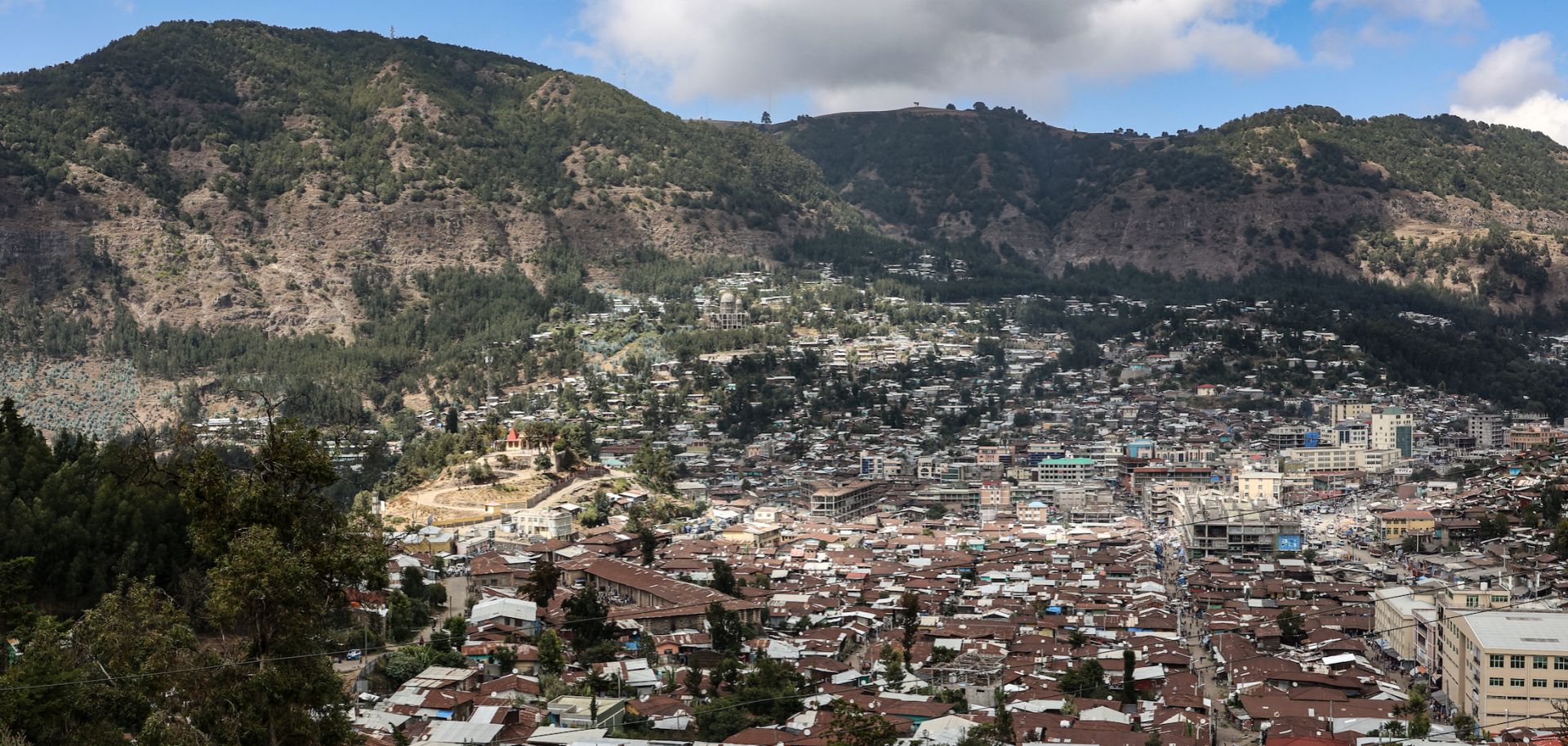
A photo taken on Jan. 10, 2022, shows an aerial view of Dessie, Ethiopia. The Tigray People's Liberation Front (TPLF) occupied the city for over 30 days in October.
Recent peace initiatives have not quelled ethnic violence in Ethiopia, and a host of complications mean that the war is likely to continue with high humanitarian and economic costs. In late March, the Ethiopian government unilaterally declared it had reached a ''humanitarian truce'' with the rebel forces in Tigray, which some international aid groups had heralded as the beginning of the end to the 18-month war. But violence between ethnic militias throughout the country has nonetheless persisted. Last month, Prime Minister Abiy Ahmed also urged all Ethiopians to participate in the national dialogue, which he described as a ''golden opportunity'' that ''will allow us to address the political challenges we have been facing for centuries and lay the groundwork for our future.'' However, the government continues to exclude the Tigray People's Liberation Front (TPLF) — its primary opponent in the ongoing civil conflict – and the Oromo Liberation Army (OLA) from participating in the process, fueling accusations by both ethnic militant groups that Abiy's supposed push for peace is disingenuous.
- Following Abiy's announcement of the dialogue, the chairwoman of the Ethiopian Political Parties Joint Council, a coalition of more than 50 opposition groups, said that Abiy's ruling Prosperity Party is ''approaching the [national] dialogue as the arbiter of the process, rather than as another equal stakeholder against whom accusations will eventually be leveled.''
- Clashes in Amhara, a region in northern Ethiopia bordering Tigray, killed 20 people and wounded 50 more on April 21. Amhara officials have blamed the OLA — the militant group representing Ethiopia's largest ethnic group, the Oromo — while Oromo officials claim Fano, an Amhara militia, carried out the attacks.
- Tigrayan rebels launched an incursion into Ethiopia's northeast Afar region in January, which has displaced up to 300,000 people.
- On March 25, the TPLF said it would respect the Ethiopian government's ''humanitarian truce'' by halting attacks if enough aid was allowed into Tigray. Since then, two aid convoys totaling 67 food trucks and four fuel tankers have reached Tigray, but the United Nations says that the millions of Tigrayans facing extreme hunger need over 100 trucks every day.
Ethnic divisions, a multitude of actors with conflicting aims, interference from external actors, and deep mistrust between the multiple players in the conflict will limit the effectiveness of peace initiatives and continue to fuel the conflict. Ethnic tensions in Ethiopia have deepened in recent months following the human rights violations allegedly perpetrated by both the TPLF and the country's armed forces, the Ethiopian National Defense Forces (ENDF). The government's move to exclude Oromo and Tigrarian militants — two of the war's major players — from its proposed national dialogue will only exacerbate these tensions, and is the most obvious barrier to resolving the conflict. But the chaos of war also offers cover for ethnic Tigrayans and Oromia to settle their long-standing political grievances with ethnic Amhara through militia violence. In addition, while the current civil war is primarily being fought by the TPLF, OLA, Fano and the government's ENDF, these are by no means the only stakeholders. Ethiopia is home to more than 80 ethnolinguistic groups that each have their own various interests and grievances with each other, further complicating efforts to reach a peace deal that appeases all major parties. Meanwhile, neighboring Eritrea is also intent on spoiling the conflict mediation process due to its own long-standing ethnic and border disputes with the TPLF, further impeding the prospects for peace. And lastly, historical grievances mean that all sides of the conflict distrust their counterparts and will likely be highly suspicious of any promises made by their rivals, limiting room for acts of ''good faith'' that typically lay the groundwork for larger peace agreements.
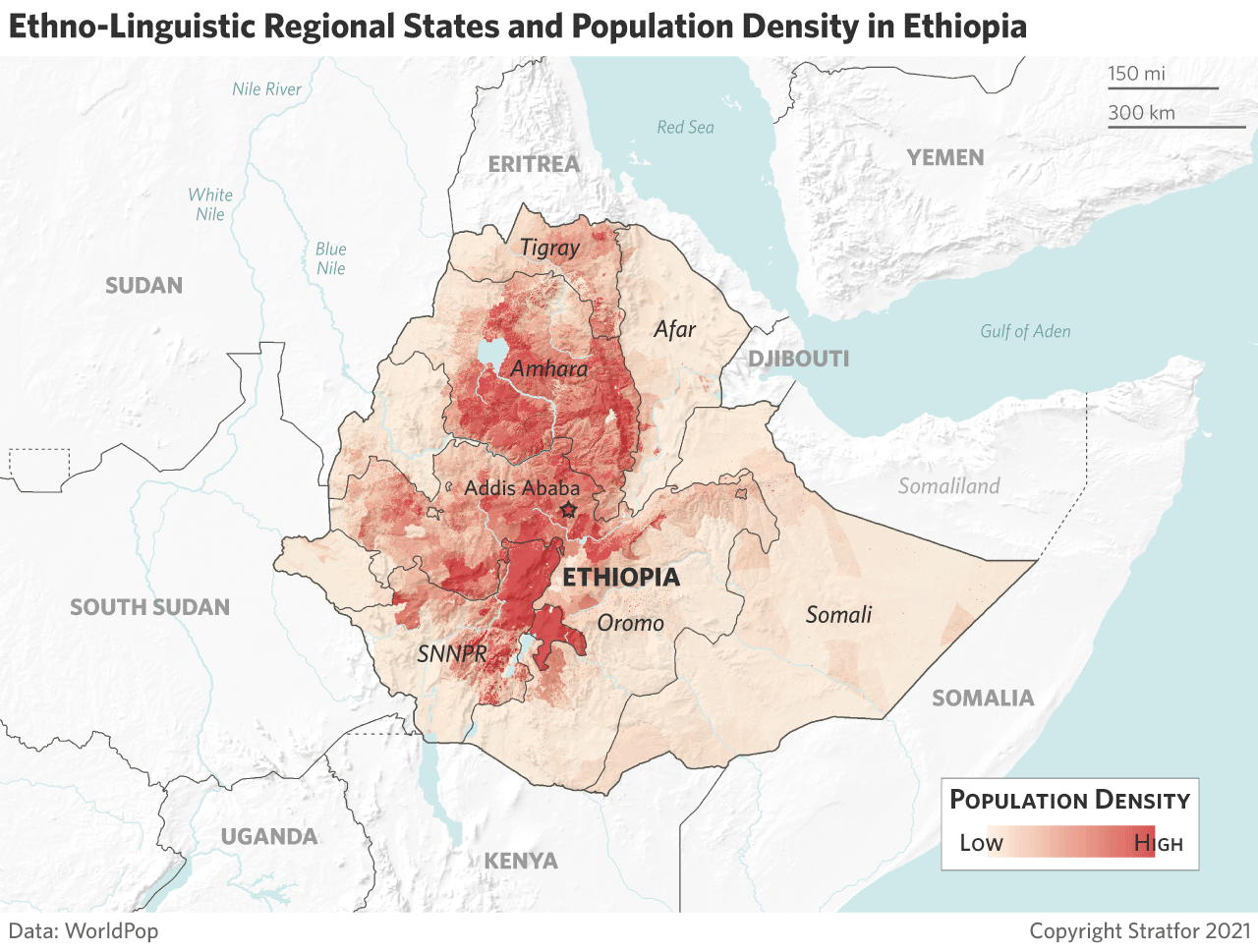
- Ethiopia is divided into 11 federal states based on language and ethnicity. Perceptions of ethnic discrimination and abuse by the national government — both under the TPLF's reign between 1991-2018 and the current tenure of Abiy, an ethnic Oromo — have historically driven political alliances and animosities. Amhara and Tigray's dispute since the 1990s over Raya and Western Tigray/Welkait Tsegede continues to fuel interethnic violence as well, with TPLF forces retaking control of Raya in June 2021.
- In addition to the Tigrayan war and clashes with the OLA, the ENDF is dealing with an insurgency in the western Benishangul-Gumuz region, occasional violence over land rights between Oromo and Amhara communities, and a boundary dispute between Somali and Afar states.
- Eritrean President Isaias Afwerki has long engaged in cross-border conflict with the TPLF, and will very likely continue to use whatever means are at his disposal to prevent a peace deal between Tigrayan rebels and the Ethiopian government. Afwerki opposes any concessions to the TPLF and claims that Tigrayan leadership is responsible for Eritrea's international isolation. Isaias would likely view a strong TPLF along Eritrea's southern border as an existential threat, increasing the likelihood that Eritrea will intervene if it perceives Abiy is retreating.
If the war persists – even as a low-level conflict relegated to specific regions – Ethiopia will likely suffer long-term economic costs. Even if the national dialogue commission expands its mandate to include the TPLF and OLA, the host of challenges to peaceful integration would very likely inhibit a lasting peace. This means that the conflict is likely to persist in the form of continued, low-level clashes among opposing ethnic militias and military forces. While events like the April 20 violence are highly unlikely to garner the same level of international criticism levied at the Ethiopian government for the Tigrayan war, they will likely prevent Abiy from achieving his economic priorities, as international investors and foreign partners are unlikely to overlook humanitarian abuses and view Ethiopia as stable. In such a scenario, slowed economic growth would likely deepen the humanitarian crisis in the country, where millions are already facing poverty, violence and extreme hunger.
- The chairman of the national dialogue commission has not confirmed whether the TPLF will eventually be allowed to participate in the process. He has previously stated that the commission is inclusive and any group is welcome as long they are peaceful and open to dialogue.
- According to the United Nations, the Horn of Africa is facing one of the most severe droughts in recent history. More than 15 million people are acutely food insecure across Ethiopia, Kenya and Somalia.
