
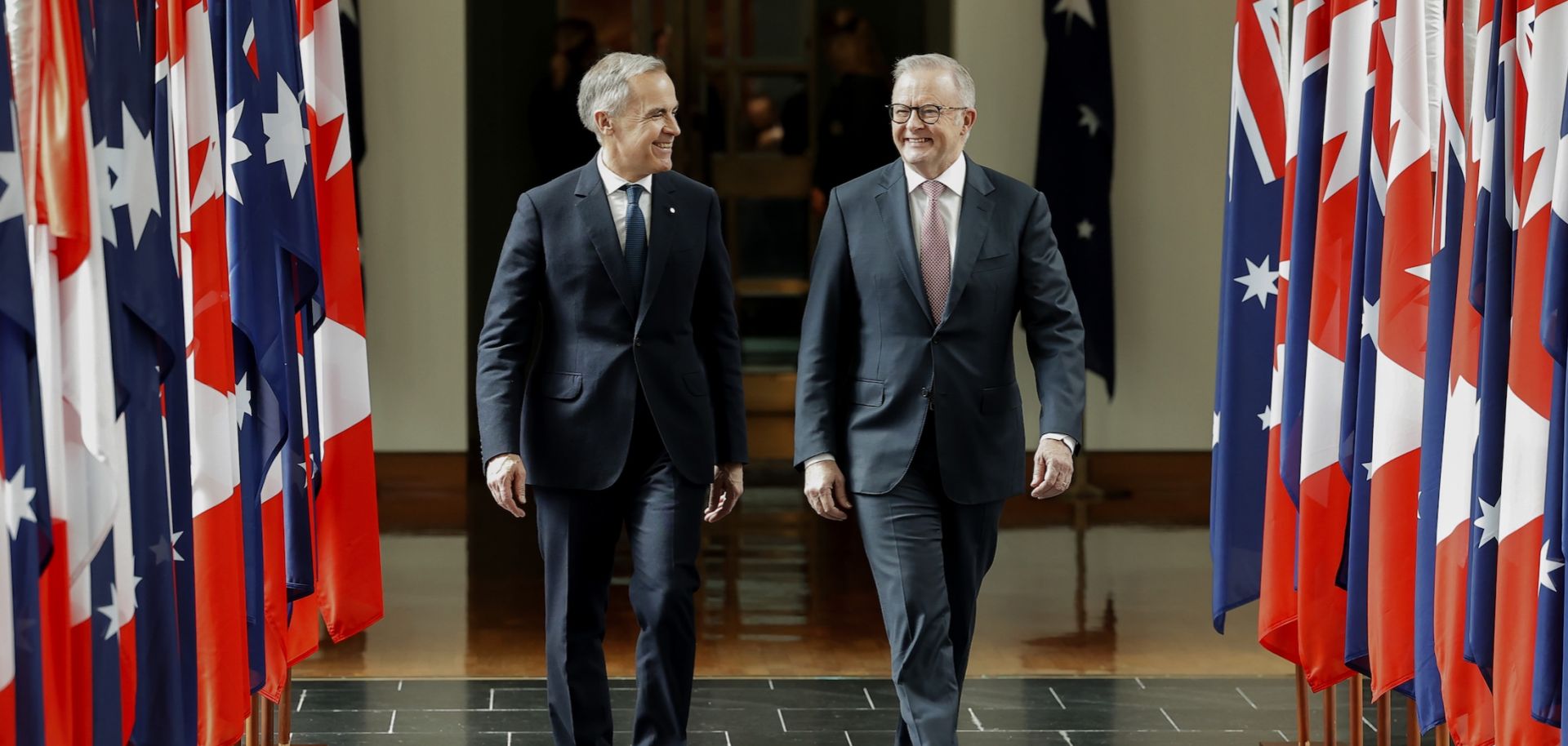
Canada's push to deepen ties with India, Australia and Japan reflects an effort to reduce economic and security dependence on the United States, yet this plan faces varying constraints and any successes may ultimately strengthen the same U.S.-centered economic and security system Ottawa is trying to hedge against. From Feb. 27 to March 6, Canadian Prime Minister Mark Carney visited India, Australia and Japan to expand economic, technological and security cooperation. During the trip, Canada and each of the three governments announced a range of initiatives covering trade negotiations, energy cooperation, investment coordination, critical minerals supply chains, defense dialogue and emerging technologies. In India, Carney met with Prime Minister Narendra Modi to advance bilateral economic cooperation and launch new negotiations toward a comprehensive trade agreement, while also announcing commercial deals and new cooperation frameworks in energy, defense and technology. Carney then traveled to Australia, where he met with Prime Minister Anthony Albanese and addressed the Australian parliament, becoming the first Canadian prime minister to do so since 2007. During the visit, the two governments announced expanded cooperation across critical minerals supply chains, defense technology, artificial intelligence (AI) and investment coordination, while reaffirming their 2022 Australia-Canada Comprehensive Strategic Partnership. Australia also agreed to join the Critical Minerals Production Alliance, a Canada-led Group of Seven initiative designed to coordinate production and investment among major mineral producers. For the final leg of his tour, Carney visited Japan, where he held meetings with Prime Minister Sanae Takaichi to strengthen economic, technological and security cooperation between the two countries, and advance bilateral coordination in areas such as maritime security, cyber policy and supply chain resilience.
- Canada and India agreed to accelerate negotiations on a Comprehensive Economic Partnership Agreement (CEPA), launched the Canada-India Defence Dialogue, agreed to negotiate a General Security of Information Agreement and announced more than $5.5 billion in commercial agreements between Canadian and Indian firms.
- Canada and Australia agreed to modernize the Canada-Australia Tax Treaty and supported expanded investment cooperation between Canadian pension funds and Australian superannuation funds.
- Canada and Japan announced a new comprehensive strategic partnership, agreed to launch a Canada-Japan Cyber Policy Dialogue and signed cooperation agreements covering coast guard exercises, emergency response coordination and counter-illegal fishing activities.
Carney's trip reflects a broader shift in Canada's economic, security and diplomatic strategy as Ottawa seeks to reset its turbulent relationship with India, reduce its heavy dependence on the United States and, as a partial means to achieving both, expand trade and security partnerships with major economies more broadly. Since winning elections in April 2025, Carney has sought to diversify Canada's ties away from historic reliance on the United States in response to a far more confrontational U.S. posture under President Donald Trump, including tariffs on Canadian goods, threats of additional trade measures and rhetoric challenging Canadian sovereignty — all of which has exposed risks of Canada's deep security and economic integration with its southern neighbor. Geography ensures that the United States will remain Canada's primary economic partner, but the scale of that dependence has renewed efforts in Ottawa to diversify export markets and deepen ties with other major economies. Reengagement with India forms part of this effort, particularly after bilateral relations deteriorated sharply beginning in 2023 following former Canadian Prime Minister Justin Trudeau's accusations that Indian government operatives were involved in the killing of a Sikh activist in Canada. India's position as one of the world's fastest-growing major economies and a large current and future consumer of energy and mineral inputs makes it a logical long-term market for Canadian resource exports. Canada's outreach to Australia and Japan similarly reflects the geography of resource and technology supply chains across the Pacific, as well as the security architecture linking advanced industrial economies in the region. As such, the three countries occupy key positions in the production, financing and consumption of strategic commodities and technologies, making them natural partners for Canada as it seeks to expand economic and security relationships beyond North America.
- In a January speech at the World Economic Forum in Davos, Carney argued that the post-World War II international order had experienced a "rupture" and called for "middle powers" (e.g., Canada, India, Australia and Japan) to coordinate more closely to secure supply chains, build technological capacity and avoid excessive dependence on either the United States or China.
- The United States absorbs roughly three-quarters of Canadian exports and dominates cross-border supply chains in sectors ranging from energy to manufacturing. This leaves Canada highly exposed to U.S. policy shifts, despite the ostensible protections of the United States-Mexico-Canada Agreement (USMCA), which itself is now a source of uncertainty as Canada and the United States (and Mexico) gear up for contentious renewal talks.
- Prior to their 2023 dispute, Canada and India had been slowly expanding economic ties, supported in part by a 2010 civil nuclear cooperation agreement that enabled Canadian uranium exports to India.
- Australia is a major producer of critical minerals and a longstanding Five Eyes intelligence partner with Canada (alongside the United States, United Kingdom and New Zealand), while Japan is one of the world's largest industrial economies and a major overseas investor in resource development.
Additionally, the trip highlights Canada's push to leverage India's future demand, Australia's resource scale and Japan's capital and industrial demand to build stronger Pacific-facing trade corridors, though each of these efforts faces constraints. For Canada, India offers the largest short-term upside in pure trade potential growth. This is because the commercial base remains relatively small, the two governments have now set a target of raising bilateral trade to $50 billion by 2030 from about $9 billion in 2024-25, and the energy relationship has room to expand well beyond uranium into liquefied natural gas (LNG), liquefied petroleum gas (LPG), crude oil, refined products and potash fertilizer. That said, even if Canada-India negotiations on a CEPA move quickly, bilateral mistrust and the practical difficulty of building new infrastructure and developing long-haul trade routes will likely keep trade expansion gradual rather than immediate. When it comes to Australia, Canada is primarily seeking to tighten coordination with a fellow major resource producer over how critical minerals are financed, stockpiled, processed and marketed, which could have a much greater economic impact than simply expanding bilateral trade. Such coordination gives Canada and Australia a better chance of shaping non-Chinese supply chains from the upstream side, particularly because the two countries are among the world's largest producers of lithium, uranium and iron ore. In practice, Canada-Australia cooperation will likely focus on aligning upstream production, expanding refining capacity and securing long-term supply agreements with industrial buyers in countries such as Japan. Still, efforts to reshape supply chains will face heavy structural constraints because China continues to dominate mineral processing, and new mining and refining projects typically take years to bring online. Japan, meanwhile, is likely to become the most important source of downstream demand and investment for Canada, as Japanese companies frequently commit to long-term purchase agreements that help finance large energy and resource projects. Tokyo's growing emphasis on economic and energy security should thus encourage Japanese firms to deepen involvement in Canadian LNG, uranium, critical minerals and advanced manufacturing, particularly as Japan seeks to diversify energy supply away from the Middle East. But even so, Canada's ability to expand energy exports to Japan will depend on the development of additional export infrastructure on its Pacific coast and will face competition from established suppliers, including the United States (which already supplies a growing share of Japanese LNG imports).
- India plans to expand nuclear power capacity to 100 gigawatts by 2047, roughly 11 times its current level. This will significantly increase demand for imported uranium that domestic reserves cannot meet. India is also one of the world's largest fertilizer importers, making potash a major component of agricultural trade with major producers such as Canada. At the same time, however, India has long expressed concern that Canada has been lenient toward supporters of the Khalistan movement, a banned separatist group in India that retains backing among segments of the Sikh diaspora, particularly in Canada (where Sikhs make up about 2% of the population). Although Carney's government has sought to reset ties with New Delhi since Trudeau's 2023 allegation, this dispute will likely continue to cast a shadow over bilateral relations, limiting the pace of normalization.
- Canada and Australia together produce about one-third of global lithium and uranium, and more than 40% of global iron ore. Ottawa is also promoting a production alliance, or "buyers' club," model rather than relying solely on price mechanisms.
- The Canada-Japan roadmap places trade, investment, economic security and energy cooperation at the center of the relationship. Japan remains heavily dependent on imported energy, sourcing roughly 90-95% of its oil from the Middle East.
Canada's outreach also reflects a parallel effort to expand security cooperation with major regional powers whose interests increasingly overlap in maritime security, supply chain protection and advanced defense technologies, reinforcing a networked approach that seeks to expand Ottawa's regional security coordination role amid growing strategic competition with China. India occupies a distinct role in this framework as a large regional power seeking greater defense coordination with Western partners while maintaining its relatively robust strategic autonomy. The newly launched Canada-India defense dialogue and negotiations toward a General Security of Information Agreement could enable deeper cooperation in intelligence sharing, defense technology and maritime domain awareness, particularly as sea lanes across the Indian Ocean become more central to global energy and commodity trade and as China expands its naval presence across the region. Australia and Japan occupy a more integrated position within the existing Western security architecture and have been central participants in efforts to strengthen deterrence and maritime security in response to China's expanding military capabilities. Australia also plays a key role in regional defense coordination with the United States and New Zealand (via the ANZUS alliance); this role is further strengthened by Australia's expanding partnerships with countries like Japan, which has steadily increased defense spending and expanded security cooperation with Western partners in recent years. Deeper engagement with India, Australia and Japan enables Canada to modestly expand its security presence across the Pacific without undertaking large-scale independent troop deployments, with Ottawa instead relying on interoperability, joint exercises and intelligence sharing with partners that already maintain significant regional capabilities. Cooperation will likely focus on areas where Canadian capabilities overlap with those of its partners, including maritime surveillance, cybersecurity, Arctic and North Pacific domain awareness, and the protection of critical infrastructure and energy supply chains that connect North America with Asian industrial economies.
- India has expanded naval patrols and maritime domain awareness operations across the Indian Ocean while increasing security coordination with Western partners through joint exercises and defense dialogues.
- The 1951 ANZUS treaty commits Australia, New Zealand and the United States to consult and cooperate in response to regional security threats.
- Japan approved its largest postwar defense buildup in 2022, committing to increase defense spending to 2% of GDP by 2027 as part of efforts to strengthen deterrence amid rising tensions with China.
Ultimately, Carney's outreach shows that even when Canada tries to diversify away from the United States, many of the resulting partnerships will still complement and benefit the U.S.-led security and economic architecture that continues to define Canada's strategic environment. Canada-Australia coordination on critical minerals helps build non-Chinese, Group of Seven-led supply chains for inputs used in defense and advanced manufacturing. But because Australia sits at the center of the AUKUS partnership, that cooperation also directly strengthens the United States' wider defense industrial ecosystem. Canada's planned acquisition of Australian over-the-horizon radar technology similarly supports the modernization of North American Aerospace Defense Command (NORAD), linking Australian defense capabilities more directly to North American (i.e., U.S.) homeland defense. Japan adds a parallel economic dynamic. While deeper Japanese investment in Canadian energy, minerals and manufacturing can help Ottawa diversify its external partnerships, much of that investment remains attractive precisely because Canada operates within integrated North American supply chains under the USMCA, meaning any weakening of the pact would not only disrupt regional trade but also reduce the strategic value of Canada as an investment platform for Japanese firms. Compared with Australia and Japan, India is less tightly embedded in U.S.-led alliance structures, but deeper Canada-India cooperation in energy and defense still contributes to a broader regional balance in which multiple powers seek to offset China's growing military and industrial influence. As a result, Ottawa's diversification strategy highlights its structural constraints, as Canada will never come remotely close to replacing the importance of U.S. defense ties with any of these regional countries, particularly U.S. treaty allies Australia and Japan. While Canada is expanding its economic and diplomatic options in response to growing uncertainty and outright threats from the United States, many of these new partnerships will inevitably reinforce the same U.S.-centered economic and security architecture. In practice, Canada is attempting to gain greater strategic autonomy within that system rather than escape it, since geography, integrated supply chains and decades of defense cooperation make a full strategic break with the United States unrealistic.
- China and India maintain a heavily militarized border along the Line of Actual Control, where clashes in 2020 produced the first combat fatalities between the two countries since 1975 and prompted both sides to deploy roughly 50,000-60,000 troops along the frontier. Since then, the two governments have reached a series of disengagement agreements and have taken steps to stabilize tensions along parts of the border. But China and India continue to maintain large forward deployments and expand military infrastructure across the frontier, underscoring that the relationship remains defined by long-term strategic competition. This means a stronger India supports a regional balance that forces China to deploy forces along its western border, somewhat limiting its ability to concentrate them on the eastern maritime front facing Taiwan, the East China Sea and the South China Sea — the areas most likely for a confrontation with the United States to occur.
- AUKUS is a defense agreement between Australia, the United States and the United Kingdom aimed at integrating advanced military capabilities among the three countries, including plans for Australia to acquire nuclear-powered submarines and cooperate on technologies such as undersea warfare, AI and quantum computing. NORAD is the joint U.S.-Canadian command responsible for monitoring and defending North American airspace.
