
A worsening diplomatic crisis between India and Canada will raise near-term risks of protests and tit-for-tat retaliation in the coming weeks. In a Sept. 18 speech before the House of Commons, Canadian Prime Minister Justin Trudeau announced that Canadian security agencies were "actively pursuing credible allegations" that "agents of the government of India" were potentially involved in the June killing of Canadian citizen and Sikh separatist leader Hardeep Singh Nijjar in British Columbia. Trudeau further labeled the alleged incident "an unacceptable violation of our sovereignty." The same day, Canadian Foreign Minister Melanie Joly announced the expulsion of the head of India's foreign intelligence agency in Canada. India has since responded by rejecting the allegations, calling them "absurd" and "unsubstantiated" and accusing Canada of providing "shelter" to Sikh separatist "terrorists and extremists" who "continue to threaten India's sovereignty and territorial integrity." India on Sept. 19 also announced the retaliatory expulsion of an unnamed senior Canadian diplomat.
- Two masked assailants shot and killed Nijjar on June 18 outside a Sikh temple in Vancouver. A prominent Sikh separatist leader, Nijjar was declared a terrorist by the Indian government on the basis of allegedly plotting violent attacks in India linked to terrorism and Sikh separatism. In 2022, an Indian investigative agency reportedly offered $12,000 in reward for his arrest.
- On Sept. 19, following the allegations, Canada updated its travel advisory to India, warning citizens to exercise a high degree of caution given threats of "terrorist attacks throughout the country."
India-Canada relations have been strained in recent years, as New Delhi has accused Ottawa of failing to take action against Sikh separatist leaders and supporters in Canada, whom India views as national security threats. Sikh separatists have for decades sought an independent state for Sikhs called Khalistan in India's Punjab region; while the movement was historically based in Punjab, Indian security operations, destabilizing infighting and a loss of popular support pushed its core abroad via the Sikh diaspora. In one high-profile incident in June, India rebuked Canada for permitting a float at a Sikh activist parade in Brampton, Ontario, depicting former Indian Prime Minister Indira Gandhi's 1984 assassination by her Sikh bodyguards. Tensions have persisted, as Canada has largely refused India's calls to clamp down on the Sikh separatist movement there, with Ottawa citing free speech protections. Strains in the two countries' relations remained visible on the sidelines of the Group of 20 summit held in New Delhi, India, from Sept. 9-10, when Indian Prime Minister Narendra Modi held a brief "pull-aside" meeting with Trudeau expressing concerns over alleged anti-India protests in Canada. Prior to the G20 summit, on Sept. 1, Canada had paused talks on a potential trade treaty with India, while also recently announcing the postponement of a trade mission to India. While Canada did not provide explicit reasons for these decisions, Canada's recent allegations have prompted widespread speculation they were made as a result of the reported investigation into India's alleged involvement in Nijjar's killing.
- Canada has a large Indian community and a particularly influential Sikh community; in a 2021 census, 770,000 people cited Sikhism as their religion, while 1.4 million of an overall population of 40 million are of Indian origin.
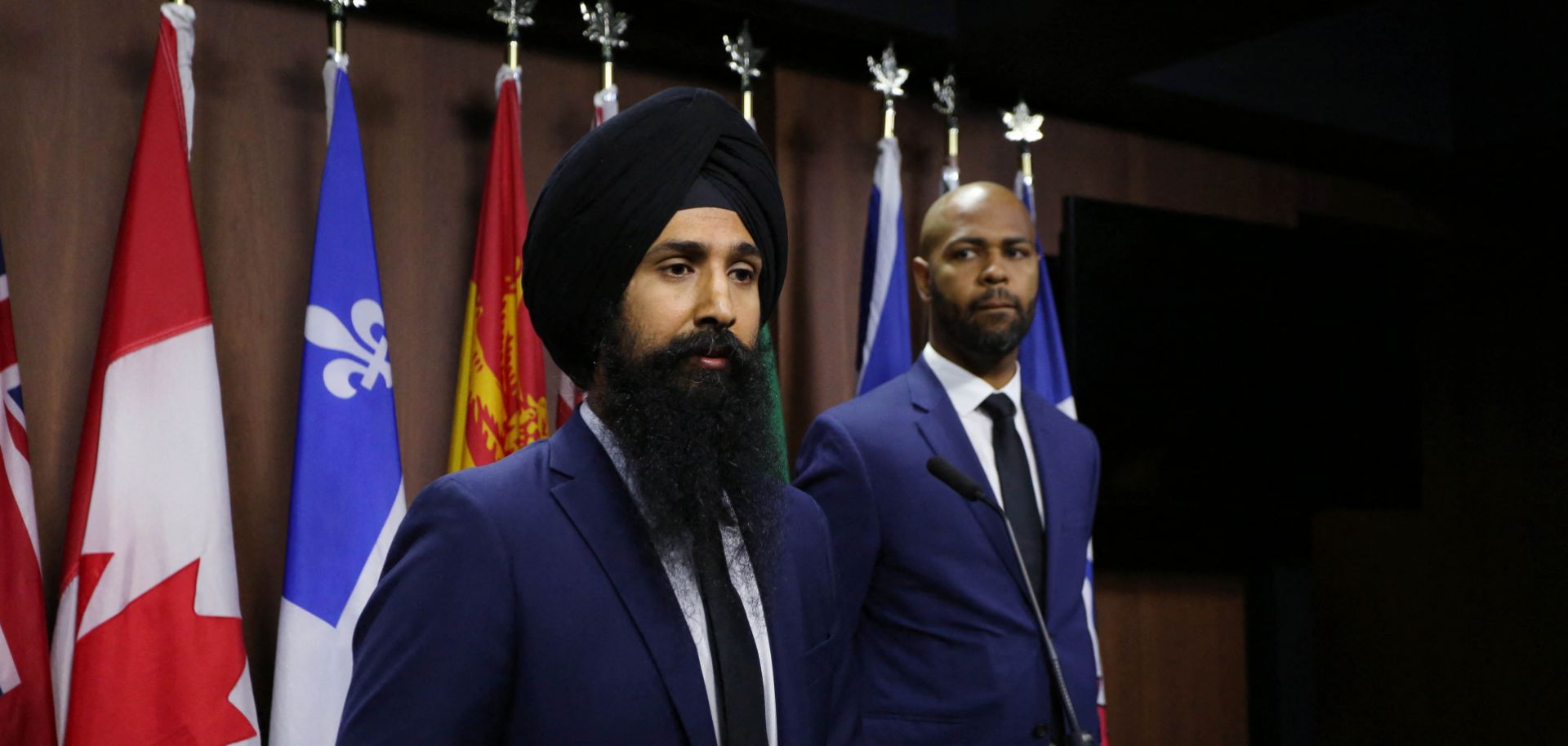
- Trudeau's Liberal party currently governs with the support of a confidence-and-supply agreement with the New Democratic Party, which is headed by Jagmeet Singh, a practicing Sikh. In the wake of Canada's allegations, Singh has stated the importance of sending a "clear message" about "what it means that a foreign nation kills a Canadian on Canadian soil."
- The past year has seen a limited resurgence of the Sikh separatist movement in India, driven by the rise in prominence of Sikh separatist leader Amritpal Singh in Punjab state. Amritpal Singh helped lead months of protests in Punjab — some of which turned violent — before state authorities arrested him in April after a weeks-long manhunt. Sikh separatists based abroad have also been linked to some of the sporadic, small-scale separatist attacks within Punjab.
The growing diplomatic crisis will raise security risks and open the door to potential further retaliatory measures in the coming weeks. Sikhs for Justice, a Sikh separatist organization based in the United States, has already called for disruptive protests outside Indian consulates in Ottawa, Toronto and Vancouver, Canada, the week of Sept. 24. As a result, there are near-term risks of demonstrations and, judging from incidents earlier this year, potential clashes between supporters of the Sikh separatist movement and of the Indian government. Meanwhile, India and Canada are unlikely to revive trade talks for the foreseeable future, though this will have little practical impact; while Canada and India have witnessed a years-long growth in trade and investment, India's and Canada's exports to one another totaled $8 billion in 2022, which suggests there will be few concrete economic consequences from a failure to sign a trade deal. That said, both Trudeau and Modi face domestic political incentives to play hardball, with Trudeau facing numerous scandals (including accusations that he has not stood up to Chinese interference in Canadian politics) and Modi promoting a strong Hindu nationalist vision ahead of general elections in 2024. The Canadian newspaper The Globe and Mail reported on Sept. 18 that the Canadian government "has privately ruled out severing diplomatic relations with New Delhi" but was considering further retaliatory measures to respond to the alleged incident. These measures could include further diplomatic ejections, visa denials and other diplomatic retaliatory measures in the coming weeks, which could more broadly complicate Canada's growing focus on the Indo-Pacific, where India has been seen as a key partner to counter China.
- Canada's main exports to India consist of energy products such as coal, coke and briquettes, along with fertilizers. However, since India is not significantly dependent on Canadian imports and could find substitutions from other states, potential Canadian retaliation in the economic sphere would only narrowly impact India.
- Over the past year, supporters of the Sikh separatist movement have conducted disruptive protests outside Indian consulates and embassies in countries including Canada, the United States, the United Kingdom and Australia. In July, for example, an estimated 250 supporters of the Khalistan movement in Canada protested across the street from the Indian consulate in Toronto; violence subsequently broke out between Sikh separatist supporters and pro-India counter-protesters, ultimately prompting the arrest of at least two Sikh separatist protesters.
- The United States, Australia and the United Kingdom — all close partners of Canada and its fellow members in the Five Eyes intelligence-sharing alliance — have expressed concern about Canada's allegations and emphasized their continuing contact with Canada as its investigation proceeds. However, the spokesperson for the United Kingdom's prime minister said the country would press on with trade talks with India.
