
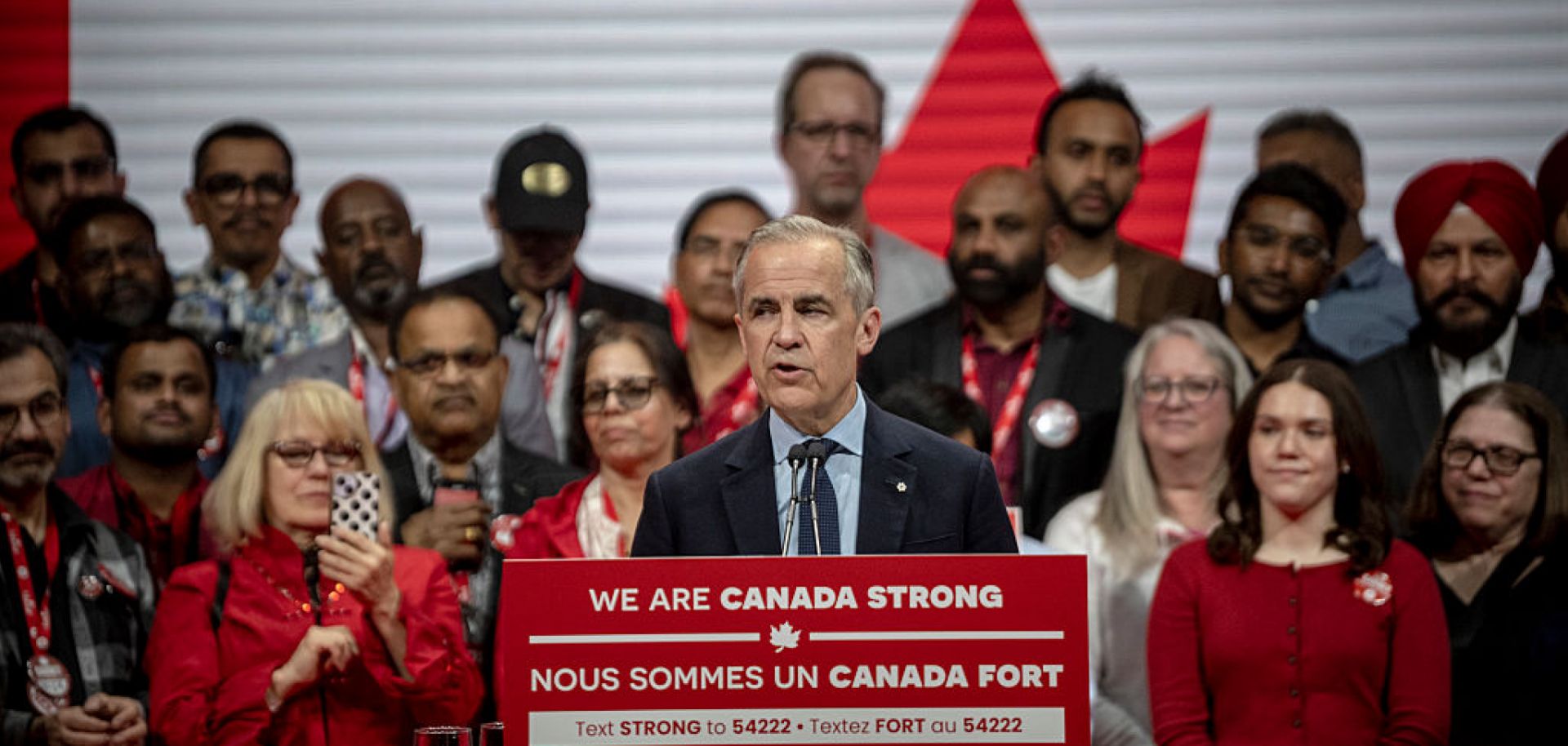
In Canada, the new Liberal government will likely push to lower tax burdens, shelter key domestic industries, increase spending as it grapples with an economic slowdown, and draw closer to Europe as Ottawa seeks to diversify its trade and security relationships away from the United States. Canadian Prime Minister Mark Carney's center-left Liberal Party won the country's early general elections on April 28, but appears to have narrowly missed capturing a majority in the House of Commons. As of midday on April 29, the Liberals had won or were leading in 168 ridings, just shy of the 172 needed to form a majority in the 343-seat chamber. The opposition center-right Conservative Party was projected to win 144 ridings, while the Bloc Quebecois (BQ) was projected to secure 23; the New Democratic Party and Green Party were projected to take seven and one, respectively. Despite seemingly falling just short of a majority, the Liberals' victory was a stunning reversal of fortunes in just under four months. At the start of the year, when former Liberal Prime Minister Justin Trudeau announced his resignation, paving the way for early elections, the opposition Conservatives held a lead of over 20 points, having tapped into widespread public frustration with Trudeau's nearly ten-year tenure, especially over the rising cost of living. Since then, however, U.S. President Donald Trump's aggressive trade policy and rhetoric towards Canada soured Canadian voters on the Conservatives and their leader, Pierre Poilievre, who had long been compared to Trump as he promoted similar populist policies.
- On Jan. 6, Trudeau, who had been in office since November 2015, announced that he would step down as Liberal leader and eventually resign as prime minister following a party leadership contest. Carney, who previously led the central banks of both Canada and England, won that election and took over as prime minister on March 14, after which he quickly called for early general elections.
- Poilievre, who lost his own riding and whose leadership of the Conservatives is now in question, had prepared an electoral strategy designed to take advantage of popular frustration with Trudeau and many of his leftist policies, including strong environmental rules and high taxes to fund social welfare programs. However, the defining election issue quickly became how best to handle Trump after he imposed tariffs on Canada and repeatedly belittled Canada's sovereignty by referring to it as the 51st state, including on the day Canadians went to the polls. These dynamics, combined with Carney significantly moderating or fully jettisoning many of Trudeau's policies, crucially upended the race.
- New Democratic Party (NDP) leader Jagmeet Singh resigned after losing his own riding and the party dropping below the 12-seat threshold required for official party status, which grants access to benefits such as research funding and staffing support.
Despite facing pressures to move to the left, Carney will likely push for more centrist domestic policies and will pursue higher spending to ease the threat of a recession. Carney was elected on a moderate platform to distance himself from Trudeau's legacy, and he is much more likely to move towards the center on numerous domestic policies. Still, because the Liberals do not appear to have gained a parliamentary majority, they will need support from the BQ or NDP to pass legislation. Canada does not have a history of coalition governments and, given that the Liberals are just a few seats shy of a majority, they are more likely to lead a minority government and negotiate with the BQ or NDP on an ad hoc basis; another option would be for the Liberals to enter into a confidence-and-supply agreement in which the they rely on support from one or both other leftist parties for confidence votes and the federal budget, but otherwise receive no formal guarantees of support. Either option will give the NDP or BQ some level of influence over Carney's government, pressuring him to adopt more leftist positions on multiple domestic issues. Thus, while the Liberals are likely to implement a variety of tax cuts, exemptions and rebates, especially for lower and middle-income households, as well as for industries most exposed to U.S. tariffs, the NDP will press for more social benefits, and the BQ will seek more autonomy for Quebec. Similarly, Carney's government will likely also need to water down plans to ease rules on homebuilding, streamline regulations to develop natural resources, and reduce red tape to build new infrastructure like roads and ports — all of which will meet some level of resistance from the NDP and BQ. Carney's plans will be part of a larger effort, which he has valued at CA$130 billion (US$94 billion) over the next four years, to stoke growth in order to limit the harmful impacts of an economic slowdown that could turn into a technical recession later this year, especially if U.S. tariffs persist. Carney's plan would add to Canada's debt burden, but Canada is in a generally favorable fiscal position compared to many other advanced economies. This means that, while more spending will put pressure on the government's finances, Carney's plan is unlikely to lead to a near-term fiscal crisis, absent significantly worse economic headwinds.
- According to the Office of the Parliamentary Budget Officer, a Canadian legislative unit that gives independent analysis, the government deficit in FY 2025-26 is estimated to be C$46.8 billion, or about 1.47% of GDP. Carney's plan would take it to C$62.3 billion (1.96% of GDP) before falling in the following three fiscal years. Meanwhile, Canada's federal debt-to-GDP ratio is only approximately 42%, and it holds strong credit ratings from all the major agencies, despite some of them warning over the rising debt burden and slowing growth, giving it fiscal space to temporarily spend more without stoking significant market pushback against temporarily elevated debt levels.
- Canada currently faces 25% U.S. tariffs on all goods not compliant with the U.S.-Mexico-Canada Agreement or USMCA (though Canadian energy and potash exports only face 10% tariffs). Canada, like all other countries, also faces 25% U.S. tariffs on steel, aluminum and non-U.S. content in vehicles. All three are crucial Canadian exports to the United States, and, against the backdrop of already slow growth, the persistence of high U.S. tariffs threatens to tip Canada — which sends three-quarters of its exports to the United States — into a recession later this year.
- A major component of Carney's spending plan involves billions of dollars in new defense spending to acquire new physical capabilities, expand the size of the armed forces and bolster the defense industrial base. Carney has pledged to hit NATO's defense spending target of 2% of GDP by 2030 (compared to just 1.37% in 2024), two years earlier than the pledge made by Trudeau.
- In his first move after becoming prime minister in March, Carney ordered the removal of the controversial consumer carbon tax, one of Trudeau's signature policies, but which had become an albatross for his government. Especially with pressure from the NDP and BQ, Carney is unlikely to remove the industrial carbon tax and will likely maintain the overall emissions cap on oil production. Although he will probably look to reduce the burden on companies, including potentially by weakening the cap if prolonged U.S. tariffs harm the oil and gas industry, divergences between Ottawa and the western Prairie provinces, especially oil and gas-producing Alberta, will result in tensions.
Carney's government will likely maintain its trade retaliation against the United States, while also pursuing closer defense and economic ties with other foreign partners, chiefly those in Europe. Compared to domestic policy, the NDP and BQ are less likely to significantly affect foreign policy, meaning that Carney will likely continue his strong stance against U.S. tariffs and Trump's personal rhetoric demeaning Canada. This means that he will likely continue to use retaliatory tariffs, export taxes or other measures to put more pressure on the Trump administration to wind down tariffs. Still, Carney's goal will be to end the trade war in order to reduce the harmful spillover impacts to the Canadian economy, meaning his government will likely offer some concessions to the United States. Such concessions will likely include imposing trade and other restrictions on China, as well as moves to widen market access in less sensitive industries — though not more contentious ones like the agriculture and dairy sectors — and around revisions to USMCA, talks over which are likely to heat up in the coming months. However, even with those measures in place, it remains uncertain whether they would de-escalate trade tensions with the White House, leaving a heightened risk that retaliatory tariffs could continue. As a result, Carney will seek to diversify Ottawa's economic, security and other ties beyond the United States to insulate Canada from future frictions with the United States. Chiefly, this means pursuing closer ties with the European Union and the United Kingdom, with media leaks indicating that Canada is already in advanced talks with Brussels for much greater defense cooperation. Deeper trade ties are also likely — not only with the European Union and United Kingdom, but also with potential partners in places like South America and Southeast Asia that Liberal leaders have touted. However, the Liberals' need to appease the NDP and especially the generally protectionist BQ will likely put an upper limit on progress.
- According to media leaks, Ottawa is reportedly in late-stage talks with Brussels to include Canada in the European Union's strategy to diversify its defense suppliers away from the United States. Though there are still disagreements among EU members on the precise terms, this could include giving Canadian defense firms preferential access to the EU market and/or allowing Canada to be included, perhaps with the United Kingdom as well, in the European Union's plan to make common military purchases.
- Canada already has largely comprehensive free trade deals with both the United Kingdom and the European Union. Still, the former is a continuity deal since London left the bloc, suggesting there is room for an expansion of trade ties. The latter is not fully enforced, in large part because France has not ratified the deal due to resistance from its domestic agricultural sector, suggesting an opportunity to make progress in areas like removing certain non-tariff barriers and granting greater market access for some goods. Progress on both fronts suffered setbacks in 2024 when British trade negotiators walked out of talks in January, largely due to what they claimed was Canada's refusal to open up its protected dairy industry. Two months later, France's Senate overwhelmingly refused to ratify the European Union's 2017 free trade deal with Canada, sending the proposal back to the National Assembly, largely due to pressure from French farmers worried about what they alleged would be unfair competition and threats to France's food sovereignty.
- Under a Carney government, Canada's tense relations with China are unlikely to meaningfully improve and could easily worsen. On the campaign trail, the Liberal Party and Carney specifically faced accusations of previously underplaying threats from China, leading him to take a more aggressive rhetorical stance against Beijing. While Carney has acknowledged China's importance to Canada as its second-largest trading partner, he has also labeled it the biggest threat to Canadian security.
