
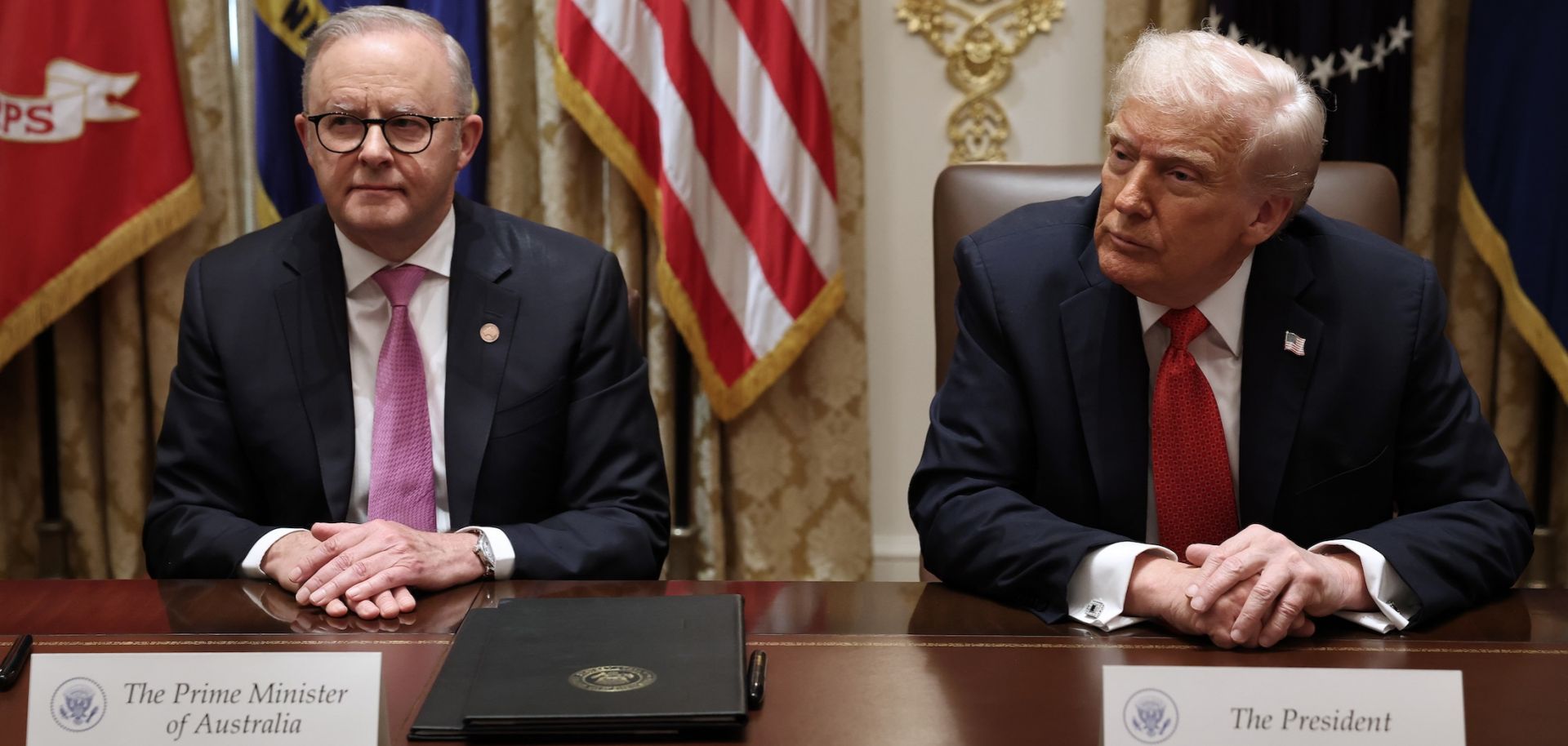
The United States and Australia's new critical minerals pact and Trump's endorsement of AUKUS reflect a mutual desire to tighten defense and supply chain integration as a way to reduce strategic reliance on China, though these political commitments are unlikely to yield tangible results before the end of the decade due to industrial bottlenecks. On Oct. 20, U.S. President Donald Trump and Australian Prime Minister Anthony Albanese met at the White House for a bilateral summit that delivered two principal outcomes: a critical minerals deal (dubbed the U.S.-Australia Framework for Securing Supply in the Mining and Processing of Critical Minerals and Rare Earths) and a public reaffirmation of U.S. commitment to the AUKUS nuclear submarine partnership. The critical minerals framework commits both governments to jointly mobilize financing through their respective export-credit and development agencies to support priority mining, refining and processing projects. The U.S. Export-Import Bank, the U.S. International Development Finance Corporation and Export Finance Australia's Critical Minerals Facility will together mobilize at least $1 billion in initial co-financing over the next six months, with the intent to catalyze roughly $8-8.5 billion in private sector investment. The framework also introduces mechanisms for price stabilization and stockpiling, tightened foreign investment screening, permitting acceleration for strategic projects and joint research on recycling and geological mapping. In parallel, Trump declared that the AUKUS security pact between Australia, the United Kingdom and the United States would proceed ''full steam ahead.'' This declaration aimed to reassure Canberra of Washington's continued commitment to Pillar I of AUKUS, despite the U.S. Defense Department's ongoing review assessing industrial capacity, timelines and costs for implementation. The meeting — which was Albanese's first with Trump since Trump's return to the White House in January — also ended months of speculation about a drift in the U.S.-Australia alliance and provided overdue political reaffirmation of Canberra's place within Washington's defense industrial agenda.
- Both governments presented the minerals deal as a ''whole-of-industry'' approach to competition with China and a deepening of bilateral cooperation, highlighting that the U.S.-Australia alliance now integrates defense industrial and broader supply chain coordination through both the critical minerals and AUKUS frameworks.
- Eligible projects will focus on rare earth separation, gallium and germanium refining, lithium and cobalt midstream processing and recycling facilities in both countries.
- Pillar I of AUKUS covers the transfer, construction and operation of nuclear-powered submarines for Australia, including U.S. and U.K. rotational deployments, training of Australian personnel and eventual domestic production.
The summit was driven by the convergence of economic vulnerability and strategic urgency across both countries, particularly in light of Chinese export restrictions. In July, China imposed export controls on gallium, germanium and dysprosium, which it then expanded in October to include additional rare earth products and battery material technologies. The restrictions have since disrupted global supply chains for semiconductors and the magnets used in electric vehicles. Prices have spiked, Australian projects (such as Arafura's rare earth refinery in the Northern Territory and Alcoa's gallium pilot plant in Western Australia) have stalled, and U.S. defense planners have faced renewed pressure to secure inputs for munitions and clean energy manufacturing. The disruptions have also highlighted the West's dependence on Chinese refining capacity, which accounts for roughly 85-90% of global output. For Australia (which holds roughly one-fifth of the world's lithium reserves, as well as top-tier deposits of nickel, cobalt and rare earth elements — all crucial inputs for electric vehicle batteries, clean energy systems and advanced defense technologies), the moment provided leverage to seek U.S. financing and market access, not only for new mining ventures but also for downstream refining and processing capacity where Australia is currently heavily and structurally dependent on China. For the United States, the framework offered a way to anchor Australia deeper into U.S. industrial and defense value chains ahead of 2026 AUKUS-related defense industrial milestones because it encompasses the minerals and aspirational supply chain independence from China needed for that project. Simultaneously, the Pentagon's AUKUS review, launched in July to examine whether U.S. shipyards can sustain the agreement, among other reasons, has highlighted the need to augment industrial capacity through allied coordination. Canberra and Washington are building what officials now term an ''allied industrial commons,'' a network of co-financed, mutually secured supply chains for strategic materials and technologies designed to dilute China's economic leverage and reduce attendant strategic challenges over the long term.
- Critical minerals projects outside China often struggle to achieve or sustain commercial viability. Thin refining margins, cyclical prices and competition from heavily subsidized Chinese producers with lower environmental costs undercut returns, while lengthy permitting processes and uncertain long-term demand from Western buyers discourage private investment. In the short to medium term, Australia can narrow this gap through various mechanisms, including government-backed export credit, guaranteed loans and U.S. procurement guarantees that improve bankability and limit investment risk. But in the long term, sustained allied demand will be critical in achieving cost competitiveness.
- Planned AUKUS-related defense industrial milestones for 2026 include the start of rotational U.S. and U.K. submarine deployments at HMAS Stirling (Australia's primary naval base, now being upgraded to host visiting nuclear-powered submarines); the integration of Australian firms into U.S. Virginia-class submarine-related supply chains, beginning with component manufacturing, sustainment and systems integration; and the launch of trilateral nuclear engineering and shipyard training programs to develop a certified Australian workforce capable of maintaining nuclear-powered vessels by the early 2030s.
Washington and Canberra's partnership seeks to embed Australia in U.S. defense and clean energy value chains, a strategic response to China's dominance in refining that will test whether allied financing can deliver tangible supply diversification. The U.S.-Australia Critical Minerals Framework is a non-binding policy instrument designed to catalyze rather than replace private investment in strategic projects. It links the U.S. Export-Import Bank, the International Development Finance Corporation and Export Finance Australia's Critical Minerals Facility in a coordinated effort to back ''priority'' mining, refining and processing ventures through loan guarantees, concessional loans, equity stakes and long-term offtake agreements. A joint U.S.-Australian steering group will oversee project selection, identifying commercially viable proposals eligible for support. Public financing (initially a combined $1 billion) is intended as first-loss or catalytic capital, absorbing early risk so private lenders, investors and offtakers can participate with greater confidence. Each dollar of sovereign finance is meant to leverage six to eight dollars of private investment, closing funding gaps that have stalled projects. Officials are also considering price stabilization and stockpiling mechanisms to shield non-Chinese producers from market dumping or supply shocks. However, building refining and midstream processing capacity is inherently slow, because environmental approvals, engineering design and construction typically take five to seven years before commercial output can be achieved, and most Australian projects remain in early feasibility stages. China's monopolistic dominance in refining significantly exacerbates these constraints, given that Australian approval processes are slow, and midstream processing costs outside of China are typically 20-30% higher. Success will therefore depend on streamlined permitting, regulatory consistency and long-term offtake commitments from U.S. and partner manufacturers. The framework's non-binding character limits enforceability, meaning its effectiveness will depend on legally binding, project-level loan guarantees and offtake agreements it is designed to trigger. If the framework fails to attract private capital at scale, it will remain largely symbolic. But if aligned with U.S. procurement (e.g., under the Inflation Reduction Act or successor frameworks and AUKUS-linked defense demand), it could underpin a durable allied supply network for critical materials. If these conditions are met, initial loan guarantees and offtake agreements could materialize within two to three years with incremental output by 2028, marking a modest but strategically meaningful diversification of supply chains away from China that would strengthen the U.S.-Australia alliance's industrial base.
- Initial project disbursements are targeted for the second quarter of 2026, with aspired output of roughly 4,000 tons of rare earth oxides and 30 tons of semiconductor-grade gallium by 2028.
- To qualify for tax credits under the Inflation Reduction Act, U.S. automakers and clean energy producers must source battery minerals and components from countries that have a free trade agreement with the United States or are similarly trusted U.S. partners. Because Australia qualifies under these terms, projects financed through the framework would directly benefit by supplying inputs to U.S. manufacturers eligible for such subsidies, guaranteeing long-term buyers and improving commercial viability.
- The critical minerals framework complements ongoing U.S.-led supply-chain initiatives with Japan, South Korea and Southeast Asian partners, positioning Australia as a primary upstream node in a regional network for processing and manufacturing capacity designed to dilute China's dominance.
- The framework also complements AUKUS implementation, as it is intended to be an upstream enabler of AUKUS defense industrial needs such as neodymium- and praseodymium-based magnets for submarine propulsion and sonar systems, titanium and nickel alloy for hulls and reactor components and gallium and germanium inputs for radar, photonics and guidance technologies.
Additionally, Trump's reaffirmation of AUKUS signals political continuity for the trilateral security pact despite enduring operational and industrial uncertainty, implying that the pact will survive, albeit with adjustments. Trump's assurance provides immediate clarity by heavily implying that the AUKUS Pillar I will survive the Pentagon's review, which examines whether U.S. shipyards can sustain Virginia-class submarine production for both the U.S. Navy and Australia. Current output of about 1.2 submarines per year falls well short of the 2.3 per-year rate needed to supply both fleets, spurring calls for new U.S. industrial investment and greater Australian participation in component manufacturing and maintenance. This means the pact's long-term trajectory is still exposed to political volatility in Washington. Fiscal constraints, competing domestic priorities and the Trump administration's ''America First'' doctrine could reprioritize U.S. industrial investment toward domestic shipyards and suppliers, potentially slowing or narrowing allied participation, despite formal commitments. Still, bipartisan backing for AUKUS in the U.S. Congress and the strategic logic of countering China's naval expansion provide strong drivers and partial buffers against abrupt policy reversals. Success will thus depend on sustained funding and streamlined export control and technology transfer processes, as well as consistent political backing in both capitals. Constraints remain substantial amid persistent labor shortages and fragile defense supply chains, along with ongoing domestic debate in Australia over program costs, nuclear infrastructure and sovereignty. As such, the Pentagon's review will likely adjust construction timelines but not strategic intent, reaffirming AUKUS as the foundation of U.S. undersea deterrence in the Asia-Pacific region. Moreover, by aligning AUKUS implementation with the critical minerals framework, the Trump-Albanese summit formalized an industrial dimension of the U.S.-Australia alliance, consolidating longstanding defense and resource interdependencies into a more deliberate policy structure. If the United States can expand shipbuilding capacity and Australia meets infrastructure milestones, AUKUS could evolve into a sustained allied production system supporting regional deterrence through the 2030s. Conversely, delays or cost overruns could reignite debate in both countries over whether Australia's reliance on U.S. shipyards constrains its autonomy or is tantamount to a strategic burden for Washington.
- In light of the U.S. review of the first pillar of AUKUS and the ongoing debate over how Australia's future nuclear-powered submarines might contribute to allied operations in a Taiwan contingency, Canberra will likely need to accelerate shipyard and basing upgrades, expand nuclear-skilled workforce training, deepen industrial cooperation and sustain higher defense spending — projected to reach about 2.4% of GDP by 2030 — to align with allied force posture and regional deterrence goals.
- During their summit, Trump and Albanese discussed deepening cooperation on defense industrial and technology supply chains, including investment in materials essential for undersea, aerospace and artificial intelligence systems, reinforcing the link between minerals and military capability.
- HMAS Stirling near Perth and Osborne Naval Shipyard in South Australia are being expanded to host rotational U.S. and U.K. vessels by 2026 and begin assembling Australian-built submarines in the 2030s.
- China is unlikely to launch sweeping economic retaliation against Australia in response to the minerals deal, but it could apply targeted pressure to signal costs for alignment with Washington. Possible levers include informal customs slowdowns, selective import curbs on lower-priority Australian goods (such as wine or barley, as seen in 2020-2024), and heightened regulatory scrutiny of firms linked to U.S.-backed critical-mineral projects. Diplomatically, Beijing could seek to frame the new frameworks as elements of a ''Cold War-style containment bloc,'' aiming to dissuade regional states from joining similar U.S.-led supply chain initiatives.
