
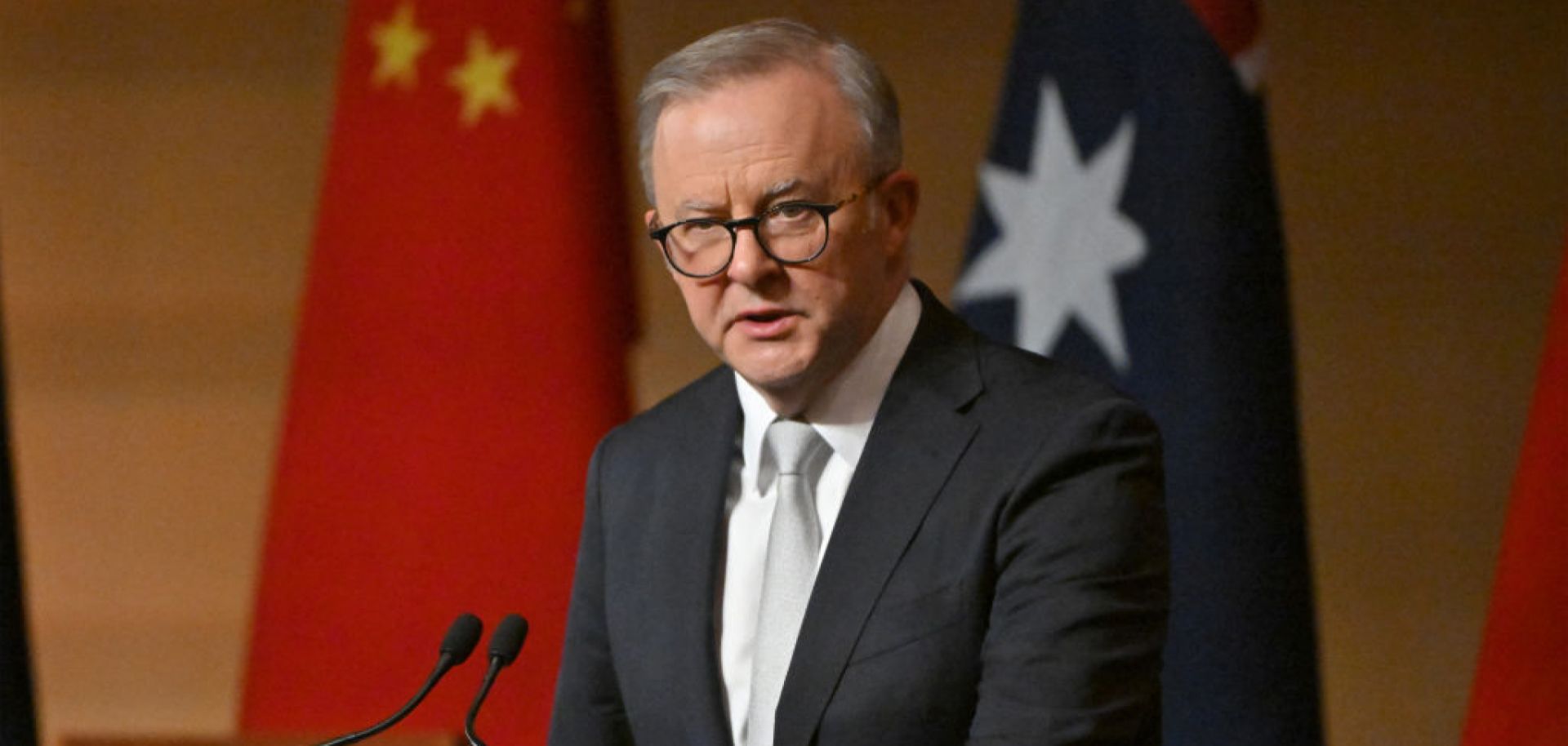
Australian Prime Minister Anthony Albanese's visit to China reflects a bid to lock in economic gains while avoiding direct confrontation, an approach that will yield short-term trade benefits. However, mounting regional security risks will likely force Canberra to harden its stance, limiting the scope of long-term economic engagement with Beijing. Albanese conducted a high-profile six-day visit to China on July 12-18, the first by an Australian head of government in nearly a decade. The trip included one-on-one meetings with Chinese President Xi Jinping in Beijing and economic and tourism-focused meetings in Shanghai, as well as other, photo-friendly events meant to generate positive sentiment, such as a visit to a panda facility in Chengdu. Both sides agreed to expand people-to-people exchanges, tourism facilitation and long-term business access. Concrete deliverables included 10-year multiple-entry visa agreements for Chinese nationals, visa-free short-term access for Australians, the resumption of formal trade dialogues and new bilateral frameworks on green energy and digital economy cooperation. Officials also agreed to pursue further negotiations on access to Australia's critical minerals and to review barriers to agricultural exports. The two sides also reaffirmed their commitment to stabilizing economic relations and reducing friction in regulatory and customs processes. On the security front, Albanese reiterated that Australia's participation in the AUKUS defense pact would proceed without modification, but he avoided direct references to Taiwan or the South China Sea. Beijing raised concerns about foreign military access and influence in the Pacific, though both governments signaled a desire to manage these disputes through dialogue. Official readouts did not address the future of China's lease of Australia's Port of Darwin, with Albanese later confirming the matter was not discussed in detail.
- Albanese also secured rhetorical support from Beijing for increased Chinese tourism and education flows into Australia, with both countries signaling intent to restore pre-pandemic travel volumes.
- Officials did not announce a resolution to the detention of Chinese-Australian academic Yang Hengjun, who was detained in China in 2019 and subsequently charged with espionage before receiving a suspended death sentence. However, Australian officials indicated the matter was raised in private.
- Albanese's delegation included business and university leaders, and meetings in Shanghai focused on reviving Chinese investment in Australian strategic sectors under increased regulatory scrutiny, such as critical minerals, critical infrastructure, renewable energy and technology.
- The Port of Darwin is adjacent to U.S. Marine rotation zones and key joint military air facilities, and Australia leased it to the Chinese-owned Landbridge Group for 99 years in 2015. The lease has raised enduring national security concerns over potential Chinese influence on Australia's northern military infrastructure, prompting bipartisan moves in 2025 to reclaim the port through negotiated acquisition or seizure.
The visit came against the backdrop of a diplomatic freeze and Chinese trade restrictions in recent years, as well as more recent tensions over Australian scrutiny of Chinese investment and military operations. From 2020 to 2022, China imposed restrictions on key Australian exports, including barley, wine, coal and lobsters, causing a sharp deterioration in bilateral ties. The advent of Albanese's first term in 2022 began a cautious diplomatic reset, marked by the lifting of many sanctions and a reactivation of high-level dialogue. By 2025, both countries sought to institutionalize this stabilization, with China framing Australia as a "reliable" Western partner in an increasingly polarized region and Australia aiming to hedge between economic engagement with China and deepening strategic ties with the United States, Japan and the Philippines. For Beijing, warming ties with Canberra helped dilute Western consensus on economic decoupling and framed China as a cooperative power willing to resolve disputes, despite Beijing's long-established pattern of undertaking diplomatic coercion only to then later secure favorable outcomes via diplomatic reprieve. In this context, the visit was particularly important given escalating tensions with the United States, tariff threats and growing scrutiny of China's outbound investments. For Australia, the trip aligned with Canberra's long-standing interest in maintaining and expanding access to its largest trading partner — particularly in sectors like education, agriculture and critical minerals — while mitigating risks of renewed trade restrictions. However, Albanese's decision to avoid direct confrontation over sensitive issues like Taiwan, the South China Sea, cybersecurity, political prisoners and the Chinese lease of the Port of Darwin drew criticism from domestic opponents, who accused him of being overly conciliatory.
- In 2020, China imposed trade restrictions on a range of Australian exports in response to Australia's call for a COVID-19 origins investigation. China has incrementally lifted most of these restrictions since mid-2022 following the diplomatic reset under the Albanese government, though some technical barriers and informal curbs remain in place.
- Still, bilateral tensions persist around diverging national security interests. On Feb. 11, a Chinese Shenyang J-16 fighter intercepted an Australian P‑8A Poseidon surveillance aircraft over the South China Sea, releasing flares and chaff within approximately 30 meters, a maneuver that Australia formally protested as unsafe and unprofessional. From Feb. 21 to March 9, the Chinese navy conducted three unannounced live-fire drills in the Tasman Sea within Australia's exclusive economic zone, disrupting at least 49 commercial flights and prompting diplomatic complaints from both Australia and New Zealand, as well as startling both countries' security establishments. Moreover, from July 13 to Aug. 4, Australia is hosting its largest-ever iteration of annual Talisman Sabre military exercises involving 35,000 troops from 19 countries, increasing the likelihood of Chinese pushback in the Pacific.
- Australia has tightened its foreign investment screening regime, particularly since mid-2024, imposing stricter scrutiny and prohibitions on Chinese investment in strategic sectors like critical minerals, renewable energy, infrastructure and sensitive technologies, while also banning foreign purchases of established properties since April.
In the short term, Albanese's visit created new openings for modest recovery in the China-Australia economic relationship, but diverging security priorities will impose an upper limit on economic integration. In the short term, restored high-level engagement and visa liberalizations will likely accelerate the return of Chinese students, tourists and commercial actors to Australia, providing modest gains for sectors like education, agriculture and services previously affected by Chinese trade restrictions. However, benefits will likely remain contained to these and similar sectors that are not deemed critical to national security. Future cooperation in areas like green energy, digital infrastructure and investment flows will depend on whether Australia expands or tightens its restrictions on Chinese companies — particularly on data security, critical infrastructure, technology and supply chains such as rare earth refining — and how visibly it continues to deepen its military alignment with the United States and regional allies through frameworks like AUKUS. Beijing's framing of Australia as a "reliable partner" suggests an interest in disassociating Canberra from broader U.S.-led containment efforts, but Australia remains embedded in defense frameworks that China views as hostile, including AUKUS and regional joint exercises with the likes of the Philippines. In the coming years, Australia's main strategic challenge will be to maintain credible deterrence, regional leadership and long-term strategic autonomy while also preserving its trade and investment ties with China.
- Demonstrating sectoral limits, Australia rebuffed a Chinese proposal on July 15 to include artificial intelligence in a future trade deal, citing national security concerns.
- In June, the U.S. Department of Defense opened a formal review of AUKUS Pillar I, which involves the United States and the United Kingdom selling nuclear-powered submarines to Australia. The United States may use the review to condition or, less likely, scrap Pillar I of the deal, meaning Australia may not receive its promised submarines, at least along the initially proposed timelines. However, Australia is set to sign a 50-year submarine pact with the United Kingdom under the AUKUS framework to offset potential disruptions caused by the U.S. review. AUKUS is central to China's unease with respect to Australia because the planned acquisition of U.S.- and U.K.-made nuclear-powered submarines would enable Australia to conduct long-range patrols — including in waters around Taiwan — directly supporting U.S. deterrence efforts against a potential Chinese invasion.
Over the medium term, Australia will likely further restrict Chinese access to strategic sectors (including critical minerals, infrastructure and technology), as national security concerns constrain economic integration. Canberra's current strategy of diplomatic restraint — demonstrated by its subdued response to recent Chinese naval activity and on the Chinese lease of the Port of Darwin — is unlikely to hold if China resumes coercive military behavior near Australia's shores or within its exclusive economic zone. While Albanese's visit makes this less likely in the short term, such Chinese military actions would become more likely in the event of another confrontation in the South China Sea or elsewhere. Future provocations, such as unsafe intercepts or unannounced exercises near Australian territory, would likely prompt Canberra to escalate military coordination with the United States, accelerate defense procurement under AUKUS and further harden investment and data-security restrictions targeting Chinese entities. This recalibration would reduce the likelihood of Chinese companies gaining greater access to the Australian market in the future and could stall or reverse Beijing's reengagement with Australian sectors like education, tourism and agriculture. In parallel, Canberra will face growing pressure to reassert its strategic leadership in the Pacific Islands, where China's expanding naval footprint and diplomatic overtures are challenging Australia's longstanding influence. This could involve expanding and deepening bilateral security pacts with countries like Papua New Guinea, Fiji and Tuvalu. Additionally, Australia could provide these countries with expanded maritime patrol assets, infrastructure finance, and training programs. Such efforts would be aimed at denying China strategic access and bolstering deterrence against Chinese naval expansion in the Pacific, all while reinforcing Australia's role as the region's primary security partner. Domestically, Albanese's balancing act could make him more politically vulnerable. A sharper turn toward confrontation with China could rally bipartisan support in defense circles but would complicate his Labor Party's efforts to deliver trade-based economic relief amid sluggish growth. Conversely, if Labor maintains its current restraint amid escalating Chinese pressure, it could face electoral blowback from voters and opposition leaders portraying the government as weak on sovereignty and national security.
- In July, Fijian Prime Minister Sitiveni Rabuka proposed a multilateral treaty for adoption at the Pacific Islands Forum summit in September, which would explicitly bar Chinese military bases and security access across the region. While Australia is unlikely to formally endorse the initiative, it has tacitly supported Fiji's aims through bilateral veto-right agreements with Pacific Island states (meaning it could unilaterally veto a defense arrangement with China), expanded maritime security aid and efforts to limit Beijing's military entrenchment without provoking direct confrontation.
- The Port of Darwin's deliberate omission from discussions during Albanese's six-day trip signals that the two countries are not pursuing a consensual or negotiated buy‑back at this time. This increases the likelihood that Australia will move unilaterally to reclaim the port, likely through forced divestment or compulsory acquisition, at the risk of diplomatic fallout or legal challenge from China.
