
The U.S. review of AUKUS Pillar I puts the deal in jeopardy, but strong strategic imperatives mean Washington is more likely to revise the pact than scrap Pillar I outright. On June 11, the U.S. Department of Defense formally launched a 30-day review of AUKUS Pillar I, the nuclear-powered submarine component of the trilateral security pact between Australia, the United Kingdom and the United States signed in 2021. According to the Pentagon, the review aims to evaluate if the AUKUS submarine deal aligns with U.S. military capacity, industrial readiness and national interests pursuant to the Trump administration's "America First" doctrine. U.S. Undersecretary of Defense for Policy Elbridge Colby, a known AUKUS sceptic, will oversee the review, assessing the feasibility and desirability of delivering up to five Virginia‑class attack submarines to Australia. The review will have no immediate direct bearing on Pillar II, but its outcome will have significant implications for its future.
- AUKUS was originally conceived to bolster collective deterrence against China by strengthening undersea capabilities and accelerating the integration of next-generation technologies among trusted allies. Pillar I of AUKUS involves the transfer and co-development of nuclear-powered submarines, including the planned delivery of U.S. Virginia-class submarines to Australia and the joint construction of a new SSN-AUKUS class nuclear-powered submarine by the United Kingdom and Australia. Pillar II focuses on collaboration in advanced defense technologies, such as artificial intelligence, quantum computing, hypersonics, cyber capabilities and undersea autonomous systems.
- Following the review's announcement, the United Kingdom reaffirmed its support for AUKUS, describing the pact as a "landmark security and defence partnership," and stressed that London would remain engaged even as Washington undertakes its review, which it deemed similar to a 2024 U.K. assessment.
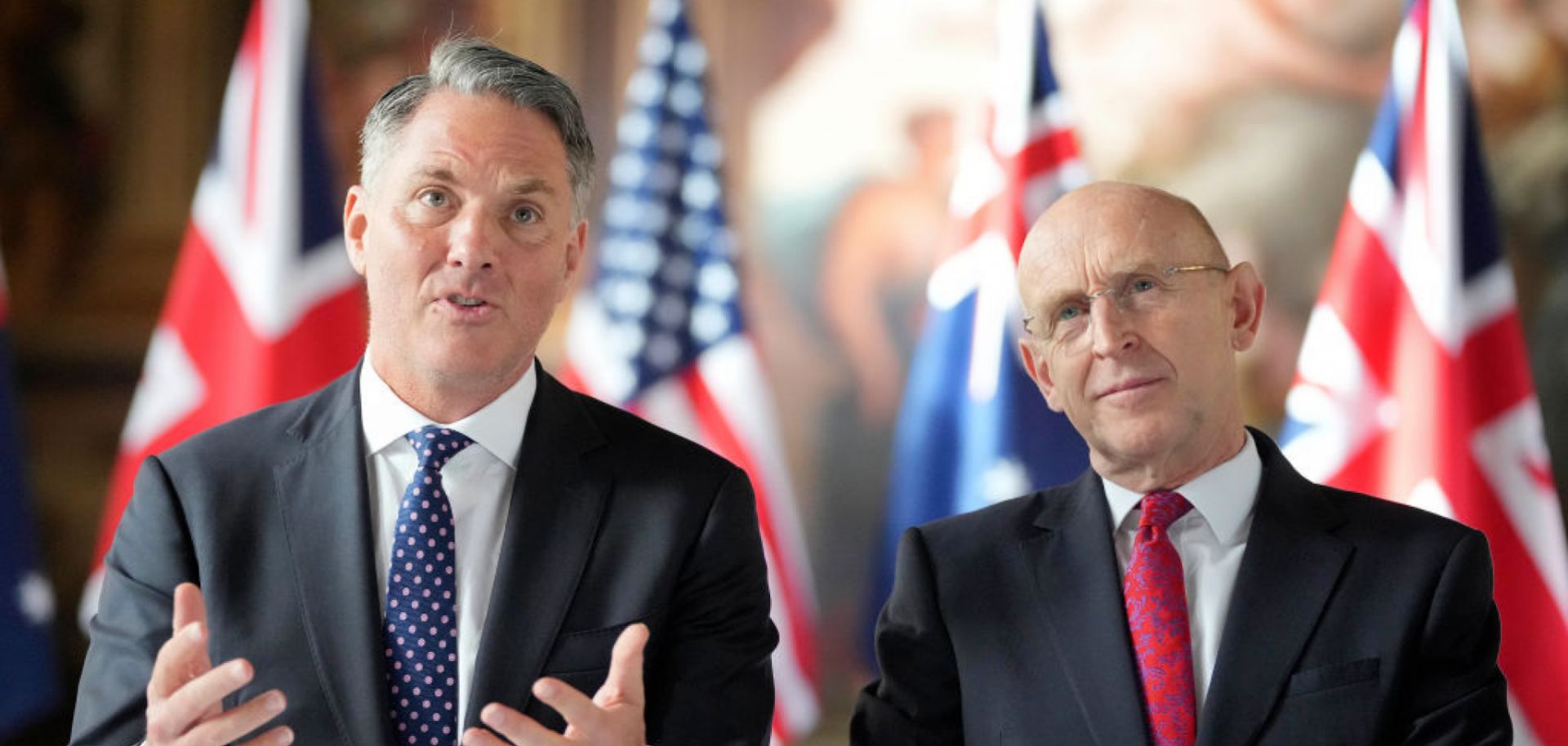
- In Australia, on June 12, Defense Minister Richard Marles dubbed the U.S. review "natural and understandable," painting it as standard procedure . Meanwhile, Australian crossbenchers accused Canberra's major parties, including the Labor government led by Prime Minister Anthony Albanese and the opposition Liberal-National coalition, of blindly "drinking AUKUS Kool‑Aid," and demanded a transparent review and parliamentary inquiry into AUKUS.
The timing of the review reflects growing U.S. and, to a lesser degree, Australian skepticism about AUKUS. U.S. concern over AUKUS increased after U.S. President Donald Trump returned to the White House in January, even though some of the underlying issues have been simmering for years. First, U.S. defense industrial and shipbuilding capacity is significantly strained. Congressional estimates state the Virginia‑class program is running two years behind schedule and $17 billion over budget. Currently, the United States is only able to launch around 1.1-1.7 submarines per year, well below the 2.3-plus earmarked to both replenish U.S. stock and fulfill Pillar I commitments to Australia. From the perspective of the White House and many Republicans who lead both houses of Congress, exporting key naval platforms when domestic readiness is lacking risks strategic overreach. The determination is thus inching toward the notion that unless U.S. production accelerates or Australia compensates significantly, Pillar I will stall. At the same time, Australia's performance has frustrated Washington. Canberra's defense spending was around 2% of gross domestic product in 2024, far short of the U.S.-requested threshold of 3%-3.5% . Additionally, Australia's construction of the infrastructure required to facilitate the delivery of new submarines, such as Perth's nuclear‑radiological facility, faces delays, further impeding Australia's readiness to host and sustain U.S. submarines. Australia has also withheld a firm commitment to deploying submarines in a potential Taiwan contingency, raising doubts over their strategic value in helping the United States project power in the region and signaling reluctance to fully align with U.S. strategic posture. Even in Australia, critics outside the two main parties argue that the lack of domestic oversight has left the pact unexamined, stoking anti‑AUKUS sentiment .
- At the annual Shangri-La Defense dialogue in Singapore in May and June, U.S. Secretary of Defense Pete Hegseth explicitly asked Australia to raise defense spending to at least 3%-3.5%, a request the Albanese government has publicly refused. The Albanese government has pledged to raise Australia's defense spending to a planned 2.4% by 2033, but this is far short of U.S. demands.
- Additional stressors in the U.S.-Australia relationship include 50% U.S. tariffs on steel and aluminum that hurt joint defense industrial production, Canberra's recent sanctions on Israeli ministers, and scrutiny in Washington over U.S. funding of Australian universities that allegedly incorporate DEI programs and/or have research ties to China.
- These stressors are also driving Australia to diversify defense partners, such as by pursuing a security pact with the European Union and sponsoring Canada joining AUKUS Pillar II, though the latter could face pushback from Washington.
U.S.-Australian misalignment and industrial shortfalls make a revised or scaled-back Pillar I the most likely outcome of the review. Given strong strategic imperatives to see the deal through, namely deterring China amid its rapidly growing naval reach that has directly threatened Australia in recent months, the review will likely push the deal forward but require Canberra to make targeted revisions. Some of these revisions will likely relate to U.S. shipyard performance, including Australia upping its financial contributions, as $2.5 billion of a promised $4 billion is still outstanding. Others may include a commitment to fast‑tracking critical infrastructure like Perth's radiation handling facilities, increasing Australian defense spending commitments to 3%-3.5%, and more clearly aligning with U.S. contingency planning around Taiwan and the South China Sea, another contested regional area. In return, the United States could reaffirm phased deliveries beginning in the early 2030s and offer limited additional industrial support to accelerate submarine commissioning and deeper collaboration on Pillar II projects, contingent on Australia meeting its obligations.
- The direct threat China's navy poses to Australia grew more evident after Beijing's February live fire drills in the Tasman Sea, roughly halfway between Australia and New Zealand, without prior notice to Canberra, Wellington or commercial flights (causing abrupt diversions). These drills were the first of their kind.
- Though Australia has committed to surveillance and limited patrols in the South China Sea, where Chinese maritime activity continues to expand, it remains cautious about deeper operational integration with the United States.
- In June 2024, a U.S. government audit found that the Virginia-class submarine program was producing only about 1.2 submarines per year, well below the target of two, and was running two to three years behind schedule, with over $500 million in extra costs on the first two submarines.
- In May, the U.S. Congress shifted $4.5 billion from future budgets into 2026 to fund an extra Virginia-class submarine sooner and approved an additional $5.7 billion to support shipyard capacity and stabilize production.
In two less likely scenarios, various internal U.S. pressures could push Washington to scrap Pillar I entirely or continue it as is. The United States could defer or scrap Pillar I if the review concludes that committing Virginia-class submarines to Australia jeopardizes U.S. naval readiness and industrial integrity, particularly since Washington is unsure of Canberra's commitments to its primary strategic imperative of deterring a Chinese invasion of Taiwan. With U.S. naval planners also watching budget deliberations and industrial delays, there is observable momentum toward restricting or deferring such exports, meaning scrapping or deferring Pillar I would be a more likely outcome if Australia refuses to meet U.S. demands. A suspension of Pillar I would substantially undermine the confidence of AUKUS partners and consequently imperil Pillar II, while derailing long-term trilateral defense integration plans with the United Kingdom. Alternatively, Washington could let the deal go through as is because the United States has already secured key concessions from Australia — such as a long-term funding commitment and expanded port access for U.S. submarines. The United States could also take this route to avoid damaging U.S. credibility with allies, disrupting trilateral defense planning with the United Kingdom and leaving Australia with a looming 10-15 year submarine capability gap as its diesel-powered Collins-class fleet is set to be retired in the 2030s. While Trump has shown little concern for such issues in his contentious relations with traditional allies, most U.S. military leaders view AUKUS as crucial for future force posture in the region.
- In 2023, the Australian government committed $239 billion over thirty years to AUKUS, including contributions to U.S. shipyards, marking it as Canberra's largest-ever defense investment.
- London, already facing delays in its own SSN-AUKUS schedule, would also confront renewed procurement uncertainty if Washington scraps Pillar I.
