
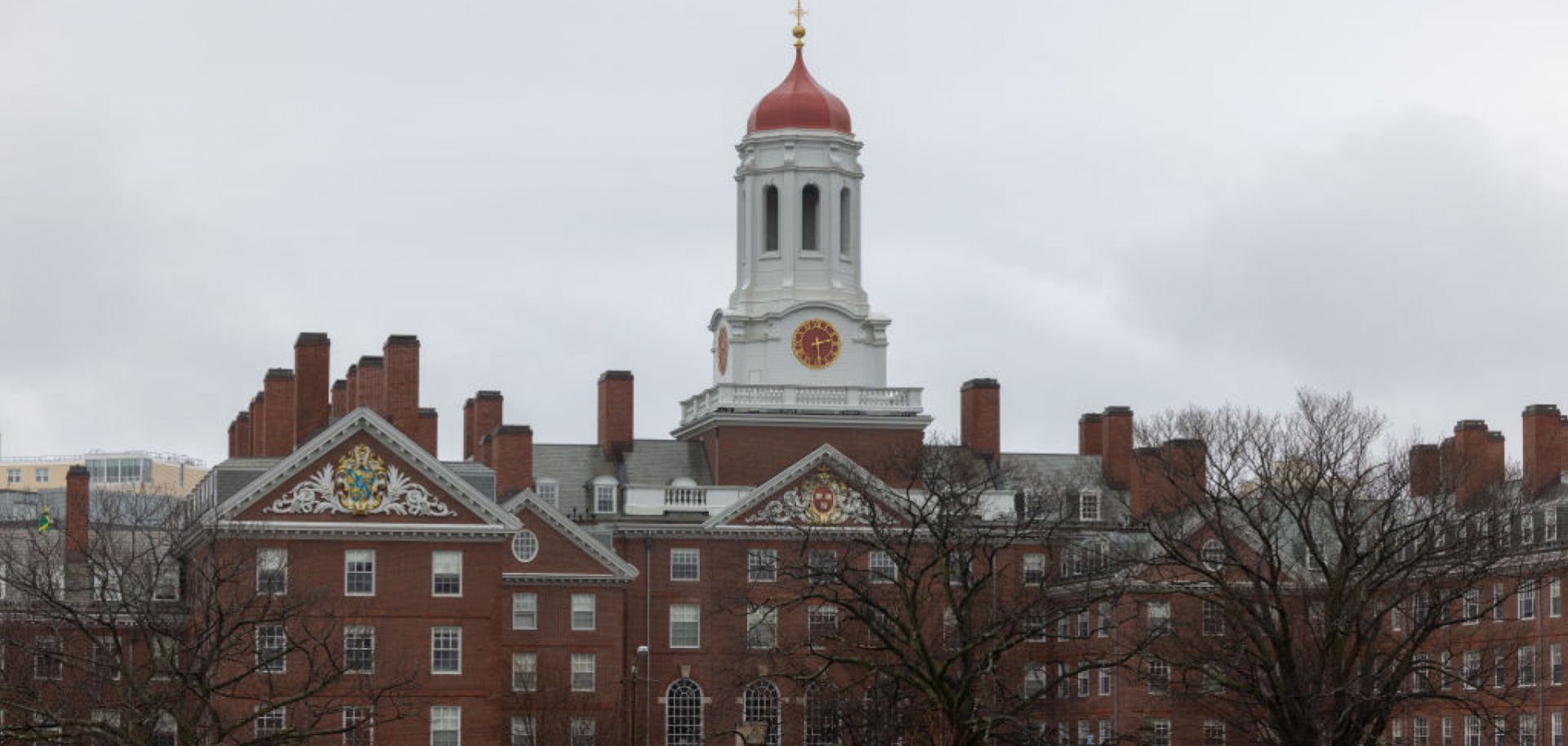
The White House's pressure campaign against Harvard and other elite U.S. universities, if sustained, will undermine U.S. scientific research, innovation and competitiveness vis-a-vis China. The administration of U.S. President Donald Trump's pressure campaign against higher education reached a new height on May 22 when the Department of Homeland Security (DHS) revoked the approval of Harvard University's Student and Exchange Visitor Program, which allows the Ivy League school to enroll foreign students, after Harvard refused to turn over detailed student records that the department demanded in April. While a federal judge issued a temporary restraining order on May 23 preventing DHS from revoking the program's certificate, the White House's efforts to pressure elite institutions — including other measures to restrict visas for students — are increasingly expanding to new areas. To this end, on May 22, the House of Representatives approved a tax cut and spending bill that will raise the tax rate on investment returns for university endowments from 1.4% to as high as 21%, based on the size of the endowment. With Trump backing the move, this means that, if the tax increase survives debate in the Senate, most elite universities like Harvard — which at $52 billion has the largest endowment of any U.S. university — will fall under the highest tax bracket.
- The attempted revocation of Harvard's student visa program is just the latest move the White House has made against elite universities. In April, the Trump administration froze $2.2 billion in long-term research grants for Harvard, as well as nearly $2 billion in funding for Cornell University and Northwestern University. President Trump has also threatened to strip Harvard's tax-exempt status.
- Following the judge's order, Trump on May 26 threatened to freeze $3 billion in more grants and on May 27, the administration asked federal agencies to cancel contracts worth about $100 million. Separately, on May 28, Secretary of State Marco Rubio sent a diplomatic cable to State Department officials ordering U.S. embassies to stop scheduling appointments for student and foreign exchange visas, as the Trump administration seeks to expand social media screening and vetting as a part of its visa process.
- In the fall 2023 semester, the last date of publicly available information, international students comprised over 27% of Harvard's total enrollment.
- In a May 22 post on X, Homeland Security Secretary Kristi Noem accused Harvard of "fostering violence, antisemitism, and coordinating with the Chinese Communist Party on its campus." She also said Harvard could regain the approval for its student visa program if within 72 hours it turned over all records of illegal activity, dangerous or violent activity, threats made to other students or university personnel, "deprivation of rights" of other classmates or university personnel, protest activity and disciplinary records of nonimmigrant students over the last five years. This means that if the temporary restraining order is rescinded, Harvard could still comply with DHS demands in an attempt to retain its visa program.
While the Trump administration is mainly targeting elite universities ostensibly under the banner of fighting antisemitism, these efforts reflect a broader distrust of the U.S. elite establishment and an attempt by the White House to reshape U.S. academia away from its allegedly liberal bent. As highlighted by Noem's social media post, the White House's directives against higher education have so far largely been in the name of combating antisemitism, following the wave of pro-Palestinian activism that swept across the United States in 2024 amid the war in Gaza. However, the Trump administration's focus is far wider, as it has argued that liberals have compromised the U.S. education system — beyond post-secondary schools — and that federal and state governments must take a stronger hand in developing curricula and guiding other behavior on campuses. This stance dovetails with the Trump administration's efforts to crack down on supposedly liberal ideas in other areas, as in the White House's scrutiny of DEI initiatives and other so-called culture wars issues like LGBTQ+ rights. In addition, Trump and his core support base have an extremely skeptical view of academic research, specifically regarding conventional scientific principles. Moreover, many of the blue-collar workers who support Trump never went to college, and many Americans — regardless of their political viewpoint — have questioned the value of attending college given dramatically increasing tuition costs over the last two decades, leading to even more skepticism about elite universities among the U.S. public.
Trump's pressure on universities, if sustained throughout his term, will significantly harm affected universities' finances, reducing research and making the United States less attractive to foreign students who disproportionately study in-demand fields. Should the White House continue its pressure campaign as expected, let alone expand it, elite institutions will struggle to meet cascading challenges. First, federal grants to universities are an important source of funding for schools, accounting for 11% of Harvard's total revenue in its 2024 fiscal year and significantly more for some of the university's specific schools; for instance, Harvard's public health school drew on federal funding to account for 46% of its budget the same year. But freezes or declines in grants are just one way Trump and his allies' policies affect university funding. Foreign students often pay the highest tuition at many universities, meaning they effectively subsidize tuition for U.S. students; thus, if DHS cuts off Harvard's student visa program, it could force the university to raise tuition for other U.S. students. Moreover, the new endowment taxes could have a much larger impact on the university's finances, as distributions from Harvard's endowment accounted for 37% of the university's revenue in FY 2024. Harvard used most of that endowment revenue to fund scholarships and other similar programs, meaning the university may need to pare back or limit the growth of those programs, even if the student visa program is restored. Regardless, the Trump administration's crackdown on immigration already appears to be making the United States a less attractive destination for foreign students, which over time risks creating a brain drain challenge as more foreign talent chooses not to study in the United States. This will affect STEM — science, technology, engineering and mathematics — fields the most. Roughly half of the number of master's and PhD students in STEM fields are foreign-born, and many of them stay in the United States for work after graduation. With fewer international students studying in the United States and more choosing education opportunities in Europe, Canada, China or elsewhere, the United States risks worsening its already extremely high shortage of educated STEM workers beyond academia and decreasing similar shortages in other countries. Trump's decision to target elite universities may also disproportionately affect research since around three-quarters of all university research is performed by the country's top 115 universities, according to the National Science Board; most other smaller schools that have not been targeted as frequently, if at all, focus more on education than research.
- During Trump's first term, after his 2017 travel ban on several countries, the number of international applications to U.S. colleges fell by 2.2% for undergraduates and 5.5% for graduate students, demonstrating how his policies, which have been even more aggressive in his second term, reduce incentives for foreign students to study in the United States.
- Foreign-born workers account for more than 40% of the doctorate-level scientists and engineers in the United States, according to the National Science Board.
Curtailments to basic science research, either due to funding cuts or fewer STEM post-doc and PhD students, risk hurting the United States' technological and innovative competitiveness in the long run. While companies and other entities provide the bulk of applied research in the United States (i.e., research into commercial applications), universities still account for about 15% of applied research, and basic science research at academic institutions is crucial, accounting for around 45% of all basic research in the United States. While the immediate impacts of basic science research are limited and less clear than those of applied research, basic research is indispensable as part of the United States' overall technological and scientific development and competitiveness. Unlike applied research, basic science research often applies to many different fields and industries, meaning that it acts effectively as a force multiplier across innovation in the long run. Moreover, basic research is the foundation of applied research, with many inventions requiring basic research to occur before the applied research can succeed. Basic research is also longer-living than patents that emerge from applied research, as basic research papers are typically cited for a longer period of time than patents. The International Monetary Fund estimates that a 10% increase in the stock of basic research can increase a country's productivity by 0.3%, illustrating how a significant disruption to basic research in the United States could be very costly over time.
- Basic research is the foundation of all modern technology. GPS systems, for example, rely on both of Einstein's theories of relativity, while WiFi technology was originally derived from mathematical techniques created to study mini black holes.
The rising unattractiveness of studying in the United States and the potential negative impacts on basic science research will undercut the United States' long-term competitiveness against China in emerging technologies that depend on basic science research. China is emerging as a hotbed of both basic and applied science research. In recent years, Chinese researchers have also published more important papers — those among the top 1% most cited — than the United States, topping the United States for the first time in 2018. With the Chinese educational system focused on STEM subjects and the government focused on investing in emerging technologies and emerging basic science research to leapfrog the West in technology, this means any damage to U.S. academia will have long-term repercussions as China continues to forge ahead with research. Key areas that are at risk include climate change, green, AI, quantum information and nuclear fusion technologies and research. The Trump administration's hostility to climate change and green technology will likely only reinforce the risks that Chinese basic and applied research in these areas will strengthen China's position in the future. Moreover, as the United States scales up restrictions on Chinese students (as well as other foreign students), many of those students will find themselves working elsewhere, with many more of them staying at Chinese universities, research institutions and companies. This means the United States will be increasingly unable to take advantage of Chinese-born, U.S.-trained scientists staying in the United States, either in academia or elsewhere.
- While the Trump administration's campaign against academia will ultimately hurt the United States' competitiveness, if the campaign is brief or focuses on only a handful of universities, it may limit the overall impact. The vast majority of top-ranked global universities are based in the United States, with U.S. schools taking 15 of the top 20 spots in the latest U.S. News & World Report rankings. The United States also has a large incumbency advantage when it comes to basic research, and while some Chinese universities are closing the gap, the scope of their research is not nearly as large as that of their U.S. counterparts, with only a handful of Chinese universities becoming truly internationally competitive.
