
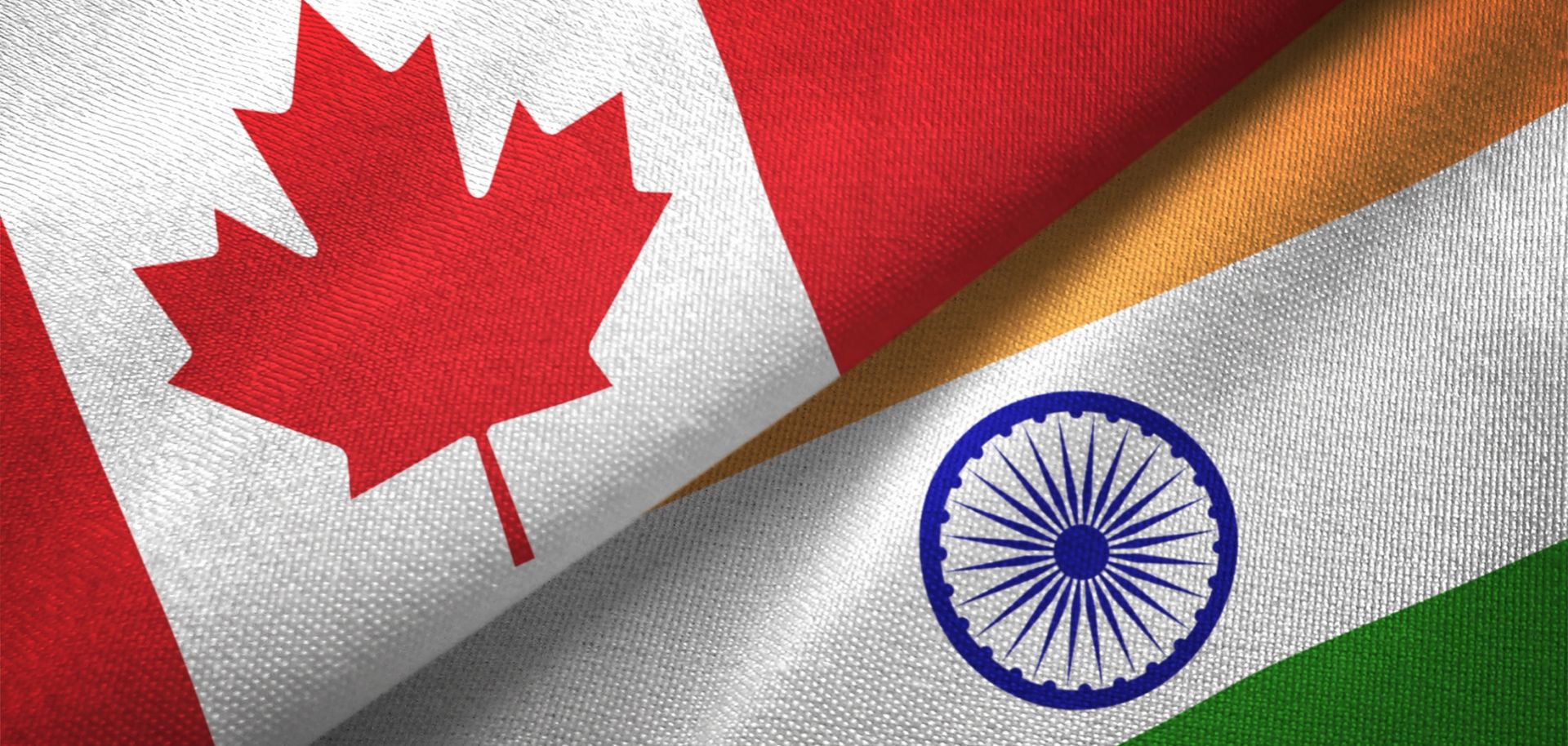
India and Canada's recent diplomatic engagements open the door to improved bilateral ties and resumed trade negotiations, though lingering mistrust — particularly over Sikh separatist activity in Canada — may limit deeper progress. During her visit to India from Oct. 12-14, Canadian Foreign Minister Anita Anand met with Indian External Affairs Minister S. Jaishankar. The two officials agreed on a new roadmap to rebuild trust and deepen cooperation across areas such as trade, critical minerals, artificial intelligence, energy and security. Jaishankar also emphasized that both countries aim to ''de-risk the international economy by forging strong partnerships of growing range and depth.'' Anand was the first Canadian cabinet minister to visit India in two years, after the assassination of a Sikh separatist on Canadian soil severely strained ties.
Anand's visit and the newly agreed-on roadmap set the stage for renewed India-Canada engagement after two years of diplomatic friction. Anand's visit signals that the diplomatic reset launched by Canadian Prime Minister Mark Carney and his Indian counterpart Narendra Modi during the G-7 leaders' summit in June is gaining momentum. This rapprochement follows a major diplomatic rift between the two countries over the June 2023 killing of Canadian citizen and Sikh separatist leader Hardeep Singh Nijjar in British Columbia. Tensions escalated in September 2023, when then-Canadian Prime Minister Justin Trudeau alleged that Indian agents were involved in the assassination due to Nijjar's support for the Khalistan movement, which seeks to create an independent Sikh homeland in India's Punjab region. This triggered an uproar in India, which rejected Trudeau's allegations as ''absurd'' and politically motivated. The resulting rift prompted the two countries to expel each other's senior diplomats and suspend negotiations on a free trade agreement. However, in August 2025, India and Canada reappointed new high commissioners, marking the first formal step toward normalizing diplomatic relations following the 2023 rift. The reconciliation came after Mark Carney took office as Canadian prime minister in March 2025, replacing Trudeau. Canada's motivations for reconciliation include expanding trade and student exchanges, while India seeks to maintain foreign investment and foster partnerships in critical minerals and clean energy.
- Following Trudeau's allegations, India temporarily suspended visa services for Canadian nationals, while Canada reduced consular staff in India, leading to slower processing and limited services.
- For decades, Sikh separatists have advocated for an independent state called Khalistan in India's Punjab region. While the movement's roots remain in Punjab, Indian security operations, internal conflicts and declining local support have pushed much of its activity abroad, particularly within the Sikh diaspora. The large Indian diaspora in Canada (particularly Sikh communities in British Columbia and Ontario) often creates friction between Ottawa and New Delhi, especially over India's perception of Canada as too lenient toward anti-India activism.
- Canada sees India as a part of its broader Indo-Pacific strategy, viewing it as a potential democratic counterweight to China, though Ottawa and New Delhi's practical security cooperation remains limited. India, meanwhile, primarily views Canada within the larger context of its relationship with the West, rather than as a key defense or strategic partner.
India and Canada's warming ties could see them resume trade talks, though conflicting economic interests and regulatory differences will impede progress toward a deal; ongoing Sikh separatist activities in Canada will also sustain the risk of another major diplomatic rift. The recent meetings, new roadmap and reappointment of high commissioners all signal a thaw in India-Canada relations. Beyond the symbolic diplomatic gestures, these moves could also create conditions for restarting stalled trade negotiations. India and Canada maintain a growing but not highly interdependent trade relationship, as neither country relies heavily on the other for goods. However, a trade deal could still offer advantages for both countries. From a strategic standpoint, India and Canada are seeking to diversify their trade relationships in the face of high U.S. tariffs, which have encouraged them to find alternative markets beyond the United States. Such a deal would also likely streamline market access for Indian exports, reduce tariffs and potentially create opportunities for students and professionals to move to Canada. Additionally, it could encourage collaboration in high-value sectors like clean technology, critical minerals and digital services. However, despite these potential benefits, finalizing an agreement will remain a challenge due to differing regulatory standards, the need to protect sensitive domestic industries in both countries, and political sensitivities surrounding issues like immigration and agricultural trade. Additionally, while ties between India and Canada appear to be improving, Sikh separatist activities in Canada will remain a consistent thorn in the relationship. Disagreements over how Canada addresses these activities on its soil could trigger similar diplomatic rifts in the future, particularly if India perceives that Ottawa is not taking sufficient action to curb the Khalistan movement, which New Delhi views as a national security threat.
- In 2024, bilateral trade between Canada and India reached $9.84 billion, an increase from $9.32 billion in 2023. Canada's merchandise exports to India totaled $5.3 billion last year, primarily comprising vegetables, mineral fuels, wood pulp, fertilizers and paper. Canada also imported $8.0 billion worth of Indian goods, including pharmaceuticals, machinery, electronics, precious stones and steel products. In the services sector, Canada's exports to India significantly outpaced imports, totaling $16.1 billion compared to $3.5 billion, respectively.
- Even before Canada abruptly paused trade talks in 2023, progress toward a deal had been slow. These discussions, which began in 2010 as a Comprehensive Economic Partnership Agreement (CEPA), were scaled back in 2022 to a more limited Early Progress Trade Agreement (EPTA). According to Indian media reports, the EPTA would exclude all ''difficult areas,'' including labor, environment, intellectual property rights and digital trade. But even with these exclusions, the two sides were unable to complete negotiations in 2023.
