
India's recent deals with New Zealand and Oman signal modest efforts to expand trade, investment and labor mobility, but various constraints will limit their impact as India struggles to reach larger agreements with partners like the United States, European Union and Gulf Cooperation Council. On Dec. 22, India and New Zealand announced that, after nine months of negotiations, they had reached a free trade agreement (FTA) to reduce tariffs, improve labor mobility and expand trade of goods and services and investment. Signing is expected in the first half of 2026. The announcement of the FTA came days after India and Oman on Dec. 18 signed a comprehensive economic partnership agreement (CEPA).
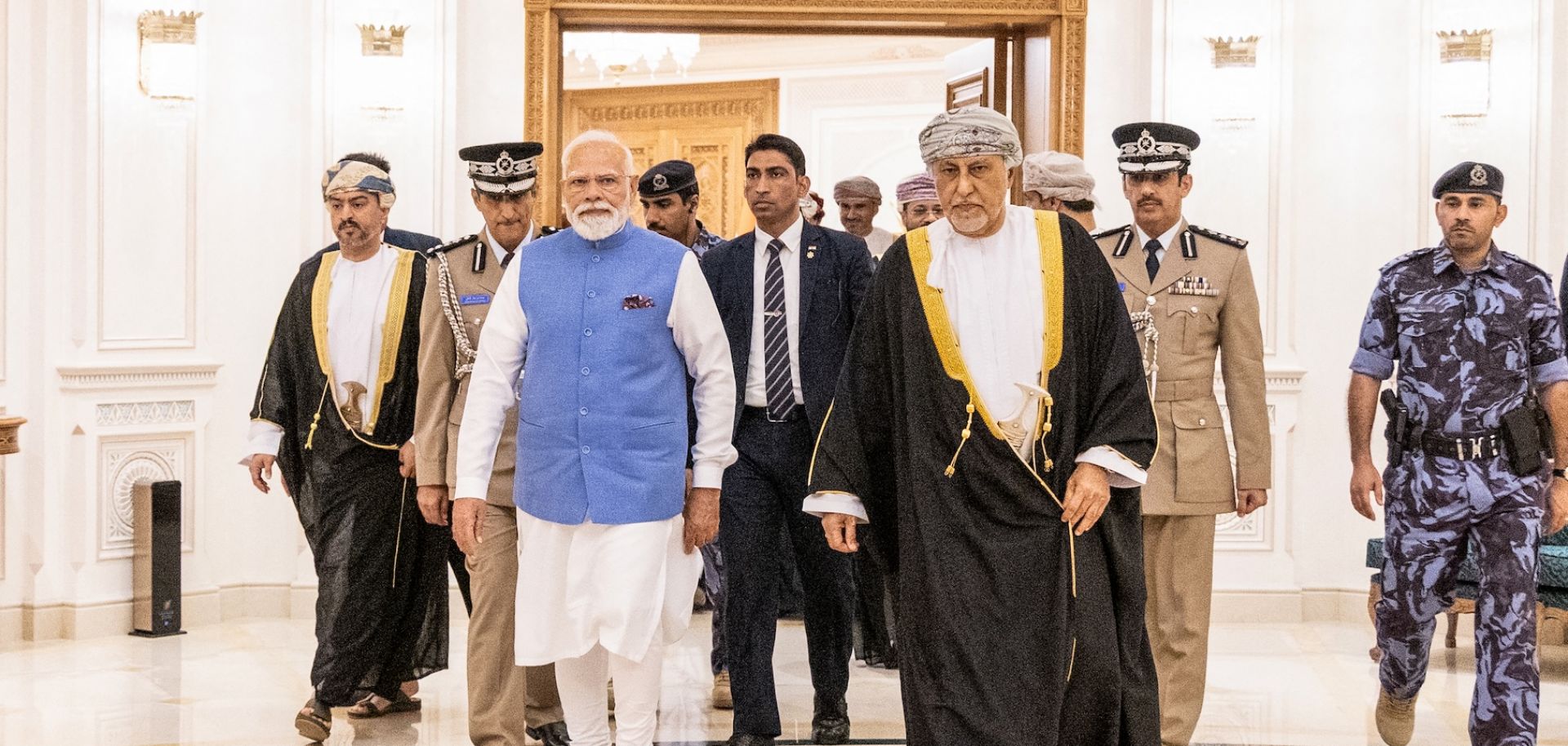
- The CEPA was signed during Indian Prime Minister Narendra Modi's visit to Oman, where he met with Sultan Haitham bin Tariq al Said to review bilateral partnerships in trade, investment and energy, among other areas. On Dec. 19, India's Commerce and Industry Minister Piyush Goyal said the CEPA would be implemented within three months. The agreement eliminates or significantly reduces tariffs on the vast majority of goods traded between the two countries, expands market access for services, improves labor mobility for Indian workers and allows greater Indian investment in key Omani sectors, while largely excluding politically sensitive areas such as agriculture and dairy.
India, New Zealand and Oman are all pursuing trade and/or economic diversification strategies to varying levels of success. These trade deals fit into India's broader push to diversify trade partners and cushion the impact of U.S. tariffs by expanding preferential market access and other economic ties with other countries, following an FTA with the United Kingdom signed in May. New Delhi has also accelerated efforts to conclude additional FTAs and is in advanced talks with other partners, including the European Union and the Gulf Cooperation Council (GCC), while also trying, thus far in vain, to secure tariff relief via an FTA with the United States. New Zealand is pursuing a similar diversification strategy, aiming to have FTAs with key trading partners covering 90% of its goods exports by 2030 and is currently negotiating agreements with the Pacific Alliance as well as a green economy partnership with Singapore and Chile. Meanwhile, Oman is pursuing economic diversification as part of its Vision 2040 plan, though its efforts are proving more difficult than for neighbors like Saudi Arabia, as Oman lacks the financial resources and sovereign wealth funds backed by large energy reserves to invest in megaprojects or backstop development plans.
- The United States imposed 25% tariffs on India on Aug. 7, later doubled to 50% on Aug. 27, arguing that the country's imports of Russian oil were helping fund the war in Ukraine. Both Indian and U.S. officials have indicated that they are moving closer to finalizing a trade deal to address U.S. concerns over the trade imbalance, as India recorded a $46 billion surplus with the United States in 2024-25. Progress, however, has been slowed by India's reluctance to open up its agriculture and dairy industries, along with its continued imports of Russian oil.
- Though Oman has outpaced inflation in GDP growth, unemployment among its nationals remains notably higher than the official 3.5%, which largely reflects the virtually zero unemployment among foreigners, who make up a substantial share of the country's labor force. These labor dynamics make Oman cautious about trade agreements like the CEPA with India, as such deals might raise concerns about domestic job competition, especially in sectors where Oman is trying to upskill its labor force, such as healthcare, technology and supply chains.
- New Zealand is currently subject to a 15% reciprocal tariff rate from the United States, which — alongside heightened military activity near its maritime approaches by China, New Zealand's top trade partner — is driving Wellington's trade diversification imperatives.
- With unemployment a key concern, India's trade agreements aim to create jobs by boosting exports, deepening integration into global supply chains, enhancing the competitiveness of domestic businesses and attracting greater foreign investment through improved market access.
The New Zealand‑India FTA is set to strengthen economic ties, boost investment and expand labor mobility, though its immediate impact on trade will likely be modest given small bilateral volumes and that parliamentary approval is still required in New Zealand. The India-New Zealand FTA underscores New Delhi's efforts to expand its global economic footprint, but its immediate impact on exports is likely to be modest due to small trade volumes. Total bilateral trade reached $10.6 billion in 2024‑25, with India exporting $4.07 billion and importing $6.55 billion. The agreement is therefore less a major trade milestone than a platform for closer economic cooperation. The FTA provides India with zero-duty access for all its exports to New Zealand, while India will liberalize tariffs on 70% of product lines, covering 95% of bilateral trade. Key Indian sectors likely to benefit include textiles, apparel, engineering goods, leather, footwear and marine products, while New Zealand stands to gain in horticulture, wood, coal and sheep products. However, sensitive items such as dairy, certain meats, onions and almonds remain excluded from the deal, limiting immediate export gains for India and New Zealand in sectors where they are a major global supplier. The agreement also seeks to catalyze $20 billion of New Zealand investment in India over 15 years, though whether this will materialize remains unclear. For India, the FTA establishes new opportunities for labor mobility, including improved entry and stay conditions for Indian professionals and students, as well as a Temporary Employment Entry Visa for up to 5,000 skilled workers at a time, allowing stays of up to three years. However, for the FTA to enter into force, it must pass in New Zealand's Parliament. However, New Zealand First, which is part of the governing coalition, has objected to the agreement's immigration provisions and the exclusion of dairy products. Without the support of New Zealand First, the agreement would be three votes short in Parliament. As such, Prime Minister Christopher Luxon is counting on opposition backing, pointing to a longstanding norm of bipartisan cooperation on trade policy, a precedent likely to hold despite a more fragmented political environment. By contrast, India's approval process is centralized, as trade agreements require only cabinet authorization, which has already been granted.
- New Zealand investment in India would focus on renewable energy, infrastructure, agriculture and food processing, forestry, education and technology, while excluding large-scale dairy farming or retail dairy expansion.
The India‑Oman CEPA is likely to modestly increase trade while expanding investment and labor mobility, moderately strengthening India's energy and regional economic ties, though it may also challenge Oman's efforts to prioritize national employment under its Omanization policy. Although the CEPA highlights deepening bilateral ties, it is likely to only slightly increase India's export volumes given the relatively modest scale of trade, with two-way flows reaching $10.6 billion in 2024-25, of which India exported approximately $4 billion worth of goods and imported roughly $6.5 billion. Oman nevertheless remains strategically important for New Delhi as a key energy partner. Despite its small economy, Oman's position along the Strait of Hormuz gives it some regional importance, serving as a transport hub and potential naval partner for India, supporting both energy security and the expansion of India's naval reach through ports like Duqm. Oman was India's fourth-largest energy supplier this year, with liquefied natural gas accounting for nearly all imports. India's exports to Oman are more diversified, led by agricultural products, mineral oils and steel. Under the agreement, Oman will grant zero-duty access on more than 98% of its tariff lines, covering 99.38% of India's exports, benefiting labor-intensive Indian sectors such as gems and jewelry, textiles and pharmaceuticals. India will liberalize tariffs on about 78% of its tariff lines, covering roughly 95% of imports from Oman. Beyond goods trade, a key feature of the CEPA is easier movement for Indian professionals to work in Oman. The agreement allows more employees from Indian companies to be transferred to Oman, from 20% to 50% of eligible staff and lets contractual workers stay longer, from 90 days up to two years, with the option to extend further. Professionals will benefit from more flexible entry and stay rules, making it easier for them to work and collaborate in Oman. Additionally, the agreement allows 100% Indian FDI in major Omani services sectors, easing previous restrictions on foreign ownership and enabling Indian investors to operate with greater control and less red tape, while supporting the regional expansion of India's services industry. For Oman, the CEPA will slightly support Muscat's Vision 2040 goals by encouraging investment and trade in non-hydrocarbon sectors, though its impact on economic diversification will likely be modest. In this respect, the deal will benefit India more than Oman, as it primarily provides Indian firms greater access to Omani markets, while also potentially increasing Oman's reliance on affordable Indian labor and companies, which could slow Omanization and limit opportunities for Omani citizens.
- The agreement allows Indian companies to transfer more employees to Oman, increasing the quota from 20% to 50% of eligible staff and extending the allowed stay for contractual workers from 90 days to two years, with further extensions possible. Professionals benefit from more flexible entry and stay rules. While this supports Indian and Omani businesses, it could complicate Omanization efforts by reducing opportunities for Omanis in sectors where foreign professionals are now more easily employed and increasing anti-foreigner sentiment.
India is likely to strengthen Gulf ties, but a broader GCC-wide agreement is unlikely due to differing priorities among the bloc's members, making bilateral agreements the more feasible path to expand trade, investment and services while managing issues like energy, labor mobility and regulatory policies. India seeks to strengthen economic ties with the Gulf because the region is a major source of energy imports, a growing market for Indian goods and services and a hub for Indian expatriates whose remittances are important to the economy. However, the wide variation in priorities among GCC members — including energy exports, investment terms, domestic employment policies and regulatory differences — makes a single GCC-wide agreement difficult to achieve. Saudi Arabia is not pursuing a standalone bilateral deal with India because it prefers to negotiate through the GCC, which allows it to coordinate commitments with other Gulf states and preserve its leverage on energy and security issues. Still, India and Saudi Arabia continue to engage bilaterally through mechanisms such as the Strategic Partnership Council, which supports cooperation on trade, investment and strategic matters. To varying degrees, the other GCC members — Kuwait, Qatar, the United Arab Emirates, Bahrain and Oman — prioritize expanding non-oil sectors such as finance, logistics, technology and professional services, attracting foreign investment and balancing the employment of foreign workers with national workforce development policies to support economic diversification. The India‑UAE CEPA, which took effect in 2022, has significantly boosted trade, with bilateral commerce growing from approximately $73 billion to over $100 billion in three years, driven by tariff reductions, expanded market access and enhanced cooperation in investment and services. India is also in discussions with Qatar for an FTA, likely covering expanded market access for Indian non‑energy exports as well as provisions for investment and services cooperation. A key sticking point is the energy-driven trade imbalance that favors Qatar, as well as ensuring that tariff concessions do not significantly undercut India's domestic industries. In practice, India's bilateral approach allows it to leverage competition among Gulf partners to secure favorable terms by, for example, using Oman and other smaller states' interest in trade and investment access to negotiate improved labor mobility and tariff provisions in the UAE CEPA. At the same time, the strategic importance of certain states gives them leverage to shape negotiations, as seen with Saudi Arabia and Qatar, whose critical energy supplies and long-term LNG contracts influence discussions on investment, trade liberalization and labor mobility to protect national priorities.
- Kuwait has signaled interest in closer ties but remains cautious on extensive labor mobility and broad market access provisions. Bahrain, while smaller in overall trade volume, has expressed interest in expanding cooperation in services and financial sectors, though formal FTA talks have not yet been launched. Sectarian sensitivities may also factor into labor mobility and investment decisions, as the arrival of new Indian workers, primarily Sunni or Hindu, could shift the delicate Shia-Sunni balance in the country.
- In 2024‑25, India's total trade with GCC countries was led by the UAE at approximately $100 billion, followed by Saudi Arabia at $42 billion, Qatar at about $14.6 billion, Oman at $10.6 billion, Kuwait around $10 billion and Bahrain at roughly $1.6 billion.
India will work toward finalizing trade deals with the United States and European Union in an effort to diversify market access, strengthen strategic economic ties and deepen integration into global supply chains, but disputes over sensitive sectors such as agriculture, carbon-intensive exports and pharmaceuticals are likely to constrain the scope of concessions and slow the deals' conclusion. India is actively expanding its trade network, with 15 FTAs covering 26 countries, six preferential trade agreements and ongoing negotiations reflecting a strategy to diversify market access, strengthen strategic economic ties and deepen integration into global supply chains. If negotiations with the United States and European Union conclude, India would have trade agreements with nearly all major global economic blocs. However, talks with both face continued hurdles. Negotiations with the European Union are complicated by agriculture, the Carbon Border Adjustment Mechanism (which could raise costs for Indian steel, aluminum and cement exports by 20-35%) and EU demands for reductions in nontariff barriers and procurement reforms — areas where India has shown limited flexibility. That said, India's more accommodating stance on immigration and carbon-related provisions in its U.K. agreement suggests that it could apply a similar approach with the European Union to ease negotiations. To manage these frictions with the European Union, India is likely to offer selective tariff reductions on less politically sensitive imports such as automobiles and spirits, while resisting deeper concessions in agriculture and other protected sectors. Talks with the United States are ongoing but face uncertainty due to domestic legal challenges to Washington's tariff regime, which could affect the scope and durability of any trade commitments. At the same time, the prospect of U.S. tariffs on pharmaceutical products poses a significant risk for India, given the sector's heavy reliance on the United States as a key export market and its roughly 1.72% contribution to GDP. To manage this risk, India will likely seek to offer tariff cuts on U.S. electronics, industrial goods and medical equipment, alongside increased purchases of U.S. defense equipment and energy, though such measures are likely to have only a limited impact on Washington's position, which is driven largely by domestic supply chain and political considerations. Trade deals with the United States and European Union are likely to be eventually finalized, but, as with India's agreements with Oman and New Zealand, they will likely be modest in scope and incremental in impact rather than transformative, given the major sticking points.
- The European Union is among India's largest trading partners for goods, with trade reaching nearly $126 billion in 2024. Key EU exports to India include machinery, transport equipment, chemicals and pharmaceuticals, while India's exports to the bloc primarily consist of textiles, agricultural products, engineering goods and iron and steel products.
- India is likely to further scale back direct purchases of Russian oil in the near term, though the reduction is unlikely to be permanent, as New Delhi is likely to continue exploring workarounds through unsanctioned refiners, potentially heightening tensions with the United States and complicating trade negotiations.
