
Editor's Note: This article is the eighth installment in an ongoing RANE series on the shifting patterns of global trade. The first installment provided a broad overview of the geopolitical and economic implications of these shifts. The second examined how recent changes to U.S. trade and tariff policies will affect nearshoring trends in Canada, Latin America and the Caribbean. The third assessed how rising tensions between Israel, the United States and Iran could impact shipping in the Strait of Hormuz. The fourth installment assessed how U.S. reciprocal tariffs will have major economic and political impacts on Japan and South Korea, particularly as both East Asian countries prepare for summer elections. The fifth discussed India's evolving trade strategy of boosting key exports while protecting sensitive sectors. The sixth assessed that Turkey's trade diversification strategy will continue to hinge on neutrality. And the seventh explored how U.S. tariff threats are driving ASEAN countries to seek alternative trade partners.
Over the next decade, Gulf Arab states will continue expanding their oil and gas exports to emerging markets, particularly in Asia, while these countries seek alternative export markets to the United States amid tariff uncertainty; but despite these shifting trade dynamics, Gulf Arab countries will maintain strong military and technological ties with the United States. The oil-rich countries in the Gulf Cooperation Council, or GCC (Saudi Arabia, Kuwait, Qatar, the United Arab Emirates, Bahrain and Oman) are set to benefit from changing global trade partners. While hydrocarbon products currently comprise most of GCC nations' global exports, a significant portion of their trade growth is expected to come from non-hydrocarbon sectors in the coming years. This shift is part of their long-term economic and trade diversification strategies (including Saudi Arabia's Vision 2030, Abu Dhabi Economic Vision 2030 in the United Arab Emirates and Qatar's National Vision 2030), which are all aimed at reducing dependence on hydrocarbon production and bolstering non-oil sectors such as tourism, transportation and technology. In particular, trade volumes between Gulf Arab countries and East and South Asian nations are expected to increase, building upon trends from the previous decade.
- Bilateral trade volumes between GCC countries and China surpassed those between GCC and the European Union in the mid-2010s. Although both GCC-China and GCC-EU trade levels have continued to grow in recent years, the former has done so at a faster pace than the latter, mainly due to rising Chinese energy demand. In contrast, the volume of GCC-U.S. trade has declined since peaking in the early 2010s, partly because of the GCC's increasing shift toward China.
As part of their economic diversification strategies, Gulf countries have strengthened ties with emerging Asian markets in recent years, while maintaining strategic relationships with both the United States and China. East Asian and South Asian countries' increasing energy demands have enabled Gulf countries to expand their exports into these growing markets. While hydrocarbons continue to dominate Gulf exports (they comprise 90% of Qatar's exports, for example), many Gulf countries are also making efforts to reduce trade barriers more broadly with Asia's fast-growing economies, for example, by engaging in free trade negotiations with Malaysia. As part of their economic diversification strategies, several GCC nations, including Saudi Arabia and the United Arab Emirates, have also implemented pro-business reforms that streamline trade practices and reduce non-tariff trade barriers, in an effort to both attract more foreign investment and encourage greater global economic integration. Additionally, the Saudi and UAE governments have invested domestically in artificial intelligence and emerging technologies, which has fueled demand for imports of highly specialized components and niche technologies, supplied mainly by the United States and China. This, however, has also placed Gulf countries in the middle of the United States' growing technology competition with China. Indeed, GCC nations' expanding trade ties with China have, at times, seen the United States restrict their access to sensitive, cutting-edge U.S. technologies, citing concerns over Chinese acquisitions of such technologies. Gulf countries have also faced pressure to cooperate more closely with the United States and the West on semiconductors and AI, among other emerging technology sectors.
- In the final days of his term, former U.S. President Joe Biden issued new regulations on exports of U.S.-made semiconductor chips used in artificial intelligence (AI) systems, which left many Middle Eastern countries facing a cap on how many AI chips they were allowed to purchase from the United States. However, current U.S. President Donald Trump repealed the Biden-era regulation ahead of his May 13-16 trip to the Middle East.
- In order to align with global standards for business best practices, Saudi Arabia has recently tightened its corporate ownership laws to align with the international guidelines set by the Financial Action Task Force (FATF) and increase transparency to improve international business confidence for transactions. Additionally, the United Arab Emirates has improved its anti-money laundering and counterterrorism financing frameworks, resulting in its 2024 removal from the FATF's gray list, which will likely increase the speed of transactions due to reduced monitoring.
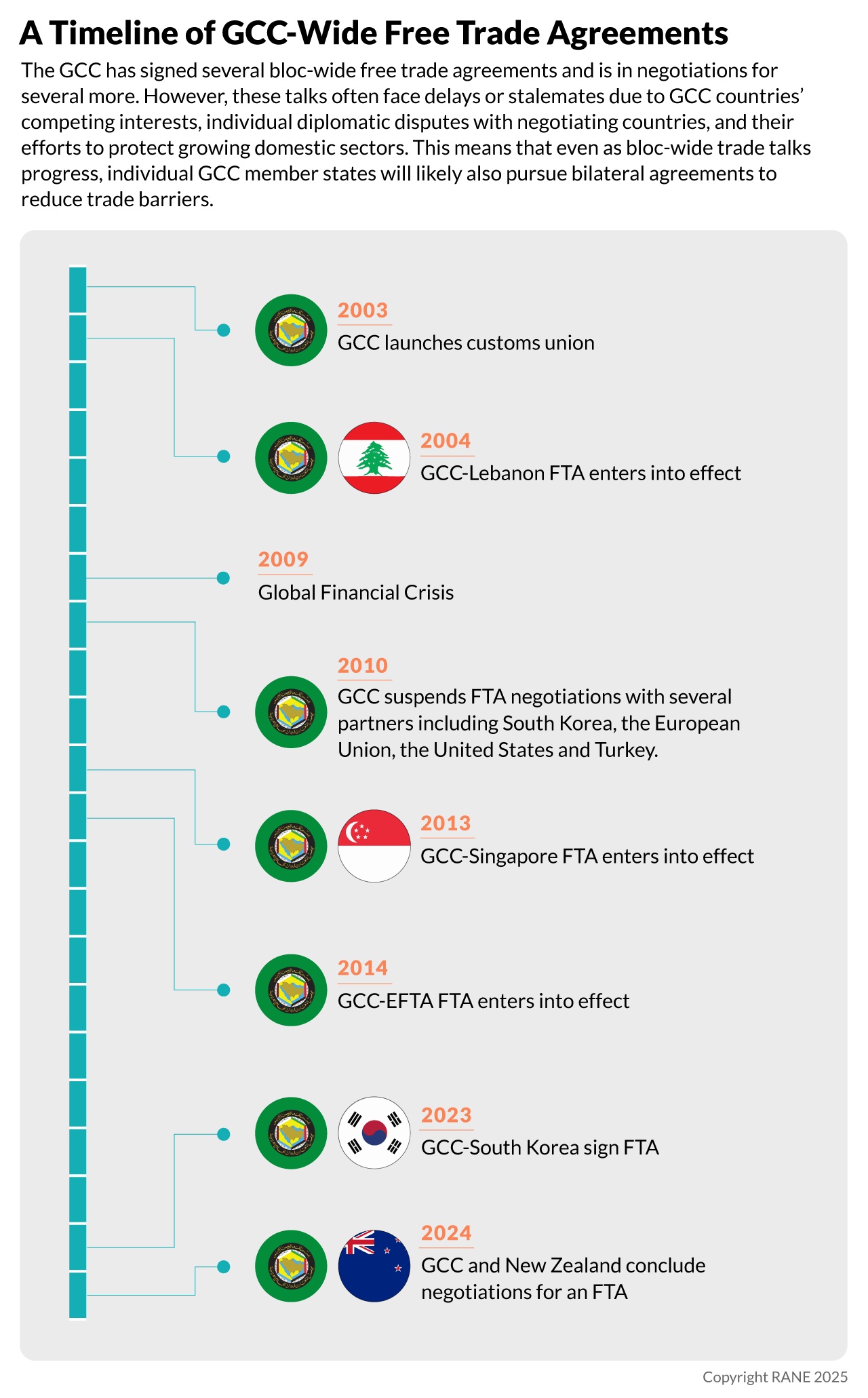
Gulf Arab countries are more likely to reach individual, bilateral agreements with other countries in the coming years, as intra-GCC disputes will probably continue to stall negotiations on most new bloc-wide free trade agreements. Many countries, including the United Kingdom, India and Southeast Asian countries, are either starting or resuming negotiations on free trade agreements (FTAs) with the GCC. However, competing interests among Gulf countries and diplomatic disputes with foreign nations, along with fears that FTAs could undermine some GCC countries' nascent efforts to develop specific economic sectors, have hindered previous efforts to reach bloc-wide FTA negotiations with other trading partners. These obstacles are expected to persist over the next few years, particularly as inter-GCC competition increases over economic opportunities and investments. Consequently, the vast majority, if not all, new negotiations on GCC-wide trade deals will likely be protracted, stalled or ultimately abandoned. To overcome this impasse, individual Gulf countries will probably continue to pursue separate bilateral trade deals with countries outside the region. The more readily and frequently such independent FTAs are concluded, the less likely future GCC-wide agreements will be pursued, given their often lengthy and sometimes unsuccessful negotiation processes.
- While the GCC has several FTAs in place with trading partners such as Singapore, South Korea and the European Free Trade Association, securing these agreements proved to be a long and difficult process. For example, negotiations for the GCC-South Korea agreement, which began in 2007, were not finalized until December 2023. This extended delay was largely due to the GCC's decision in 2010 to suspend ongoing FTA negotiations with several countries, a choice influenced by the 2009 global economic crisis.
- After years of stalled GCC-EU trade negotiations, the European Union and the United Arab Emirates agreed in April to begin bilateral negotiations for an FTA. The United Arab Emirates also recently finalized a bilateral trade deal with the Philippines that is expected to be signed in June. India and Oman are also in the final rounds of negotiations for an FTA, which is likely to be signed by late 2025. Thailand and Saudi Arabia recently began FTA talks as well.
In the medium to long term, Gulf Arab states are expected to increasingly shift their oil and gas exports eastward, as they aim to capitalize on growing demand in emerging Asian markets like India. According to Moody's, China's oil demand will plateau within the next three to five years, while India's oil demand is expected to continue growing. This is happening as the United States and Canada are ramping up domestic oil production and self-sufficiency, and against the backdrop of falling oil demand in Western Europe, where countries are increasingly transitioning to renewable energy. As Gulf countries seek to gradually diversify their trade ties and economies, the Asian oil market will continue to offer export opportunities in the medium to long term and boost expanded energy cooperation. Indeed, on April 23, Saudi Arabia announced plans to build two oil refineries in India as part of broader Saudi investment initiatives there. New Delhi and Riyadh also announced plans for long-term bilateral energy cooperation, particularly to increase India's supply of crude and liquefied petroleum gas. However, disagreements over the terms, including the volume of crude oil Saudi Arabia supplies, may impede the oil refineries' construction. Similarly, Qatar and, to a lesser extent, the United Arab Emirates will likely aim to secure additional long-term liquefied natural gas (LNG) supply agreements. These long-term energy agreements with India and China will provide some economic stability for certain Gulf states as they grapple with low global oil prices. Furthermore, high U.S. tariffs will likely create opportunities for Gulf exporters, as Chinese importers of U.S. LNG accelerate efforts to diversify their suppliers away from the United States. This will, in turn, increase Qatar's and, to a lesser extent, the United Arab Emirates' share in the Chinese LNG market. Additionally, energy cooperation with China will bolster Gulf energy diversification efforts through imported clean energy technologies, such as solar and wind technologies from China.
- According to the International Energy Agency, India will become the fastest-growing oil market over the next five years due to increasing energy demands from urbanization, industrialization and a burgeoning middle class.
- Several Gulf countries, notably Saudi Arabia and the United Arab Emirates, have prioritized expanding clean and renewable energy sources like solar and wind power to diversify their energy portfolios and reduce domestic oil consumption. These efforts will also create opportunities for increased clean energy trade between GCC states and China, which dominates global clean energy supply chains.
- In November 2022, Qatar Energy signed a 27-year deal with China's Sinopec to supply 4 million metric tons of LNG annually. Later, in June 2023, Qatar Energy signed a similar agreement with China National Petroleum Corporation. In April 2025, the China National Offshore Oil Corporation reached an agreement with the United Arab Emirates' Abu Dhabi National Oil Corp to purchase liquefied natural gas.
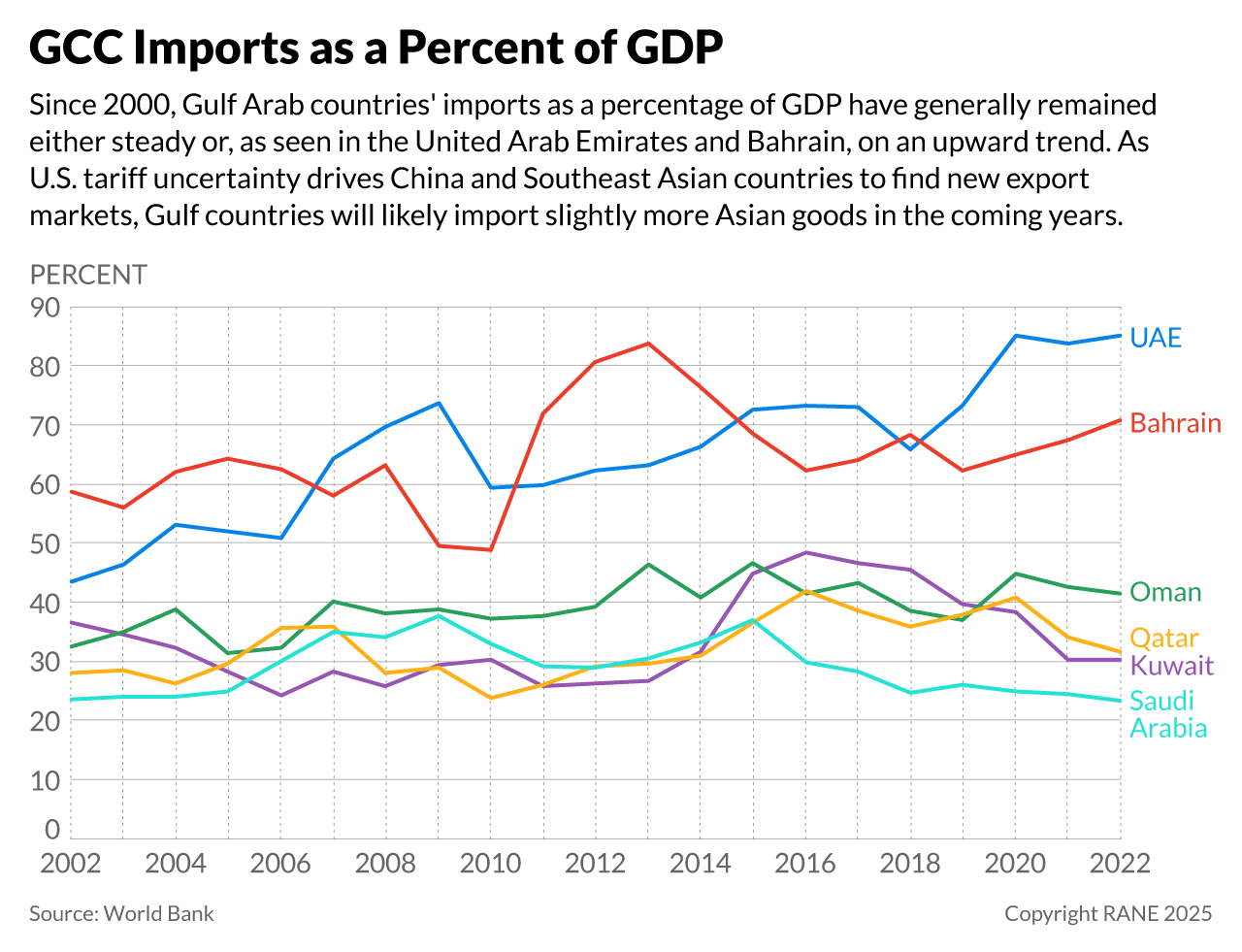
As U.S. tariff uncertainty incentivizes East and Southeast Asian economies to seek alternative export markets, Gulf Arab countries may levy additional anti-dumping duties, particularly on specific metals and electronic goods, in an effort to safeguard their expanding domestic industries. Gulf countries will likely experience limited direct impacts from the U.S. tariff war since oil and gas exports are excluded from Trump's tariffs and the Gulf countries only face the 10% baseline tariff. However, the persistent threat of U.S. tariffs on Asian countries is likely pushing them toward Gulf markets. On May 26, at the GCC-ASEAN summit, Malaysian Prime Minister Anwar Ibrahim said that a "transition in the geopolitical order [was] underway, and the global trading system [was] under further strain with the recent imposition of U.S. unilateral tariffs." The high U.S. tariffs on Chinese goods, meanwhile, have fueled China's push for pan-Asian cooperation and increased regional trade, with Chinese Premier Li Qiang calling for "expand[ing] regional opening up and develop[ing] a big market" during a May 27 joint summit between Chinese, ASEAN and GCC leaders." Amid the uncertainty around U.S. tariffs, Asian countries will likely seek to export more of their goods to Gulf countries; however, these Gulf exports would not entirely offset the significantly larger U.S. market. Gulf countries, for their part, will likely also increase their imports of certain Asian products, such as textiles and some finished electronics, though they may impose additional anti-dumping measures on certain Asian goods, such as aluminum and alloys, to protect developing domestic sectors key to their economic diversification efforts.
- On May 27, Kuwaiti Crown Prince Sheikh Sabah Al-Khaled Al Hamad Al Sabah said that GCC-ASEAN trade volumes aimed to reach $180 billion annually by 2032. In 2023, the GCC was ASEAN's seventh-largest trading partner, with trade volumes totaling $131 billion.
- Beginning on June 8, GCC countries imposed five-year anti-dumping duties on some electrical products from China, such as plugs, switches and connections.
The United States will push to expand military cooperation with Gulf countries and limit Gulf trade with China, increasing regional partners' reliance on U.S. trade in the technology and defense sectors. China and Gulf countries have cooperated on military and defense objectives in the past, including by conducting joint military drills and missile and drone production. However, Gulf countries have purchased only a limited number of Chinese weapons, primarily air defense systems, amid initiatives to boost indigenous weapons manufacturing capabilities and purchase weapons compatible with U.S. and NATO systems. The United States will likely incentivize Gulf countries to maintain and even accelerate this pattern in defense trade by selling advanced weaponry and AI technologies to its partners in the Middle East. Washington's desire to increase these sales is due to U.S. efforts to expand military partnerships with Gulf countries, in many of which the United States has a troop presence, and to counter Iranian influence in the region. Additionally, the White House's decreasing concern about U.S. weapons' end use will facilitate sales to Gulf countries, though there will likely be some pushback from Congress. Thus, U.S.-Gulf military trade will likely expand over the next several years, although likely not as quickly as the United States would prefer. For example, even though the United States and Saudi Arabia signed a $142 billion arms deal in May 2025, Saudi Arabia will likely only partially follow through on its commitments. Likewise, the Trump administration's May 13 rescission of Biden-era quotas on AI chip exports creates more room for expanded technology sales. However, Saudi Arabia and the United Arab Emirates are pursuing collaboration and some technological exchange with China, introducing vectors for China to potentially acquire advanced U.S. technology purchased by Gulf countries. The United States will guard against this risk in part by conditioning sales of advanced technology — especially AI and other sensitive technologies — on Gulf countries implementing security frameworks to guard against Chinese acquisition. For instance, the United States and the United Arab Emirates recently finalized a framework for security protocols that will restrict Chinese access to advanced AI technologies, paving the way for increased U.S. exports of AI chips to the United Arab Emirates. Gulf countries' restricted ability to trade with China on sensitive technologies will further increase their reliance on U.S. advanced technologies.
- In 2021, the administration of then-U.S. President Joe Biden imposed a ban on the sale of offensive weapons to Saudi Arabia amid concerns that the weapons could be used in violation of human rights during Saudi Arabia's conflict with Yemen's Iran-backed Houthi movement. However, in 2024, the Biden administration repealed this ban, as Saudi Crown Prince Mohammed bin Salman has tempered some of his more radical and aggressive policies in recent years. Nevertheless, the Trump administration's deal to sell weapons to the United Arab Emirates has faced some pushback from Democrats in Congress, who have cited similar concerns with the Emiratis' alleged human rights abuses in Sudan's civil war. But this is ultimately unlikely to impede the sale, as the Democrats do not have enough support in Congress to block it.
- During his recent tour of the Middle East, Trump signed several large trade deals with Saudi Arabia, Qatar, and the United Arab Emirates. These deals primarily involved the acquisition of U.S. aircraft, advanced military equipment, and unmanned aerial vehicles. But while this highlights the enduring importance of U.S.-Gulf military ties, there is a limit to how much further these relations can expand due to the United States' commitment to Israel. Indeed, upholding Israel's qualitative military edge in the Middle East is a fundamental tenet of U.S. policy in the region. Consequently, highly advanced U.S. aircraft, such as F-35s, are likely to remain off the table for trade with Gulf countries, even those that have normalized relations with Israel, such as Bahrain and the United Arab Emirates. Additionally, Gulf countries are very unlikely to purchase the full volume of the arms deals, given that they only purchased a fraction of their commitments during Trump's first term.
- U.S. semiconductor company Nvidia announced that it would sell 18,000 AI chips to the Saudi-owned AI startup Humain, with additional plans to sell hundreds of thousands of its graphics processing units to Humain over the next five years. Furthermore, Stargate UAE — an AI infrastructure cluster joint project between Emirati and U.S. companies — will likely use 100,000 advanced Nvidia AI chips during the project's initial rollout alone, which is scheduled for 2026.
