
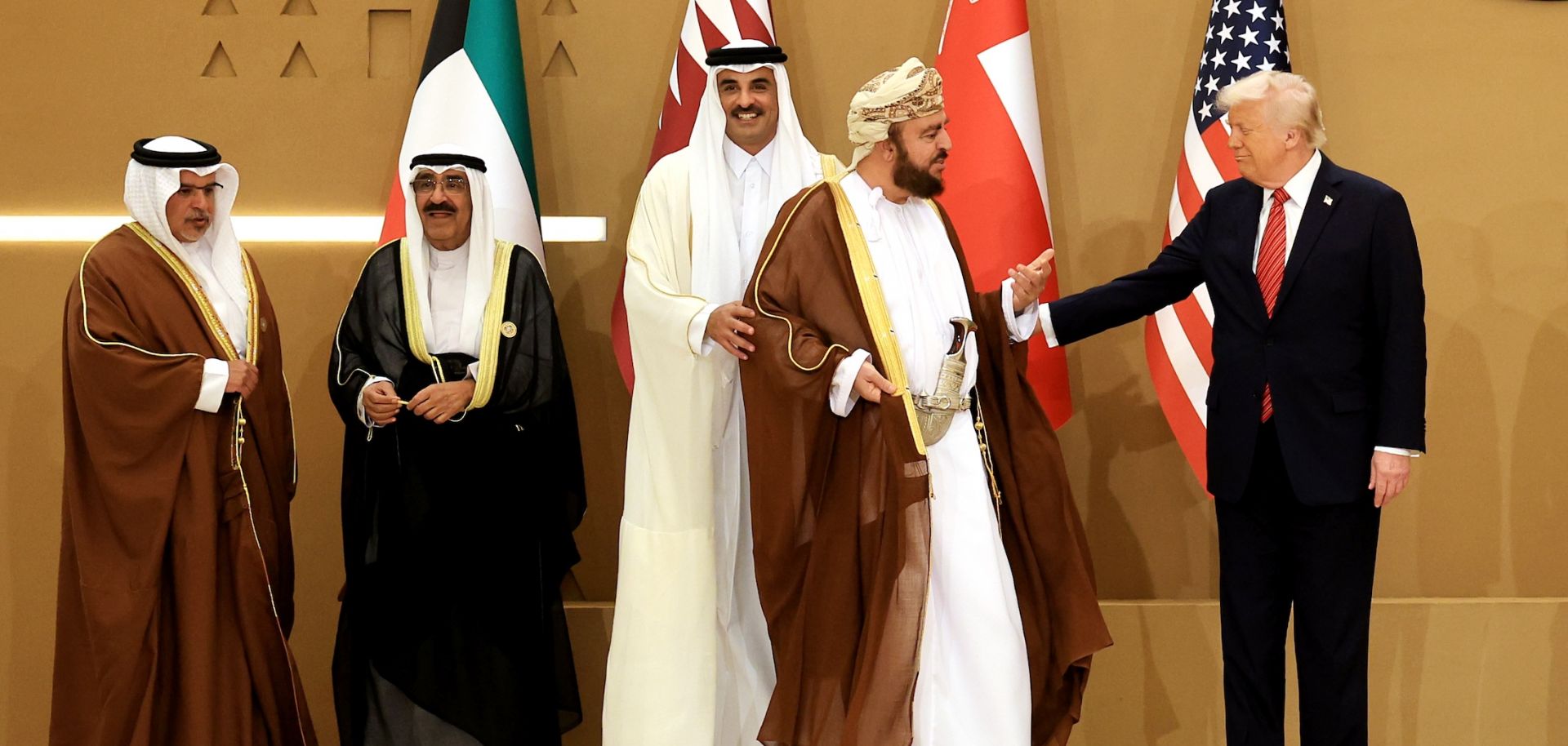
Much has been made of U.S. President Donald Trump's recent tour of the Middle East, where he slammed the interventionist policies of his predecessors. "In the end, the so-called nation builders wrecked far more nations than they built. And the interventionalists [sic] were intervening in complex societies that they did not even understand," he said in Riyadh, about the widely panned Iraq invasion of 2003.
Some have hailed Trump's remarks as signaling the end of American interventionism in the Middle East, or at least the beginning of the end, as the United States retrenches. Trump's newly appointed ambassador to Turkey, Tom Barrack, even went so far as to say, "The era of Western interference is over. The future belongs to regional solutions, but partnerships, and a diplomacy grounded in respect."
Doveish though this all sounds, the reality is that the United States remains poised to use its many tools to reshape the balance of power in the Middle East. The region still matters to American energy and trade interests, and its political system remains attached to the overall security of Israel, Washington's key ally. None of that changed with Trump's election in November 2024. However, the United States' approach to the Middle East, or at least Trump's approach, is shifting toward more reactionary interventions, shorter military campaigns, and a greater reliance on economic and diplomatic leverage. That will free some countries in the region, like Turkey, to act on their own agency, but it will shackle others, like Israel, with responsibilities they have not had in many years.
Why the Regional Police Power Learned to Hold Back
Trade and energy interests, and the need to secure both, have kept the United States engaged in the Middle East since the end of World War II. But how Washington has chased those imperatives has shifted over the decades. During the Cold War, the United States pursued a containment strategy that sought to keep the Soviet Union out of the Middle East by relying on friendly powers like Israel, Turkey and, before 1979, Iran. But once the Cold War ended, American policymakers began believing that the key to securing U.S. regional interests was not merely managing threats but ending them by turning the Middle East into a geopolitical version of Europe — one without strong rivals able to challenge Washington's need for trade and energy, united in some pro-U.S. diplomatic framework like NATO or the European Union.
This ushered in the era of maximalist interventions that Trump lambasted in Riyadh, as Washington sought to fill the strategic vacuum in the region left by the Soviet Union's collapse, later emboldened by the hawkishness that emerged in the United States after the 9/11 attacks. During this period, U.S. leaders tried to reshape the Middle East into a region that was at least not anti-American, if not pro-American, through military campaigns, sanctions and diplomatic maneuvering — leading to the Oslo Accords, as well as the "rogue states" and "axis of evil" rhetoric. This era was also marked by the repeated U.S. military and diplomatic campaigns to end Iraq's weapons of mass destruction, which eventually culminated in the U.S. invasion of Iraq in 2003.
The Iraq War, however, is when more Americans began to question the scale and scope of their country's interventions in the Middle East. Indeed, backlash to the Iraq War is what partially helped Barack Obama win the 2008 presidential election. But at the time, there was still a broad recognition that the United States needed the region's energy resources, and needed to ensure that global trade could pass by unharmed between Europe and Asia (after all, Obama did not get very far in pushing for alternative energies — a strategy that would have weakened America's need for the Middle East to provide global price stability for oil and gas). In other words, U.S. interventions should be restrained, but they also could not end.
When the Islamic State came to Iraq and threatened to topple the government of a major oil producer, the Obama administration, despite withdrawing only a few years prior, went back into the country in 2014. When civil war in Libya threatened to interrupt the country's oil supplies and create a humanitarian crisis that might have landed on Europe's doorstep, Obama began conducting airstrikes in favor of the rebellion. When Iran crept toward more and more advanced nuclear technology and enrichment, Obama imposed crushing sanctions to prevent Tehran from developing a nuclear deterrent that might shield it from retaliation as it undertook a destabilizing strategy of regional hegemony. The United States could and would intervene, but it would target specific outcomes, leaving behind the grand reorganization pursued by Obama's predecessor, George W. Bush. The United States, as the last remaining superpower, could pick a massive escalation, but, post-Iraq, no president would get reelected as a result of one.
Trump's foreign policy instincts were honed during this era. In his first term, he selectively intervened in the Middle East as reluctantly, and in some cases as reactively, as Obama did. Trump conducted two brief bombing campaigns in Syria as punishment for chemical weapons use. In response to political outrage within the United States, he also sanctioned Saudi Arabia following the murder of journalist Jamal Khashoggi in 2018. Additionally, Trump moved twice against Turkey — first to free Pastor Andrew Bruson, and then to halt a Turkish invasion of Syria during the United States' abortive withdrawal in 2019. On Iran, Trump adopted a strong stance against the country's nuclear program and foreign policies, which led to the U.S. withdrawal from the Iran nuclear deal in 2018 and the U.S. assassination of Iranian general Qassem Soleimani in 2020. However, Trump stopped short of explicitly calling for the overthrow of the Iranian government. And when confronted with the prospect of war — like after Iran attacked Saudi oil facilities in 2019 and fired missiles at a U.S. airbase in Iraq in 2020 in retaliation for Soleimani's killing — Trump demurred from full-scale escalation, implicitly knowing that it would sink his reelection prospects.
Trump's successor, Joe Biden, did much the same. Biden retaliated with limited scope and scale to provocations in Iraq and Syria, conducted a targeted campaign against the Houthis in Yemen, and defended Israel from Iranian attacks while avoiding escalatory actions that could trigger a wider war with Tehran. Biden also carried out Trump's peace deal with the Taliban in Afghanistan, even as that deal ultimately led to the unraveling of the pro-American government there. Biden was not as bombastic online as Trump was when ordering such operations, but his core approach to the region — of limited retaliation, specific targets and narrow goals — was similar. When Biden was defeated by Trump in 2024, it was domestic issues, like inflation, that sank him, rather than his campaigns in the Middle East.
Restraint, but Not Isolationism
Trump entered his second term in January 2025 with a pledge to "end wars," something he has since struggled to do in Ukraine and Gaza. But despite this pledge, Trump has so far not shied away from using military power. In the spring of 2025, the Trump administration launched an intense airstrike campaign against Iran-backed Houthi militants in Yemen, in response to the group's escalating attacks on Israel and Red Sea shipping. But Trump put an end to the campaign on May 6, after concluding it was too close to becoming one of the so-called "forever wars" that so many Americans, including his supporters, now adamantly oppose. He has restarted nuclear talks with Iran, but has refused to rule out direct strikes on the country should those fail. And with Israel, Trump has not threatened to reduce crucial U.S. political or military support to get Israel to end military operations in Gaza, routine violations of the Hezbollah ceasefire, or incursions into southern Syria.
All of this suggests that, despite his recent remarks lambasting U.S. interventions in the Middle East, Trump is not preparing to militarily withdraw from the region by closing major U.S. bases, in order to solely focus on diplomatic and economic deals going forward. The United States' core imperatives in the region — namely, securing energy and trade interests — remain. And Trump, like many of is predecessors, is simply reinterpreting the way Washington pursues those interests by suggesting that a more autonomous network of friends and allies will be able to secure them with the United States doing less of the heavy lifting. Unlike during his first term, there has been no high-level talk of building some sort of Arab security alliance akin to NATO, but the impulse remains that if the United States can expand frameworks like the Abraham Accords (the pacts normalizing ties between Arab nations and Israel), a mutual nexus of interest will naturally secure America's imperatives with less need for direct intervention.
The Middle East remains complex, and much has changed since Trump first entered the White House in 2017. The Islamic State has also gone underground, and there is no longer a caliphate to conquer, but its adherents must still be battled by someone, even if U.S. boots on the ground are no longer as needed. In Syria, the civil war has ended, but Trump will still need to nudge along the country's provisional government so that it develops into at least a neutral, stable power. Iran still has a troublesome nuclear program, but its allies in Syria and Lebanon (i.e., Bashar al Assad and Hezbollah, respectively) have been defeated, and Tehran can no longer credibly threaten the region's security the way it once did. Yemen is still intractably divided, but its anti-American Houthis are now more focused on supporting Palestinians' fight against Israel than they are on seizing territory in southern Yemen. Turkey maintains ties with Russia and China that irked Trump during his first term, but Turkey has also emerged as a key player in Syria's political transition, and a balancer against Russia that cannot be readily replaced.
But perhaps what has changed most since Trump was last in office is Israel, which has embarked upon an expansive campaign of buffer zones and full-scale wars to wipe out the threats that challenged it on Oct. 7, 2023.
Trumpian Interventions
Trump has so far largely pursued the same approach to the Middle East that he did during his first term. He still prefers quick escalations with quick de-escalations, part of his habit of both winning headlines and avoiding expensive confrontations. And he still cares about the U.S. energy and trade interests in the region, knowing that to ignore them would hit the U.S. economy and, in turn, his domestic popularity. But with new challenges in the Middle East, he must now carry out new interventions. And regardless of lofty talk about keeping such interventions limited, the reality is that even under Trump, the United States will be compelled to pick winners and losers.
In regard to the energy-rich Gulf Arab states, it will be relatively easy to keep the promise of non-intervention, as here, Trump's instincts and American imperatives align readily. Trump has never had a strong personal desire to reshape other countries' political systems, as some of his predecessors, including Obama and George W. Bush, tried to do in their efforts to liberalize Gulf Arab states. In his first term, Trump faced pressure from Congress to punish Saudi Arabia and the United Arab Emirates for their domestic human rights records and interventions in places like Yemen. But this time, U.S. lawmakers are much more sensitive to any action that could increase domestic gas prices (Trump won the 2024 election in part by promising to lower those prices, after all), and are thus less eager to sanction the Gulf Arab oil exports that have filled the hole in the global market left by sanctioned Russian oil. Even some of the anti-Islamist hawks in Congress have been quieter on Qatar after backing the Saudi-Emirati blockade there because of Doha's relationship with Islamism. This allows Trump freer rein to leave the Gulf Arab states alone, acting as a protector in the region but not a political guide.
Trump also generally has an interest in bringing Turkey closer in strategic and political alignment. The country's key position on the Black Sea and role in NATO has made it useful to the United States as it confronts Russia — but even so, Trump has shown little interest in further escalating with Moscow, and is thus unlikely to further pressure Turkey to cut ties with Russia. Additionally, in Syria, Trump seems content to let Turkey handle counterterrorism threats following the Assad regime's collapse in December 2024, given that any extremists who entangle themselves in the country would also be enemies of Turkey.
But while Trump may not want to force Turkey to become a European-style democracy or a compliant member of NATO, his opinions on Turkish policies still create the prospect of significant economic and diplomatic disputes. For one, Turkey has high tariffs on certain U.S. imports, and its digital services taxes also irk the White House due to the disproportionate impact on large U.S. tech companies; Trump could use either of these issues to justify imposing higher U.S. tariffs on Turkish imports. Turkey's growing arms industry may also frustrate Trump, who is eager to make the United States the prime supplier of weapons to the region. Additionally, there is a chance that Trump's supporters could suddenly take issue with a specific Turkish policy, namely the country's treatment of Christians, compelling Trump to again pursue severe economic retaliation as he did in his first term.
With Iran, Trump's instinct is to use economic pressure to win a deal and avoid war. This has seen him impose sweeping sanctions on the country as part of his maximum pressure campaign. But Trump also has a growing instinct related to his legacy, where Iran is a sore point, given that it was he who abandoned the 2015 Iran nuclear deal in pursuit of what he called a "better" deal that has since remained elusive.
Iran is weaker now than it was in 2017; years of crushing sanctions, plus the fall of Assad and the defeat of Hezbollah and Israeli airstrikes on Iran's air defenses have left it exposed strategically and militarily. This certainly encourages Trump to believe that Iran is in a position to offer concessions on its nuclear program. But Iran is far from defeated, and its powerful friends in Russia and China continue to buttress its economy and military. Tehran may also calculate that it can outlast Trump again, refusing to concede to his administration's demands. Should Trump come to believe this is true, he will be forced to choose whether to let Iran simply wait out his term, accepting the mark on his legacy — or if he will force Iran to change tact with military power. Indeed, Trump has threatened to break his pledge of ending U.S. military interventions in the region if Iran abandons nuclear talks.
But it is with Israel that Trump's more targeted, restrained instincts may yet create a notable change — and a notable gap. Gaza is not an American war, and Trump's personal inclination is for the war to end, even as he has provided sparse details on how this could happen. He is not yet willing to push Israel to end this war short of the total defeat of Hamas. But neither is he necessarily willing to shield Israel from the subsequent diplomatic blowback caused by its war in Gaza. He has reportedly decoupled civilian nuclear cooperation with Saudi Arabia from Israeli normalization, a sign that his administration recognizes that Saudi-Israeli normalization cannot go forward without at least an end to the war in Gaza. He has taken a few steps to block European powers from weakening ties with Israel and even imposing sanctions on its settlers, a trend that, if it continues, could pose a substantial challenge to Israel's economy and eventually parts of its military supply chain. And he pushed back against pro-Israel hawks in the United States who want strikes against Iran sooner rather than later, with Trump reportedly telling Israeli Prime Minister Netanyahu in May to hold off on a campaign so nuclear talks with Iran can proceed.
All of this suggests that while Trump is not becoming anti-Israel, he is not willing to put his own capital or American power in a position where it can shield the country unless their interests align. Israel can fight the war in Gaza as it sees fit, but it must pay the diplomatic and economic price without American help. And while Israel can rattle its sabers at Iran, Trump would be undoubtedly enraged by an Israeli strike that takes place before talks have collapsed. If Trump decides he can accept a stalemate — or worse, an Iranian civilian nuclear program — Israel will have to decide if it can shoulder the impact of inevitable American blowback by attacking Iran in the aftermath. Israel, in other words, is being pushed to shoulder more of its own diplomatic, economic and military responsibilities, as Trump leans back from guaranteeing Israel as stridently as in the past.
The era of U.S. interference in the Middle East, therefore, is not quite over. Rather, it is evolving away from the more recent neoconservative crusades and back toward the limited realpolitik that characterized most of America's history in the region. What is not changing are Washington's geopolitical imperatives that keep pulling it back into the region — a reality that ensures that Trump will remain just as engaged in the Middle East in his second term as he was in his first.
