
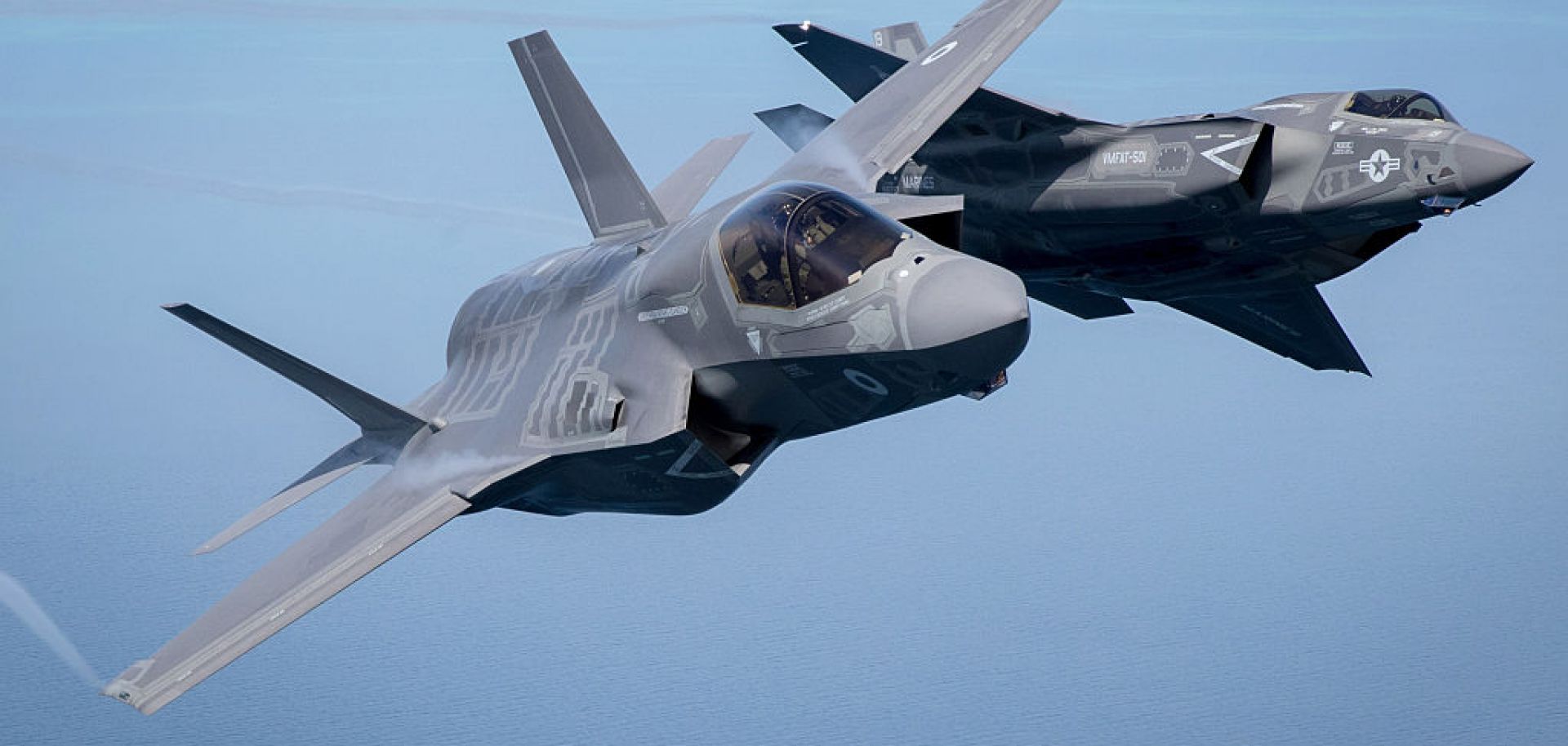
A U.S. Marine Corps F-35B aircraft over the North Sea having taken off from RAF Fairford on July 1, 2016 in Gloucestershire, England.
Against the backdrop of nuclear negotiations, the United States is once again threatening to strike Iran over its nuclear program should such talks fail. Meanwhile, Washington is running an escalated air campaign in Yemen and has frozen air campaigns it could restart in Syria and Iraq. The United States has long had the world's largest and most capable air force, which in the wake of the unpopular ground wars in Iraq and Afghanistan has once again become a favored tool for the superpower in the region, as its politicians on both sides of the aisle are eager to avoid terrestrial political and strategic debacles. To Washington, airpower holds deep appeal: few of America's adversaries have capable air defenses, and pinpoint strikes against specific targets create the perception among the U.S. public that Washington's aims are surgical and achievable, limiting war weariness from putting boots on the ground.
But while airpower may limit political risk in the near term, it has a mixed record of achieving big strategic breakthroughs. If anything, the lack of strategic breakthroughs through airpower risks making the public, and eventually the U.S. government, lose faith in its ability to create change — and accelerate America's impulse to withdraw. If and when future airpower campaigns fail to achieve their objectives, they will also spur further sentiment shifts in Washington that accelerate America's withdrawal from the region, paradoxically weakening America's influence through its airpower strength.
The Role of Airpower, and Its Uneven Record
Since airpower first entered warfare over a century ago, it has been a key aspect of most military campaigns. Airpower allows reconnaissance past enemy front lines, strikes against forces that would otherwise be in a secure geography, and ferries forces back and forth across long front lines or combat zones. The technological prowess that goes into airpower, and its impressive physical display as bombers, jets, and helicopters roar overhead, also has a psychological impact, inspiring friendly forces and demoralizing rivals who cannot counter it. When the United States invaded Iraq in 2003, it began with the so-called shock and awe aerial campaign that relied heavily on air and missile power, hitting the Iraqi government's command and control centers, and disrupting their ability to form a defense against the rapidly advancing coalition.
Yet while technologically impressive and catastrophically impactful on the front lines, airpower has a much more mixed record of achieving strategic breakthroughs. Airpower is a single tool of military strategy that must be calibrated to achieve the objectives for which it is best suited. When airpower is overused by politicians to break political will or force strategic change from an entrenched rival, airpower, no matter how overwhelming, tends to come up short.
There are several famous historical examples, including Nazi Germany's failure to break the United Kingdom's resolve during the Battle of Britain and the U.S. failure to vanquish North Vietnam in Operation Rolling Thunder. After the United Kingdom withstood the German aerial onslaught and the tide turned in World War II and the Allies gained air superiority, they sought to use strategic air destruction to break the Germans' will and capacity to make war. But the opposite happened: Germany's industrial output increased toward the end of the war in 1944, even when Allied air raids became more intense, with the Germans adapting to the onslaught to better hide and distribute their industrial infrastructure. Only dual ground invasions of Germany broke its industrial backbone, and meanwhile, popular support for Hitler remained strong until his 1945 suicide. Meanwhile, airpower could do little in Vietnam to halt the supply lines that ran to China and then farther afield to the Soviet Union. Although the United States could and did strike any targets it chose throughout much of North Vietnam, this equipment was quickly replaced by the Communist bloc, while airstrikes failed to demoralize the North Vietnamese and in fact boosted recruitment to help them replace their losses.
Even regionally within the Middle East, airpower has a mixed record. Thirty days of intense air bombardment of Saddam Hussein's Iraq failed to convince Baghdad to withdraw its army from occupied Kuwait in 1991. Eight years of the War of the Cities between Iraq and Iran, where the two traded airstrikes and ballistic missile barrages against one another's civilian populations, did not win the war for either side; the conflict ended in a negotiated stalemate. The U.S. air campaigns to destroy weapons of mass destruction in Iraq in 1998 and in Syria in 2017 and 2018 failed to achieve their objectives, too; Saddam never pledged to abandon his arsenal (which largely didn't exist anyway), and Bashar al Assad never fully dismantled his own despite pledges to do so. Most recently, the United States entered a campaign against the Houthis in Yemen, striking the country hundreds of times over the past few months, claiming numerous tactical successes but failing to prevent the Houthis from continuously launching missiles toward Israel and conducting their harassment campaign against civilian maritime traffic in the Red Sea. That campaign was nominally paused on May 6, in part because of the lack of impact on the Houthis' strike capabilities.
All of this is not to deride airpower's effectiveness across the board: When attached to a limited policy objective in which airpower's narrow impact can be most likely achieved, airstrikes can restore deterrence, degrade enemy capabilities, and even shift political will away from starting larger wars. For example, the United States has retaliated numerous times against Syrian and Iraqi militias in the past decade, resulting in an uneasy but largely favorable balance of deterrence against these forces. Meanwhile, in the 1991 Gulf War, airpower may not have broken Saddam Hussein's political resolve, but it certainly softened up his military and command and control system. This made the ensuing ground war one of the most successful military campaigns ever. Even in World War II, strategic bombing against Germany impacted its ability to defend its borders for Allied and Soviet ground invasions. In other words, if airpower is calibrated to either nudge a rival's behavior rather than wholly reframe it, or if it is combined with the necessary ground component needed to break the pillars of power that sustain a rival state's power, then airpower has a powerful role to play.
The U.S. Weariness of 'Forever' Wars
The United States faces political and strategic constraints that hinder its ability to use airpower in the Middle East. Politically, the United States is in the grips of a nationalist populism appearing on both sides of the political spectrum. This trend, caused by growing war weariness and a belief that money could be better spent at home, has produced two contradictory political impulses. Populists push for isolationism so that the United States can focus on its own long-standing problems. Nationalists, meanwhile, push for rapid-fire and escalatory military campaigns that do not require significant sacrifices from the U.S. public, but which respond to rivals' provocations. If there is a way to conceptualize the combination of nationalism and populism, it is widespread, bipartisan resistance to the "forever war" (the term itself comes from the title of a 1974 science fiction book about an eventually futile 1,000-year-long space war, which has gained popularity as a term to describe the now 24-year-long Global War on Terror).
Nominally, populists and nationalists would push America to withdraw from the region entirely, responding only to direct provocations as part of its new, more inwardly focused national spirit. But nationalist-populism has not fully conquered America's foreign policies: lingering strategic designs for the United States to reframe the balance of power in the Middle East away from Iran and its proxies toward the U.S. network of friends and allies remain. These continue to appear through attempts at Saudi-Israeli normalization, an integrated regional air defense, and attempts to restrain or dismantle the Iranian nuclear program. Finally, it is also responsible for global energy security and trade routes. This responsibility has led to military involvement in Yemen to secure the vital Red Sea shipping lane while maintaining air bases across the energy-rich countries of the Gulf Cooperation Council. Moreover, even the nationalists and populists admit there are no immediate options beyond U.S. power to secure these interests: in the now-infamous Signalgate leaks, Vice President JD Vance, himself of the nationalist-populist foreign policy school of thought, complained about Europe's inability to help intervene against the Houthis. In other words, the traditional globally focused U.S. dominance strategy still has life left.
Washington's policymakers thus face the imperative of maintaining trade and energy security, but the extent to which they can wield power remains limited. They have supporters urging them to secure trade and energy supplies, and to restrain Iran further, but not to use large amounts of U.S. blood and treasure to do so. This dynamic tends to favor air campaigns, with their low casualties, relatively smaller cost and (sometimes illusory) promise of quick results. Since the Obama administration, the United States has kept ground forces in the region to a minimum, and kept airpower at the ready for quick campaigns in response to rivals encroaching on U.S. interests. Even at the height of the war against the Islamic State in Iraq and Syria in 2014-17, the U.S. had only deployed a few thousand troops, which paled in comparison to the nearly 500,000 who were part of the operation to invade Iraq just a decade plus before (a number that includes the hundreds of thousands of sailors, airmen, and logistical forces needed for this significant ground operation).
The threats to regional U.S. interests are more entrenched, however, than airpower alone can manage. The Houthis have endured numerous airstrikes for more than a decade, which have not broken their political will to continue confrontations with their rivals. Instead, they have improved their recruitment capabilities and incentivized adaptation to these open-ended air campaigns by building a distributed network of military infrastructure that allows them to continue their attacks on Israel in the Red Sea and, if necessary, against the Gulf Arab states once more. Meanwhile, Iran has spent years hardening its nuclear program sites and potentially building subversive clandestine sites that would allow it to restore its capabilities in the event of Israeli or American airstrikes. Though neither the Houthis nor Iran can stop U.S. or Israeli airpower on their own — as demonstrated by Israel's October 2024 airstrikes against Iranian targets, which destroyed many of Iran's air defenses — they have developed redundancies, distribution networks, hardened infrastructure and a means of retaliation, meaning that no U.S. or Israeli airstrike against them comes without a cost or achieves the complete impact that the U.S. and Israel seek. Quietly, many defense planners in the United States and Israel recognize this, which is a significant reason why Israel has not attacked Iran the way it did the nuclear programs in Syria in 2007 and Iraq in 1982.
Restraint Without Breakthrough and Its Consequences
Despite all this, the impulse to use airpower remains. U.S. President Donald Trump has notably said that if negotiations with Iran fail, he is prepared to use airstrikes against Iran to prevent it from developing a nuclear weapon. But he has said nothing about regime change or ground invasion, the two strategies most likely to end Iran's potential threat of developing a nuclear weapon. His silence on either approach is notable, as both risk dragging the United States into an extended conflict that would distract Washington from confrontations with Russia and China, while also outraging a large part of the U.S. public that is increasingly isolationist. Thus, if Trump is to strike Iran, his air campaign will likely resemble past bombardments, featuring furious airstrikes and numerous headlines but comparatively mild impacts on the ground and certainly no sudden break in Iran's political will to maintain a nuclear program. While the United States could reign in the air more or less indefinitely, and could demolish the physical infrastructure of much of Iran's nuclear program, such a campaign would be more likely to rally Iranians to their government and strengthen it politically so that once the campaign ended Iran could restart reconstruction of that program. Moreover, another major constraint on an entirely successful air campaign is that the United States cannot fully destroy Iran's nuclear capabilities, given that airstrikes on Iran's Bushehr nuclear reactor would cause a catastrophic radiation event that would threaten all its partners and allies. Airstrikes, in other words, would buy time, but not firm results: Iran's government would be strengthened, and its resolve to restart its nuclear program, and even weaponize it, would be, too.
The United States would thus face an unattractive options: to keep the air campaign going indefinitely, to the tune of billions of dollars and much-needed munitions; to prevent reconstruction; to return to the very negotiating table it abandoned and restore the status quo before the strikes; or to escalate its campaign into that of regime change, either by supporting a rebellion on the ground or sending in forces itself. The latter option is almost unthinkable in the current environment of nationalist-populism, yet as it is discarded, Washington would be stuck considering another forever war in the air, or a negotiation process so hampered by mistrust that it would need either substantial U.S. concessions to make progress, or would simply produce no diplomatic outcome at all, as Iran slowly rebuilds its program.
Even short of the Iran strike scenario, U.S. overreliance on airpower is already hitting its natural walls, as the Houthis have not been deterred from ending their strikes on Israel and shipping in the Red Sea. It is unclear whether Washington will muster the support for a ground offensive in Yemen that might change that dynamic, but even so, even the reports of a ground offensive are a tacit omission that airpower alone will not stop the Houthis. Meanwhile, America's long-standing intervention in Syria to drive the Islamic State underground is coming to an end. Washington is looking to hand off the still-on-going campaign to local partners, having gone as far as its airpower and special forces can in such an anti-insurgent war. And in Iraq, though airstrikes on Iran-aligned militias have helped prevent them from escalation against American forces, they have not removed their deep influence on the Iraqi state and its security forces. Iraq remains pulled in Iran's direction, and whether it breaks that dynamic seems likely to take place independent of U.S. power.
Thus there is a question of whether over the next four years air campaigns will produce their own, new type of nationalist-populist weariness: nationalist pushback because such campaigns cannot reframe the region in America's favor as they want and distract from the confrontation with China, and populist because they use national treasure these populists would rather see kept at home. There are only so many bombing campaigns that can occur without result before the public starts to demand an end to them. Should there be casualties, like pilots being shot down, or aircraft carriers being struck by ragtag forces like the Houthis, and high-profile failures, like the inability to break Iranian resolve to develop its nuclear program, this trend is sure to deepen. The tactic designed to allow intervention without deepening withdrawalism will instead do the opposite, and Washington will face more and more calls to retrench from the Middle East and cede its security dynamics to the locals, some of whom might be less than capable friends — and some who might be adversaries.
