
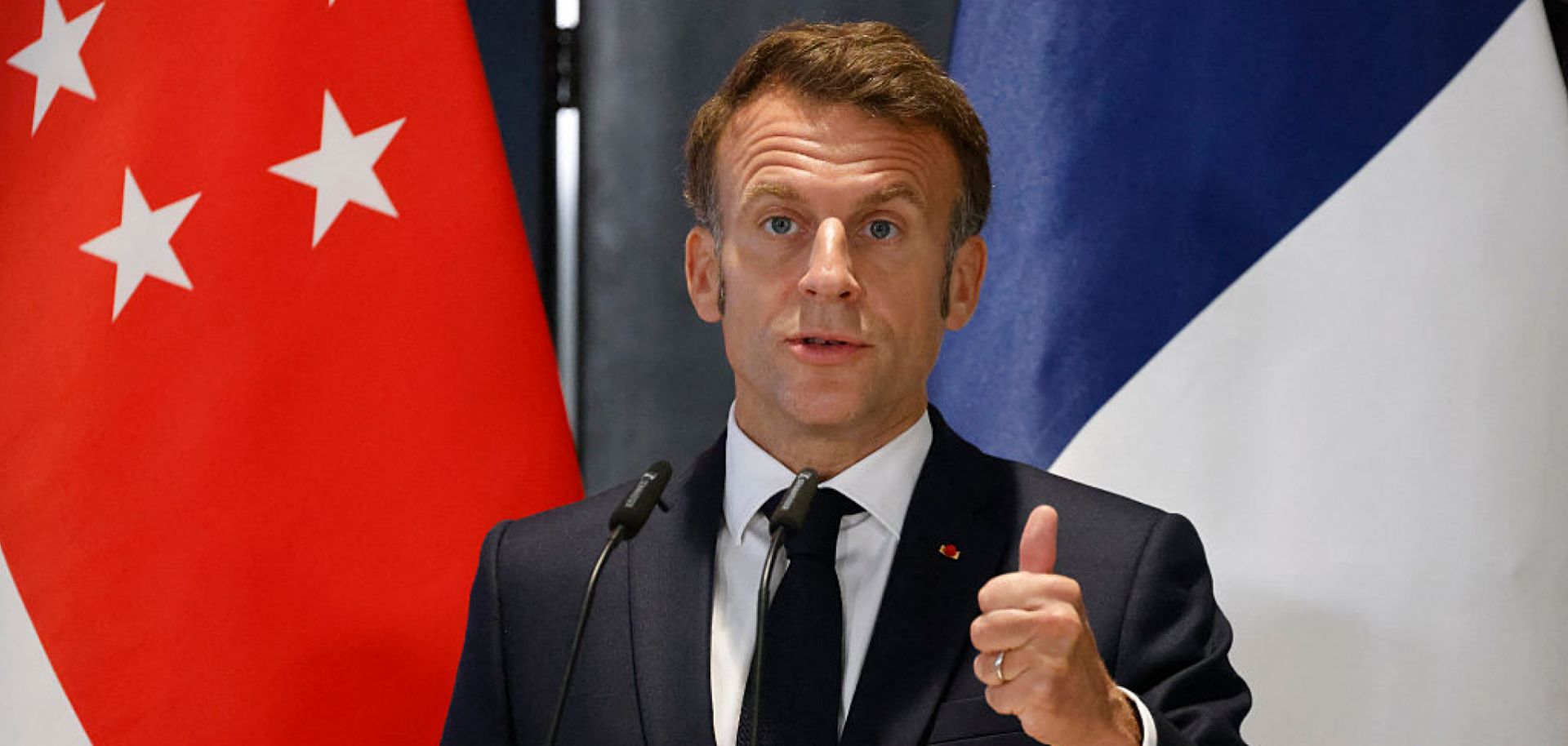
France is leveraging diplomacy, along with major defense and energy deals, to expand its role in Southeast Asia, but the longevity of its influence will hinge on maintaining naval and diplomatic engagement, delivering localized defense and maritime security benefits, and aligning with — rather than disrupting — regional strategic priorities. From May 25 to May 31, French President Emmanuel Macron conducted a high-profile diplomatic tour of Southeast Asia, with state visits to Vietnam, Indonesia and Singapore. First, Macron visited Vietnam from May 25 to 26, during which France and Vietnam signed approximately $10.25 billion worth of commercial deals, partnership agreements and memorandums of understanding. In Indonesia from May 27 to 29, Macron and President Prabowo Subianto deepened bilateral strategic ties, namely through Indonesia's confirmed acquisition of 42 Rafale fighter jets (from a 2022 agreement) and advanced discussions for 18 more, as well as two Scorpene Evolved submarines (to be constructed in Indonesia) and 13 Thales radar systems, several of which will be deployed in Indonesia's new capital, Nusantara, which is still under construction. From May 30 to 31, Macron concluded his tour in Singapore, where the two countries elevated their ties to a comprehensive strategic partnership, marking Singapore's first such partnership with a European Union member state. On May 31, Macron delivered the keynote address at the 2025 Shangri-La Dialogue, urging a united front — what he called "a coalition of independence" — between Europe and Asia to counter coercion and "great power bullying" in the region, a reference to the United States, China and their intensifying competition between which Southeast Asian countries are increasingly coming under pressure to choose sides.
- Macron's visit to Vietnam was the first by a French president since Francois Hollande in 2016, though the two countries did upgrade ties to a comprehensive strategic partnership in 2024 during top leader To Lam's state visit to Paris. Major deals in Hanoi included VietJet's purchase of 20 Airbus A330-900 aircraft, joint projects in nuclear energy, defense, rail and maritime transport, and the deployment of Airbus earth-observation satellites. France's Sanofi also secured deals in the pharmaceuticals sector, particularly in vaccine manufacturing and distribution.
- Reportedly, Indonesia's 2022 purchase of 42 Rafale fighter jets came under internal scrutiny amid reports that several of these jets were downed by Pakistan using Chinese-made J-10C fighter jets in Islamabad's May conflict with India. Still, Jakarta moved forward with plans to expand the deal, citing confidence in the platform. France and Indonesia also signed over a dozen agreements spanning critical minerals, agriculture, disaster preparedness and defense industry localization. A key energy initiative was a joint TotalEnergies-RGE solar and battery storage project in Indonesia's Riau province.
- France and Singapore signed 13 agreements covering nuclear energy cooperation, classified information protection, defense research and development, and joint maritime awareness initiatives.
- In his speech at the Shangri-La Dialogue, Macron emphasized that allowing Russia to annex parts of Ukraine without consequence would potentially embolden China against Taiwan and in the South China Sea. He also criticized perceived double standards in addressing conflicts such as Gaza — where many regional countries have been vocally critical of Israel — while being relatively silent on Russia, stressing the importance of consistent international responses to uphold territorial integrity and sovereignty. Furthermore, Macron highlighted France's commitment to the Asia-Pacific region — citing its military presence and strategic partnerships in the region — and called for enhanced cooperation between NATO and Asian nations.
Macron's tour aimed to strengthen France's presence in Southeast Asia by establishing and deepening comprehensive partnerships in defense, energy, trade and cultural diplomacy. France has long held overseas territories in the Indian and Pacific Oceans, which include French Polynesia, Reunion and New Caledonia. But Paris only began seeking to convert this presence into broader strategic influence in the mid-2010s, when shifting global dynamics and Macron's 2018 Indo-Pacific Strategy refocused French attention on the region. Against this backdrop, Macron's visit reflects a push to deepen the breadth of France's relationships in Asia by offering strategic, defense, economic and technological partnerships that serve as an alternative to those offered by the region's two dominant powers: China and the United States. Indeed, the French president's emphasis on territorial integrity and the need for consistent and principled responses to violations of sovereignty reflects France's broader effort to position itself as a credible actor outside current power blocs. Macron's tour also sought to support French domestic goals, such as securing major commercial deals for French firms, expanding export markets and bolstering Macron's foreign policy credentials at a time when European cohesion is under strain. Additionally, the trip was likely, in part, aimed at preemptively countering potential efforts by Russia to reassert its presence in Southeast Asia, should the war in Ukraine end on terms favorable to Moscow that enable Russia to pursue wider global strategic goals.
- Highlighting its strategic ambitions in Southeast Asia, Russia reportedly requested to build an airbase in Indonesia in February, but Jakarta denied this request.
Vietnam, Singapore and Indonesia, for their part, increasingly see France as an attractive alternative partner amid growing U.S.-China tensions, shifting trade dynamics and evolving defense relationships. The trip follows the imposition of U.S. tariffs on Southeast Asian exports, mounting pressure in the South China Sea and Taiwan Strait, and a broader realignment of supply chains and security cooperation frameworks across the region. As global firms look beyond China, Vietnam has become a key destination for advanced manufacturing and defense diversification. Indonesia, meanwhile — with its large population, natural resource base and expanding defense budget — is seeking strengthened autonomy and aims to reduce its military reliance on older Russian and Chinese platforms. Singapore remains the region's financial and logistics hub and has steadily expanded its cooperation with Western security partners, particularly on maritime and cyber issues. For all three of these countries, France stands out as an attractive partner due to its sizable economy, robust defense sector and existing regional presence. Partnering with Paris also aligns with Vietnam, Indonesia and Singapore's multialigned foreign policies, complementing doctrines that eschew formal alliances. Additionally, closer relations with France could help them deepen ties with other EU members in the coming years.
- China had an unusually low profile at the annual Shangri-La Dialogue, with its defense minister declining to attend and its delegation of relatively low-ranking officials remaining largely silent throughout the event. The United States, by contrast, was much more active at Shangri-La. Defense Secretary Pete Hegseth warned of China's military preparations for an invasion of Taiwan. He urged regional allies to boost defense spending and framed Washington's robust network of regional partners as a key strategic advantage. Hegseth also held bilateral meetings with counterparts to strengthen security cooperation. In response, Chinese officials accused the United States of fomenting division and a "Cold War mentality."
France's growing interest in Southeast Asia will create future opportunities for more defense and trade deals, while offering the region space to maintain strategic autonomy. In Vietnam, the commercial deals reached during Macron's visit will translate into greater French involvement in infrastructure, energy and aerospace sectors over the next two to three years. While defense cooperation will likely initially remain limited due to Vietnam's cautious posture and preference for diversification, French satellite and surveillance technologies will bolster Hanoi's maritime domain awareness, particularly relevant in the South China Sea, where Vietnam contests maritime territory with China. In Indonesia, defense deliveries and local coproduction of Rafale fighter jets and Scorpene-class submarines will entrench France's presence in the island nation's evolving defense industrial ecosystem. Jakarta's desire to localize military production will keep French firms engaged in joint ventures, training programs and parts supply chains, while successful implementation would open the door to future contracts in air defense or surveillance. The TotalEnergies-RGE solar and battery storage project in Indonesia's Riau province, if executed effectively, could also serve as a model for French participation in Indonesia's broader green energy transition. In Singapore, France's upgraded relationship will likely yield the most immediate strategic dividends. Regular high-level defense dialogues, increased naval cooperation and technology-sharing frameworks will begin to institutionalize France's presence in Singapore's security planning, especially in maritime surveillance and digital infrastructure. However, France's efforts to expand its foothold in Southeast Asia face structural constraints, including geographic distance and limited naval and diplomatic bandwidth relative to the United States and China. More broadly, despite France and other EU nations' deepening ties in the region, many ASEAN countries are also skeptical of European powers' long-term commitment to Asian security due to limited resources and more pressing European security concerns (e.g., Russia's war in Ukraine). Though in France's case, this concern is partially offset by its Pacific territories, which give Paris an inherent stake in the broader region, again highlighting it as Southeast Asia's European power of choice for now.
- Beyond defense industrial ties, France would likely consider expanding operational cooperation, including joint drills or patrols, with Indonesia (which has shown interest in deepening maritime coordination) and, to a lesser extent, Singapore (where naval cooperation and interoperability initiatives are already underway and will likely expand under the new comprehensive strategic partnership). But Vietnam remains unlikely to engage in such activities with France due to Hanoi's preference for strategic ambiguity and reluctance to be seen aligning operationally with any single external partner.
