
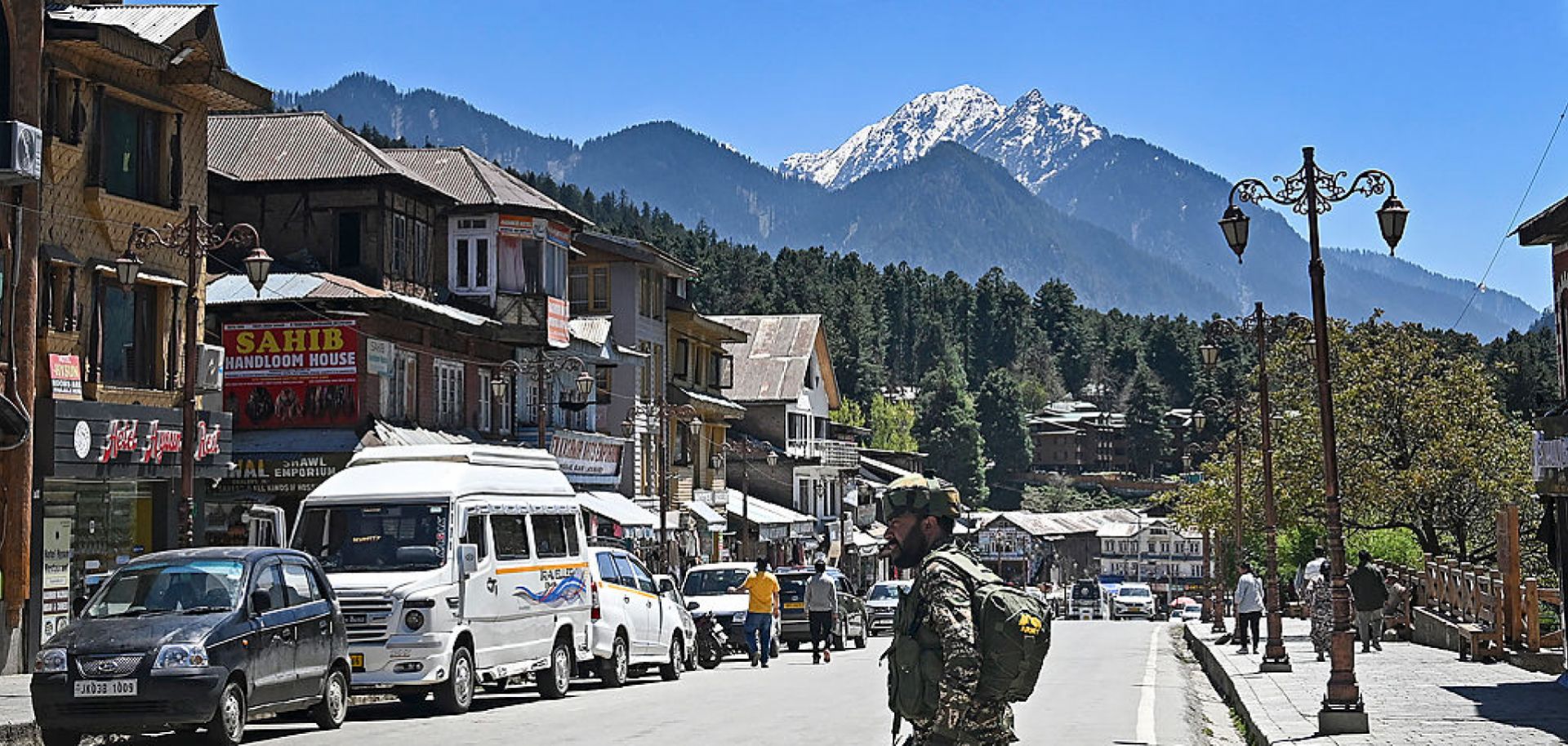
India will likely launch limited military strikes against Pakistan in the coming days in retaliation for the deadly April 22 attack in Kashmir, increasing the risk of escalation despite both sides' desire to avoid a full-scale war and international pressure to de-escalate. On April 28, India and Pakistan entered their fifth consecutive day of cross-border gunfire, following India's accusations that Pakistan was involved in the April 22 militant attack in Indian-administered Kashmir that killed 26 civilians and injured 17 others. The Resistance Front — a militant group India accuses of being a front for the Pakistani militant group Lashkar-e-Taiba — initially claimed responsibility for the attack, which it says was in opposition to India sending more than 85,000 "outsiders" to Kashmir to promote "demographic change." The Resistance Front, which formed in the wake of India's contentious 2019 revocation of Kashmir's autonomy, has claimed sporadic attacks on non-locals in the region in recent years, though none as deadly as the April 22 attack. Amid growing scrutiny of the group in subsequent days, The Resistance Front on April 26 withdrew its claim that it was behind the attack, alleging a cyber intrusion likely by Indian intelligence resulted in the prior "unauthorized" and purportedly erroneous initial claim of responsibility. In the wake of the April 22 assault, India and Pakistan have announced sweeping tit-for-tat measures that have downgraded bilateral relations. India suspended the Indus Waters Treaty, which regulates the sharing of the vital Indus River system, expelled Pakistani diplomats, and halted the issuance of special visas to Pakistani citizens. Pakistan then retaliated by closing its airspace to Indian airlines, cutting off all trade with India (including through third-party countries), and revoking visas for Indian nationals, except for Sikh pilgrims.
- India has identified at least two Pakistanis and two Kashmiris, who it believes are most directly responsible for the April 22 attack. India claims these individuals are members of or are otherwise linked to Lashkar-e-Taiba, and at least one may have reportedly previously served in Pakistan's security services.
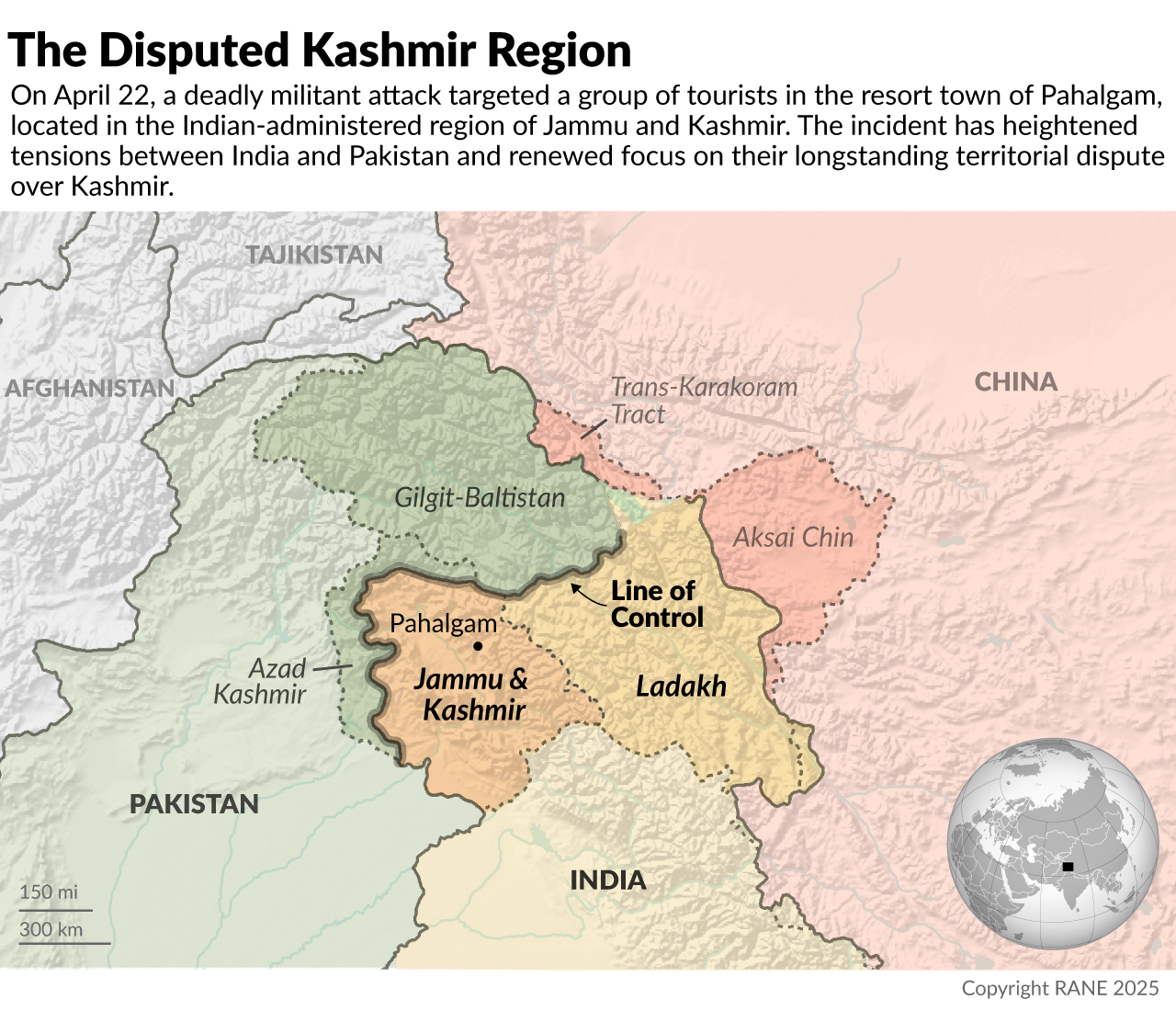
Given strong domestic political pressure and its comparatively greater ability to absorb the consequences of limited escalation, India will likely respond to the alleged Pakistani-linked attack with targeted military action against militants in Kashmir, which could involve airstrikes and/or limited ground operations. The April 22 attack was among the deadliest to target civilians in India in years, which is fueling intense public pressure on New Delhi to respond forcefully. Given its bigger military and much larger and more resilient economy, India will likely also calculate that it can better manage the risks of a kinetic escalation than Pakistan, further pushing New Delhi toward at least limited retaliation. In prior border conflicts with Pakistan in 2016 and 2019, India responded within roughly 10 to 12 days of an initial attack, providing a potential approximate time frame for when the country might conduct a kinetic response to the Kashmir attack. To limit risks of full-scale conflict, India will likely consider targeted military action against alleged militants and/or militant infrastructure in Pakistan-administered Azad Kashmir, including cross-border strikes, air operations and/or special operations raids across the Line of Control (LoC). Pakistan, for its part, will similarly face intense domestic pressure to respond to any Indian kinetic action. However, the country's comparatively greater economic and domestic security challenges will likely see Islamabad pursue more restrained and measured retaliation, such as small arms fire, artillery shelling and limited airstrikes. Pakistan may also pay greater focus to symbolic gestures, such as diplomatic protests, military posturing, violations of Indian airspace and public messaging intended to allay domestic anger without triggering a conflict with India that Pakistan would face greater constraints in waging.
- After the Uri attack in September 2016 killed 19 Indian soldiers, India conducted strikes across the LoC, targeting what it described as militant launch pads in Pakistan-administered Kashmir. Following this, Pakistan denied the strikes occurred and avoided further military engagement. Later, after the 2019 Pulwama attack killed at least 40 Indian paramilitary personnel, India carried out airstrikes on an alleged militant camp in Balakot. Pakistan retaliated with its own air operations, resulting in an aerial dogfight and the brief capture of an Indian pilot. In both cases, the two countries demonstrated military strength but ultimately sought to avoid a full-scale war; and each time, de-escalation was accomplished through backchannel diplomacy and implicit signaling (such as public gestures of restraint, like Pakistan releasing the captured Indian pilot in 2019), rather than through formal talks or joint declarations.
- India's military response will likely target border areas in Pakistan-held Azad Kashmir that are relatively close to Jammu and Kashmir's Poonch and Rajouri sectors, such as Kotli, Bhimber, Forward Kahuta, and parts of Mirpur. These are the areas believed to facilitate cross-border militant infiltrations into India-held Kashmir; indeed, local media reports indicate India suspects the perpetrators of the April 22 attack may have operated from Poonch and/or Rajouri. In recent years, India has also flagged these areas as experiencing more resilient militancy, likely due to their proximity to the LoC, as well as their rugged terrain and dense forests, which challenge Indian security operations.
International calls for restraint will also prevent a broader escalation of the conflict. Past India-Pakistan crises, like the Uri and Pulwama attacks, concluded without spiraling into full-scale conflict, in part due to sustained international pressure on both countries to de-escalate — a dynamic that could similarly help contain the current situation. Iran and Saudi Arabia, which maintain relationships with both India and Pakistan, have already expressed willingness to mediate the latest crisis. Meanwhile, the United Nations and European Union have urged both nations to exercise restraint and engage in diplomatic dialogue to prevent further escalation. The United States, while a key ally of India, has been more restrained in its approach. After the attack, the administration of U.S. President Donald Trump voiced strong support for India's stance on terrorism, yet Trump himself has also highlighted his cordial relations with both India and Pakistan. China, meanwhile, is interested in de-escalation due to its strategic interests and ties to both India and Pakistan. Beijing is unlikely to intervene early in a visible or one-sided manner, as openly backing Pakistan could damage its already strained relationship with India. Instead, China is more likely to hold back until it becomes clear that India-Pakistan tensions are escalating to a truly dangerous level, at which point Beijing may push more assertively for diplomatic dialogue to protect its strategic interests. That said, while Beijing could seek to present itself as a responsible stakeholder or peacemaker, India may still view China's close ties with Pakistan with skepticism, potentially challenging Beijing's efficacy as a mediator.
- India and Pakistan will be able to interpret the United States' more nuanced position on the crisis in ways that serve their respective narratives. India may feel emboldened to adopt a more assertive stance against Pakistan, seeing the White House's strong statements of support against terrorism as a signal that Washington will not actively oppose Indian actions, while Pakistan could see Trump's more neutral rhetoric as a sign of lessened U.S.-India alignment.
Despite both sides' desire to avoid a broader conflict, the risk of escalation will rise sharply if India's retaliatory actions result in significant Pakistani military or civilian casualties, or threaten key infrastructure. Public pressure in both countries — along with the potential for miscalculations, significant casualties (both civilian and military) and damage to strategic assets (e.g., key military and civilian infrastructure) — could push India and Pakistan toward a military conflict, even if neither side initially seeks it. Pakistan has pledged cooperation in a "neutral" investigation into the April 22 attack, potentially signaling a desire to de-escalate the situation. However, Pakistan would likely retaliate if India were to escalate by conducting large-scale cross-border airstrikes, targeting deeper military infrastructure, or launching a more significant ground operation. A wider military escalation would likely see both sides conduct more resource-intensive and prolonged ground and air operations, probably focusing on military assets. However, given that each country is nuclear-armed and wants to avoid the severely disruptive and costly effects of a prolonged and full-blown conflict, there would probably be strong drivers for India and Pakistan to quickly end any more severe kinetic exchanges and/or military operations.
- Clashes over water management could also become a flashpoint in growing India-Pakistan tensions. On April 26, Pakistani authorities reported that India released water from the Uri Dam without prior notice, causing a sharp rise in the Jhelum River and prompting flood warnings in Pakistan-administered Kashmir. The incident has raised fears that India could increasingly use water flows as leverage over Pakistan, including by suspending critical hydrological data sharing or withholding flood warnings. While it currently lacks the infrastructure to fully halt water flows to Pakistan, India could take steps that gradually worsen water scarcity, agricultural disruptions and flood risks in the country, heightening bilateral tensions and increasing pressure on Islamabad to retaliate.
Beyond military clashes in Kashmir, surging nationalism in both countries could spur disruptive and violent protests in major Pakistani and Indian cities. The Kashmir attack has triggered a wave of nationalist fervor in India and Pakistan, as well as among their respective diaspora in countries such as Canada, England, France and the United States. This sentiment has already fueled nationalist protests in both India and Pakistan, along with some clashes between members of the Indian and Pakistani diaspora communities abroad. In India, a surge in anti-Muslim rhetoric and Hindu nationalist activity will raise the risk of intercommunal clashes and the targeting of mosques and Muslim communities, which may, in turn, provoke retaliatory attacks by Muslims and their supporters, not just in India but also in neighboring Bangladesh. Beyond consequent disruptions to business continuity and associated personal safety risks, such unrest could further strain New Delhi's already delicate relations with Dhaka, complicating diplomatic efforts. Meanwhile, in Pakistan, demonstrations have similarly erupted in response to India's suspension of the Indus Waters Treaty, a move that Pakistan perceives as a severe threat to its agricultural production and water security. While the protests in Pakistan have so far not been overly disruptive or violent, India's potential kinetic response would likely fuel heightened nationalist sentiment and the consequent severity of unrest. Additionally, Pakistani security resources are already stretched thin amid authorities' ongoing struggle to counter worsening militancy in the country, on top of the new threat of Indian retaliation, which could allow for protests to more quickly grow out of control.
