
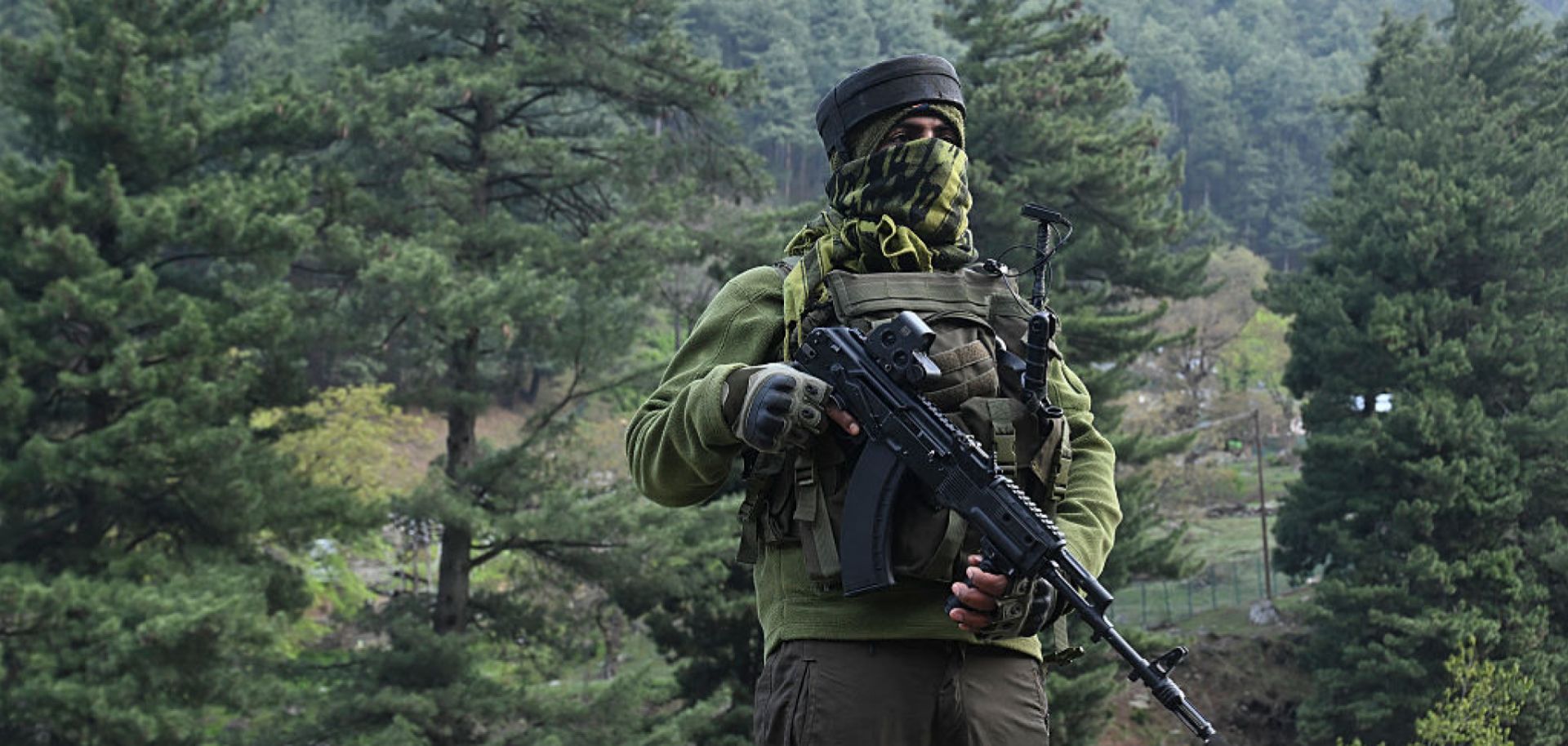
India and Pakistan's series of tit-for-tat diplomatic and economic moves following a deadly militant attack will heighten the risk of kinetic responses, such as airstrikes or special forces operations, while also fueling domestic unrest due to rising nationalist sentiment in both countries. On April 23-24, India and Pakistan announced a series of sweeping tit-for-tat measures to scale back bilateral ties following a deadly militant attack in Indian-administered Kashmir that killed 26 civilians and injured 17 others. The attack, which took place on April 22 at the Baisaran meadows near the popular tourist town of Pahalgam, is one of the deadliest assaults on civilians in India since the 2008 Mumbai attacks. Briefing the media on April 23, Indian Foreign Secretary Vikram Misri stated that a special security cabinet meeting had confirmed Pakistani links to the attack. In response, the Indian government has taken several steps, including suspending a key river water treaty that governs the sharing of the Indus River system between the two countries. Additionally, India declared Pakistan's defense advisers in New Delhi persona non grata and ordered their departure. India also announced plans to cut its diplomatic staff in Islamabad from 55 to 30, close the Attari-Wagah border crossing (the only operational land crossing with Pakistan), and stop issuing special visas to Pakistani nationals. Moreover, New Delhi has ordered Pakistani nationals to leave India by April 27. In response, on April 24, Pakistan announced it would retaliate by closing its airspace to Indian carriers, halting all trade with India, including goods routed through third countries, and canceling visas for Indian nationals (except Sikh pilgrims). Islamabad also threatened to withdraw from bilateral agreements, including the 1972 Simla Agreement, which outlines key principles for managing ties and maintaining the ceasefire line in Kashmir.
- A group known as The Resistance Front, which Indian security services accuse of having links to Pakistan, claimed responsibility for the April 22 attack in Kashmir. Indian security sources have long linked the group to Lashkar-e-Taiba, an Islamist group with ties to Pakistani intelligence services that has conducted militant operations in Indian-controlled Kashmir for decades.
- Indian Foreign Secretary Vikram Misri announced that the Indus Waters Treaty of 1960 would be suspended with immediate effect and remain so until Pakistan took credible and irreversible action to end its support for cross-border terrorism. In response, the Pakistani government warned on April 24 that any disruption to its water supply would be treated as 'an act of war,' vowing to retaliate 'with full force across the complete spectrum of national power.'
- Speaking in a televised interview on April 23, Pakistani Foreign Minister and Deputy Prime Minister Ishaq Dar criticized India's actions following the Kashmir attack as 'immature and hasty,' saying New Delhi had provided no evidence linking Pakistan to the deadly incident.
- The November 2008 Mumbai attacks were a series of coordinated terrorist attacks carried out by Pakistani-based militants from Lashkar-e-Taiba, who killed over 160 people — marking one of the deadliest assaults in India.
While security in Jammu and Kashmir has improved since India's 2019 removal of the region's special status and resulting crackdown, sporadic militancy has continued. In February 2019, the Pakistan-based militant group Jaish-e-Mohammed killed 40 Indian security personnel in the Pulwama district of Kashmir. The attack prompted a severe deterioration of relations between India and Pakistan, including exchanges of airstrikes and border skirmishes between the countries in subsequent weeks. Later that year, India revoked Kashmir's special autonomous status, which facilitated India's subsequent greater focus and resourcing of counterterrorism operations there. In the intervening years, security in Jammu and Kashmir has improved as Indian security forces have adopted a much heavier presence. However, some pockets of the region have experienced more resilient militancy, and sporadic, smaller-scale attacks targeting non-locals and minority Kashmiri Hindus have become one of India's primary security concerns in the territory. The Resistance Front has been at the forefront of these attacks, claiming several since India's contentious 2019 decision. Prior spates of attacks claimed by The Resistance Front have prompted mass exoduses of non-locals and renewed fears of militancy in the region.
- Article 370 of the Indian Constitution previously granted Indian-administered Jammu and Kashmir special status, allowing the territory to have its own constitution and considerable autonomy. However, in August 2019, the Indian government revoked the article and reclassified the region as a union territory, placing it under direct administration from New Delhi and breaking up the eastern half to create the separate territory of Ladakh. The move was part of a broader effort by the ruling Bharatiya Janata Party to more fully integrate Jammu and Kashmir with the rest of India.
- Since the British partition in 1947, India and Pakistan have both claimed Kashmir, leading to three wars and ongoing border skirmishes. Armed insurgents in the region, supported by many Muslim Kashmiris, have long resisted Indian rule, seeking either integration with Pakistan or independence. India accuses Pakistan of fueling the violence, while Islamabad denies this, asserting that it views the separatist movements as a legitimate struggle for freedom. While it is unclear whether Pakistan's security services were involved in the latest attack in the region, there is a well-documented history of support for militants based in Jammu and Kashmir, which has fueled the ongoing violence there.
The halt of the Indus Waters Treaty marks a major setback in India-Pakistan ties that, while unlikely to immediately disrupt water flows to Pakistan, could seriously threaten Pakistan's water resources and agricultural stability if there is a sustained interruption to the flow of the Indus River. The suspension of the Indus Waters Treaty marks an unprecedented rupture in one of the few long-standing areas of cooperation between India and Pakistan. Since its signing in 1960, the treaty has endured multiple wars and periods of severe tension, standing as a rare example of sustained transboundary water cooperation in South Asia. Its abrupt suspension is not just a diplomatic setback, but also threatens a protracted deterioration of bilateral relations. That said, the immediate impact on Pakistan's water supply may be more symbolic than operational. The treaty's suspension does not mean Pakistan's will immediately be out of water supply as India cannot instantly stop river flows without constructing new infrastructure, such as large-scale storage facilities or diversion dams, which would take years and carry risks of their own — including potentially flooding Indian territory or triggering Chinese countermeasures on shared rivers like the Brahmaputra. Still, the medium- to long-term stakes are high. Pakistan relies heavily on the Indus River and its tributaries for agriculture, drinking water and overall food security. The Indus basin provides around 154.3 million acre-feet of water annually, supporting irrigation across vast agricultural lands that are essential for both the economy and rural livelihoods. Any disruption to this water flow could reduce crop yields, exacerbate food shortages and intensify Pakistan's ongoing economic challenges, particularly in farming-dependent regions like Punjab and Sindh. If India begins using more of the western rivers' water than is currently permitted under the treaty, it could gradually reduce downstream flows, posing serious risks to Pakistan's agricultural output and water security.
- The Indus Waters Treaty, signed in 1960 after years of negotiations mediated by the World Bank, was a landmark agreement between India and Pakistan to manage their shared river systems following Partition in August 1947. The treaty allocated control of the eastern rivers — Ravi, Sutlej and Beas — to India, which primarily flow through India before reaching Pakistan, while granting Pakistan rights over the western rivers — Indus, Jhelum and Chenab. While the World Bank has a role in appointing neutral experts and facilitating dispute resolution, it may not be able to enforce the suspension of the Indus Waters Treaty. Instead, Pakistan could pursue legal recourse through international forums such as the International Court of Justice (ICJ) to challenge India's actions as a violation of international law.
India's reduction of diplomatic staff, cancellation of special visas and closure of the primary border crossing, along with Pakistan's suspension of trade, will heavily disrupt most bilateral economic interactions for at least the next several weeks, potentially harming regional supply chains and hindering long-term economic cooperation in South Asia. The reduction of India's diplomatic staff in Islamabad will constrain routine diplomatic functions, delay bilateral communication and limit engagement on consular and humanitarian matters. Meanwhile, the cancellation of special visa access for Pakistani nationals will likely sever personal, cultural and medical travel links, affecting families with cross-border ties and those seeking specialized treatment in Indian hospitals. These actions, taken together with the closure of the primary border crossing, underscore New Delhi's intention to isolate Pakistan diplomatically and economically. While trade between India and Pakistan was already limited, Pakistan's decision to suspend all trade, including through third-party countries, will likely disrupt regional supply chains, especially if trade remains halted for a prolonged period, impacting businesses that rely on goods transiting from one country to the other.
- Trade between India and Pakistan has significantly declined in recent years, particularly following the Pulwama terrorist attack in 2019. In 2022-23, India's exports to Pakistan amounted to just $627.1 million, a sharp drop from $1.92 billion in 2017-18. Similarly, imports from Pakistan also saw a significant reduction, with figures declining from $488.5 million in 2017-18 to only $20.11 million in 2022-23. This decline reflects the growing strain on trade relations between the two countries, highlighting their diminishing economic ties.
While both sides will likely aim to geographically restrict any military escalation to Kashmir, broader tensions raise the likelihood of limited kinetic responses, such as airstrikes and special forces operations, risking further instability. Heightened political sensitivity and Indian officials' statements linking the attack to Pakistan significantly raise the risk of India conducting retaliatory strikes into Pakistani territory. Intelligence and surveillance efforts by both sides are poised to intensify along the Line of Control — the de facto border between Indian- and Pakistani-administered Kashmir. India will likely mobilize limited forces near Kashmir, particularly air assets, in a prelude to potential military operations. In response, Pakistan will likely entrench defensive positions and mobilize its own air assets in the region. India could carry out airstrikes against what it perceives as militant camps, similar to its 2019 strike on Pakistan's town of Balakot, or deploy special forces for surgical operations like its 2016 response to a terrorist attack in Uri. India may also consider targeted assassinations of planners or facilitators of the recent Kashmir attack. The scope of such operations will likely depend on the proximity of the suspected camps to the Line of Control and the extent of cross-border coordination involved in the attack. Pakistan, meanwhile, may counter with limited retaliatory strikes, authorize cross-border infiltrations, or escalate artillery and sniper activity along the Line of Control. If tensions spiral further, Pakistan could test tactical missiles, likely conventional, or conduct aggressive posturing under the guise of military exercises. While both sides will likely seek to contain any kinetic operations within the geographic boundaries of Kashmir to keep military escalation well below the nuclear threshold, the military buildup and retaliatory operations still carry a significant risk of miscalculation. Furthermore, as nationals begin evacuating from both sides, the likelihood of a military strike, probably initiated by India, will rise given the domestic pressure to act, coupled with Pakistan's tit-for-tat responses.
- In 2016, after an attack on an Indian army base in Uri, Kashmir, India conducted 'surgical strikes' targeting militant camps across the Line of Control.
- In 2019, in response to the Pulwama bombing, India carried out an airstrike on a militant camp in Balakot, Pakistan, claiming to target Jaish-e-Mohammed operatives.
Tensions between India and Pakistan will likely increase intercommunal violence in India and protests in Pakistan, which could worsen instability and constrain de-escalation efforts. The risk of domestic unrest is rising in both India and Pakistan as tensions escalate. In India, heightened nationalist sentiment and public outrage following the attack will likely lead to a surge in anti-Muslim rhetoric and violence, raising the risk of intercommunal clashes, particularly in politically polarized states like Uttar Pradesh and Gujarat, where communal tensions have historically flared under similar conditions. The targeting of mosques or Muslim communities by Hindu nationalists could lead to retaliatory attacks by pro-Muslim groups against Hindus in India and neighboring Bangladesh, threatening to undermine New Delhi's already strained relations with Dhaka. In Pakistan, where protests have already erupted across the country, public anger is growing over India's suspension of the Indus Waters Treaty, which many people view as an existential threat given the country's reliance on the Indus Basin for agriculture and drinking water. These demonstrations will not only amplify public pressure on both governments to adopt more aggressive stances but also, particularly in Pakistan, risk escalating domestic instability. In both countries, the current trajectory threatens to inflame nationalist fervor and social instability, making de-escalation increasingly difficult.
