
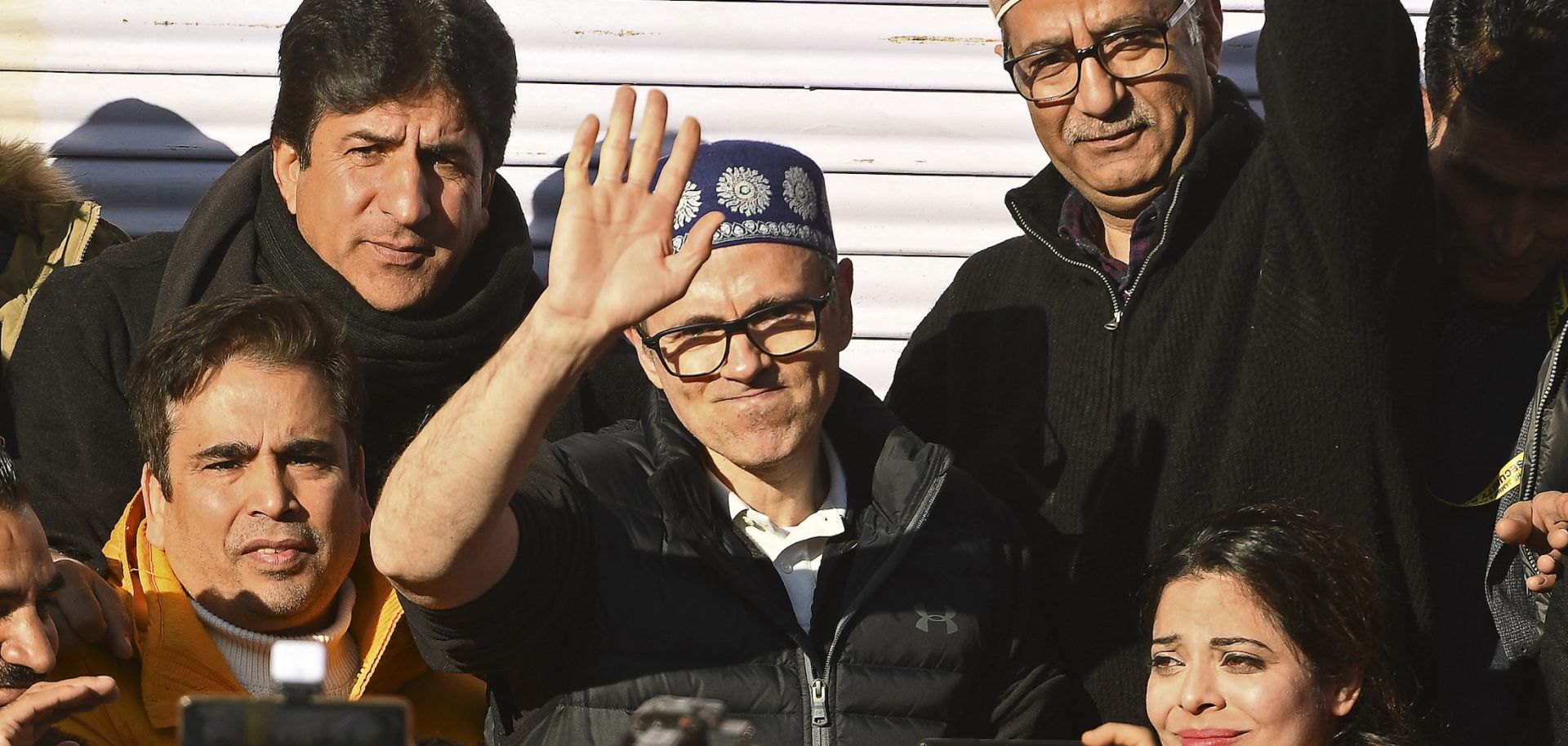
Jammu and Kashmir's new government will attempt to seek a restoration of full autonomy or at least statehood for the territory, but it will bump up against firm resistance from New Delhi, increasing the likelihood of violent unrest and Pakistani pressure. Omar Abdullah, the leader of the Jammu and Kashmir National Conference in the Indian-administered territory, will take oath as the territory's chief minister on Oct. 16. India's Election Commission announced Oct. 8 that the JKNC, in alliance with the Indian National Congress and Communist Party of India (Marxist) won the assembly elections in Jammu and Kashmir. These parties received a combined total of 49 seats in the 90-seat assembly, while the ruling Bharatiya Janata Party secured 29. Voting occurred Sep. 18, Sept. 25 and Oct. 1. This was the first local election in Jammu and Kashmir in a decade, and the first since the BJP-led government of Prime Minister Narendra Modi revoked its autonomy in 2019 and divided and downgrading the state into two federally controlled union territories, Jammu and Kashmir, which has a legislature, and Ladakh, which does not.
- The elections were scheduled following a December 2023 ruling by India's Supreme Court, which dismissed petitions seeking the overturning of the revocation of the region's special status and set Sept. 30, 2024, as the deadline for provincial elections.
- Article 370 of the Indian Constitution granted special status to Jammu and Kashmir, allowing the region to maintain its own constitution and significant autonomy. On Aug. 5, 2019, however, the BJP central government revoked the article and transformed it from a state into a union territory under direct control from New Delhi. This move was part of a larger BJP effort aimed at integrating the territory more closely with the rest of India.
- Since the revocation of Article 370 in 2019, a move later approved by the Supreme Court, Jammu and Kashmir elections initially saw low voter turnout as separatist leaders and groups often called for boycotts and many residents expressed distrust in the electoral process by not voting. But regional parties like the JKNC participated in the most recent elections, leading Jammu and Kashmir to record an overall turnout of 63.88% in the recent election cycle, up from the 58.5% recorded in the recent Indian general elections from April-June — indicating increased political activity and interest among the population.
Despite the JKNC win having indicated support for the reinstatement of Article 370, substantial obstacles — including opposition from both the BJP and the Congress party — make it highly unlikely that Jammu and Kashmir's special status will be restored as long as the BJP leads the central government in New Delhi. JKNC campaigned on a platform of restoring Jammu and Kashmir's prerogatives, so its win signaled a rejection of central government policies, including the 2019 revocation of Jammu and Kashmir's special status, restrictions on civil liberties and attempts by the BJP-led government in New Delhi to promote Hindu interests in the territory. While the BJP's 2019 revocation found support in India, especially among Modi's followers, it was largely opposed in Jammu and Kashmir, where it was viewed as an attack on the region's identity and autonomy, and raised fears of demographic changes. Against this backdrop, BJP opponents framed the September 2024 election as a step toward restoring democracy after years of conflict, convincing many locals to view it as a chance to elect their representatives and protest the 2019 changes. Now in office, the JKNC government is likely to focus on economic development, restoring statehood or even reinstating Article 370. Significant hurdles to these efforts, however, make the restoration of Jammu and Kashmir's autonomy highly unlikely. Although the election restored a limited government and regional assembly in Jammu and Kashmir after direct rule from New Delhi, local power remains restricted, with the region continuing as a "union territory" under federal control with India's Parliament as the main legislative authority. For instance, the regional assembly's powers will be largely limited to education and culture, and key functions such as policing and official appointments fall under the authority of the lieutenant governor, who is appointed by the Indian president, a member of the BJP. Despite its electoral loss in Jammu and Kashmir, the BJP is unlikely to accede to JKNC demands because reinstating Article 370 would require parliamentary approval, and the BJP-led coalition has a majority in the national Parliament. Moreover, the main opposition Congress party did not address the issue of Article 370 repeal in its campaign platform for the Jammu and Kashmir assembly elections. Instead, in an effort to boost local development and gain support from the region's residents, the party has committed to prioritizing the people of Jammu and Kashmir in government job recruitment, government contracts, land allotments and access to regional resources, with a focus on economic opportunities and welfare.
- While some Congress party leaders have hinted at the possibility of reinstating Article 370, they often alternatively hint at restoring statehood, despite the different implications of each move. Reinstating Article 370 would involve restoring the special autonomous status that Jammu and Kashmir previously held, allowing for full autonomy in governance. In contrast, restoring statehood would establish Jammu and Kashmir as a state within India as opposed to a union territory, allowing for a greater degree of legislative authority while still operating within India's federal structure.
- Under the 2019 Jammu and Kashmir Reorganisation Act, the Jammu and Kashmir lieutenant governor, appointed by the Indian president, was given authority over key administrative and legal areas, including policing, public order, official postings and granting prosecution sanctions. This move sparked sharp criticism from the Congress party and JKNC, which argued that it would render the chief minister powerless and disempower the region's people.
- The government's decision to permit individuals from outside Jammu and Kashmir to buy land and establish residency in the region has intensified concerns among local Muslims about potential demographic shifts undermining the area's Muslim majority. Resentment is also growing over the return of Hindu-Kashmiri Pandits, who are reclaiming homes they abandoned decades ago amid unrest now occupied by others. Militants in the region have continued their attacks on Hindus and non-locals, including migrant workers, in response to what they perceive as efforts to alter the demographics of Jammu and Kashmir.
Given the likelihood that the BJP will not permit the reinstatement of Article 370, the JKNC and Congress will likely advocate for the halfway measure of statehood, something the Modi-led government may be more willing to approve. As restoring Article 370 appears highly unlikely, both the JKNC and Congress will work to win Jammu and Kashmir statehood. Indeed, Abdullah reiterated Oct. 10 that his first line of business would be to take up the restoration of statehood with the central government and Modi. On the campaign trail ahead of assembly elections in Jammu and Kashmir, Modi actually committed to restoring statehood in Jammu and Kashmir, though it remains unclear whether that was contingent on the BJP being voted into power. Granting statehood would likely address some of the grievances related to political freedom and reduce the risk of unrest, especially given the pressure the government is likely to face emanating from Jammu and Kashmir. Given the December 2023 Supreme Court that statehood should be restored as soon as possible plus statements from BJP leaders indicating their commitment to this process, pressure appears to be growing on Modi to follow through on his promise. If approved, the restoration process would likely take some time, as it involves the lieutenant governor recommending it to the federal government, which would then need Parliament to amend the 2019 act that reorganized Jammu and Kashmir.
Elections may encourage Pakistan to renew calls for greater autonomy in Jammu and Kashmir territory, but it is unlikely to change the status quo, especially as Islamabad's domestic challenges limit its capacity to pressure New Delhi. The greater region has historically been a flashpoint between India and Pakistan, both of which claim it in full but control only parts. Therefore, an electoral result that has brought to power a government that desires more autonomy from New Delhi might prompt Pakistan to renew its efforts to bring international attention to the Kashmir issue, seeking to advance its own geopolitical interests while advocating for a resolution that claims to reflect the aspirations of the Kashmiri people by promoting greater autonomy. This would heighten bilateral tensions with India. But rather than coercing New Delhi, Pakistani pressure would be more likely to harden the Indian government's stance and reinforce its decision to leave the region's special autonomous status revoked. Already, India continues to assert that Pakistan supports militant violence in the region. Moreover, despite Islamabad's potential desire to use the issue to pressure New Delhi, Pakistan's domestic challenges — including economic difficulties, rising militant attacks and political instability linked to the Pakistan Tehreek-e-Insaf — means it faces major constraints on its ability to escalate tensions with India, even if it wanted to.
- The Resistance Front and the Peoples' Anti-Fascist Front have accounted for most attacks in Jammu and Kashmir in recent years; they primarily have targeted migrant workers and religious minorities, particularly Hindus. Since the abrogation of Article 370, the number of security incidents in Jammu and Kashmir has declined due to New Delhi's intensified security measures against local jihadist groups.
Continued Indian central government control over Jammu and Kashmir despite renewed local support for greater autonomy will increase the risk of unrest and militant attacks in the coming months, but India's overwhelming military presence will very likely put an upper limit on any violence that arises. Given the first local elections for the first time in a decade and the subsequent JKNC-Congress victory have rekindled local aspirations for Kashmiri autonomy, the continuation of Indian control over the region will inflame grievances and heighten the likelihood of disruptive and potentially violent protests in the coming months. While the restoration of statehood may help temper the unrest, many Kashmiris will want more, and the revocation of Article 370 will continue to serve as a trigger for violence and unrest. The likelihood of militant attacks will similarly remain elevated as militants likely exploit heightened local grievances to recruit and attack. As seen in recent years, this would manifest in attacks against minority Kashmiri Hindus and nonlocals, as well as fiercer fighting against Indian security forces in parts of Kashmir. This will occur against a backdrop of weakened civil society and militant groups in the region due to New Delhi's post-2019 crackdown, which has limited political and militant groups' capacity to mobilize. India will continue to use its heavy deployment of security forces in the region to quickly put down any budding violence. Indian military officials have noted facing stiff resistance from militants in Poonch and Rajouri districts over the past year. The run-up to Kashmir's elections also saw increased violence in the region, including a high-profile June attack on Hindu pilgrims in Jammu that left nine dead and dozens of others wounded.
