
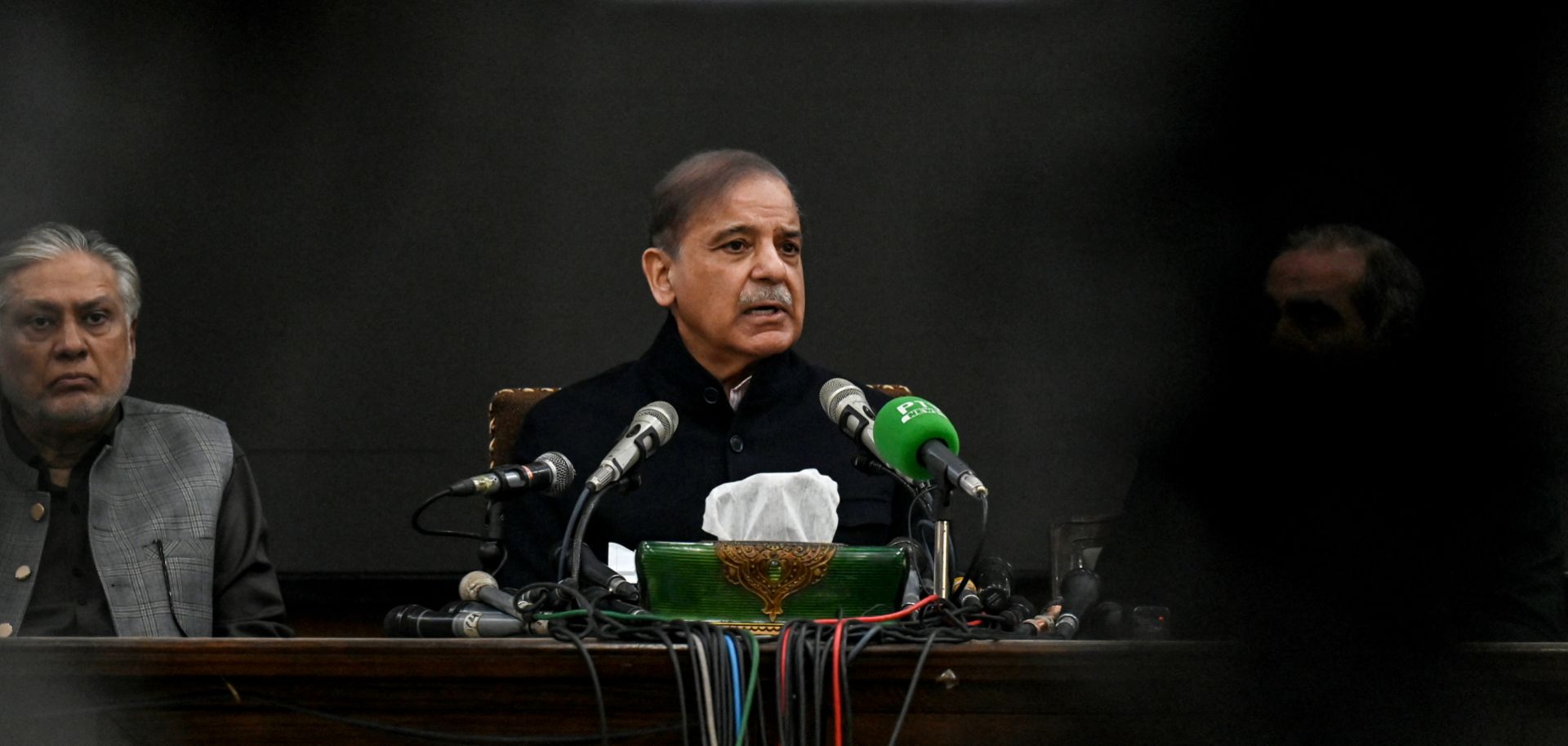
With the help of the military, Pakistan's new government will prioritize negotiating a deal with the International Monetary Fund and addressing the country's economic and political crisis by cracking down on dissent. But the coalition's internal fragmentation and unpopularity will hinder its reform efforts, exacerbated by election-related unrest. According to the Pakistani constitution, President Arif Alvi must summon the National Assembly by Feb. 29 to commence the inauguration of the lawmakers who were elected in the country's inconclusive general ballot on Feb. 8, where no single party secured a majority. Shortly after the election, the Pakistan Muslim League-Nawaz (PML-N), Pakistan People's Party (PPP) and other minor parties, including the Muttahida Qaumi Movement (MQM), agreed to establish a coalition government. Meanwhile, the coalition of independent candidates affiliated with former Prime Minister Imran Khan's Pakistan Tehreek-e-Insaf (PTI), in conjunction with the minority Sunni Ittehad Council Political Party, have indicated they would assume the role of the opposition.
- Pakistan's National Assembly consists of 336 seats, with 266 filled through direct voting and the remaining 70 reserved for women and minorities. A minimum of 134 seats out of the 266 directly elected seats is needed for a single political party to form a government. Independent candidates aligned with Khan's PTI party secured 93 of these directly elected seats in the Feb. 8 general election, while the PML-N, led by former Prime Minister Nawaz Sharif, secured 75 seats, and the PPP, led by former Foreign Minister Bilawal Bhutto Zardari, obtained 54 seats, resulting in no majority and thus no conclusive winner.
- On the first day of the new legislative session, the National Assembly will hold elections for a new speaker and deputy speaker. On the following day, lawmakers will then select Pakistan's next prime minister, who is expected to assume office in the first week of March. The newly formed ruling coalition nominated PML-N leader Shehbaz Sharif as its prime ministerial candidate and Asif Ali Zardari, co-chair of PPP, as its presidential nominee.
While the formation of a coalition between the PML-N and PPP may offer a semblance of stability after a period of deep political uncertainty in Pakistan, the new government will remain fragile amid widespread perceptions that the general election was unfair due to efforts to sideline Khan and his PTI party ahead of the vote. Khan, who remains widely popular, is currently serving a sentence and was thus barred from contesting in the elections. Authorities have also cracked down heavily on Khan's PTI party after his supporters in May 2023 engaged in violent unrest following his arrest. In January, a Supreme Court decision then prohibited parliamentary candidates from using the PTI's recognizable electoral symbol, a cricket bat, in the Feb. 8 general election, which forced PTI candidates to run as independents. These systematic efforts to sideline Khan ahead of the Feb. 8 ballot, combined with allegations of electoral rigging in the recent vote, will likely continue to fuel unrest and protests in the coming months. Indeed, against this backdrop, many Pakistanis view the PML-N and the PPP's new coalition as an alliance between dynastic powers that betrays the will of voters and serves as a testament to the country's alleged democratic backsliding. This makes it unlikely that the new coalition will garner substantial support or legitimacy from the electorate during its tenure, which could hinder the government's ability to pass policies.
- Since Khan's arrest triggered mass nationwide protests in May 2023, authorities have cracked down heavily on his PTI party and his supporters. Security personnel have forcefully dispersed PTI gatherings, resorting to arrests, tear gas and intimidation. Media blackouts and online censorship have also targeted the PTI, with its websites blocked.
- Electoral symbols are crucial for recognizing candidates' party affiliation in Pakistan, where over 40% of the population is illiterate.
In the short term, the coalition will focus on securing a new loan from the International Monetary Fund (IMF) amid rising public discontent and post-election unrest, but conflicting ideologies between the PML-N and PPP may hinder reform implementation. Amid Pakistan's significant economic challenges and the impending repayment of a $1 billion bond by April, the new administration will likely prioritize negotiating a new IMF loan, reportedly worth at least $6 billion. Simultaneously, the government will focus on securing additional investment from countries like Saudi Arabia and China, and potentially leveraging initiatives like the Special Investment Facilitation Council (SIFC). The primary objectives of the forthcoming IMF program will include managing Pakistan's balance of payments deficit, ensuring debt sustainability, and bolstering tax revenues. Consequently, to appease the IMF, the elected government will be likely be compelled to enact unpopular economic reforms — like tax hikes and subsidy cuts — at the risk of fueling further public discontent and unrest, which could hinder Pakistan's ability to secure additional funding and heighten the risk of default by potentially impacting investor confidence. Meanwhile, despite shared objectives of economic recovery and countering Khan's influence, the PML-N and PPP's ideological differences and personal interests could destabilize their new government. The PPP, generally leaning slightly leftward, prioritizes farmer rights and asserts a pro-worker stance, opposing privatization initiatives. In contrast, the PML-N is seen as pro-business and supports privatization, often advocating for the interests of large corporations, traders and merchants. Thus, while the immediate objective is to secure a new IMF program, the two parties' conflicting ideologies may further threaten the coalition government's longevity by impeding its ability to make decisions — especially in light of the coalition's already deep unpopularity among Pakistanis.
- On Feb. 22, IMF Communications Department Director Julie Kozack said that the IMF looked forward to collaborating with the new Pakistani government on policies aimed at securing macroeconomic stability. The announcement followed remarks made by Khan that he would send a letter to the IMF urging an independent audit of the country's Feb. 8 general elections before further IMF discussions with the government proceed.
- During his previous term as prime minister from April 2022 to August 2023, PML-N leader Shehbaz Sharif spearheaded the establishment of the SIFC, which is primarily tasked with attracting foreign investments and driving the nation's economic growth. The council also aims to streamline the investment process by serving as a ''one-stop shop'' for potential investors.
- In June 2023, then-Prime Minister Sharif successfully secured a nine-month, $3 billion loan under the IMF's Stand-By Arrangement. Pakistan is currently undergoing a final review as part of that loan program, potentially unlocking approximately $1.1 billion in funding before the arrangement expires in April.
In the coming months, Pakistan's military will likely maintain and possibly increase its political involvement, with a focus on preserving coalition unity to thwart any potential return of Khan and his PTI party, portending further efforts to suppress dissent. Pakistan's powerful military establishment has been accused of meddling in the general election by supporting Sharif's PML-N party, while attempting to sideline Khan's PTI party. But independents aligned with the PTI still ended up winning more seats than any single party — illustrating the limitations of the army's alleged ''political engineering,'' as well as the deep-rooted public backlash against the military's alleged interference in political and state affairs. Despite this, the army will likely sustain its political involvement and potentially intensify its role in the government to ensure the coalition remains intact amid persistent political instability and protests. In the short term, this will likely see the army focus on upholding government unity by collaborating with and pressuring coalition members to forestall instability and fragmentation, recognizing that a government collapse could potentially facilitate the return of the PTI and Khan. The military will likely also seek to quelch external threats by maintaining its efforts to suppress dissent, including by cracking down on any post-election protests. A coalition devoid of the PTI poses constraints on the stability or redemption of the army's public image, given the lingering accusations of electoral manipulation. However, the military leadership has shown no sign of being willing to negotiate with the PTI, and thus appears unlikely to allow Khan or his party another chance to lead — portending a crackdown on PTI supporters and protestors that will only further erode the army's public image and raise the risk of further instability.
- Pakistan's worsening security landscape will only compound these post-election domestic challenges. In recent months, Tehreek-e-Taliban Pakistan (TTP) and Islamic State militants have escalated their attacks in Pakistan, particularly in Khyber Pakhtunkhwa and Balochistan. Moreover, tensions along the borders with Iran and Afghanistan have escalated, necessitating collaboration between the incoming government and Pakistan's military establishment to address mounting terrorist threats and other security challenges.
