
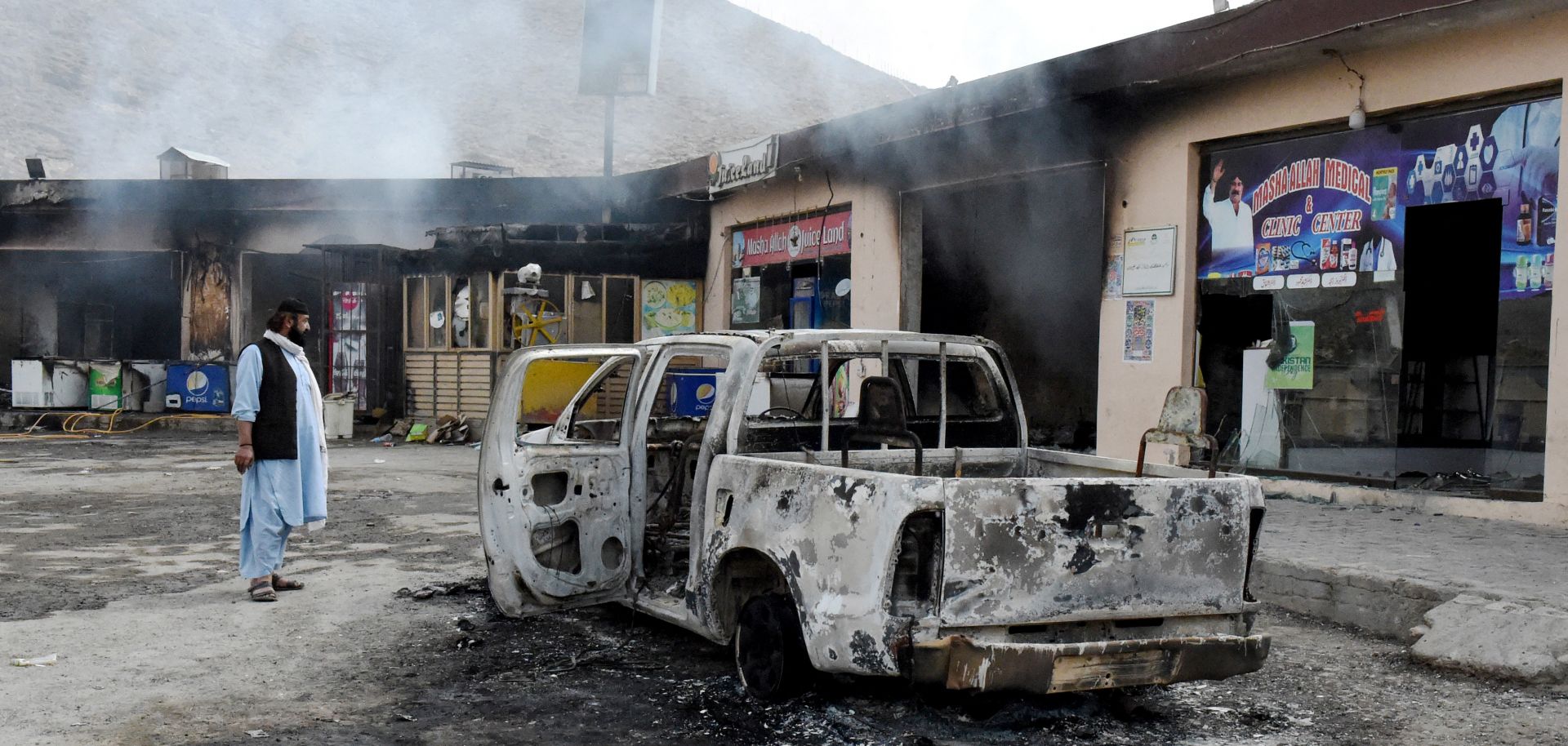
Economic and political constraints will limit the scale and efficacy of Pakistan's latest counterterrorism campaign, sustaining the threat of militant attacks and delays to the China-Pakistan Economic Corridor despite likely efforts to bolster foreigners' security and engagement with key foreign stakeholders. Dawn reported June 27 that about 50 militants attacked Pakistani security forces early June 25 at an outpost and at a Pakistan Petroleum Limited oil and gas exploration site in the restive province of Balochistan. Militants and security forces subsequently engaged in hourslong firefights, killing two Pakistani soldiers. The separatist Baloch Liberation Army subsequently claimed the attack, which exemplifies the onslaught of militant attacks Pakistan has faced in recent years. Amid this sustained violence, Pakistani Prime Minister Shehbaz Sharif announced June 22 a "reinvigorated and reenergized" nationwide counterterrorism campaign entitled Operation Azm-e-Istehkam, or "Resolve for Stability." Opposition politicians have criticized the prospective campaign, saying it was announced without consulting Parliament and that based on previous Pakistani military campaigns, it would likely result in the mass displacement of local populations and significant destruction. Pakistani officials have responded that the campaign would involve a range of government agencies and nongovernmental entities, and rely on both kinetic and nonkinetic means.
- The Tehrik-i-Taliban Pakistan, or TTP, has primarily been responsible for the sustained militant attacks Pakistan has faced since the Afghan Taliban took over Afghanistan in August 2021. The TTP mostly targets Pakistani security forces, and is currently based in eastern Afghanistan, but some of its members have returned to northwest Pakistan, where the group originated and was previously based.
- Baloch separatists have been the second-most active contingent of militants in Pakistan in recent years, continuing their long-standing war with the Pakistani state while expanding its attacks against Chinese nationals and interests. Among other things, Baloch separatists are aggrieved with what they see as Pakistan and China's exploitation of Baloch land and resources, particularly through CPEC and other investments.
- The TTP has increasingly attempted to appeal to Baloch separatists, resulting in TTP attacks on Chinese interests.
Operation Azm-e-Istehkam follows ineffective counterterrorism efforts in 2023 and growing Chinese pressure for better protection for its nationals in Pakistan. Islamabad previously announced a major counterterrorism push in April 2023, which the government had termed an "all-out comprehensive operation" to combat militancy. Subsequent months saw Pakistan conduct spates of small-scale, targeted "intelligence-based operations" along with nonkinetic efforts like strengthening engagement with civil society to discourage militancy. But while Pakistani officials have deemed the operations a success, media reports indicate the campaign was far more limited than the major military campaigns Pakistan last undertook in the 2010s, with some sources even claiming a formal campaign in 2023 never commenced. Moreover, reported militant attacks and consequent casualties nearly doubled from 2022 to 2023. Militant violence has continued into 2024, with three high-profile attacks in recent months — two of which directly targeted Chinese interests — likely helping exhaust China's patience with Pakistan's inability to secure Chinese nationals and assets. This, alongside China's frustration with Pakistan's inability to pay for Chinese investments, appeared to stifle Pakistan's attempts in recent weeks to accelerate progress on the CPEC and other projects, which Pakistan wants to support its economic recovery. During Sharif's visit to China in June, Chinese leader Xi Jinping and other officials pressed Pakistan to "guarantee" the safety of its interests and to create a "safe, stable, and predictable" business environment, leaving Sharif to return to Pakistan largely empty-handed. According to media reports, China has also begun pressing the Afghan Taliban to stop Afghanistan-based militants from conducting cross-border attacks on Chinese interests in Pakistan, deeming it a condition for further Chinese investment in Afghanistan.
- Citing unnamed sources from Pakistan's Ministry of Planning, Development and Special Initiatives, Pakistani newspaper Business Recorder reported May 29 that in the run-up to Sharif's June visit, China's Vice Foreign Minister Sun Weidong conveyed to Pakistani officials the need for a major nationwide counterterrorism operation of similar scale to that which Pakistan conducted in the 2010s. Later May 29, Business Recorder seemingly deleted the article, but users on X have posted its content on the social media platform.
- The Pakistan Institute for Conflict and Security Studies reported militant attacks in Pakistan nearly doubled from 380 attacks reported in 2022 to 641 in 2023; casualties from attacks also nearly doubled from 539 people reported killed and 836 injured in 2022 to 974 people reported killed and 1,351 injured in 2023.
- China's anxieties have further risen in recent months following two high-profile attacks on Chinese interests. On March 20, Baloch separatists attacked the Gwadar Port Authority complex of the Chinese-operated Gwadar Port in southwest Pakistan, killing at least three Pakistani security personnel. Militants whom Pakistani authorities suspect are linked to TTP subsequently killed more than five Chinese workers March 26 in northwest Pakistan. Later, militants also targeted a convoy of Japanese nationals on April 19 in Karachi, seemingly misidentifying them as Chinese.
- While Pakistan's counterterrorism efforts have appeared largely limited, prominent exceptions include its conduct of airstrikes targeting Afghanistan-based militants in March 2024 and April 2022, as well as its initiation in late 2023 of mass deportations targeting Afghan migrants seemingly intended to pressure the Afghan Taliban to counter the TTP and other anti-Pakistan militants.
Pakistan's economic challenges and political constraints will limit the scale and efficacy of kinetic operations under the new counterterrorism campaign. Pakistan's economic and political stability has improved since the first half of 2023, when the country announced the launch of its last major counterterrorism effort; Pakistan was then on the verge of default and experienced regular bouts of severe nationwide unrest fueled by former Prime Minister Imran Khan's standoff with authorities. While improved stability likely contributed to the government's decision to announce a renewed counterterrorism push, these gains remain modest and tenuous. Pakistan's severe economic challenges persist, requiring it to secure a new International Monetary Fund program and subsequently remain aligned with the fund's bailout conditions — which will prove unpopular. In addition, the political opposition's stronger than expected performance in February's general election has provided it with greater influence, as demonstrated by the government's pivot to addressing its concerns on the proposed campaign. Pakistan's need to prioritize economic recovery and consider opposition resistance will thus constrain the scale and consequent efficacy of the government's renewed counterterrorism efforts — particularly kinetic operations, which are often costlier than nonkinetic efforts. One prominent exception will likely be Pakistan's newfound willingness to conduct airstrikes against militants in Afghanistan, which it demonstrated in March after years of the Afghan Taliban appearing unwilling or incapable of stemming TTP attacks in Pakistan. To this end, Pakistani Defense Minister Khawaja Asif on June 27 expressed support for targeting TTP hideouts in Afghanistan under the new campaign. Resource constraints and a desire to limit a complete rupture in relations with the Afghan Taliban will likely stop Pakistan, however, from conducting such strikes regularly.
- Pakistani officials' recent statements have already hinted that Operation Azm-e-Istehkam will only have a modest military component, with Sharif clarifying June 25 that "already ongoing [intelligence-based operations] will be intensified" under the campaign rather than involve a "large-scaled armed operation that would require [population] displacement."
- Beyond airstrikes, Pakistan may also be increasingly willing to conduct small-scale cross-border raids or other clandestine action against anti-Pakistan militants in Afghanistan. Unidentified gunmen and improvised explosive devices have in recent years killed a number of high-value anti-Pakistan militants in Afghanistan, fueling speculation that Pakistan has been responsible for the killings.
Pakistan is intent on, and likely capable of, bolstering Chinese nationals' security and strengthening cooperation with foreign stakeholders, which will probably drive some improvements to the security of foreign interests. Given Chinese pressure and the Pakistani government's desire to boost progress on CPEC, much of Operation Azm-e-Istehkam will focus on improving the security of Chinese interests. The creation of additional military and law enforcement units dedicated to securing Chinese investment projects and nationals, as well as the provision of additional armored vehicles for vulnerable individuals and increased deployment of technologies like surveillance cameras, are all cheaper than a major military campaign and would likely result in tangible improvements to foreigners' safety. In addition, recent heightened international concern about the threat of terrorism emanating from the Afghanistan-Pakistan region suggests regional countries and even some farther abroad will be more willing to bolster security cooperation and intelligence sharing with Pakistan. While mistrust between Pakistan and countries like Iran will limit the closeness of some of these relationships, shared concerns over militancy will likely still facilitate greater cooperation, and potentially resource sharing. China's reported efforts to pressure the Afghan Taliban, for example, may portend Pakistan coordinating more closely with China on diplomatic efforts to pressure regional action against militants. The United States has also consistently expressed support for Pakistani counterterrorism efforts in recent years, and in June reiterated its commitment to conducting further high-level security dialogues and military-to-military engagements with Pakistan, in addition to sustaining funding for Pakistan's counterterrorism capacity-building programs.
- In announcing the operation, Pakistani authorities said they would review "measures to ensure foolproof security for Chinese nationals in Pakistan" and had issued "new standard operating procedures" to "enhance mechanisms" for securing Chinese nationals; "diplomatic efforts" would also be "intensified" as part of the campaign.
- Pakistan has already begun bolstering Chinese nationals' security in recent weeks. In mid-June, authorities announced they would create a special police unit in Islamabad dedicated to protecting foreign nationals — particularly Chinese citizens. A similar unit already operates in Karachi.
- Authorities have in recent years strengthened security measures and provided additional protective vehicles for Chinese and some other foreign nationals, which appear to have helped authorities foil attacks or at least reduce casualties. For example, the armored vehicles Japanese nationals were riding in April 19 appeared instrumental in the foreigners' escaping largely unscathed.
- Illustrating the potential for greater regional security cooperation, Iran and Pakistan vowed in April to bolster efforts to present a "united front" against Afghanistan-based militants, which both sides agreed constitute a threat to regional and global security. The agreement was also made amid efforts to repair ties damaged by the two countries' exchange of kinetic strikes in January.
Beyond modest improvements in foreigners' safety, however, Pakistan's latest campaign will almost certainly fail to meaningfully stem militant attacks, sustaining instability in Pakistan and delays on Chinese investment there. That much of the latest campaign appears similar to the ineffective effort Pakistan ostensibly launched in 2023 suggests that for all the government's rhetoric, militant attacks will almost certainly persist. This will sustain threats to Pakistani security forces and Chinese nationals, which alongside Pakistan's continuing economic challenges will fuel instability as well as Chinese anxieties with bolstering its investments in Pakistan. This portends further delays to CPEC and other Chinese investments, as well as consequent limits on the extent to which these investments help fuel Pakistan's economic recovery. While China remains highly unlikely to abandon CPEC given its prominence within the country's broader Belt and Road Initiative, persistent attacks on Chinese interests and consequent delays in Chinese investment will further weaken CPEC's historical reputation as the Belt and Road Initiative's "crown jewel."
