
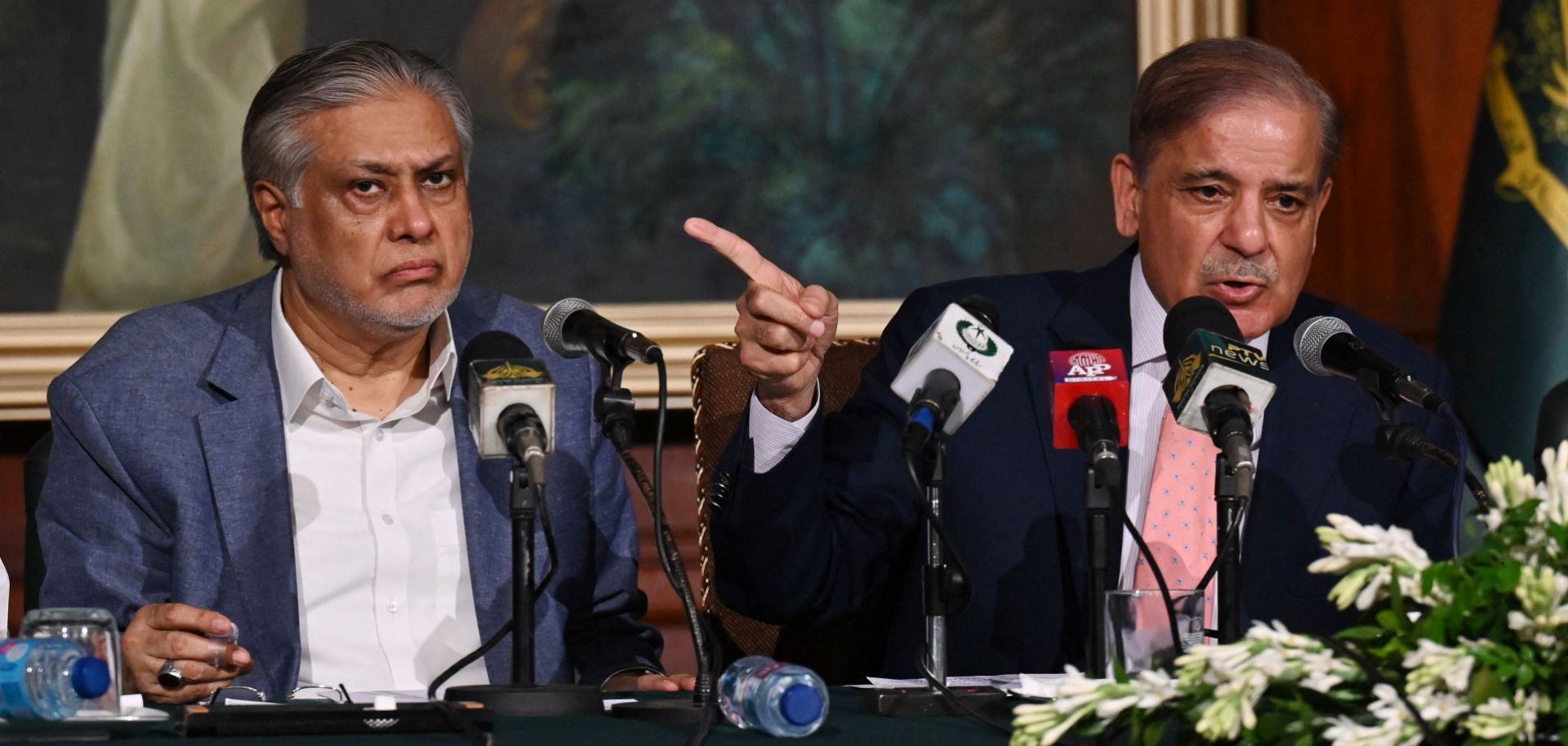
Pakistan will likely secure the final tranche of its stand-by arrangement with the International Monetary Fund and then pursue a new IMF agreement, but the government's political weakness and unpopularity may constrain its ability to enact related economic reforms. On March 20, the IMF announced it had reached a staff-level agreement with the Pakistani government following the second and final review of the country's $3 billion stand-by arrangement (SBA). Pending approval from the IMF's executive board, expected by late April, the staff-level agreement will release the final $1.1 billion tranche of the SBA, which was inked in June 2023 under the leadership of then-Prime Minister Shehbaz Sharif, who was recently re-elected for a comeback term following Pakistan's Feb. 8 general election. In announcing the new staff-level agreement, the IMF noted that the government's implementation of recommended reforms — combined with renewed support from multilateral and bilateral partners — had improved Pakistan's economic and financial standing, with the country now expected to see both increased GDP growth and decreased inflation in 2024. But while the Pakistani economy is starting to show some signs of life, the new government still faces steep challenges in maintaining that trajectory, which will require enacting more painful and politically controversial austerity measures to secure additional IMF funding.
- The new IMF staff-level agreement follows Pakistan's Feb. 8 general election and the subsequent formation of a new coalition government headed by Sharif, who also served as Pakistan's prime minister from April 2022 to August 2023.
- From March 14-19, an IMF delegation convened in Islamabad to discuss the second review of Pakistan's economic program with Sharif's new government. Prior to the review, the Pakistani government had to fulfill IMF conditions such as revising its budget, increasing interest rates, and boosting revenue through tax adjustments.
- In June 2023, Sharif's previous government obtained the $3 billion short-term financial assistance package from the IMF, formally known as an SBA. This support came as the country was facing the imminent risk of a default amid dwindling foreign reserves, a weakening local currency, and record inflation.
Despite the IMF's newly improved projections, Pakistan still faces severe economic challenges, including significant external financing requirements in the context of low foreign exchange reserves. According to the fund, Pakistan's GDP is now projected to increase from -0.5% in 2023 to 2.5% in 2024. Inflation, meanwhile, is set to decrease to 23.6% in 2024 after a combination of tax and gas tariff hikes, along with a significant depreciation of the rupee, caused inflation to average nearly 30% in 2023. However, Pakistan's central bank recently warned that potential price hikes and increased energy costs could eventually drive inflation back up. Over the past year, the country's foreign exchange reserves have also nearly tripled from $3.1 billion to approximately $8 billion. But $8 billion still barely covers just two months of essential imports. Moreover, according to IMF reports, Pakistan's external debt service for 2024-25 total roughly $11 billion. Of this sum, $5 billion is owed to multilateral creditors, such as the IMF and World Bank, while $2.5 billion is owed to bilateral creditors like China and Saudi Arabia (though some of those creditors, including China, have opted to roll over this debt). Pakistan's debt service related to private bonds, meanwhile, stands at $500 million.
- Pakistan's fiscal deficit reached 7.7% of GDP in the fiscal year 2022-2023.
With the current SBA set to expire in April, the new Pakistani government will prioritize securing a new, larger IMF program in the coming months, likely prompting the implementation of more economic reforms and austerity measures. The release of the final $1.1 billion tranche of the SBA in April coincides with Pakistan's deadline to settle approximately $1 billion for dollar bonds maturing that month, which the government will likely pay given its higher foreign exchange reserves. However, Pakistan's foreign exchange reserves — while growing — remain critically low, which will leave the country reliant on the continuation of an IMF program to access foreign loans. As the current SBA nears expiration in April, securing a new, larger IMF loan will thus be Islamabad's top priority. As part of this effort, Sharif's new government will likely continue implementing the policy initiatives that his previous government began under the current SBA, which have focused on expanding the tax base and maintaining a monetary policy aimed at curbing inflation while permitting exchange rate flexibility — all to enhance economic and financial stability.
- The goal of the new IMF loan program would be to address Pakistan's fiscal and external sustainability weaknesses and lay the groundwork for sustainable growth. Discussions with the IMF regarding such a loan are expected to commence in the coming months, with potential objectives including privatizing state-owned enterprises to generate revenue and reduce expenditure, enhancing debt sustainability, and restoring resilience to the energy sector by enhancing electricity infrastructure and governance and distribution, while implementing anti-theft measures.
However, the coalition government's external unpopularity and internal ideological differences may eventually hinder Islamabad's ability to enact the reforms needed to keep unlocking IMF funding. Sharif's past success in securing the June 2023 SBA, implementing IMF-recommended reforms, and his recent re-election as prime minister may enhance the prospects of Pakistan obtaining a new IMF package. Indeed, on the campaign trail, Sharif's PML-N party pledged to reduce the country's fiscal deficit and stabilize its balance of payments — both of which align with IMF objectives. In the short term, this indicates that Sharif's new coalition government will unite to focus on satisfying the IMF's demands for further economic reform. However, challenges may eventually emerge following the approval of both the final tranche of the SBA and a prospective new IMF program, particularly concerning Pakistanis' potential reform fatigue amid the continued implementation of austerity measures that increase living costs (by, for example, reducing energy tariffs) and reduce government assistance programs (by, for example, cutting social spending). Divergent ideologies within coalition parties and the wider National Assembly could also exacerbate the government's inherent political fragility, as evidenced by its already high disapproval among the Pakistani public, with many believing the coalition came to power in a rigged election following systematic efforts to sideline former Prime Minister Imran Khan and his party ahead of the vote. In the long term, these factors may limit the government's effectiveness in implementing reforms, especially given the differing economic ideologies between its two main members: Sharif's Pakistan Muslim League-Nawaz (PML-N) party and the Pakistan People's Party (PPP), with the former advocating for more pro-business policies compared to the latter's more pro-worker policies.
- Pakistan's Feb. 8 general election failed to establish a clear winner. Consequently, on Feb. 21, the PPP and the PML-N announced they reached a power-sharing arrangement to establish a coalition government. The announcement initially triggered protests and social unrest due to the two main parties' widespread unpopularity and allegations of electoral rigging among supporters of the country's sidelined and imprisoned former prime minister, Imran Khan.
- The PPP is seen as a pro-worker party that supports farmer rights and more left-wing policies. The PLM-N, meanwhile, is seen as the pro-business party that favors privatization and represents the interests of large corporations traders, and merchants.
