
Intensifying concerns about terrorism and instability emanating from Afghanistan, alongside economic opportunities, will drive increased international engagement with the Afghan Taliban in the coming years, though the group's hard-line religious rule and continuing links to other militant groups will likely put a ceiling on the level of foreign engagement and deter many countries from formally recognizing the regime diplomatically. On May 28, Russia's special presidential envoy for Afghanistan told state-run news agency TASS that Russia's foreign and justice ministries had advised President Vladimir Putin that the Afghan Taliban could ''be removed'' from Moscow's list of designated terrorist organizations. The move comes days after the chief of Russia's Federal Security Service (FSB) explicitly acknowledged on May 24 to state-run news agency RIA Novosti that the Afghanistan-based Islamic State Khorasan Province (ISKP) was responsible for the March 22 terrorist attack at the Crocus City Hall near Moscow, which Russia had for weeks dubiously claimed was linked to Ukraine and the West, despite Islamic State claiming responsibility for the assault. Since the terrorist attack — which involved four assailants opening fire during a packed concert and setting the building ablaze in the deadliest such attack the country had seen in decades — Russia has avoided kinetic action in Afghanistan and has instead sought to bolster engagement with the Afghan Taliban, which has long fought ISKP. Russia's actions bear some similarities to Iran's response following the Jan. 3 twin bombings targeting a commemorative ceremony for slain Iranian General Qasem Soleimani in the eastern city of Kerman. That attack was also the deadliest Iran had seen in decades, and was subsequently claimed by Islamic State, with Iran's Ministry of Intelligence later confirming the group had trained one of the perpetrators in Afghanistan. But Iran, too, has avoided retaliatory kinetic action in Afghanistan, instead striking on Jan. 15 an alleged Israeli intelligence headquarters in northern Iraq and targets linked to ''terrorist organizations'' (including Islamic State) in Syria. On Jan. 16, Iran also fired missiles at a Baloch militant group in Pakistan that had claimed responsibility for prior attacks in Iran, though not the January twin bombing in Kerman. In the months since the Kerman attack, Iran has continued deporting Afghan migrants, has begun constructing a wall in an attempt to ''seal'' its eastern border with Afghanistan, and has also discussed bolstering engagement and counterterrorism cooperation with the Afghan Taliban.
- Kremlin spokesperson Dmitry Peskov recently appeared to convey a pragmatic motivation for Russia's decision to strengthen dialogue with the Afghan Taliban by saying on April 2 that Afghanistan ''is next to us'' and that talking to the group was required ''to resolve pressing issues.''
- Alongside bolstering engagement with Afghanistan's de facto rulers, Russia has also intensified crackdowns on Central Asians and other migrants in Russia in response to the March 22 attack.
- While most countries have avoided kinetic action in Afghanistan since the Afghan Taliban takeover, Pakistan has been a prominent exception: amid a steep rise in attacks by Tehreek-e-Taliban Pakistan (TTP) and other militants Pakistan says are based in Afghanistan, Pakistan has conducted airstrikes in Afghanistan targeting alleged militants on at least two occasions — most recently in March 2024 and previously in April 2022. Additionally, in recent years, unidentified gunmen and improvised explosive devices have also killed a handful of high-value anti-Pakistan militants in Afghanistan, fueling speculation that Pakistan has also engaged in targeted killings.
Russia and Iran's actions in the aftermath of the recent deadly attacks linked to the Afghanistan-based ISKP underscore a growing belief among various countries that engaging with the Afghan Taliban is the least costly and most effective way to pursue their strategic interests and address their security concerns. Following the Afghan Taliban's takeover of Afghanistan in August 2021, much of the international community (and particularly the West) vowed to isolate the group in an effort to compel it to moderate and discourage its support for militancy. Beyond limiting diplomatic engagement with the group's officials, as well as criticizing its hard-line rule and non-inclusive governance, countries also imposed crippling sanctions. However, most neighboring and regional countries appeared more pragmatic, demonstrating a willingness to engage with the Afghan Taliban — or at least not reject the group outright — to limit the risk of violence or instability in Afghanistan spilling over to their territories. In the nearly three years since, more countries have begun to slowly engage with the Afghan Taliban despite its having doubled down on its hard-line rule, likely out of a belief that isolating the group has failed to achieve its objectives, and that countries' strategic and security interests may be better served through greater engagement with Afghanistan's de facto authorities. For example, while the United States has been among the Afghan Taliban's most prominent critics, media reports emerged in February that the U.S. State Department approved in October 2023 an Integrated Country Strategy document for Afghanistan that appeared to suggest Washington was deliberating greater (though still narrow) engagement with the Afghan Taliban, and potentially exploring reopening a U.S. consulate in Kabul. Last year, Tajikistan — which is distinct among regional countries in its historically strong opposition to the Afghan Taliban and support for anti-Taliban resistance forces — also appeared to allow Taliban officials to at least informally take over the Afghan consulate in the Tajik border city of Khorog, marking a prominent shift in Tajik policy. China, meanwhile, has continued to bolster its robust engagement and relations with the Afghan Taliban in recent months, despite continuing to avoid formally recognizing the group diplomatically. China has been among the most proactive in exploring and pursuing investment and resource extraction opportunities in neighboring Afghanistan — though China has consistently deemed the security of its nationals and assets as paramount, and has sought the Afghan Taliban's commitment to preventing Uyghur militants from operating in Afghanistan. In early 2024, China became the first country to officially accept an Afghan Taliban envoy since the group seized control of Afghanistan in August 2021; China also previously invited Afghan Taliban officials to join its October 2023 Belt and Road Initiative infrastructure development forum. Both sides' officials continue to conduct fairly regular visits to each other's countries to discuss security, economic and other shared interests.
- Disagreements persist between the Afghan Taliban's hard-line and more pragmatic leaders. Those in the pragmatic camp worry the group's hard-line Supreme Leader Haibatullah Akhundzada's harsh policies are alienating Afghans and crippling the group's foreign relations. However, the international community's growing engagement with the group, despite its doubling down on hard-line policies, has likely strengthened internal support for Akhundzada and further reduced the already limited influence of the Afghan Taliban's more pragmatic leaders.
- Though Tajikistan's potentially changing attitude toward the Afghan Taliban is significant, relations between the two remain far from close, let alone amiable. Tajikistan still supports or at least provides a haven to anti-Taliban political figures and resistance leaders. In November 2023, the country held the eleventh Herat Security Dialogue in its capital Dushanbe — hosting a number of anti-Taliban figures, regional politicians and analysts who discussed Afghanistan's current situation and potential future.
- The U.S. State Department's latest Integrated Country Strategy document for Afghanistan does not suggest the United States is currently intent on recognizing the country's de facto authorities. However, it emphasizes that ''we must build functional relationships that advance our objectives and further our understanding of the Taliban's readiness and ability to fulfill their commitments to us.''
- South Asian media sources have often speculated that the U.S. government and Afghan Taliban engage in some level of counterterrorism cooperation. Though neither side has confirmed such speculation, U.S. officials have acknowledged both sides share similar interests in countering ISKP militants. One senior U.S. defense official told The Washington Post in April 2023 that ''I would never want to say that we had mortgaged our counterterrorism to a group like the Taliban, but it's a fact that, operationally, they put pressure on [ISKP]. In a strange world, we have mutually beneficial objectives there.''
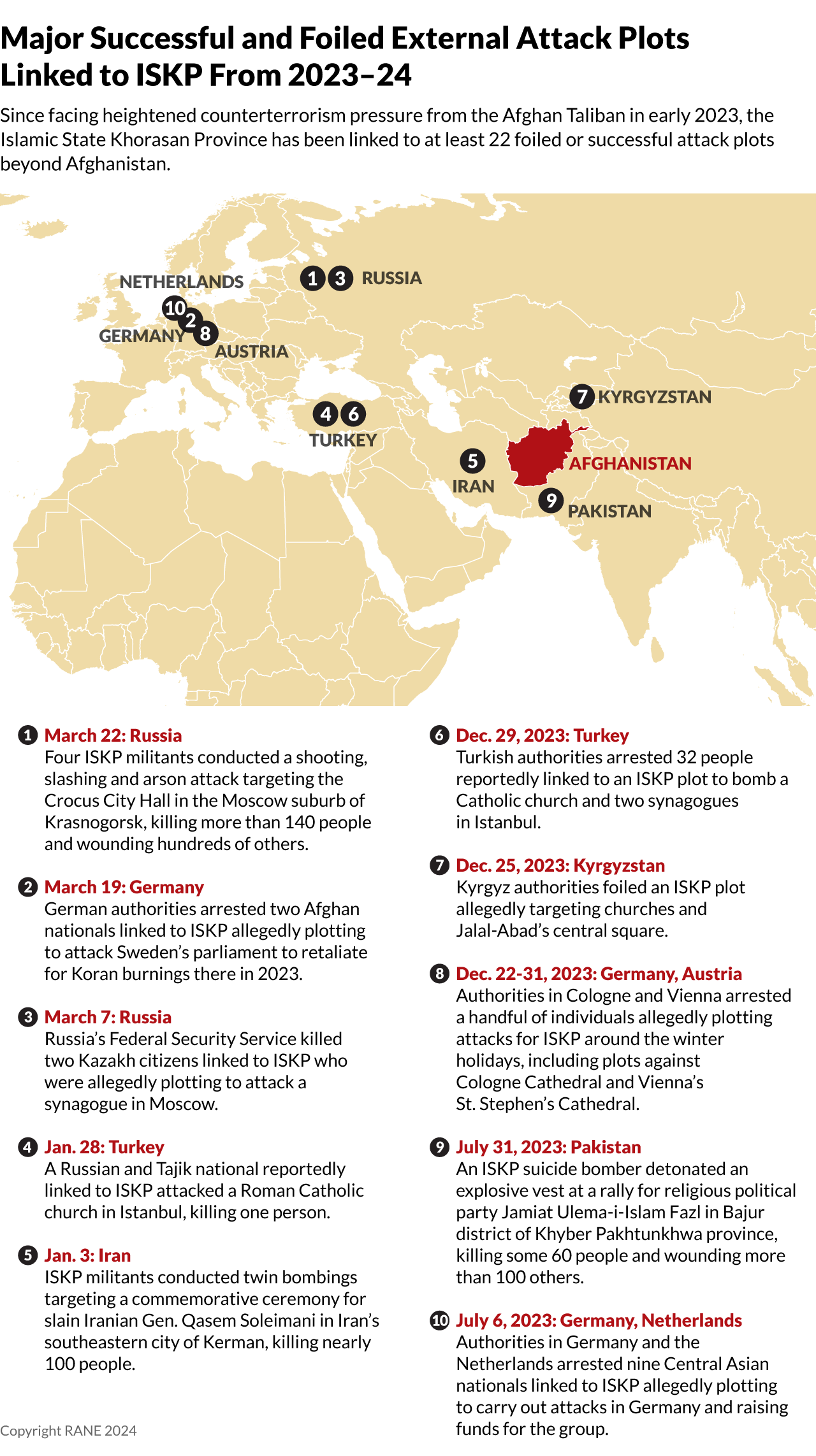
Growing global concerns about ISKP and Afghanistan's stability will drive greater international engagement with the Afghan Taliban in the coming years as foreign governments seek to avoid getting militarily entangled in the country. ISKP's attacks in Russia and Iran, as well as the numerous plots linked to the group that authorities in Europe and elsewhere have foiled, have intensified international concern about a militant threat emanating from Afghanistan. While these attack plots have varied and may have involved different regional networks or key personnel, ISKP's leaders and militants in Afghanistan likely remain important in at least organizing and facilitating these efforts abroad, and are all but certain to play a key role in plotting attacks against regional countries. Recent events have underscored, however, that most countries want to limit their military involvement in Afghanistan. Countries also appear to be increasingly recognizing that the Afghan Taliban have been able to enforce some degree of stability in Afghanistan in recent years, or at least limit the extent to which instability worsens and spills over to those nearby. Against this backdrop, foreign countries appear poised to heighten engagement with the Afghan Taliban (whether official or unofficial) as doing so is increasingly viewed as a less costly and arguably more effective strategy than committing significant assets on the ground themselves or carrying out their own kinetic strikes to counter militancy. Engagement with the Afghan Taliban will likely involve discussions on intelligence sharing and countering mutually perceived threats, as well as deliberations on counterterrorism cooperation and the provision of capabilities (like surveillance equipment and materiel) to advance such efforts. Regional countries like Iran and China will continue to engage closest with the Afghan Taliban, given these countries' intense concerns regarding security and instability — which generally far outweigh any disagreements with thfe Afghan Taliban's hard-line ideology and rule, or concern over the group's reliability and trustworthiness.
- Most countries likely also recognize that ISKP's cell-based structure makes it challenging to meaningfully disrupt or degrade the group's capabilities, especially in the absence of military assets on the ground. Even the Afghan Taliban — which has a geographically widespread presence in Afghanistan and has prioritized fighting ISKP since the former's takeover in August 2021 — took around two years to develop sufficient penetration into ISKP's networks and to refine its counterterrorism strategy before it was able to meaningfully disrupt ISKP's activity in early to mid-2023. The fact that ISKP has re-commenced sporadic attacks in recent months only further underscores its resilience and the challenges that even actors with assets on the ground face in degrading the group.
Economic opportunities will also drive increased international engagement with the Afghan Taliban, though foreign investment interest and viability will remain contingent on Afghanistan's security and stability. Many countries (especially China) remain deeply interested in Afghanistan's largely untapped mineral resources, which include rich deposits of lithium, copper, iron, coal and cobalt. Some countries have also demonstrated an interest in Afghanistan's oil and natural gas supplies; in the coming years, the Chinese energy firm Xinjiang Central Asia Petroleum and Gas Company is set to expand the $49 million it has so far invested in extracting and producing oil from the Amu Darya basin in northern Afghanistan. Regional countries' ongoing and proposed infrastructure projects, which either run through Afghanistan or are centered there, further underscore foreign interest in developing and realizing Afghanistan's economic and resource potential. In recent weeks, for example, the Afghan Taliban, Kazakhstan, and Turkmenistan agreed to build a logistics hub in the western Afghan province of Herat for regional exports. Though no timeline has been reported for the project, Afghan officials discussed the proposed hub's potential as a transit point for Russian oil to regional countries, while Kazakhstan's trade ministry said it wanted to develop road and rail infrastructure to facilitate the export of goods to South Asia and the Gulf. Though such economic interests will drive increased engagement with the Afghan Taliban, the viability of investments will remain contingent on the Afghan Taliban's ability to provide security. A number of investment projects, such as the Turkmenistan-Afghanistan-Pakistan-India pipeline (or TAPI), remain incomplete and/or have been stalled for years due to security challenges, as well as disagreements between participating countries over financing and other terms.
- Underscoring growing foreign interest in strengthening economic links with Afghanistan, Russia's special presidential envoy for Afghanistan on May 28 reportedly said Russia had invited the Afghan Taliban to its June 5-8 international economic forum in St. Petersburg, Russia's biggest annual economic forum. The move to invite the Afghan Taliban was also likely driven by a decline in Western participation in the forum since Russia's invasion of Ukraine in February 2022, and subsequent growth in the participation of investors from other countries and regions — including China, India, as well as the Middle East and Africa.
- The threat of ISKP attacks has previously deterred foreign investment interest in Afghanistan. For example, after ISKP militants in December 2022 attacked a Kabul hotel popular with Chinese business travelers — resulting in some 21 casualties — China's embassy in Kabul urged its citizens to evacuate from Afghanistan, and media reports indicated many foreign businessmen became hesitant to invest. After the hotel attack, a prominent Kabul-based Chinese businessman and head of the China-Afghanistan Trade Committee commented bluntly that ''If security is good, investment will be good. If security is average, investment will be average. If security is bad, investment will be bad.''
Even as more countries engage with the Afghan Taliban, concerns over domestic blowback and some countries' willingness to conduct kinetic action in Afghanistan will likely put an upper limit on the extent of foreign engagement and the number of governments willing to formally recognize the group. Some governments will remain wary of strengthening relations with Afghanistan's de facto authorities for fear of fueling security risks in their own countries. Tajikistan and Uzbekistan, in particular, have experienced intense periods of violent Islamist militancy, and ISKP's recent efforts to recruit Central Asians (especially Tajiks) will only further intensify these governments' concerns that engagement or close relations with the Afghan Taliban risk inadvertently legitimizing the group and consequently galvanizing Islamists within their borders. While these governments likely believe engaging with the Afghan Taliban to jointly address security concerns or pursue certain economic interests is worth the risk, such concerns will still foster an upper limit to their relations with the group. Other governments, particularly in the West, will also be hesitant to expand engagement with the Afghan Taliban amid concerns regarding how domestic populations would react to ''normalized'' relations with a hard-line religious regime they often accuse of engaging in rights abuses — let alone concern for how engaging with that regime may facilitate such abuses. These concerns will also limit international interest in formally recognizing the Afghan Taliban — especially when countries can engage with the group without recognizing it formally and potentially triggering domestic or international consequences. When it comes to Pakistan, Islamabad's distrust of the Afghan Taliban — fueled by a long-standing border dispute and Pakistan's belief that the group has been unwilling to crack down on anti-Pakistan militants in eastern Afghanistan — will present a sustained challenge to the two sides' bilateral relations. While neither Pakistan nor the Afghan Taliban desire to rupture bilateral relations necessary for such things as sustaining trade or resolving disputes over mutual interests, Pakistan has proven uniquely willing to undertake such escalatory actions as airstrikes and mass deportations of Afghan migrants to address its security concerns and pressure Afghanistan's de facto rulers. There are no signs that attacks by anti-Pakistan militants will significantly decline in the coming months, meaning there remains a high potential for additional Pakistani escalatory (and potentially kinetic) action intended to address Islamabad's security concerns. The United States, for its part, will also remain willing to conduct occasional, limited kinetic action in Afghanistan — namely by using unmanned aerial vehicles (UAV) to conduct targeted killings of high-value militants. These kinds of kinetic operations, among other things, will fuel tensions with the Afghan Taliban and likely constrain future engagement and relations with the group. While countries will not completely disregard potentially expanding engagement with the Afghan Taliban, these collective challenges and concerns mean they will likely limit the extent of such engagement and influence how it manifests by, for example, keeping engagement clandestine and unofficial rather than conducting it publicly.
- The U.S. July 2022 UAV strike in Kabul that killed then-al Qaeda leader Ayman al-Zawahiri temporarily intensified tensions between the United States and the Afghan Taliban. U.S. officials subsequently accused the group of violating its commitment to not harbor terrorists in Afghanistan, while the Afghan Taliban's spokesperson called the U.S. strike a violation of ''international principles.'' The strike temporarily narrowed both sides' engagement with each other, with senior U.S. and Afghan Taliban officials shirking in-person meetings for months after the strike.
- The severity of the threat Uzbekistan and Tajikistan face from neighboring Afghanistan could make the two countries more apt to respond kinetically to an alleged cross-border attack, which would at least temporarily challenge their relations with the Afghan Taliban. In April 2022, Uzbekistan reportedly scrambled military jets and helicopters in response to a cross-border rocket attack from northern Afghanistan targeting an Uzbek military base that was later claimed by ISKP, potentially reflecting the country's willingness to conduct such retaliatory strikes.
- Statements from various countries' officials indicate most governments remain hesitant to formally recognize the Afghan Taliban, at least unilaterally. In responding to whether China's acceptance of an Afghan Taliban envoy's credentials in late January meant China had formally recognized the group, the spokesperson for China's foreign ministry suggested China would only recognize the Afghan Taliban if the group gained broader international acceptance, saying, ''We believe that the diplomatic recognition of the Afghan government in the world will come naturally as the concerns of various parties are effectively addressed.'' Meanwhile, Pakistan's special representative on Afghanistan said in November 2023 that Afghanistan's neighboring countries and Russia maintained an ''understanding'' that they would only formally recognize the Afghan Taliban ''simultaneously and not unilaterally'' should the regime meet certain conditions, like governing more inclusively. The Uzbek president's special representative for Afghanistan previously made similar statements in May 2022, saying the country would ''not recognize [the Afghan Taliban] alone.''
